
Review–Seeing is Believing / A Consideration of Image, Memory, and the Velocity of Time

The UMMA has recently installed an exhibition in their new media gallery located on the main floor entitled Performing Still Images: David Claerbout and Matthew Buckingham. The exhibition problematizes the relationship between photography, film, and time. Buckingham’s piece, “Image of Absalon Projected Until it Vanishes”, features a still image with the intention that the image continually deteriorates over the course of its exhibition. I saw this piece for the first time Wednesday, and it had already deteriorated to the point where Absalon’s figure is barely recognizable, and many of the finer details of the photograph have already disintegrated. The piece is a haunting reminder of the limitations of the medium—although we tend to see photography as an art form that immortalizes a snapshot of time, Buckingham reminds us that the medium, like our own memory, is faulty and transitory, ultimately worn away like all other things by time. Claerbout’s piece, “The American Room”, is a 25 minute video of a series of still photographs taken from a room—it is as if someone hit a pause button—everyone is eerily still. Although the images are still, the Claerbout has manipulated the images using green-screen technology to create the effect of a moving camera within each shot—audiences see sweeping pans and changing camera angles over these stills, a seemingly impossible phenomenon.
This Wednesday, I attended the exhibit and a panel discussion on the artists afterward. The exhibit featured a curator, two local artists, and a visiting lecture through the Stamps school, all individuals from unique artistic backgrounds who lended the audience their insight in hopes of achieving a greater understanding of the internal meaning the exhibit presents. During this exhibition, the panel addressed themes relevant not only to the two works in the exhibition, but also relevant to each artist’s entire body of work.
After viewing Claerbout’s earlier work, I understood his artistic progression to the piece I saw in person, his tremendous fascination with the social reality of time as opposed to the objective reality of time—in other words, real time versus experienced time. The computer generated effect of camera movement imposed on still images detached me from the subject I was viewing—rather than attempt to identify with the characters in the photo, I identified with the photographer, who must choose one ideal vantage point out of thousands of possibilities in order to capture the emotion of his or her subject. Another fascinating idea the panel discussed was the idea of experiencing filmic time while viewing a still image—Claerbout turns a still image into a 25-minute film that is compelling enough to keep people watching. In some sense, he’s creating something out of nothing.
Buckingham’s also considers the distinction between experienced and real time. His decaying photograph is like a metaphor for memory—our own perception of the experiences we have had in our lifetime is imperfect and fleeting. The longer it has been since the event we are recalling, the more fuzzy the details get, the more likely we are to remember the event in question incorrectly. My personal interpretation of Buckingham’s work was a confrontation with the mortality of human experience. We believe we can immortalize our experiences by logging historical records and photographs, but we forget that these records are also vulnerable to the passage of time.
Needless to say, the exhibition features fascinating and creative works of art that challenge the limits of what their medium is capable of, and present some stirring philosophical and metaphysical questions to mull over. I highly recommend attending UMMA’s hub lecture series to students interested in the UMMA’s exhibitions. The panels are an opportunity to gain a deeper introduction into an artist’s work, and to glean understanding into the artist’s personal philosophy, which in my opinion enhances the museum experience as a whole.

Read more about the exhibit here: http://www.umma.umich.edu/view/exhibitions/2013-davidclaerbout.php

Some links to videos presented during the panel discussion:
Claerbout’s “Piano Player”
Bas Jan Ader’s “The Fall”—This is pretty funny to watch on repeat
Bill Viola’s “Reflection Pool”—A 7 minute video that is a time commitment, but well worth a contemplative viewing.
REVIEW: Mary Sibande

Mary Sibande

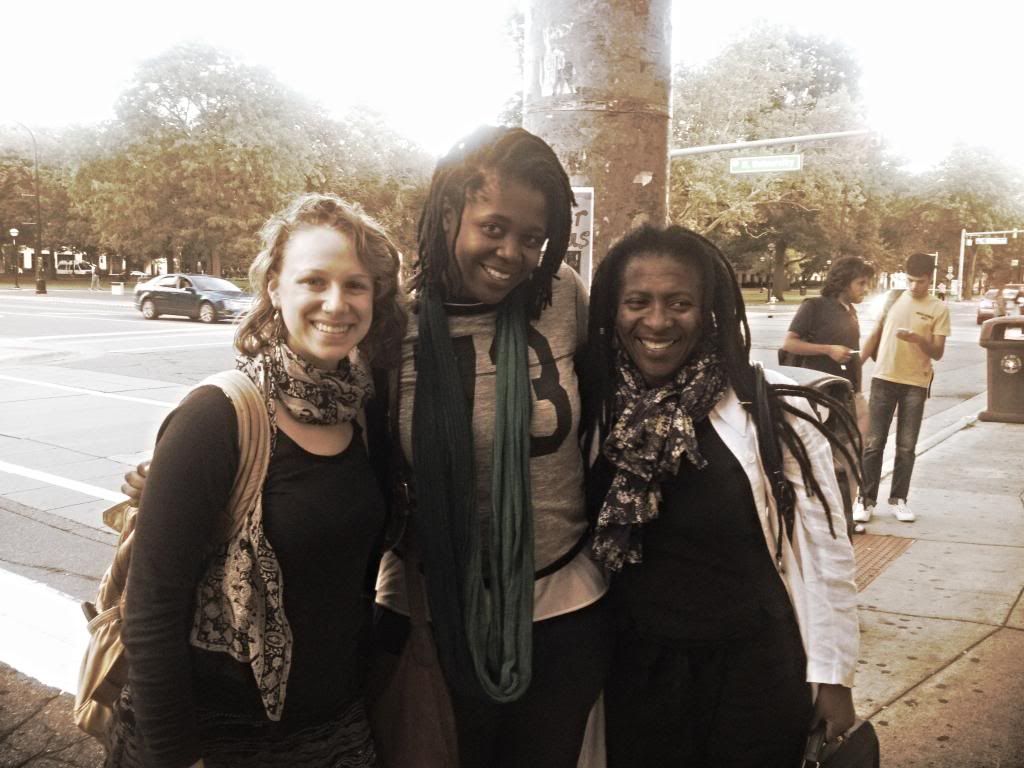
This semester, a number of venues across the entire campus, from The Slusser Gallery in the A&D Building on North Campus, to the  UMMA Commons, to the Institute for Humanities, to the DAAS Gallery in Angell Hall, to the Penny Stamps lecture series, are featuring the work of Mary Sibande. The South African artist is young, bright, and inventive. For a woman her age, she has already seen enormous success, exhibiting her work in Paris, at The Smithsonian, and more. I know how both young and bold she is because I had the pleasant opportunity of having coffee with her the other week (she is in the middle in the photo above).

The professor to whom I am a research assistant, Frieda Ekotto, is writing an article about Mary Sibande’s work and invited me to join her for the interview. We met at Amer’s on State Street and sat near the window, talking about the processes of the artist’s creations from start to finish. To illustrate some of her main points, Mary popped open her computer and started showing us photos she had snapped in her studio. I felt like I was accessing an inside look at the personal snapshots of Mary Sibande’s work. Her images sell for thousands in museums, yet there they were- simple jpegs on her PC.

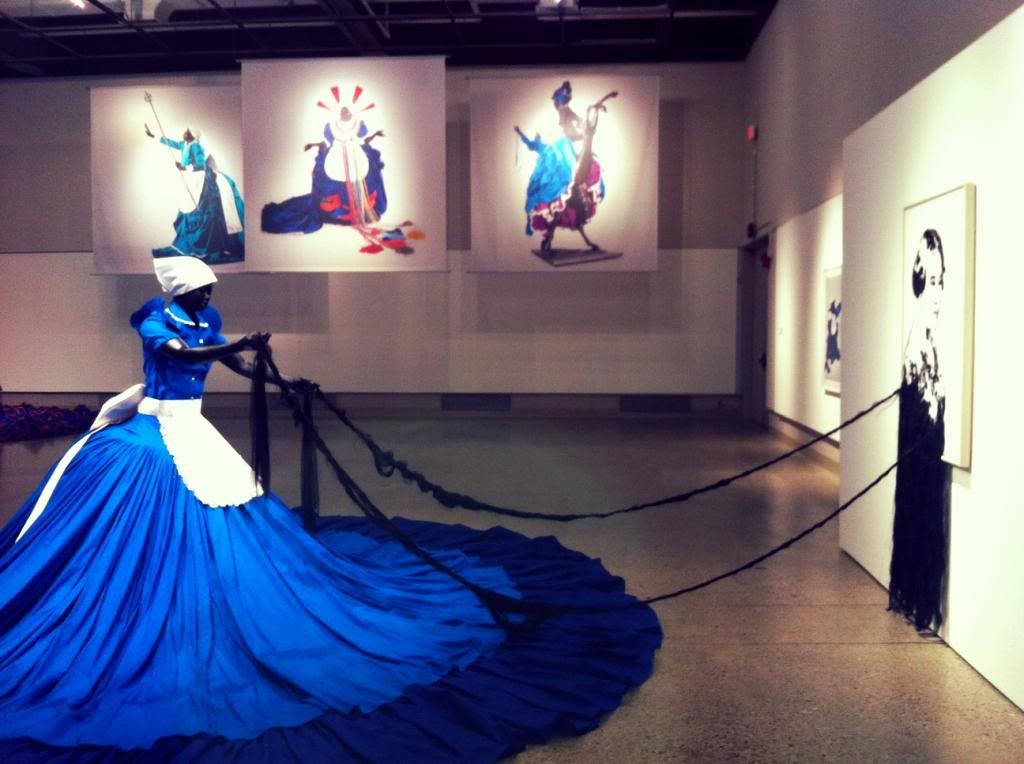
We discussed the sculpture work that is currently on exhibit at U of M. Sibande has created an almost infamous character called “Sophie.” This larger-than-life mannequin is made of wax and acrylic. The fluorescent dresses she dons are also creations of Sibande’s. Not only is this artist a sculptor and a photographer, she is also a seamstress, fashion designer, story teller, and painter. When I asked how she identifies as an artist,  she responded that she gives no title to her trade lest she limit her capacities to the practice of one particular medium.

In the photo above, which I took in the gallery on North Campus, “Sophie” is weaving tangled black thread into an image of a woman’s face. Who is this woman, you might ask? It is Madame CJ Walker, the woman behind the invention of hair straightening products used in the 1950’s by many women of African decent. This product revolutionized an American culture and she is both a heralded and controversial figure. The relationship between the figure of the weaver Sophie and that of Madame CJ Walker leads the viewer to ponder implications of race, gender, class, culture, self presentation, and more themes provoked by this piece.

Besides this one, Sibande’s exhibit features another of fascinating pieces. Be sure to take a look at Mary Sibande’s exquisitely original work. Even if you aren’t lucky enough to have coffee with her, you have numerous opportunities to become absorbed in her art this semester on campus. Enjoy!

REVIEW: Hubbard Street

Dance is somewhat of a challenge for me to understand. I lack the proper vocabulary and background knowledge to truly and accurately describe what I see performed in front of me. That said I thoroughly enjoyed Hubbard Street Dance Chicago’s amazing performance of, One Thousand Pieces. I will do my best to tell you why.

First off, it’s beyond beautiful. The dancers move with such grace and precision – I sort of made up this game to try and see if I could see someone’s knee twitch or foot slip out of place, but I never caught any slip-ups. Every move was deliberate and precise. They would rush to complete a phrase then slow to a gentle glide across the sleek dance floor. It was spectacular. Their performance also featured a mist curtain, hanging as a billowy and ever-changing backdrop to their movements. The scene change with the mist curtain also left the stage littered with water droplets, in which the dancers continued to glide and float on stage to the rhythms of Phillip Glass’s music. The sound of the water could reach me in the balcony. I was even able to make out sparkling droplets of water dancing through the air as the artists flipped their arms in the mist.

This dance performance was not a story ballet or anything – the aim, as defined by Hubbard’s first resident choreographer, Alejandro Cerrudo, was to show how images are shaped and distorted through stained glass. Why stained glass? The choreography was inspired by Marc Chagall’s America Windows, as seen on display at the Chicago Art Institute. The props were simplistic but did include a few mirrors, tilted this or that way. It was also cool to watch the dancers when the lighting adjusted to show a vibrant reflection in the floor beneath their spinning bodies. So many of their movements seemed to me to be in a singular plane, moving within some sort of field of restraint. When I would glance at the dancers’ reflections in the mirrors or the floor, their movements seemed flattened and more distant – as if I were watching the performance through a window. It was unlike anything I’d seen before. It gave a whole new dimension to the work for sure.

Hubbard Street is an amazing company and worthy of all the praise they receive. Bravo to the dancers and thanks to UMS for bringing this fabulous company to our Ann Arbor stages.

PREVIEW: Hubbard Street Dance!

This weekend come check out the UMS presentation of Hubbard Street Dance. Performing a piece inspired by Marc Chagall’s America Windows and written by Hubbard Street’s first resident choreographer, Alejandro Cerrudo, the performance is sure to take your breath away. Cerrudo, when interviewed, commented on how windows shape and distort images – this is the inspiration of the piece. They use water effects, like mist curtains, and special backlighting to exemplify the beauty of the dancers. It is sure to be a spectacle of a performance, so get on those tickets, folks!

PREVIEW: Julian Allen Senior Recital

Julian Allen Senior Recital

It’s recital season. This means that every venue in Ann Arbor is jam packed with parents, friends, and artistic talent on any given day of the month. On Saturday April 27th, The Yellow Barn hosts the Julian Allen Senior Recital. A musician in the School of Music, this performance will feature original music and lyrics by Julian Allen and multi-media collaboration with local artists. Both jazz and electronic, vocals and rap, this dynamic and varied recital will explore a number of themes, techniques, and messages. In conjunction with Dance BFA student Julia Smith-Eppsteiner, local hip-hop artists Tree City and Kadence, and a number of U-M School of Music students and alum, this performance will run the gamut of Ann Arbor talent. The show starts at 6 pm. The Yellow Barn is located on 416 W. Huron Street. See you there!

PREVIEW: Please Don’t Feed The Animals

Please Don’t Feed the Animals

This Saturday, April 20th there will be multiple gallery- both openings on campus and off- that exhibit the year long Integrative Projects of the senior students in the Penny Stamps School of Art & Design. This particular show, “Please Don’t Feed the Animals,” features the work of Erica Neumann, Anna Schulte, and Claire Jones. Each artist practices a different medium: typography, photography, and sculpture respectively. Two of these three artists are in my Book Arts class so I have already previewed their work. It is stunning- so professional, clean, intriguing, and unprecedented. Erica Neumann has fashioned animal figures out of various fonts and tells the narrative of evolution, both of typography and animal species. Anna Schulte’s photographs are a meditation of happiness. Claire Jones has created her own version of “taxidermy.”

This creative and labor intensive process will finally be on display at the Ann Arbor Art Center from April 20th to May 4th (117 W. Liberty St). An opening reception to celebrate the artwork will take place beginning at 5 pm on Saturday. Don’t miss the special  opportunity to see the talented designs of these up and coming artists. See you there!