There are three things that I am exceptionally bad at: conducting, cooking and drawing. I discovered that I could not draw in middle school art class as my peers began drawing portraits while I prided myself on my ability to draw symmetrical stick figures. Conducting was a daily struggle for me this past year as I attempted to keep up with instrumentalists used to reading scores with more than 8 parts while simultaneously transposing a good number for them. Luckily, drawing and conducting are not skills which are typically required on a daily basis, however, the ability to feed yourself is.
My inability to cook delicious (or even passable) meals is not due to a lack of effort, in fact I love to cook and the creative process associated with it, rather my lack of skill or patience. It often begins well – I search the internet for “simple healthy meal” or something similar and look through twenty or so photos until I find something that looks both feasible and tempting. I set out the pans, wash the vegetables and begin following the recipe to a T until I realize I am missing an ingredient. “No worries” I think “I’ll just substitute it with some other herb”. Two minutes later the same thing happens and yet again I substitute without knowing the true accuracy of my substitution. Fast forward to when the food is on my plate and I take the first bite – odds are it did not turn out well.
Perhaps if I was a bit more patient it would turn out better. If instead of cooking everything on high (obviously that is the most efficient way!) I considered lowering the temperature so that the pot did not overflow or if I could stop myself from opening the oven every five minutes to check if it was done, things would cook more evenly and come out less like hard bricks and more like chicken. Although I am acutely aware of my cooking faux pas there is some part of me that refuses to rectify them.
My own lack of success while attempted to cook has fueled my love of cooking TV shows. The chefs that you see on shows like Chopped and Masterchef (my two personal favorites) are true artists and I have been known to play episodes while I cook to help me pretend I am preparing a meal just as impressive. So often we look at food as a means to an end, we eat for nutrition and sustenance not for the beauty of preparation or complexity of flavors, and we forget that food can be about so much more than the number of calories per serving. We forget that the chefs who work behind the scenes are more artists than skilled laborers and that what we create in the kitchen can be, and should be, about more than the number of dirty dishes we leave behind.
“I’m at the top of my game. Leave saving the world to the men? I don’t think so,” says Elastigirl, in the 2004 Pixar movie, “The Incredibles.” As more and more women come onto the superhero scene, the conflicts become less about right and wrong, and transform into a war of the sexes. So far, in my English 418 class about Graphic Narratives, we’ve seen very few women populate our comics. When we do, the women are mostly depicted only as victims. This coming week, we begin to see Misty Knight in “Power Man” hold her own … most of the time. But even Misty is saved by Iron Fist in “Freedom” when she, as a trained cop, can obviously fight for herself. Iron Fist shifts the power scale heavily to the side of the male hero: man’s judgment is seen to trump all other opinions.
So what happens when females try to be in charge? Are they successful? How are they depicted? What do the female characters tell us about the men who try to overpower them?
Comics writer and artist, Kate Beaton, focuses much on parodying historical, literary, and pop-culture figures, all while offering up perceptive critical analysis of social politics. Beaton tends to turn toward the female perspectives, and often gives a voice, albeit one that is sarcastic and snarky, and attention to those women who often are the background noise. Beaton’s also strolled into the world of superheroes a few times, with Wonder Woman, Aquaman, and even Spiderman (dubbed by Beaton as a more specific “Brown-Recluse Man”). The value of superhero parody is that she can explore the heroic characters that everyone wants to be like, whom everyone wants to be victorious, yet no one knows anything about as a “real person” – you know, the real person who goes to the bathroom and gets drunk on Thursdays and picks their nose when they think no one is looking.
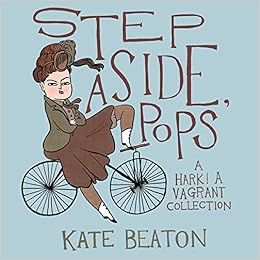
Image via Amazon.com
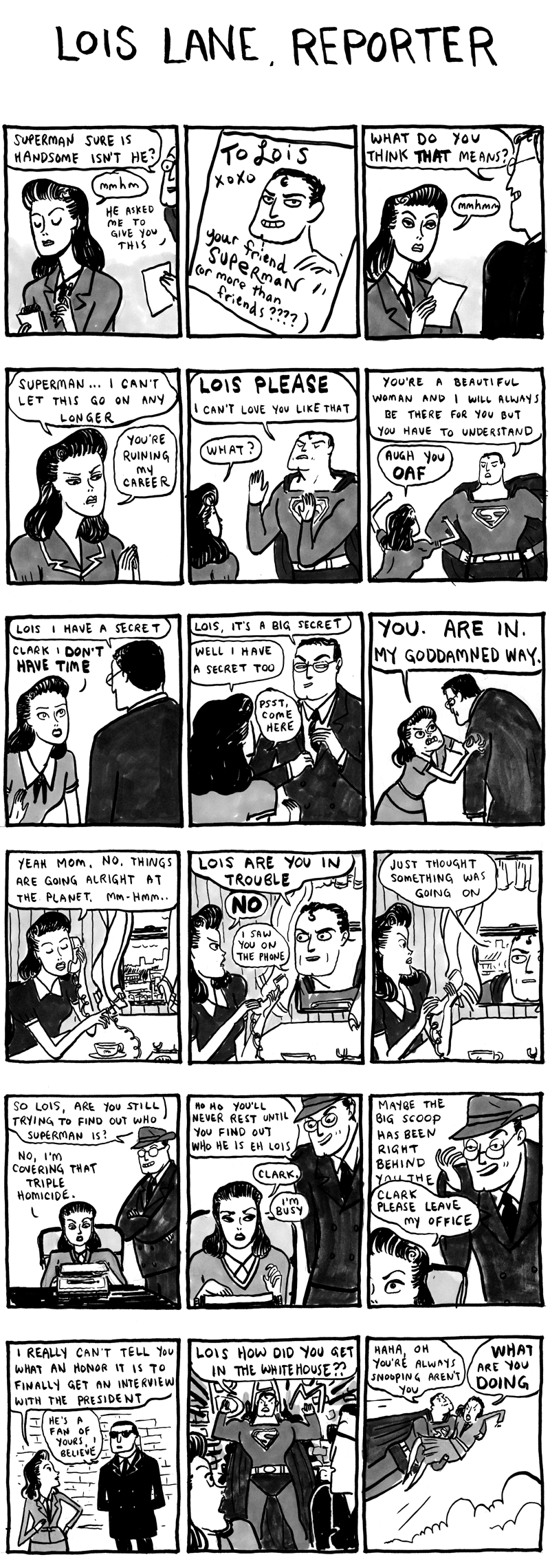
In her new book, Step Aside Pops, Beaton pays homage to Superman with the comic, “Lois Lane, Reporter.” The entire story is made up of 6 unrelated 3-panel comics, all depicting the various ways that Superman screws things up for Lois and generally gets on her nerves. Kate Beaton says, in the footnote of Step Aside Pops (pg. 16), “Don’t give me those comics where Lois is a wet blanket who can’t figure out the man beside her is Superman. If Lois isn’t kicking ass, taking names, and winning ten Pulitzer Prizes an issue, I don’t even want to hear about it.”
Beaton certainly paints Superman/Clark Kent in a different light than he was in the original Siegel and Shuster comics. Instead of the weak and cowardly Clark Kent we saw in his 1938 debut, “Champion of the Oppressed,” we see a persistently bothersome coworker whose double identity is obvious to Lois based on his obscure behavior, and she could care less about him if he was Superman or Cristiano Ronaldo. Lois is busy, driven, and is trying to save the world in her own way- by reporting about it. But, does Kate Beaton truly represent Lois as the no-crap-taking girl she wishes Lois could be?
In the first strip of panels, Lois has a strong visual presence. She fills the space of the first and third frames, while we sneak a barely legible peek at Clark Kent’s glasses and cleft chin. Lois is dressed professionally (and androgynously) with a blazer and tie, which adds a sense of corporate power. Although Lois only speaks twice, both minimally with the sarcastic sound of “mmhmm,” there’s a certain strength in the absence of her words. The mmhmm indicates a purposeful statement of annoyance, and at once shuts down the conversation. Mmhmm neither asks nor answers anything. It does not progress any action, which paradoxically puts the ultimate power of plot in Lois’ hands.
Lois continuously shows that she isn’t interested in Superman. No, not even a big secret can persuade her. In the third set of panels, Lois shows that she can play games, too, as in the panel when she beckons to Kent seductively, saying, “I have a secret, too. Psst, come here.” The lovesick Clark Kent falls for them every time. The feisty Lois we know and love responds with “You. Are In. My Goddamned Way.” This is the epitome of Kate’s kickass Lois, I think.
The next comic strip begins with Lois Lane on the phone with her mom. Suddenly, an absurdly large head of Superman pops through the window. “Lois, are you in trouble? I saw you on the phone. Just thought something was going on.” This comic scene certainly calls into question Superman’s judgment. In the 1972 Superman comic “Must There Be a Superman,” Superman considers that “Maybe I have been interfering unnecessarily! I decide what’s right or wrong…and then enforce my decision…by brute strength.” Does a superhero automatically have perfect judgment of justice? Beaton’s Lois Lane comic parodies Superman’s assumption and asks us to question, “Who is capable of saving themselves?” and even more, “Who is in trouble to begin with?”
Kate Beaton really had convinced me of Lois Lane’s badass-itude, until the last comic strip, in which Lois is at the White House in order to interview the president. Our girl has worked her way up through the journalism ladder and gotten herself to work on the story of all stories, when suddenly, SuperSnoop (I mean, Superman, eh-hem), busts the walls down and “saves” Lois. They fly into the air with Lois in Superman’s arms, and she yells, “What are you doing?” I was seriously upset that the comic ends on this note, because it reinforces the stupidity of some superheroes who “save” people who didn’t want to be saved, either because they actually think they are doing good, or in Beaton’s case, because Superman is depicted as a creepy lovesick stalker. Again, I can’t stop thinking of “The Incredibles” and this clip below, where Mr. Incredible gets sued for saving a man who tried to commit suicide and didn’t want to be saved. Even though Lois obviously was not trying to kill herself, this scene helps to explain how superheroes sometimes use their fame and strength to do things that aren’t in their victim’s best interests.
Perhaps Lois needs to have a talk with her lawyer! In any case, I enjoy Beaton’s delving into the female side of the Superman comics, which not only makes us look at Lois in a more positive light, it also turns the tables on the males of historic comics and continuously makes us wonder, “Must there be a Superman?”
This week, something extremely important happened in my life. What was it, you may ask?
Jane the Virgin returned after its mid-season break this Monday night.
*screams very loudly*
I love Jane the Virgin. I don’t know how many times I can say it in a week – I said it on Monday when the show came on, I said it on Tuesday night to my friends, I said it Wednesday to a girl I had just met. I love this show.
So here’s the story. Last semester, I was scrolling through Netflix to see what they had added recently, and I saw Jane the Virgin on there. I was instantly excited. I had heard really good things about the show, even if I didn’t know anything about it. However, this meant absolutely nothing. There are about 100 things on my Netflix queue that I was “really excited about” 3, 4, 5 months ago.
So when I was having a particularly bad day, and I didn’t feel like doing any homework (although, to be honest, when do I feel like doing my homework), I laid on the couch in my apartment with the lights off and looked on Netflix for something to make me feel better. Surprisingly, I clicked on Jane and started episode 1.
Eventually, one of my roommates migrated into the living room around episode 2 or 3, and we ended up watching either 7 or 8 episodes together. And after that I was hooked. The show was funny, dramatic, serious, clever, intuitive – everything I never knew I could have in a TV show but now needed.
I began telling everyone I knew about this show. I ended up convincing my other roommate to start it, and with one roommate already done, and three currently watching it, Jane the Virgin kind of became the apartment show.
However, all good things must come to an end, and by the time winter break rolled around, we were all done with season one and had to catch up on season two, so that this week we could all watch it together. And of course, we did, and it was fantastic.
Now that we’re all caught up to the present, I should maybe talk about the actual show. There are so many good things I could say about the show, I don’t even know where to begin. As someone who truly cares about diversity (#OscarsSoWhite y’all), I tend to get excited about things that feature a diverse cast. Last semester, I was all about Quantico. Though they could do a bit better, especially in the male cast, I am in love with Priyanka Chopra and Aunjanue Ellis is queen. Last year, I was all about Fresh Off The Boat, featuring the first Asian-American cast on primetime television in 10 years, even if its been surrounded in some much-needed controversy about representation of minorities on television.
So when I started watching Jane the Virgin, I was already pleased at how well the cast was organized. Jane has very strong latina roots, and they come across loud and clear on the show, and yet because of her sunny disposition and ability to befriend anyone, the cast opens up so that it isn’t just a latin@ show, and it doesn’t claim to be one. It doesn’t stigmatize or stereotype the lives of the women on the show, and yet they clearly aren’t there for diversity’s sake. They have complex, emotional lives, and are highly relatable characters.
And not only is the show centered on the lives of latin@s, it also focuses on female relationships and even, at times, prioritizes them over male relationships. For Jane, family is everything, and all of her decisions, her thoughts, feelings, dreams – they are all closely tied to her family. And for a very, very long time, her family has been three women. Three strong, independent, resilient, vulnerable, caring women. Even when portraying Jane as the “good girl” who took care of her teenage mom at times, Xiomara herself isn’t portrayed as helpless. I mean she raised Jane for crying out loud, so that’s saying something. And while Alba may be the grandmother, and therefore the oldest out of the three, she isn’t portrayed as “outdated” or “old-fashioned” in any way. She’s portrayed as strong and caring as well, clearly showing how her traits have been passed down all the way to Jane.
I could keep going, but I think my point is clear. Both comedic and dramatic, both sad and hilarious, both fresh and funny, Jane the Virgin is dazzling. It’s complex, it’s diverse, it resists and even challenges stereotypes, and seriously, when’s the last time you saw the main character of a TV show pregnant for the majority of it? And as evidenced by my apartment, it brings people together.
So your homework this weekend, then, is to sit down and marathon Jane the Virgin. You won’t regret it.
Last week, I was surprised to find there was a new trailer for the Suicide Squad movie.
It’s very hard for me to dislike a trailer that utilizes Bohemian Rhapsody. But the song wasn’t used as just some deafening overlay that didn’t add anything to the visuals. Instead, they edited the trailer perfectly to the beat and utilized comedic cuts in between the transitions the song is so well known for.
The visuals were also impressive and served as a confirmation that this film was far removed from the Batman world that Nolan had created with his trilogy. But I suppose some are still skeptical about Jared Leto as the Joker, others are skeptic of the Harley Quinn performance, but some were pleasantly surprised at what seems to be Jai Courtney producing his best performance to date. As for me, I’m not one to really speculate about a movie after seeing an advertisement for it. When it comes down to it, these trailers and teasers are all just advertisements.
No. Perhaps that is simplifying too much, for the two mediums aren’t precisely synonymous with one another. Whereas a general advertisement, for instance, for a car, produces intrigue based on whatever price is flashed before the screen or what sexy celebrity is driving it, a trailer for a movie is producing intrigue via segments so that you go see the rest of the movie. Arguably, no other advertisement that is shown via video has this relationship that movies do with trailers.
But, even though these trailers are fragments from the movie, a good trailer doesn’t necessarily mean the movie is good nor does a bad trailer mean that movie is bad. In fact, there have been many cases where expectations have been disappointed or where audiences have been overwhelmingly surprised.
The more I think about it, the more I realize how much of an art form the trailer truly is. It’s very difficult to create a trailer that generates both interest and hype, while also remaining true to the project it is advertising. So let me show you a couple of trailers and teasers that I find were truly exceptional. But keep in mind, that all of these examples are for fairly recent movies or at least movies that came out during my lifetime. I cannot, for example, comment on the trailer for The Shining because I never saw it prior to seeing the film. In other words, the point of the trailer becomes mute for me. Now that that is said, let’s move on.
So I’ve already talked about the Suicide Squad trailer. It was a great trailer and it is certainly generating a large amount of hype for the movie. I will not talk about the other recent hype generating advertisement machine that was the Star Wars campaign. Let’s face it, they did an amazing job advertising the movie; revealing very little while giving us just enough to get excited by the new and the nostalgic.
But there is one amazing teaser that generated so much hype without a single bit of footage – the very first teaser for The Dark Knight. I’m sure you all know that the vast majority of people were not too excited about Heath Ledger as the Joker. Which makes sense given the only movies people had seen in him were probably The Patriot, A Knight’s Tale, and Brokeback Mountain. Don’t get me wrong; he was incredible in Brokeback Mountain. But playing a cowboy stuck in a complicated relationship is one thing; playing an insane iconic comic book villain is another. Arguably, playing the homosexual cowboy is a lot harder than playing the Joker. But ironically, messing up the Joker brings more public outrage.
So all that public skepticism was in the air after the casting news came out. Then, Nolan drops this teaser and shuts everyone up.
The amount of hype this one, 55-second teaser, generated was ridiculous. It was a genius stroke of advertising, to play on the doubts of the general public. I can only imagine that Nolan was always confidently smirking as people booed at the casting choice. He’d already seen Ledger’s Joker.
Perhaps I started off with a teaser that is too brilliant. Yep, I did. But the trailer for Sin City was probably the first one where I could feel the style oozing from such a short video.
I’m a sucker for good music and well timed editing. But I think the movie did a great job at giving us a glimpse of the interesting visuals this movie would offer, mixing literal comic book art from Frank Miller’s praised series with black and white clips from the adaptation. Also, when we start seeing the names of all the cast members and the song hits that climax, the trailer is just too cool to handle.
Both of these movies met the expectations that the trailers set up. The case of The Dark Knight is bit more complicated however because the marketing generated too much hype, meaning there was bound to be small bit of disappointment, but virtually everyone all agreed the movie was amazing – specifically Ledger’s performance. However, Prometheus was an odd one.
The teaser for Prometheus mimics the music and the title formation style from the trailer for Alien. At first, it may seem clever. After all, Alien is a sci-fi classic so of course drawing similarities will attract a lot of attention. But when the movie came out, people who expected an Alien prequel were disappointed. Now I, for one, have never seen Alien, so I only found out that there were similarities between the two teasers after some minimal research. I saw Prometheus without that knowledge and had a grand old time. I won’t go in depth into why I enjoyed it, or why I think it’s a good movie. And I definitely won’t talk about why I think everyone who was disappointed by the movie because it wasn’t similar to Alien, should just stop. Why? Because to be fair, the teaser led them on. On the other hand, we did see the origin of the Xenomorph, so it is technically an Alien prequel. But it just wasn’t the claustrophobic horror show that Alien was.
Oddly enough, for someone who doesn’t get the reference to the Alien trailer, the teaser for Prometheus works wonders. For those who understood the reference, it potentially set them up for disappointment.
Of course there are many great trailers out there that I haven’t mentioned: Mad Max: Fury Road, Guardians of the Galaxy, Birdman, The Revenant, Inherent Vice, The Master, The Incredibles, and the list goes on. In fact, some of the best trailers in recent memory haven’t even been for movies, but for games. Which is an entirely different interaction between marketing and product – one that I don’t understand well enough to speak even somewhat intelligently about. For instance, the incredibly recent trailer for the Final Fantasy VII Remake or the very first trailer for Starcraft 2. Both of these are incredible pieces of marketing.
Considering trailers in the world we currently live in is odd. We no longer only see these trailers right before a movie at the theatre with other people. Instead, more often than not, we see them on YouTube by ourselves. Also, many contemporary trailers reveal too much of the story, ruining the experience of watching the movie, months before it even comes out. I think filmmakers should study the art of making good trailers because in a lot of cases, the director edits the first trailer. Learning how to blend music together with quick commercial editing all the while giving glimpses of story but not revealing too much. It is a tight balancing act in a short duration.
I think consumers of pop culture like me are naturally inclined to love rankings. Top 10 movies of the year! Top 10 summer TV shows! Rankings allow us to discover new things and retrospectively reevaluate art we may have already experienced. Reading movie rankings at the end of the year is one of the irresistible pleasures of being a regular moviegoer and criticism reader.
But they can be a real pain in the ass to create yourself, and that’s due to one problem in particular: it’s so unclear what it means to like a movie.
A year ago, I decided to maintain a list of movie rankings for each year. At the end of 2014, I’d struggled to look at the 57 movies I’d seen and simply rank all of them; it’d be much easier, I figured, to gradually add to the ranking each time I watched a new movie in 2015. And it did start off okay! The first two movies I saw in 2015, “Kingsman: The Secret Service” and “The DUFF,” had an obvious quality gap; I loved the former and thought the latter was okay, so in my preliminary ranking, “Kingsman” was #1 and “The DUFF” was #2.
“Kingsman: The Secret Service” has a pretty dramatic climax.
I found, though, that as the year went on, it became much harder. I ran into the same problem that I ran into in 2014, namely that it’s really hard to determine overall quality. It’s the same reason reducing a movie to a simple grade is so hard. It’s why I’ve come to appreciate websites whose reviews lack star or letter ratings.
What makes you “like” or “love” a movie? I’ve found almost invariably that most of the movies that are regularly considered the ‘best’ of the year are movies with which I don’t have a huge emotional connection. I was totally engaged throughout “Spotlight,” for example, and there were moments where I was horrified and moments where I felt triumphant. If it does go on to win Best Picture at the Oscars, I’ll be totally onboard, because I know intellectually that it did everything so well.
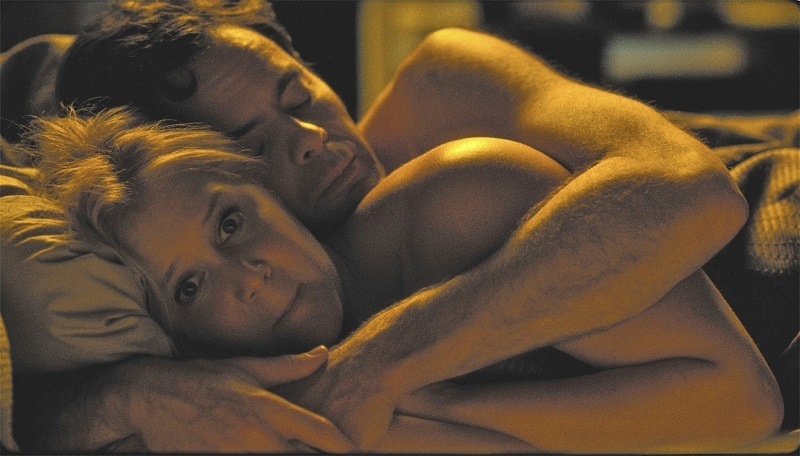
But then I watched “Spy,” “Trainwreck,” and “What We Do in the Shadows,” three great comedies that made me laugh constantly throughout. Are they all as technically accomplished as “Spotlight?” No, and of course none of them have subject matter as important as “Spotlight.” But if “Kingsman: The Secret Service” made me ache with laughter and stunned me with its ridiculously over-the-top, colorful, exhilarating action sequences, is it really that bad that I ranked that above “Spotlight,” “Carol,” “Brooklyn,” “The Hateful Eight,” and most of the other big Oscar nominees?
This especially becomes a problem when I consider movies that I didn’t really like, but which showed a clear creativity and ambition. “The Gift,” though very acclaimed, felt shapeless and confusing. In my review, I called it “admirable in its unconventionality but jarring in ways that negate its intelligent ideas,” and I stand by that. “The Gift” had an abundance of fascinating ideas that made me want to see more from writer-director Joel Edgerton, especially compared to a cliché, forgettable movie like “The DUFF” or even “Trainwreck.” And yet “Trainwreck” was my #11 movie compared to #44 “The Gift,” and even the predictable “The DUFF” managed to pass “The Gift.”
So ‘liking’ something is such an ambiguous term. If you judge quality on originality and innovation, some of your least favorite movies of the year might be some of the best, but if you judge it on the strength of emotional reaction alone, some of your favorite movies might be the worst. I tend to rely on what the movie provokes in me emotionally, so I end up with the suspense of “Sicario” and the tear-jerking “Brooklyn” high above the slightly clinical, understated “Carol,” though there was a lot I loved about that movie.
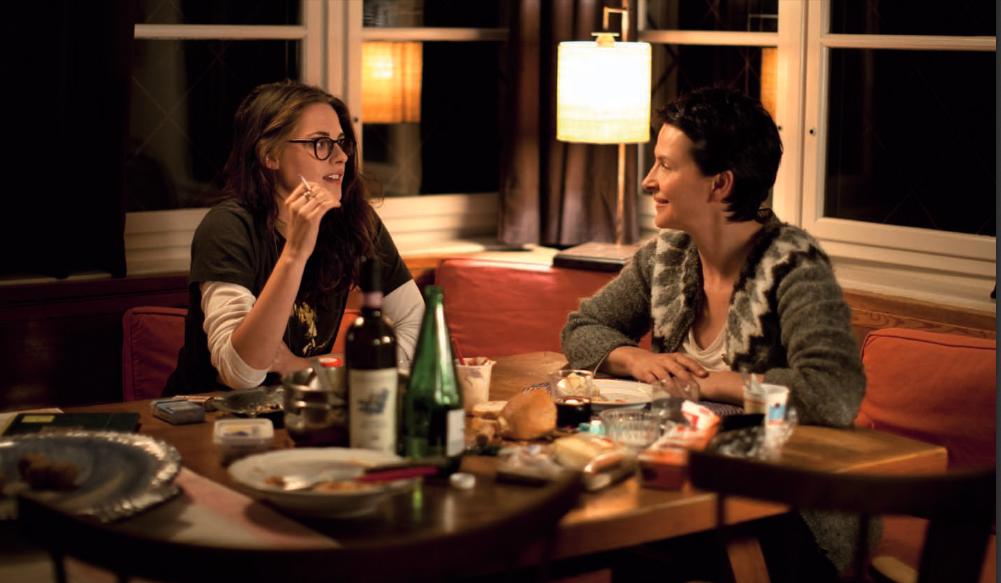
Same goes for “Clouds of Sils Maria,” which has a duo of great performances and so many thought-provoking ideas but failed to elicit more than vague interest for me. Having heard about the plot beforehand, I thought the movie would resemble Bergman’s “Persona” or Aronofsky’s “Black Swan,” two movies that had the emotional punch of psychological horror. Instead, though, it was more patient and exploratory in its themes. It felt like a movie adaptation of a classic work of literature; I’m sure somebody could write a whole book analyzing the movie, but I would’ve traded that for a bit more of an emotional connection.
I wasn’t wholly uninvolved while watching the movie—I’d still give it a solid B. Aside from the thematic exploration, it was fascinating just to watch Maria (Juliette Binoche) and Valentine (a subtle and great Kristen Stewart) converse. There were some really enjoyable scenes of the two bonding. I especially like the conversation at the bar about superheroes; the silly fantasy movie they were watching was way too on-the-nose and unrealistic, sure, but the conversation has a lot of smart things to say about big-budget fantasy blockbusters versus the high-brow psychologically based theatre that Maria dedicates her life to. I couldn’t help but cheer when Valentine defended teen actress Jo-Ann (Chloë Moretz). There’s something nuanced and interesting about the conversation—Maria is clearly a bit condescending in the way she dismisses the teen fantasy genre, and in the way she laughs off Valentine’s defending of Jo-Ann, but it never escalates into an all-out fight, only a healthy debate. You can see how comfortable the characters are with each other, and their unique dynamic kept me intrigued the whole time. Besides, Jo-Ann is an interesting character in her own right, though her subplots don’t quite fit in perfectly with everything else going on.
I guess part of my slight disengagement came from my confusion; though I knew there was so much buried commentary in the movie about identity and art’s relationship with reality, I wasn’t sure what the main conclusion to draw was. The final outcome of Valentine imitating the end of the Maloja Snake (the play she’s helping Maria rehearse for) is the logical endpoint for the character based on the theme of life imitating art, but I thought the conclusion would be a bit more tragic and disturbing instead of haunting in an understated way. Then again, maybe the movie’s ideas would be buried in melodrama if it became truly horrifying.
All of this is to say that I had no idea where to place “Clouds of Sils Maria” on my list. It currently sits at #31, which feels so wrong when you compare it to #27 “Unfriended,” #26 “Ant-Man,” and, again, “Kingsman” and “Trainwreck.” And yet each of those movies entertained me more, and elicited more immediate emotions from me. Their ideas aren’t as sophisticated, their writing isn’t as meaningful, and their characters aren’t nearly as complex. But I liked them more.