

Category: Uncategorized
How to reduce your carbon footprint (as students)
In light of taking an environment class this semester, I’m sharing simple tips we (as students!) can reduce our carbon footprint as well as some pertinent lessons I’ve learned from the class.
- Food
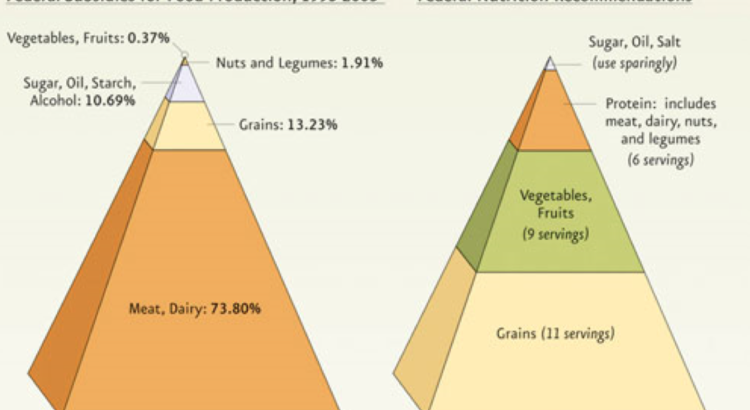
- Change the way you eat, by consuming food in line with the food pyramid: believe it or not eating less meat makes a bigger difference than driving around cars! Meat emits methane, a gas which traps a lot more heat than carbon dioxide. Fun fact: Meat production receives a lot more federal subsidies than vegetables yet federal nutrition recommendations suggests that we should eat more of vegetables and grains (major irony).
-

A fuzzy representation of federal subsidies meat production receives Eat enough food and avoid wasting. This means putting enough food on your plate that you know you can finish. When you can’t, keep the leftovers for another time (also a money saving tip instead of chucking it away).
- Grocery shopping: bring your own bags and if you have extra money, purchase produce bags so you can load up fruits and vegetables without using single use plastic provided at the supermarket.
- Clothing
- Wash your clothes in cold water: this helps the clothes last longer and reduces energy from heating up water.
- Avoid fast fashion: they don’t last long and some of the trendy pieces are only meant to last a season.
- Think in the long term when buying new clothes, will I still like this piece? Can it withstand the test of time?
- Shopping
- If you’re shopping on Amazon and don’t need your things immediately, you can opt for Amazon Day Delivery. This groups your items together and delivers them all on the same day and reduces packaging waste.
- Buy less stuff: buy what you really need and opt for used items when you need something. E.g. if you need a new winter coat, Patagonia now sells used and repaired winter gear at a reduced price (great way to save money).
- Bring your own reusable bag everywhere.
- Support environmentally responsible companies.
- Donations (if you have cash to spare)
- If you do have extra cash to spare, consider donating to environmental NGOs
- Purchase carbon offsets to offset air travel or any sort of travel. (carbonfund.org) Money received is redirected to investing in renewable energy, reforestation and energy efficiency projects.

In the Eyes of an Architecture Student: It’s Not Always Just Doing What’s Assigned
 Hi Everyone!
I’m back again this week to discuss this week’s topic: “It’s Not Always Just Doing What’s Assigned.”
Yes, I know, this week’s title is a bit wonky grammatically, but what I mean is that, in architecture school assignments, we as students are the creators of the proposals and, despite the assignment prompt, we are in ultimate charge of deciding what we should produce to complete the assignments.
To clarify, say, you get a prompt to write a paper in your English paper. This prompt most likely will provide you with specific topics you should cover in the topic of your choice, or specific additional questions to address if certain topics were already chosen for you. All you have to do is answer all these questions in your paper. right? Well, an architecture prompt is essentially the same as an English essay prompt. In architecture, the given prompts simply gives you the dimension parameters and maybe a few specified programs to be placed within your proposed building, and your professor will give you suggested modes of representation (i.e. models, drawings, vignettes, sketches, VR, gifs, etc) to produce in order to “answer” the design question graphically. Ahem, we place emphasis on SUGGESTED because there are many cases where certain modes of representation are more efficient in conveying ideas depending on the project.
It’s funny because I think back to my first ever semester in the school of architecture, and I remembered receiving the prompt and producing all of what was assigned in the prompt. All the while, I’d say that I’m just producing these views because it is what was assigned, or it “looks cool,” Now, four semesters later, I would receive the prompt and am able to comfortably consider what’s being asked of me to produce, but I’m able to decide on what modes of representation I should produce
I realize this skill is especially important because we only have so much time to produce hypothetical projects that, in reality, would take a real design firm months to maybe years to finish producing the real building or even just deem that the building just won’t work and not end up producing it at all (which, not gonna lie, is pretty depressing to have produced all models and drawings and calculations only to end up not conceiving it).
I’ll admit that I do still feel a bit insecure sometimes when I don’t produce some of the things that were suggested or even sometimes what my professor would recommend, but honestly that is a very common thing that happens in architecture school whether you’re an undergraduate or graduate student in design school, and it’s just the process of growing as a designer. This process of growth is ongoing, as I even observe such a thing happen between professionals. Even my professor will ask other professors for their feedback and learn at least one thing new each session! It’s very inspiring knowing that as a designer you’re expected to exhibit a sense of independence in making decisions sensibly, and that it will always be completely alright (recommended even) to ask others for feedback and criticism. In fact, it’s usually considered a bad thing if you’re not getting any sort of criticism because we know that nobody and nothing is perfect (no matter how close they get to perfection), and that projects are never in a “final stage,” so if your project doesn’t inspire thoughts from people then it usually means your work needs something more to even enter the realm of becoming “intellectually stimulating.”
I just wanted to share these experiences and thoughts with you all (especially if you’re a design student) because I think no matter the discipline you’re in, it’s important to establish your independence in making sensible decisions without having to rely so much on whoever you deem as a superior figure to manage your discipline. Your superior can only re-interpret what you tell them, so they will never really understand or be able to imagine your work as you talk about it. They can only come close, so it’s so much more powerful if you are able to produce whatever is necessary to get your own point across, and make your voice heard in the world.
Ciao for now 🙂 Hope you will all finish your semester strong and healthily!!

The Art of Translation
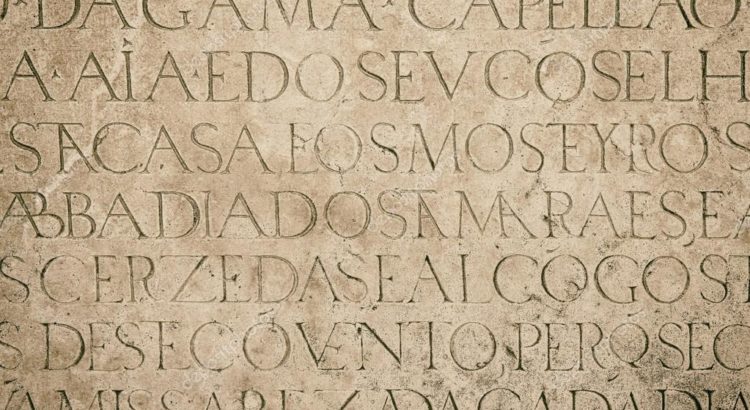
As a student of the classical Latin language, I often translate famous Latin prose and poetry that has withstood the test of time. Working with these historical pieces is wonderful in a variety of ways, but I find it particularly fascinating how different translations of the same passage can vary widely in both their structure and tone. I was recently discussing some of my thoughts on what makes a great artistic translation in my Latin class and I thought it would be great to share those thoughts with you, and hopefully peak your curiosity in the art of translation. To demonstrate what makes one translation fall short, and another translation stand out, we’ll look at two translations of the same passage from the Aeneid by Vergil, a famous passage in which the protagonist Aeneas tells of the infamous “Trojan horse” being found on the beach and the priest of Apollo, Laocoon, warning the Trojans of Greek offerings.
Then Laocoön rushes down eagerly from the heights
of the citadel, to confront them all, a large crowd with him,
and shouts from far off: ‘O unhappy citizens, what madness?
Do you think the enemy’s sailed away? Or do you think
any Greek gifts free of treachery? Is that Ulysses’s reputation?
Either there are Greeks in hiding, concealed by the wood,
or it’s been built as a machine to use against our walls,
or spy on our homes, or fall on the city from above,
or it hides some other trick: Trojans, don’t trust this horse.
Whatever it is, I’m afraid of Greeks even those bearing gifts.’
– A.S. Kline, Poetry in Translation, The Aeneid (2002)
The first translation of the passage by A.S. Kline is interesting in how literal and linear it is; it follows the structure of the original Latin very closely, not adding implied or gapped vocabulary unless absolutely necessary for understanding. This leads to some sentences feeling unfinished, such as “what madness”, in which Kline decides not to include a main verb, making the sentence unintelligible in English. In contrast to his literal interpretation of the Latin, he does take liberties in his translations of adjectives and verbs. He shifts them around from the original Latin in order to paint a different picture that better fits the image that he wants to convey. It can be argued that these modifications of the original Latin are beneficial to the English reader, but it conflicts with his other literal translation decisions. It leads to this semi-modern translation that is choppy and lacks a consistent tone, while only being marginally easier to understand.
And now Laocoon comes running down
From the citadel at the head of a great thong
And in his burning haste he cries from afar:
‘Are you out of your minds, you poor fools?
Are you so easily convinced that the enemy
Has sailed away? Do you honestly think
That any Greek gift comes without treachery?
What is Ulysses known for? Either this lumber
Is hiding Achaens inside, or it has been built
As an engine of war to attack our walls,
To spy on our homes and come down on the city
From above. Or some other evil lurks inside.
Do not trust the Horse, Trojans! Whatever it is,
I fear the Greeks, even when they bring gifts.’
– Stanley Lombardo, Hackett, Aeneid (2005)
The translation by Stanley Lombardo is different than the previous translation in a few significant ways: Lombardo does not follow the order of the original, he uses numerous adverbs that are not present in the original Latin, and he generally uses more idiomatic and figurative English to create a tone to the passage. In doing so, he creates a more flowing and intriguing narrative, and overall I think that a large number of Lombardo’s additions are supported by the original context of the Latin, if not by the literal structures and vocabulary. By being more artistic and presenting his own interpretation, Lombardo conveys better in English what Vergil conveys in the original Latin. The result is a much more interesting narrative that is more imaginative and easier to read, even if it strays far from the literal structure of the Latin.
In conclusion, there is something to be said for both consistency and imagination. A quality translation has a specific goal in mind, whether it be to follow the original language strictly, present a more imaginative narrative, or to make the passage easier to read and understand, and then makes consistent decisions to realize that goal. As far as which goal is best, each has its merits and particular nuances that make them great; such is the beauty of translation.
Basil + Gideon Interlude: Character Info

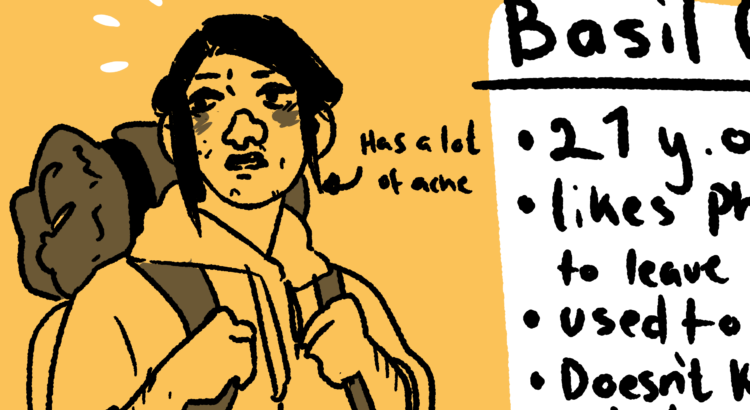
I figured I’d do something a little different this week because, I, like everyone else, am suffering at the hands of finals. So here’s some little character introduction sheets for Basil and Gideon!
Basil + Gideon is an ongoing narrative comic, if this is your first time reading check out the first installment here!
