besides drinking coffee

I went to Lisbon, Portugal with a goal to find and to buy the perfect art piece as a memento from my travels there. I wish I could provide a coherent explanation as for what constitutes ‘perfect’ art; it is a personalized perfection, per se, because no two people will see a work of art with the same lens. How neat is that? That one person could be totally captivated by a piece while another is repulsed? Same property applies to other art forms (e.g. books—literary arts. One prominent example that comes to mind is The Catcher in the Rye by J.D. Salinger. Some people could not stand it. I loved it.) Good art is the artist’s ability to inspire a strong enough feeling from you to shift you from your normal resting state, whether you like it or do not like it. What makes art good is its capacity to fill someone with the urge to do or feel something your usual thinking/feelings. Art has the flexibility to be whatever the viewer sees it to be. Maybe art harnesses an idea that links to our past or an idea for which we hope in our future, like a subliminal connection to the work, and for that reason, we develop our taste for art. Maybe we are drawn to art because of a natural force that we experience when we are drawn to anything else, like “chemistry.” As for me personally, I like the magic of thinking our attraction is more of a niche.

Thanks for reading that mindwander*. Now, onto the my short story that catalyzed this reflection.

On my ascent to explore the São Jorge Castle, I put on those imaginary shopping goggles you wear when you are looking for only one item in particular so you don’t drain your wallet…because everything is so cool. In my case, my goggles were tinted for an art piece that showed personalized perfection. So as I climb, I pass many art stands.

The first stand: a display of composite art with rustic colors and a feminine undertone. I pause to admire a piece and consider that it might be the one, so I take a picture of the store to remember it on my way back. (In retrospect, I would have registered the store if I had really liked the art.)

The second stand: Further on the route sits a focused young woman who paints to pass time on a Saturday afternoon. I like the idea of her, but her art is basic. To me, the art on display lacks the unique flavor that artists pour into their work to distinguish theirs from any other work of the same subject.

The third stand: I reach a populated overlook of the city about halfway up the hill where I encounter a woman on her phone with headphones selling reprints of artwork. This feels phony to me. Copies?? No. I could go to kinko’s and make a copy myself. Give me that fresh, original piece that I won’t find anywhere else in the world.

And then. Through my shopping goggles, I see the perfect art.

Last stand: a tiny art station sits lodged in the corner of the platform and I am immediately captivated. Meet the artist Eduardo Roberto. Oh wait, excuse me, the “one and only Eduardo Rrrrrroberto” as he introduces himself. What a treat he is. He is friendly yet focused in his work. What I notice is that all his paintings are brown…it smells like coffee…on the table, there is coffee…a cup for drinking…two cups for drinking?…he dips his brush in coffee and he works on a piece for his display board right in front of me… Besides drinking coffee, he paints with coffee! This niche style and charisma inspires that change in feeling I mentioned in my reflection. This is definitely the one.

Check him out! @ Artista Do Castelo

P.S. To further capitalize his already notable originality, he encloses my painting in brown paper and signs the wrapping with a sketch of a cartoon self portrait…a remarkably accurate representation of his character: animated and original.

*mindwander: a made-up word in my personal dictionary that means a leisurely or aimless way of thinking or explaining an existential concept as a result of overwhelming inspiration that is enough in the boundaries of the topic to not be considered a tangent. Basically, arts, ink is the platform for writing all of my mindwanders.
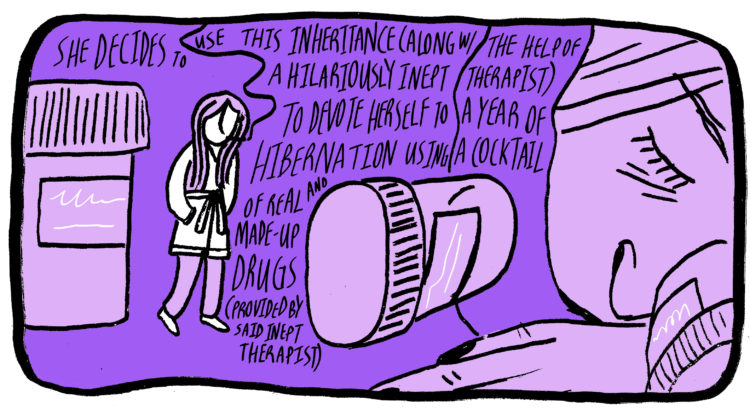
Marge Makes Comics #5: “My Year of Rest and Relaxation”, The Perfect Book For Finals Season

Hey! It’s Marge again. I don’t mean to do book reccs just when school’s winding up and everybody’s studying and nobody has any time to read but…please read “My Year of Rest and Relaxation” I have a lot of feelings about it. (Also do y’all have any book reccs? Lemme know! I’ll read ’em when I get through the pile of comics growing in my room.)

A Whole New Viola!

Since I started preparing for my junior recital a few months ago, I have become increasingly interested in contemporary music for viola. It’s an awkward instrument, or at least that’s what society says. You’re far more likely to recognize the name of a famous violinist or cellist than a famous violist. They aren’t considered solo instruments, and I think in many ways that has shaped the way I view myself as a musician. I have always seen myself as a supporting musician rather than at the forefront of a performance, but that’s not a very helpful thing to envision for myself. Why shouldn’t I be a soloist? Why shouldn’t I be a leader? At the very least, why shouldn’t I strive for that level?

I enjoy contemporary music– I feel like it represents my beliefs about music and I believe in its future. It gives me the opportunity to play music by people who are living now. It gives me the opportunity to commission pieces from composers.  It’s different and weird, but to me, those are good things.

In my quest for contemporary viola music, I came across Nadia Sirota. She’s a violist who commissions new works, plays on recordings for people like Sufjan Stevens, and works as a Creative Partner for the New York Philharmonic. For the past few years, Nadia has hosted a few podcasts based on contemporary music. Finding her website was a revelation for me. A female violist, not violinist, making waves in the music world in more than just one way. She has a solid performing and recording career, but she is also active in the arts leadership community. If she can do it, I can too.

What’s most attractive to me about this solo-viola-contemporary-world is that I might be able to achieve a sense of individuality with my career. In music school they tend to produce the same type of players with the same values and skills. There’s nothing wrong with that, especially when you’re playing the same pieces of classical music over and over again. Contemporary music puts value in classical skills as well as more out-of-the-box skills, and there’s more room to do things that have never been done before. There’s more room for inclusivity: of players, composers, and audiences. Not to say that we shouldn’t preserve the music of the past, but it’s about time that we pay attention to the music that is happening now.

Squirrels of Michigan: An Analysis

The chubby, furry creatures are a ubiquitous sight during the school year, and can be seen scurrying to and fro around the campus diags. Bushy-tailed grey squirrels for the most part have captured the hearts of university students. While squirrels are not only particular to Ann Arbor, and I want to understand why they are so ingrained in Michigan culture.

If you have ever taken a tour of the University of Michigan, your tour guide has probably mentioned the Squirrel Feeding Club that is simply a group of people passionate about feeding squirrels. However, I have never seen them in person, nor heard of anybody who’s actually a member of the club, but nonetheless the idea is wholesome and kind-hearted. If you are a member of this club… text me.

Many a time I have stopped in my tracks while walking through campus, to gaze at a squirrel who seems to stare into my soul before running off. It’s quite endearing in a strange way.

Michigan squirrels have been elevated to an almost mascot-like status, with candid photos of large squirrels holding cookies, apples, and even a jar of peanut butter. They have been serenaded, played with, even memed. Ecology and Evolutionary Biology Professor Myers in this article explained that campus squirrels have become accustomed to constant feeding and interaction with humans, and are thus more friendly than common squirrels. Apparently, they can still bite, but many students find them adorable and entertaining.

Plus, the life of a U-M squirrel must be pretty nice. Former psychology professor Christopher Peterson wrote an opinion piece on Psychology Today, explaining his reasoning of why a being Michigan squirrel would be the ideal life–the squirrels expect to be fed, run free among dozens of trees, have two breeding seasons a year, and interact with people every day.

Along with Reggie the iconic campus corgi, the beloved squirrels are sure to stay in the hearts of Michigan students.


Take Time to Color

It’s no secret that life as a college student can be stressful, especially during final exam time. As the end of the 2018-2019 school year approaches, I find myself scrambling to make summer plans, pick classes for next semester, and study for upcoming finals (while continuing to learn new material). As far as extracurricular activities go, final performances, meetings, and events are already underway. Add in personal, financial, and family responsibilities, and it’s easy to feel overwhelmed. During a hectic time period, it’s important to prioritize and make a schedule of what needs to be accomplished. At the same time, it’s important not to push yourself too hard and take a break once in awhile.

Recently, I had an assignment to create a character representing a place of importance. Devising the character, drawing it, and coloring it gave me an opportunity to do something fun and different. Pencil and pen quickly filled white space, creating something new. Adding colored pencils to the mix enlivened the work, and I found myself being way more enthusiastic about the assignment than I originally anticipated.

While concentrating on adding color and shading to my drawing, I temporarily forgot about any current stresses. Taking a break to blend colors, shade, and add highlights and lowlights provided a refreshing break. The assignment was an excuse to take time for myself while still being productive. Throughout the year, taking the time to do some sort of art – in this instance, coloring – has consistently helped me relax. I give credit to time management and using art as self-care in helping me have a happier and healthier mindset.

The visual arts can be a great creative outlet for you, too. You don’t have to view yourself as a gifted artist to take advantage of the benefits of creating art, specifically in coloring. Coloring is especially great because you get to have control over how creatively expressive you would like to be. Taking the time for this relaxing and rewarding hobby can give your mind a break from your usual, busy thoughts. This has been evident in recent years, where there’s been a popular trend of adult coloring books (many of which marketed for the purpose of relieving stress). There’s even been numerous studies and research done showing a relationship between coloring and reducing anxiety levels. So, what are you waiting for? Grab some colored pencils and get to it!

Understanding Abstract Art

abstract art ● art that does not attempt to represent external reality, but seeks to achieve its effect using shapes, forms, colors, and textures

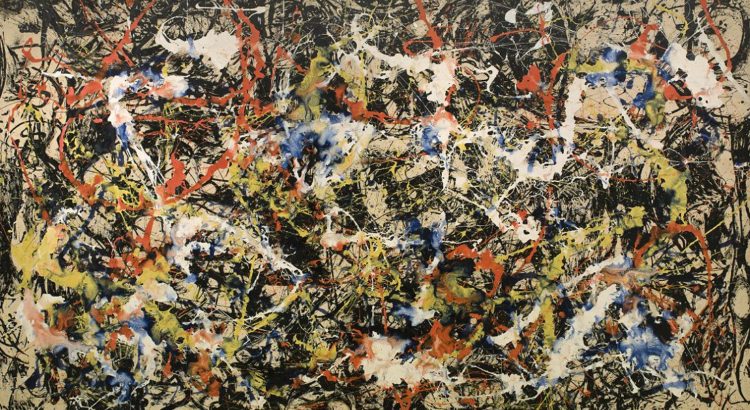
Abstract art gets a lot of biased and unnecessary criticism from popular culture; ask anybody, even people who don’t care or know anything about art, about their thoughts on the abstract art movement and I’m sure they’ll give you a strong opinion that they believe is 100% fact. I’ve had personal experience with these types of people many times, and they always say something to the effect of “this doesn’t make any sense”, or “how is this in a museum, it isn’t even good”, or the worst and most common phrase, “I could’ve made that”. To the last one, put bluntly, obviously you could have, but you didn’t, just like anything else in life. When you see a surgeon perform brain surgery, do you say “oh, I could’ve done that”? Obviously not, because although you hypothetically could have trained and went to school for many years to be able to do that, you didn’t. There is an element of respect involved that abstract artists just don’t seem to get. It has become popular to invalidate abstract artists and dismiss their art for no logical reason, and that’s an absolute shame. I would instead argue that the abstract movement has resulted in some of the most interesting art pieces in recent history, and that the movement as a whole is doing something that has never been done before.

Piet Mondrian
Composition II in Red, Blue, and Yellow – Piet Mondrian, 1929 

When confronted with a piece of abstract art, the impulse is to turn away; it’s unfamiliar, daunting, and complex. In essence, it’s a challenge to the viewer, an attempt to make them work for something, to truly examine what defines art. This is what I love about abstract art: it goes beyond the shallow world of reality and travels into the world of form and feeling. You don’t just examine it like a photograph, in a methodical and information gathering way, but instead must approach it as something new and conceptual, not just seen, but examined thoughtfully. For example, when I first see an abstract painting I often ask myself questions, such as “what do I feel?”, “what colors are being used and how does that define the aesthetic of the piece?”, “what are the subtle undertones of the painting? Is there tension, freedom, chaos, or something else?”. These types of questions often reveal something that I didn’t see right away, and help me understand the piece in my own unique way. That’s the other great side-effect of abstract art: there is no right answer and everybody can interpret it differently. It makes the piece feel personal, like it was made for you, and that relationship with art is something entirely unique.

(Header Image: Convergence, 1952 by Jackson Pollock – Jackson-Pollock.org)