On Finding Time To Create

Within the first week of moving back to campus, I’ve been spending almost all my time with my friends, going to events, settling into my new dorm, doing work for student orgs, or just getting caught up in the day-to-day functions of sleeping, showering, working out, etc. I had forgotten how all-consuming my life in college is compared to the slow, steady work habits I’d developed over the summer at home. More than anything, I was stunned and frustrated when I realized that, after spending two hours tweaking and perfecting my semester’s Google calendar, I would have very little time for my own personal endeavors: for my writing, reading, and all the creative work I love and need to do.

In years past, I’ve completely relinquished my own creative passions and pursued my schooling with a crazed fervor. During the academic year, nothing mattered to me except class, work, and deadlines. I remember waking up at 2 am in high school to study for AP Chemistry (the class bulldozed me, to say the least) and spent my free time creating lessons plans for the Islamic Studies program I worked at. If I did create or consume, it was just either therapeutic or for a class– not real, substantial work that tested the limits of my imagination. But coming to Michigan has made me realize that though this academic religiousness is certainly well-intentioned, it cannot possibly be an end in itself. I have to take what I’ve learned and do something with it, to create, to live– for various people, this can mean different things, but for me, it means to write.

But there’s a problem. I have no time to write. Between classes and evening e-board meetings and hitting the gym and hanging out with friends and studying, there is very little left in my schedule that I can truly say belongs to me. How do I find time to create in this busy, big, bustling world? I am reading Aristotle, Dickinson, the earliest greatest novels and the works of contemporary geniuses, scouring textbooks and poetry alike– but where do I find myself? Where am I in this cosmic narrative? How do I write myself in?

I’ve been obsessing over this question. How do I write myself in. Surely, I can’t do this year what I’ve always done, which was to sell myself away during the school year and win myself back for creative pursuits in the summer. I can’t expect to be a good writer and write only three out of twelve months in the year. More than anything, I don’t want to mindlessly drift through my life, desperately trying to find my last bit of control and individuality that has been buried beneath my other commitments.

So I looked at my calendar. Then I looked at it again. And again (I’m still looking at it now, in fact). I think I’ll try to sneak an hour or two of work before I leave for class in the morning, and maybe thirty minutes of reading before I go to bed at night. It’s not the perfect plan, but I think that it’s possible.

Passions, I think, are not possessed by rare and ingenious people. People are not born with passion. We create it. We nurture it, like a small child, or a plant, or any other living, breathing thing; it needs care, it needs to be protected, and it needs to be given space and time. We all care about things. But how much? That’s what separates a creator from a consumer. It’s not our talent or our passions that matter. It was never about that. It’s how much we’re willing to fight for them.

And if fighting means making a little bit more time on my Google calendar before and after bed, then so be it. I guess I’m on the battlefield. Bring it on.

Who was Claude Cahun?

 (Self Portrait, 1928)

In my art & design theory/history classes this semester, we came across the artist Claude Cahun–and I think that her story was too cool not to share. A Jewish French artist, Lucy Schwob adopted the androgynous name Claude Cahun, and produced prolific work exploring gender and beauty throughout her lifetime. She took hundreds of self portraits, donning different guises, and also created numerous literary works.

She also famously collaborated with Suzanne Malherbe, AKA Marcel Moore, to create art that broke the boundaries of aesthetic and societal normality. Cahun and Moore were involved in a lesbian relationship which they hid from the public (even though their parents married, making them stepsisters).

Amazingly, Cahun and Moore escaped to the Isle of Jersey right on the cusp of World War II and became a force to be reckoned with. They responded to the German invasion by launching a fierce anti-Nazi resistance movement, distributing flyers, translating messages, and even putting on costumes around the island. The women were sentenced to death, but were freed in 1945 after Jersey’s liberation. I found it admirable that the couple were willing to put their lives in danger in order to follow their beliefs and fight for what they believed was right. True martyrs, Claude Cahun and Marcel Moore will be remembered for their astonishing bravery and artistic genius.

Gardening in the City

It is becoming more and more popular for people to be growing their own food, or at least part of their food.  Many people have small gardens in their yard that they will grow tomatoes and other vegetables that they can put into their meals.  For people in larger cities this is a challenge because they do not have the outdoor space to plant a garden. People in larger cities are becoming creative in the way that they can plant things, even with their limited resources.

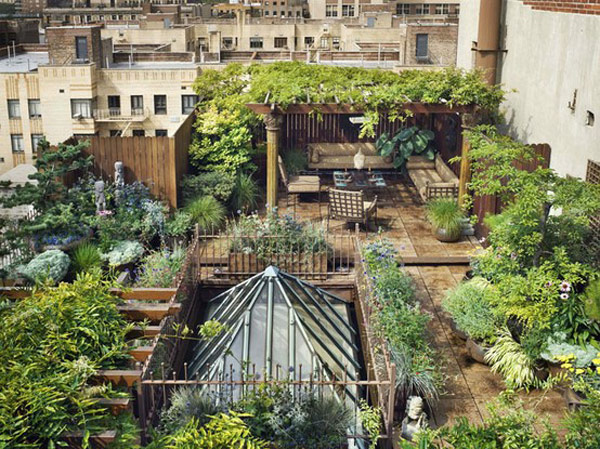
Several new trends has started in some bigger cities that don’t offer much grass and land to garden in, like New York City.  One is rooftop gardening. Most people are familiar with this concept from seeing it on TV shows and movies if nothing else. This idea utilizes the space that is available in bigger cities with lots of buildings and not much grass or open area.  It is also a great spot for a garden because of all the natural light that rooftops get. Some rooftops are also used as a community leisure area, with tables, chairs, and a grill for the residents of the building to go up there and enjoy themselves.  These rooftops are an alternative to a backyard.

Some other cities, like Ann Arbor, utilize community gardens.  Community gardens are spaces with lots of land that anyone can come and plant food or flowers in and they can continue to visit the spot to water them and let them grow.  Some, like the one in Ann Arbor, are sectioned off by the type of plant to keep the area organized. Community gardens are used in areas that don’t have a lot of grass in the city but the roofs aren’t built to have people utilize them.  For example; Ann Arbor utilizes a community garden because the houses on campus and downtown have little to no yard, and even if they did most yards are not suitable for gardening. So the community garden is a great place to go and make the garden that they can not have at home.

Hidden Gems


As a movie buff, of course I love all of the big classic films.  I’ve seen Forrest Gump, Shawshank Redemption, and Pulp Fiction countless times, and I watch Raiders of the Lost Arc at what seems to be just about every family gathering.  While huge movies like these have been proven great time and time again, there is something wonderful about finding little unheard-of gems that you stumble across and end up being absolutely incredible.  With movies like this, it can usually be really hit or miss, so when you find a great one, it is extremely satisfying.  So without further ado, here are some movies you most likely haven’t heard of, but you simply must watch.


Columbus, 2017 

This is one movie I hadn’t heard anything about until it popped up on my Hulu.  Upon watching it I was extremely surprised that I hadn’t heard more about it, since it was one of the most original movies I had seen in a while.  It is about a Korean-American, middle aged man and a 20-something woman who find each other and basically explore architecture throughout Columbus, Ohio.  The girl is an architecture fanatic and the man is an uninterested son of a famous architect.  My favorite part of this movie gave me a really new outlook on architecture due to how the characters find beauty in even the most simple buildings.  This movie is visually stunning and has such unique character relationships.


Hunt for the Wilderpeople, 2016

One reason you probably haven’t heard about this movie is that it is quite literally from the other side of the world: New Zealand.  It was directed by Taika Waititi, who I fell in love with from Flight of the Conchords, but is probably best known for directing Thor: Ragnorok.  This movie is about an troubled orphan boy who is adopted by an older couple.  The wife dies and an adventure ensues with the man and the little boy.  It is a quirky and hilarious film, with a lot of heart.  Plus, there is literally no better accent out there than New Zealand in my personal opinion.


Brigsby Bear , 2017

In an industry in which we are seeing so many remakes and repeats, a movie as original as Brigsby Bear is a true rarity.  This film is hard to describe without giving a lot away but here is my attempt:  a man who was kidnapped as a baby is ripped out of the only world he knows and brought back to his real family.  We watch as he tries to adjust to the real world and understand how to interact with other people.  With no idea what to do with his life, he decides to try to finish making his favorite canceled TV show by himself, a show called “Brigsby Bear”.  It stars SNL’s Kyle Mooney (my personal favorite cast member at the moment), so of course it is extremely funny, but it is so heartwarming too, especially if you are an aspiring film maker.


Wind River, 2017

I saw this movie in theaters, and went in knowing very little about it.  Sufficed to say I was quite surprised that it wasn’t making its circuits during award season, since I found it to be one of my favorite films of the year.  It follows a male wildlife officer and a female FBI agent as they investigate the murder of an 18 year old girl on a Native American reservation.  This film is a beautifully crafted mystery with the backdrop of snowy Wyoming.  The story is extremely heartbreaking, due to how honest it is, and the reality it explores of how the native people are so very overlooked in this country.  Overall it is powerful and tells a message that needs to be heard.

Foundation Year in Review

As my first year at Michigan comes to a close, I am bittersweet about leaving for the summer. Of course I’m excited to go back home, but I’ve made so many great friends and memories over the past eight months here that I’m hesitant to leave.

As a freshman dual degree candidate, I chose to take my foundation year at Stamps. Every freshman, around 180 or so, takes three specific studios and a supplemental art history/theory course each semester. Although I had to work with mediums with which I was very unfamiliar, I believe I learned so much surrounded by diverse peers and great teachers.

For example, my interest in art for social justice has deepened. I have loved graphic design since early high school, and my interest has only grown. Yet now I realize the possibilities for responsible design, and design to effect social change. In Art and Design in Context and Art and Design History, I was exposed to a lot of contemporary art and the social/historical/political contexts relevant to significant artists, which made me more motivated to make my own work.

I have also gained valuable experience with different techniques and styles of art. 3D (sculpture/tactile projects) and 4D (audio/video) in particular were whole new worlds to me. At times, I felt completely inexperienced compared to my peers, but I believe that the challenge made me a better artist, who can express creativity and refine ideas to come up with a better final piece. Now I am looking forward to exploring more, whether that means delving into video and photography, or participating in performance art, or learning about UI/UX design. These explorations can lead to even bigger ideas, that are both visually appealing and progressive in some way.

What’s important is the meaning that art has for you as an artist. You can choose what to address, and what to show within your own art. Whether that is to counter harmful stereotypes, push for social progress, or just capture beauty, art is truly democratic in the sense that it is open to everyone and can consist of nearly everything. I’m beyond excited to continue my creative journey at Michigan and beyond.

Summer!

With summer only two weeks away, there are so many things to think about.  Will you go back home? Where will you find a job/internship? And most importantly: What snacks will you eat?!  A new and fun trend is to eat fun, colorful, and healthy popsicles. Here is a list of some to try out this summer.

You can make a popsicle with just about anything.  A yogurt, granola, and honey popsicle is great for a hot morning or just a snack.  You can also add fruit to it, whatever you like in your yogurt. This is a great recipe that has a little crunch to it.  A pineapple pink lemonade popsicle is made with only pineapple

chunks, pink lemonade mix, and water. It’s a refreshing twist on lemonade for the hot summer.  A creative popsicle is a chai tea ice cream pop. This popsicle has an ombre look and the flavor of chai tea. It’s a great tea substitute for the hot summer days.  Rhubarb and elderflower ice popsicles are a different and fun popsicle to try. It is very easy to make with only having to use fruit and natural fruit juices. It is also a very pretty popsicle, if you add food coloring to make a very pretty shade of pink.  A fun, but not so healthy popsicle, is a chocolate popsicle. This can easily be made by freezing chocolate pudding. It’s great for a sweet treat during the hot summer months. Another frozen sweet treat is a chocolate covered peanut butter popsicle. It is exactly what it sounds like, and another great thing to eat when you need something sweet.  A different popsicle to try is a jello popsicle. This is very simple, you make jello and then put in the freezer. It is a fun and different way to eat your jello this summer.

Fruit popsicles are also very popular this summer.  A grapefruit popsicle is a refreshing and healthy popsicle to try this summer.  It is made with just grapefruit juice, lemonade, and a slice of grapefruit. This recipe is pretty to look at and tastes great.  Another fruity popsicle is a hibiscus and minty watermelon popsicle. This sounds very fancy, and very delicious. This is also a healthy popsicle to try.  Raspberry-mango popsicles are pretty to look at and a great combo of fruit. They are made with only raspberries, mangos, coconut milk, and honey. Peaches and cream is another great recipe for the summer.  Peaches and cream are abundant in the summertime so it’s fitting to put them in a popsicle together. A simpler popsicle is a strawberry popsicle. This is great to cool off with, and to make it a little more exciting you can dip the end in chocolate and put it back in the freezer.  Now you have frozen chocolate covered strawberries.