
You know the way your personality can be predicted based on the type of music or clothes you naturally gravitate towards? Well it is the same with the types of buildings or interior design you naturally want to stay in.
It is said that if you prefer lighter colors, you are more likely to be a calm and collected person who takes great pains to be organized and neat. Whereas, if you prefer more intense colors, you are more likely to make plans more hastily, and be extroverted. Do you think these claims are true? Share your thoughts!
Category: Uncategorized
Suicide Alley – The Incal
How do you start a story that takes place in a world as strange as the one found in The Incal? Answer: you toss your protagonist down Suicide Alley; a locale m
ore vertical than horizontal; a place where your face meets an acid lake, not concrete. Of course John Difool, the class “R” Licensed Private Investigator, is fully aware of what kind of place Suicide Alley is. But we don’t.
Any story that delves into a world via some tunnel, vertical, horizontal, diagonal, what have you, harks immediate comparison to Carroll’s famed work. Unlike Alice however, John never lands, but is caught by his pursuers just before plunging into an acid bath; his fall is not made alone; there are spectators, watching, some eventually joining; the plunge into this world is incomplete yet complete, and more importantly, it is oddly shared by the numerous fictional characters surrounding the rather interruptive action. But this interruption, what others perceive to be just another namesake suicide of the Alley, is as mundane as the narration accompanying the images of falling bodies, white birds, and the tubular urban hub encompassing the endangered Difool. “His fatal plunge down Suicide Alley triggers the usual wave of suicides,” the narrator notes. It’s all expected.
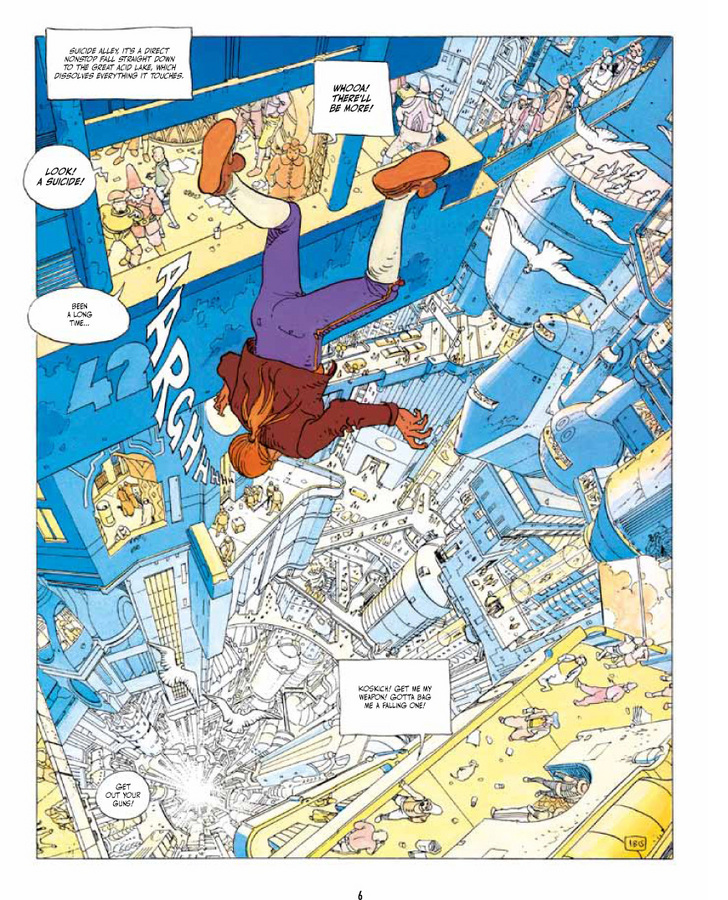 For once we don’t need to journey into Wonderland – the rabbit hole already surrounds us. It very much feels like the anti-rabbit hole, a jab, a jocular implementation of audience expectancy so keenly reflected by the near death and subsequent sparing endured by Difool. If anything, that model only repeats itself throughout the comic, as Jodorowsky and Moebius let us fall and get caught in false-safety-nets as if the fall is eternal. We are treated like ragdolls like Difool, tossed down the Alley and not spared the acid pool unlike the suicides plunging after Difool. Reading The Incal, you are taken for a ride.
Try the Eggs Benedict If You Want To
In undergrad, it’s about time that you start narrowing in on a major that will determine the rest of your life. Now is the time when you decide which direction you want to go. If you take x class, it will look good on z application and help you get into y school. If you waste anytime, you’ll fall behind your colleagues and lessen your chances of succeeding in that field. The sooner you decide the better. Talk to this person to network for this job. Get a paid internship, but also volunteer, stay healthy and fit, make friends, be home for your family, be in class for your grades…
This is the overwhelming expectation for college students.
Back up to that first sentence. How are we supposed to know what we want to do for the rest of our life when we can’t decide simplest things in life, like what we want to eat for breakfast? At Angelo’s, we change our minds on what we want to eat for breakfast moments before we order our food, even after it’s in front of us. We will be hungry for breakfast tomorrow so why does it matter what we eat now? We exchange opinions, randomly select through “eeny, meeny, miny, moe”, take table surveys…all to decide what to order. Even if there is a general consensus, we still might change our minds.
Some of you are lucky enough to have a favorite menu item on which you set our minds even before you know you are going to Angelo’s. Not once have you ordered another meal or merely given a glance at the rest of the menu. You order the same reuben every single time because it’s good and you like it. Easy…like choosing a career. Some kids have grown up knowing what they wanted to do, and they follow the plan with unwavering confidence. They may have tried other things they did not fancy. Maybe they are content staying in their comfort zone. That is perfectly okay. However, a problem arises when you block out the potential options or even worse, you neglect your desire to explore out of fear.
Why are you afraid?
Something was once concrete, certain, and so close to real. You labored over the planning to reach an endpoint and fulfill a reason. The moment you change your mind, all that planning seems worthless….is it really worthless?
Let’s go back to Angelo’s. One day, you finally open the menu. You decide to try the salmon eggs benedict. Turns out, the salmon eggs benedict is the greatest food you have ever tasted. Instead of just knowing how the reuben tastes, you now also know how the salmon eggs benedict tastes. Think of the different samplings as insight to other walks of life. If you decide you don’t want to go to law school, there is no force holding you back from following what you really want to do other than your own dogged determination. How do you overcome that stubbornness? OPEN THE FREAKING MENU.
So again, I question: “We will be hungry for breakfast tomorrow, so why does it matter what we eat now?” No matter what you eat at Angelo’s, your stomach will be full, and the hunger will be satisfied, but did you enjoy your experience at Angelo’s? Like the hunger, the stress of selecting a career will pass. What matters, were you satisfied with your time spent as you worked towards a career? When you can answer yes, this is when you know you will go back to Angelo’s…and when you have found your career.
Book Review – Here
…Wow.
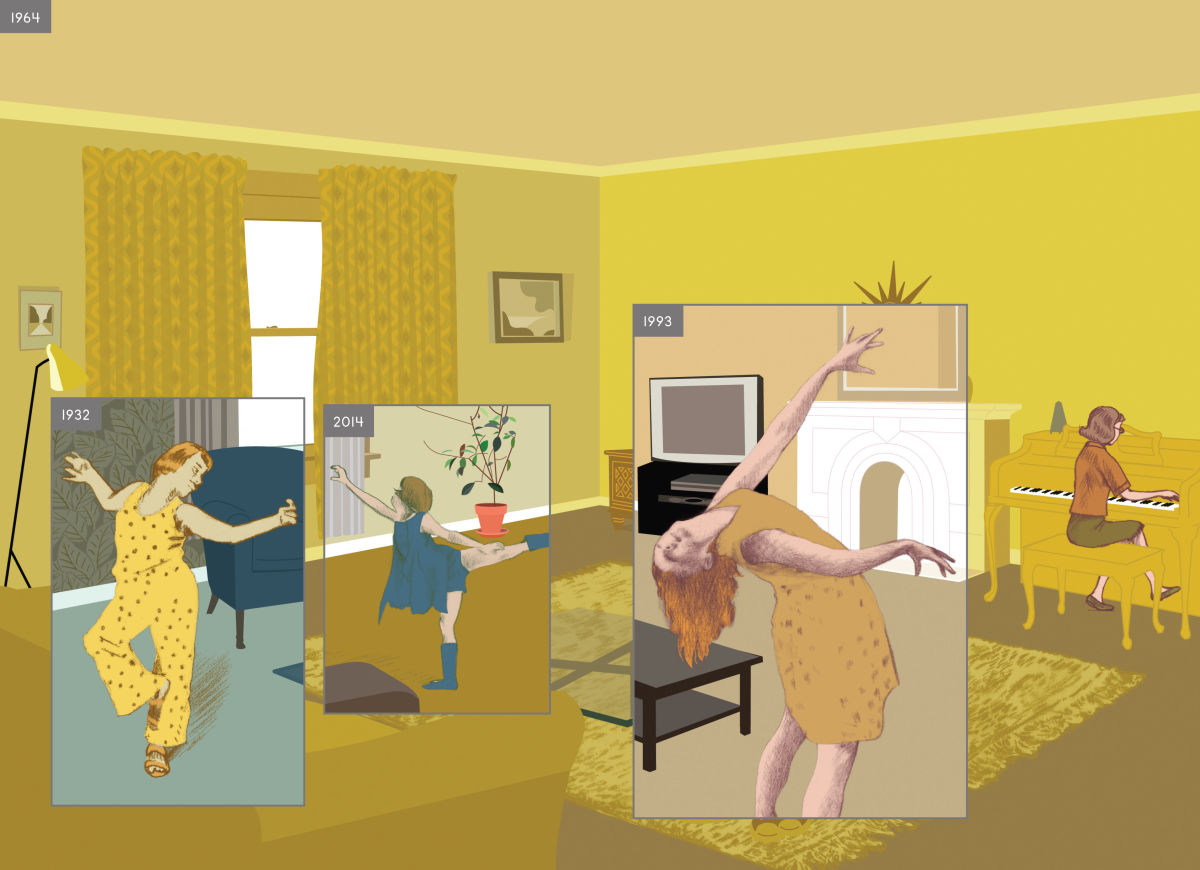
I don’t even know how to begin with this book, so I’ll start by copying the description on the inside cover, to give you an idea of what it is if you’re reading this review: “the story of a corner of a room and of the events that have occurred in that space over the course of hundreds of thousands of years.” So it’s basically as if someone plopped down a camera in one specific spot billions of years ago, and that camera took pictures of the same space for billions of years, past present day, thousands of years into the future. Here gives you a random assortment of those pictures (drawn, of course—this is a comic, I suppose, or maybe a graphic novel, though it’s all semantics) in non-chronological order. There’s no story, really.
And there are no main characters. Dialogue is very sparse, and most of the time we’re dropped into the middle of a conversation that we have no context for. We don’t get to know any characters, and because of the extremely disjointed, non-narrative nature of the story, it’s hard to even know who people are in relation to one another. If you mapped every panel out chronologically, studied the characters’ appearances, and made some inferences, you could probably get a good idea how many different people have lived in the house, and when they moved, and when they moved furniture around, but it’s difficult.
It’s easy to see what kind of fun can be had from a book like this one. It makes you wonder what your own house looked like decades before you moved there. It makes you wonder what it’ll look like after you move out. It makes you imagine your house being built in the first place, and it makes you imagine a time when your house won’t exist anymore—because it’ll be ravaged by something, whether it’s a flood, a fire, a renovation, or just the gradual passage of time. Eventually, humans won’t be here anymore, and your house won’t be, either.
So that’s a pretty strong conceit to begin with, but it could get a little old. It’s possible that you could figure out the format of the book and get the essential themes in the first quarter or so, and your eyes could start to glaze over as you realize it’s pretty much the same thing for the rest of the book.
I think there are a few things that saved this book from redundancy for me. First, there are sprinkles of narrative throughout, sort of little micro-stories embedded in the book. There’s the old couple in 1986 telling the story of how they met. There’s a futuristic hologram woman in 2213 teaching a group of students (or tourists?) about when humans used to rely on primitive technology like wristwatches, wallets, and keys. There’s a man in 2005 taking care of his father. There’s the house itself being built in 1907. There’s the man painting a woman during a picnic in 1870. These mini-narratives keep it from feeling too repetitive.
But even though it’s easy to get stuck in the rhythm of just flying through the book, briefly glancing at each page, getting the gist, and moving on, stopping and really absorbing it pays off. There are so many unspeakably beautiful things contained in here. There are stretches where the disjointed panels get more and more crowded on each page, all from different time periods, and it feels like time is speeding up, like there’s a symphony going on around you and it’s crescendoing and beginning to deafen you. There are so many moments throughout the book where I felt overwhelmed, like I was coming to some sort of epiphany, where I felt all the walls of spacetime closing in around me. It makes you feel insignificant, like one impermanent blip in the greater scheme of things, but it’s also weirdly life-affirming somehow, in ways I can’t explain.
It makes you feel a lot of things. You feel curious; you want to get to know these characters, even though you never will. There are moments when you see the Earth as it was before humans, millions or billions of years ago, and you feel profoundly isolated, profoundly alone. Same goes for some of the panels set in the future. There are moments that are, intentionally or not, horrifying. The book feels like it was written by God, by an omnipotent figure who’s capturing these images throughout the history of the Earth, and it feels like you’ve accidentally stumbled into his office and seen his work. It’s a deeply disconcerting feeling—it almost feels like a horror movie, in a weird, indescribable way.
I remember a quote from Drew McWeeny’s review of The Witch: “Eggers manages to create a sense of mood and dread that is so suffocating at times that it feels like we’re watching something genuinely transgressive, something we should not be seeing.” Most people might not have that same reaction to Here, but occasionally I felt that way: disturbed, like I was being shown something beyond humans, something that I wasn’t equipped to process either intellectually or emotionally. It reminded me a little of watching Under the Skin, or the last act of 2001: A Space Odyssey.
And it’s strange, because this is a story with no characters, no consistent thing worth getting emotionally invested in—you could say ‘the space is a character,’ but that doesn’t describe it quite well, either, because it’s not sentient or anthropomorphized, and it changes forms so drastically. There’s nothing specifically emotional in the book, really; some might say that it’s a thought-provoking intellectual exercise, but a primarily clinical one. You’re not going to cry because a character dies, or because you’re really rooting for a romantic pairing. And yet there are moments reading this book where I found myself shivering, and there are moments when I thought I was going to tear up.
There’s too much I want to say here, and I could keep writing thousands of words and still not describe every thought-provoking image I encountered here, every connection I drew, every deeper thought I had. All I can say now is that you should read it.
A Clothes Look At Style

Glance at your closet and look at the kinds of clothes and accessories you own. Then, think of five adjectives that best describe your whole wardrobe. Next, think of five adjectives that fully describe yourself and your personality. Now, compare both groups of words. According to Rachel Zoe, “fashion is a way to say who you are without having to speak,” so it should not surprise you if you repeated any words between the two groups I had you brainstorm. With her simple quote, Zoe sends a powerful message to society. Although she is explicitly talking about your physical appearance with fashion, she is actually alluding to the way clothes make you feel about yourself and the way you present yourself to your peers. Generally speaking, when you wear clothes in public (whether it be with that guy you wanted to impress, or to office hours with your professor), you think of how comfortable your clothes feel, how your clothes interacts with your curves, and how you think your peers will perceive you. Funnily, whenever you choose your outfit for the day, you think of all of these things but forget that clothes have the power to speak to people just as loudly as the words you say. The next time you go to an interview, yes, totally be yourself, but be clever about it. Choose something comfortable that sends the vibes that you want your interviewer to feel, but also make sure that you are still recognizable in the end. It would be amusing if you were totally “off of your fashion game” once you accepted the position after the successful interview, but came to work as a seemingly totally different person because your style at the interview was so unlike your typical, everyday wardrobe. It is important to have success at interviews, but it is more important to be accepted for your capabilities and personality.
image source: https://goo.gl/images/te4dOZ
Sleeping Inside a Banksy
I would hesitate to call Banksy’s art subtle at least in regards to his larger installations like Dismaland, and most recently, the Walled Off Hotel that sits at the barrier separating Israel and Palestine. Like I said, subtlety is not the word that comes to mind. This isn’t to suggest that the work isn’t effective, as the Hotel will undoubtedly (for it already has) generate a lot of controversy and rather generative discussion. The sheer directness and ambitious scale are bountiful reminders that Banksy is well aware of what he is doing.
Of course this isn’t the first large installation he has done either. His Dismaland, a dystopian amusement park was closed in 2015.
But regardless of the buzz that Banksy generates, from his street art to these installations or varying degrees of performance art, I have to wonder about the effectiveness of, specifically, the medium of installation art.
A great deal of my struggle to fully invest myself in installation art revolves around the inevitable pitfall of labeling something as just that. Although one of the points of interest in art like the Walled Off Hotel is that you can quite literally sleep in art, to me calling it so is a double-edged sword because calling something art makes it feel somewhat distant or at least off on some form of tangential, yet parallel, world. The world it lies parallel to, I don’t wish to call it reality, is sort of our unconscious goings-about – a world where we don’t really scrutinize or really think about. The world of art on the other hand asks the audience to put their thinking caps on. It feels so separated.
To word it differently, perhaps what I most fear about installation art, or other artistic endeavors that you may find on those art blogs that accumulate various cute little paintings or inventive crafting, is that for most people, it may all just come across as novelties with little to no lasting effect.
Yes we can literally sleep in art, but when couldn’t we? We already did, but doing it in so direct a manner probably calls our attention to our unconscious everyday-activities. But I genuinely believe most people forget about that moment. Instead they regress to their default settings.
I know this sounds like some rambling of hopelessness, but I think it is key to remember that Banksy is definitely not doing this for everyone. No artist would hold the unreasonable dream of creating content that everyone likes. Regardless, I have to question the effectiveness of installation art when we so often return to a default setting after what is objectively a perceptively jarring experience. But perhaps that is why it is so effective – because it shows how most people cannot remain in an exposed world generated by the parallel world of art. Even a hotel is incredibly ephemeral. A weird dream.
