Rise of the Action Heroine

I love action movies. I can talk about Fellini and Godard, I can admire French new wave, and I certainly do love the auteur golden age of cinema – but whether steered by a gangster, superhero or cop, I’m always drawn to a good action movie vehicle. I discovered the silly, fantastic trinity of Die Hard, Speed, and The Matrix when I was making daily trips to the neighborhood blockbuster at the age of 10, and quickly fell in love with the concise sweep of the well-executed action movie. “What’s a good action movie?” I would ask my parents as I trolled the action aisle at our (dearly departed) neighborhood Blockbuster, and they suggested in turn James Bond, Indiana Jones, Miller’s Crossing, The Untouchables, The Usual Suspects, and The Bourne Identity. My sister and I would get sugary snacks and watch and rewatch the X-men series, while I would drag my friends to see the new Spiderman movie the day it was released.

And I haven’t grown out of it. The new Star Trek movie was fantastic (though the sequel was slightly disappointing), I followed the Bourne trilogy to its end, and though I’m getting fatigued of superheroes I still watched every Batman, and have kept up to date on the (increasingly tiresome, but still mostly fun) Marvel hegemon. My sister moons over the Grand Budapest Hotel release, but I’m already excited for the new Guardians of the Galaxy in August.

But in order to love action movies, I’ve had to accept that I’m never going to see myself represented in them. I don’t expect to see compelling, non-idiotic female leads – and I do expect to see women treated as rewards, as plot devices and romantic pawns, and generally created as undeveloped, flat characters. With the entire Hollywood movie industry generally characterized as men making films for men – with women only holding 18% of behind the camera roles, and many films failing to feature enough women to pass the simple Bechdel test – it might seem unsurprising that the most testosterone-fueled of the movie genres is short on female leads. It could be argued that we should focus our attention on incorporating women as complex characters in more dramas and comedies, and surrender the action movie to male domination – but I disagree. We need more female action heroes.

The action genre may be generally simple, but it’s a kind of simplicity that can be indicative of broad social and cultural norms. The form of the archetypal  ‘bad guy’ has always told us a lot about the western mindset, as he evolved from a Russian-accented evil mastermind during the Cold War to a modern ideologically motivated and often vaguely middle-eastern terrorist (or, reflecting our modern fears, even a natural disaster or post-apocalyptic baddie). And while the action movie villain reflects what we’re currently afraid of, the hero reflects what we aspire to be, and what we trust to conquer our fears. When these heroes are all men, it damages our perception of what’s possible. I certainly don’t look to action movies to tell me what I can and can’t do – if I did I’d have pretty warped perceptions of physics and gun safety – but I can’t help but look at blockbuster movies as major cultural signals, as indicators that the cultural monolith affirms or denies my ability to be a ‘hero.’ Lupita Nyong’o’s recently spoke about this kind of cultural affirmation in her moving ‘Black Women In Hollywood’ acceptance speech, explaining how the international success of dark-skinned model Alex Wek helped her to embrace her own dark complexion as beautiful. The fashion world’s embrace of Wek was an important signal to Nyong’o, a cultural affirmation of non-white beauty. In action movies, we need signals affirming non-male strength and power, not only because female leads will affirm our own strength and give us female role models, but because movies will be better for it. Even the most fantastic scenario or the most ridiculously costumed hero must in some way be analogous to the consumer’s life, and when more than half of movie-consumers are female, it pays – both artistically and literally – to make these analogies align to the lives of women.

And these roles are out there. La Femme Nikita, Luc Besson’s post Professional movie about a female spy, was the first action movie with a female lead that I remember watching. Though Nikita might be a druggy psychopath at the beginning of the movie, I loved the development of her secret agent skills, her sexual authority, and especially the idea that a woman being dragged off to die would scream her own name. Kill Bill, True Grit and Alien all come to mind as past examples, but it may be the enormous success of the Jennifer Lawrence driven Hunger Games series that ultimately marks a turning point in Hollywood’s relationship with female action leads. With The Hunger Games proving that women and men will turn out, in droves, to see a female kick ass, the movie industry would be foolish not to capitalize on this broken ground and make more non-chick-flick roles for women.

I still love a lot of movies that ignore women. It’s hard not to, since some of the best movies do. But I also recognize how I’m culturally minimized by the industry. So while the otherwise-excellent True Detective series may have been meta-criticizing its leads’ relationships with women, making some kind of easily ignored point that ignoring women leads to death and destruction, at this point I’m so exhausted with shows that use similar scenery – the fetishized, ritualized murder of women – without engaging female perspectives that I’m not really listening anymore. It’s the same fatigued, misogynistic landscape that women have been bored by for centuries. If you want to get our attention, make roles that recognize us – as paying consumers, and as capable humans.
 

Death of the Artist

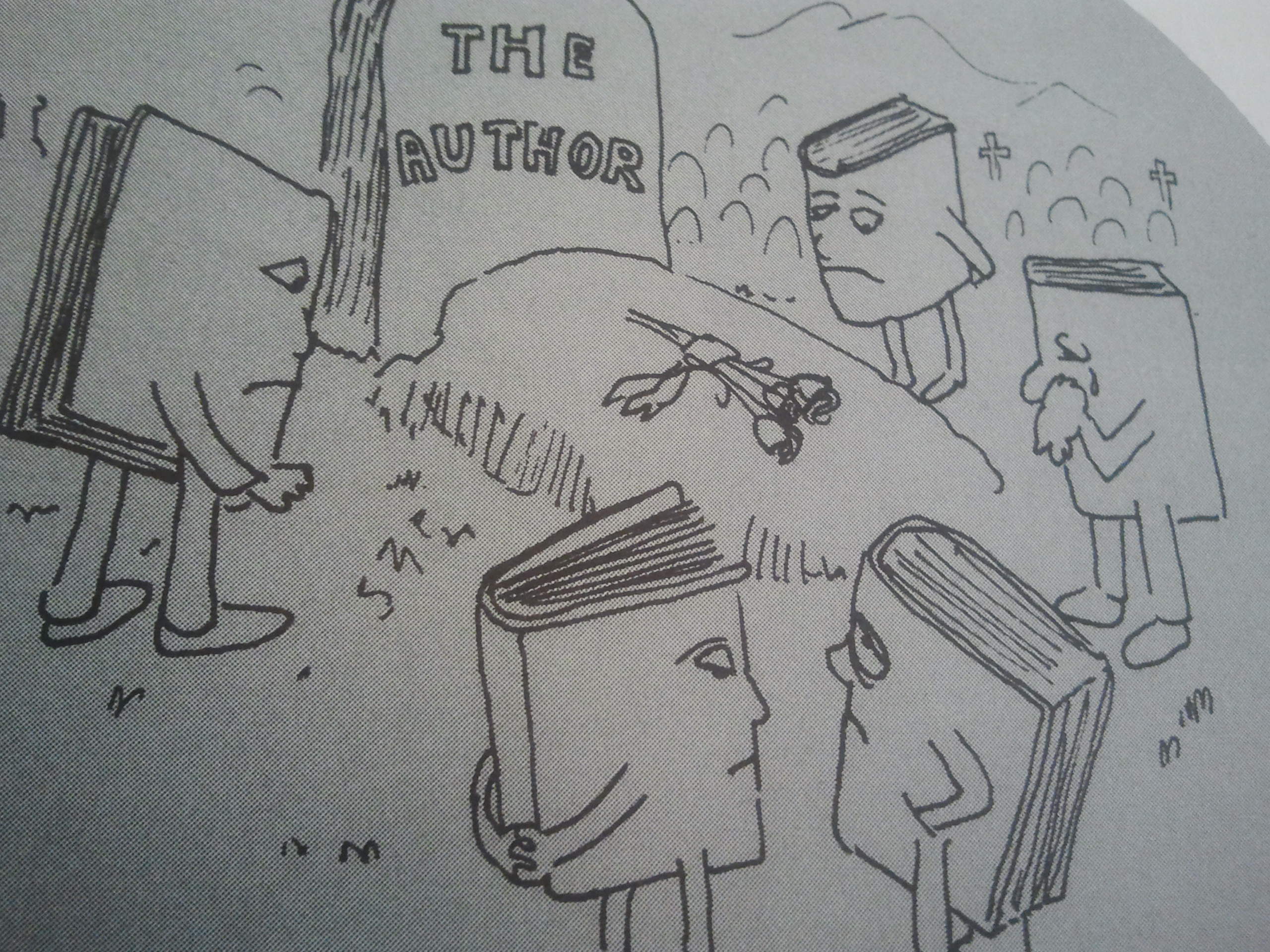
Cartoon by Donald D Palmer 1997

I’ve recently been giving a lot of thought to an essay I read during my freshman year at New York University entitled “The Death of the Author” by Roland Barthes. The gist of the article is that “to give a text an Author is to impose a limit on that text, to furnish it with a final signified, to close the writing.” At first, I disagreed that any piece of writing or art could be considered without an understanding of the author’s intentions, but as I continue my journey in the world of art and writing, my views are beginning to line up with the idea of a self-governed piece of writing. Once the character is on the page, it is she/he who is doing the thinking, acting, developing, not the author. Once the painter frames his work, it is no longer his, but an autonomous presence inviting the world to engage with it in diverse ways. An example of this is the art of Jackson Pollock.

Jackson Pollock “Autumn Rhythm” 1950

As with any artist, there is an unquestionable amount of control exerted as a means to facilitate the art. However, Pollock invites a certain amount of chance into his works by using methods such as splattering and dripping paint onto the canvas. As soon as the paint is released from his brush, stick, or can, it has a life of its own and flies to the canvas without any certainty where it will land or how it will splash. This is a very literal example of the larger point, but recognizing the autonomy of any work is crucial to understanding it. The world of the painting, the musical composition, the work of literature, or any  other completed work offers an escape into the fantastical for anyone willing to engage with the piece and allow it to take them where it will. Much of art criticism and review comes back to this. In the end, it is just people talking about how they engage with art. The author or artist’s intention is only as important as you make it, it doesn’t have to taint the way the work speaks to you. When I was much younger, my school would take us on field trips to hear the local symphony orchestra. While they played, I would make up stories in my head to the tune of whatever song was playing. I can almost guarantee that the composers and the musicians were not imagining their piece playing out to my juvenile narratives, but that doesn’t mean that my connection to the piece is not just as valid as say Stravinsky’s vision in composing The Rite of Spring (though undoubtedly less complex or sexually charged).

I used to be so intimidated by art, fearful to develop an incorrect understanding of it when facing it down without the artist or a scholar guiding me, but thanks to my return to Barthes, I now realize that I am not helpless. By freeing art from the constraints of an artist’s intention, we open ourselves up to a whole new way of engaging with all of the art around us. In Barthes’ words: “thus is revealed the total existence of writing: a text is made of multiple writings, drawn from many cultures and entering into mutual relations of dialogue, parody, contestation, but there is one place where this multiplicity is focused and that place is the reader, not, as was hitherto said, the author.”

Spontaneous! 4 Days Early

At the beginning of this year, I made the goal to actively learn something everyday. Call it a “New Year’s Resolution,” call it a “goal,” call it an aspiration: to be more self-reflective in the ways I grow and change and develop and (mis)form and queer and . . . and . . . .

I realized a couple days ago that my need/instinct to control everything about my life (planning, organizing, etc.) was getting in the way of me actually living. It got in the way of me interacting with others, myself, and the world. “I learned that I am stuck in a routine from which I cannot currently escape.”

Change it up. Be more spontaneous.

Instead of planning for things a week in advance (and not allowing myself to do activities that happen unexpectedly) I stopped. WHAT?! My Google calendar is still in full force but I have open gaps that I have my “spontaneous time.” If people ask me to do something tomorrow, I actually try to see if I can fit them in or see if I have free time instead of falling back on the usual, “Oh, I need to study,” or worse, “I’m too busy.”

Instead of loathing and meditating and harboring deep angst and anxiety about unexpected changes, I’m taking deep breaths, I’m listening to Jazz, and smelling the new fresh spring smell and moving forward.

Oh! So a snow storm hits and an event you’ve been planning for months at work falls through. Move on, replan, reschedule, breathe.

Oh! So a friend asks you to coffee and you DO have a half hour. Go get coffee.

Oh! So your lover will be in a nearby building and is on break for 15 minutes. Go walk over and say hello and catch up.

Simple things. Simple changes. Simple. Simple. Simple.

Well almost simple. It’s that time of the month (full moon time!) where I set aside reflective time to reevaluate, feel myself and the world, and meditate on living (4 days to go!). And as the cliche goes: all good things come in moderation.

My spontaneity has freed me and, also, stressed me out. It’s important to have balance, and I’m working at it.

A book came to me that I need to write (while reading Virginia Woolf) last week. So I’m going to write it. I’ve never really written prose fiction, but, you know what, now is the time.

And, for me, spontaneity is allowing me to explore, create, and begin my days a new. Something that hasn’t happened for a very long time.

腹芸 & 08|=(_)$<4+!0|\|

As famously explored by Ishmael in Melville’s Moby Dick, we are isolatoes. All creatures are islands, seemingly together and cohesive, but alone in their own skins. We may form chains, like archipelagos, but our individual selves are forever detached from the selves of those around us. We are each are own souls, spiritually separated, and beings that can never truly understand the fullness of another, if even ourselves. The closest connection we have is communication.

The origin, the “commons”, is shared by the subsequent community that is formed. Communication is a set of rules through which we are connected. It is an everyday art that can bond our otherwise untouchable souls. Escaping the human superiority complex, all creatures are capable of some flavor of communication, be it oral, visual, olfactory, or else. The finer aspects of communication lie in fluency, for when users begin to subconsciously understand the intricacies of the art, greater interpersonal relationships can form, bringing isolated bodies together.

The embodiment of this mantra is haragei 腹芸, referred to in Japanese as a rhetoric form that relies on subtle implications. Affected by culture, these communications spread and adapt to circumstance. Rarely enabling a concrete understanding, haragei is a representative form of communication that relies on attitudes and communal feeling. It is unspoken but moving, for it plays on more feelings than specific words. The subtlety is the source of its power, as is often the case for any art form. Haregei may be the most useful art of communication to break the barrier between our souls. Only, of course, if it mutually learned.

The most important aspect of communication lies in the origin of the word–commonality. If the form of communication cannot be used by the community members among which the system was developed, it is useless. From the guttural sounds of animals to languages in which we program computers, the gamut of communicative means relies on structure and group consensus.

While haragei is an innately simple art of conveying thoughts and feelings, obfuscation, 08|=(_)$<4+!0|\| in leetspeak, is the complication of communication. Shifts in common structure. Jargon. Repetitious or repetitive words. VV3!|^o| mechanics. Uncommon expressions. Deviations from commonplace idioms. Obfuscation is the collection of uncommon practices in a language that is designed to mislead unwarranted receivers. When in a group of several islands, obfuscation in communication can be useful for connecting a minority of parties in the group–drawing a bridge of jargon that cannot be understood by the majority.

The disparate results of obfuscation are two-fold. For security purposes in digital environments, obfuscation can aide in encrypted messaging. For highly technical fields, such as medicine, the complicated speak can disguise unappealing information to the rest of the community. However, obfuscation, such as 133+ (leet), can often lead to communicative discrimination without a grander purpose. And when obfuscation is unintentional, poor communication results.

When communication fails, the only connection between our souls is lost. We are isolatoes.

Arcade Fire: Reflektor

This Monday, I was able to head over to the Palace in order to experience Arcade Fire live.
By all means I am not at all a frequent attendee of concerts, however, I was very happy with my decision to go to this energetic performance.

In general, from the predictable concert finale of Wake Up, to the rotating man wearing all mirrors, to the odd break in the performance where they played two Stevie Wonder songs, to Win Butler mocking Wrecking Ball, to the pulsating music throughout the approximately two hour performance, the concert never seemed to really let up in terms of pure fun and energy. It was enjoyable through and through.

The set list was…for those who are curious…

Reflektor
Flashbulb Eyes
Neighborhood #3 (Power Out)
Rebellion
Rococo
The Suburbs
Ready to Start
Neighborhood #1 (Tunnels)
We Exist
Normal Person
Intervention
Keep the Car Running
Haiti
Afterlife
Hey Orpheus
Sprawl II (Mountains Beyond Mountains)
Superstition
Uptight (Everything’s Alright)
Here Comes the Night Time
Wake Up

Here is the music video for Afterlife, a song off of their newest album, Reflektor.

In All Honesty

You know sometimes I think it’s funny. I’m supposed to be this right-brained, creative thinker, stick it to the man type of person. People employed in creative fields are often portrayed as rule breakers, giving the public “groundbreaking” or “daring” things. They do “art for arts sake,” and if no one likes their art who cares because it’s mine. No one can take that away.

And really, I do wish that were me. I wish I could sit back and let people decide what they think, and if what they think is negative, then by gone they’re just wrong and my art is amazing and who cares. But that just isn’t me. That’s never me.

I don’t mind bending the rules a little bit. I don’t mind having new, innovative ideas that some people might consider weird or out there. But getting completely rejected is something I’m not comfortable with. I can’t do my work and say “here it is, whether you like it or not.” I have to have that qualifier, something that tells me that yes people will approve.

But really, it’s my own mind game. I’m my own worst critic, and truthfully, it’s hard for me to say that I’ve ever thought that my art (whether it be performance or my writing) is actually good. I mean I still get uncomfortable when people ask “what have you written?” and I say that I’ve been working off and on a “book” for a little over 3 years. It makes me feel uncomfortable just typing it. I don’t think I deserve to even call my writing a book.

There’s plenty of my writing that I’ve liked. There’s writing that I’ve shared. And there;s writing that I’ve gotten approval on from multiple people.

But unfortunately, I’ve never truly believed them. I smile, nod, say thank you and that it means a lot, because it does. Each type I receive a compliment, I get a little brick in my self-esteem house. It comes along slowly.

But there’s more things working against me than there are working for me. I had to give a presentation today, and I did so much more badly than I could have imagined (and I already knew I’d struggle). And even though that has nothing to do with writing, it’s just a school assignment and I do well in that class normally, I can’t help but to think that if I can’t do one presentation, who am I to think that I can be a writer, that I can be successful and independent when I mess up a simple thing that the rest of my class does fine with.

It’s awful to face, but it’s the bitter truth. My inadequacy can be crippling, and in turn it destroys my self-esteem.

I apologize for the downer, but sometimes being creative comes with harsh realities. The tortured artist might by a silly cliché but the struggles people face are still real.