Death of the Meme

On Thursday night at the Michigan Difference Leadership Event there was a portion of the show dedicated to “dying memes and other cultural phenomena.”

What does this even mean?

It was a montage of Honey Boo Boo–who I luckily avoided on my recent hiatus from tv/internet, the Harlem Shake–aka appropriative white people convulsing to a bastardized song, someone driving a car–sadly not Glozell, Taylor Swift–singing without goats (because that gem will never die), and others. Put to sad music we “mourned” this YouTube video while staring at a screen, in the union, in Ann Arbor: far away from anyone who is connected to these glimpses of “culture.” I felt like I was cheering for a cement wall so I decided to eat more cheese.

But these “cultural” phenomena won’t pass away. There will always be someone getting their own TV show for being “different,” white people will always be awkward and offensive, people will always drive (not me!), Taylor Swift will continue to age but sing for adolescent girls while she simultaneously shames their existence.

Even then, these “2012-2013” memes and videos will live on. Bon Qui Qui and Nyan Cat are still out there, Afrocircus? Still out there. As long as we have Internet we will always have our entertaining distractions.

That’s what fascinates me. Do things ever disappear from the Internet or get destroyed? Or do they stay on the web forever? Will we be able to access these things in years to come? Decades? Centuries?

New forms of art have a lifetime that is infinite and preservable. That awkward vlog you made will outlast you. That offensive tweet I tweeted will stay on twitter till it tweets its dying tweet. My rage toward the world on Facebook will be eternal rage. That’s badass.

So as I write my final papers, study for my last exams, drink pots of coffee, check the weather for NYC (and not Ann Arbor), dress inappropriately for the rain, accidentally leaves bits of clothing everywhere I visit, and eat carrots—that man’s abs I reblog that are “artsy” or that video I favorite will never leave the world. They may leave my vision, or my mind, but they are only a click away.

Mapping the Imaginary

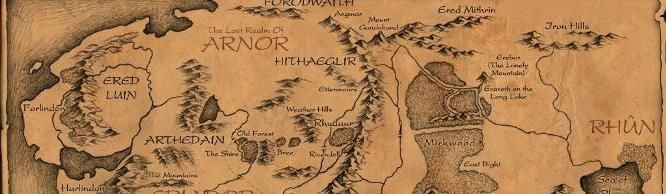
The childhood pursuit of creating fictional worlds never really goes away. The control one has over the geography, and then possibly peopling the landscape, is so very satisfying, so very full of potential. There are few enough constraints (the medium, the mind) to provide opportunities instead of options, but just enough to prevent creating something from scratch from being impossibly daunting. For a period of time when I was younger, drawing maps of imaginary lands could entertain me better than anything else. But free-range map-making does more than entertain; it’s creating, designing, building.

Author David Mitchell speaks to inventing maps as a child: “Those maps, I think, were my protonovels. I was reading Tolkien, and it was the maps as much as the text that floated my boat. What was happening behind these mountains where Frodo and company never went? What about the town along the edge of the sea? What kind of people lived there? The empty spaces required me to turn anthropologist-creator.”

The idea of cartography as a sort of anthropology is an intriguing one. Miscellaneous land-forms sprung out of a blank page are all well and good, but they’re no good just sitting there. Characters are needed to traverse the lands, sail the seas. Worlds are experiential, but everyone experiences differently. So now, in addition to simple geography, you can fill in entire socio-political structures, civilizations and societies and peoples with their various dispositions and various histories. It’s one of the reasons works of fiction and fantasy often have the insides of their covers adorned with maps, I suspect— people and plotlines are tied to geography.

World-building also occurs in other formats, albeit more constrained ones, as in computer-based games with oddslot open formats. While there might be set goals as in any other game (completing tasks, finding objects, defeating enemies), the best part of the game is often building things, constructing your building or town or country. In fact, it might even that it is because of the restrictions the game’s parameters place on the player that makes being able to creatively and effectively build and create things so fulfilling.

Fabricating Fortitude in Geodesic Domes

A question often asked in technical interviews revolves around the shape of manhole covers. Piqued in order to engage one’s manner of thinking, this question can point at the power of circles and the ultrastrong nature of spheres. When there are no corners, no beginning or end, there is no singular point of weakness. The whole, gathered together, is strong. This is the idea behind geodesic domes–our potential homes and workplaces of the future.

But what is a geodesic dome?

This structure, while relatively simplistic, provides a much stronger support system than the majority of rectangular constructions. They contain a series of angled triangles that connect at pivotal points to offer a forcible strength. While they can embody a structure similar to a polyhedron, they represent an almost sphere-like quality similar to the shape of the globe, almost mimicking the skyline of the heavens. While the heyday of domes for residential purposes was back in the 1960s and early 1970s, the popularity of these domes has grown in recent years. With the rise of environmental awareness and the ever-increasing need to feel unique as populations expand, the idea of owning and/or operating out of a geodesic dome becomes appealing. They offer a lot of potential for both personal and communal use.

While using a geodesic dome to build a home is energy efficient, eco-friendly, and easy to build in comparison to a contemporary rectangular construction, the unique appeal of the design can set a residential home apart from its neighbors.  The possibilities for both the interior and exterior expressions with these domes is as limitless as their spherical design. Talk about curb appeal.

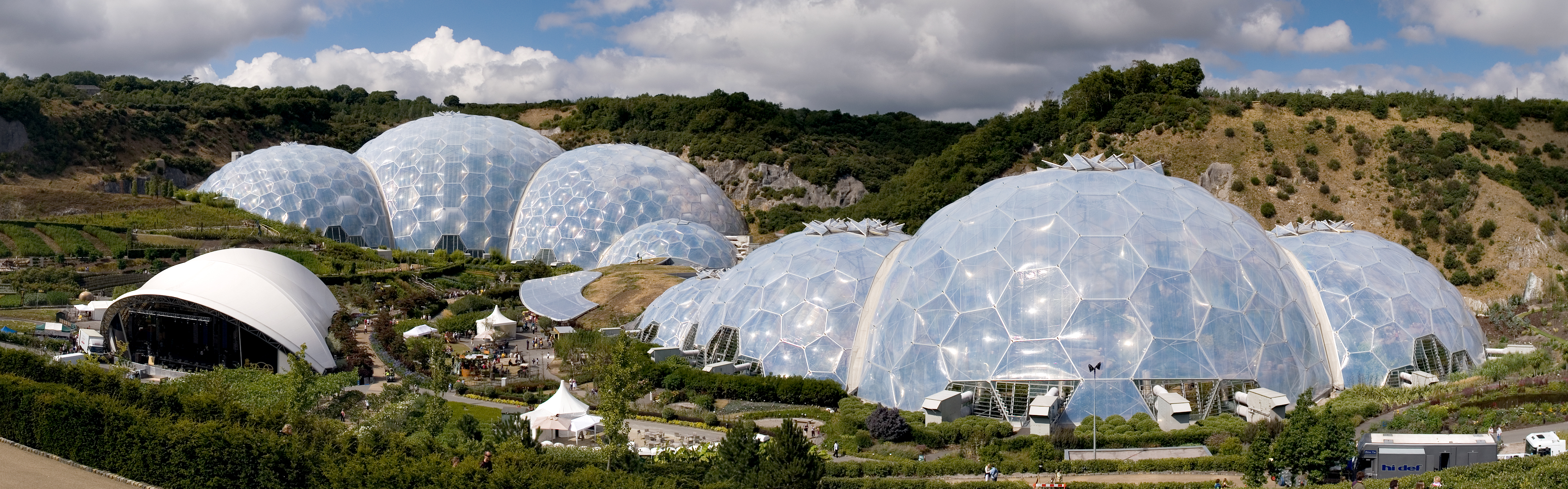
There are also a number of domes used for communal and commercial purposes, from Antarctica to Australia and from China to the United States. Many domes have the capacity to hold many more people than traditional large structures of a box shape. These often are seen from a distance as a landmark and unique specimen to an area. There are several sports complexes, such as the Superior Dome, in Michigan’s Upper Peninsula, as well as botanical gardens and amusement parks (Disney’s Epcot). Entire communities could exist beneath the arch of a geodesic dome, and the idea is quite appealing. There is currently a complex, know as the Eden Project, that contains several large domes that are used as greenhouses for the purpose of containing thousands of floral life from around the globe. Perhaps we like mimicking or field of existence, our planet, on a smaller scale. The future relationship we could foster with these domes will speak volumes about the progression of architecture and man’s consciousness for both the planet and the human race.

Imagine entire cities of geodesic domes.

WHO IS LUTHER BURBANK?

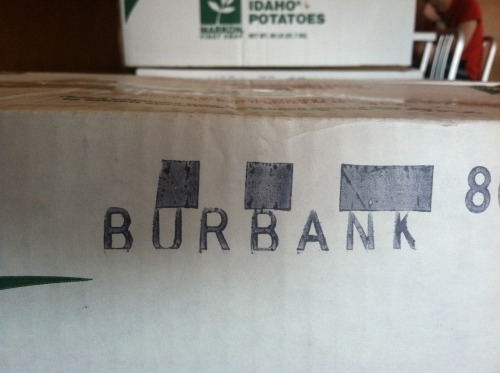
Luther Burbank is a man. He is a picture of a man. He is a picture of a potato that is a man that is Luther Burbank.

I’ve been working on a project for the past semester with two amazing collaborators, Willie Filkowski and Nola Smith. Willie is a redhead and an interarts major. Nola’s hair is black and she is a dance major. Both are incredible thinkers, performers, collaborators, but most importantly, they are incredible people. They have made the weird/frustrating/impossible process of making-a-thing both engaging and very, very fun.

We’ve been working on a show for the past several months that will finally be presented in studio one (in the Walgreen Drama Center) next thursday through friday – April 18th, 19th, and 20th – with support from Basement Arts and arts@Michigan. It’s called WHO IS LUTHER BURBANK? and promises to be something very, very interesting.

WHO IS LUTHER BURBANK? is a piece (a work of dance-theatre? multi-media performance? a play? I’m not quite sure!) that starts with a found text. Nola brought to the group a book, Our Wonder World Vol. X: The Quiz Book, a children’s encyclopedia of sorts that was originally published in 1914. It is a compendium of facts, answers, tricks, riddles, games, histories, conundrums and questions. Questions like, What does a sailor do in his play time? What is tree surgery? What sort of cat is allowed in a library? and, most importantly, Who is Luther Burbank?

This non-sequitorial inquisitive barrage of a book set us on a path that led back to Mr. Burbank himself. We found him to be an inspiration, a mythic figure of history that meant both everything and nothing to us. And that is where our show begins. From there, we expanded to potatoes, to home vocations for girls, to dances, to games, into ourselves, and into the world of Luther B. I hope that you find this interesting, and that you might consider coming out to see it! I promise that it will be a great time.

Just over a week away from the performance, things are looking good. We’ve got some great stuff happening. Plenty of stuff to do, but it’s coming together really nicely! I’ll check back in a week: just a few days before our performance to document some of the tech-week process. Hope to see you there!

Angie Estes Poetry Reading

Do people look most like themselves right before and right after they speak?

This was one of the many things I pondered while attending the Angie Estes poetry reading on Thursday at UMMA.  I attended the reading as part of a requirement for a creating writing course and entered the auditorium expecting half an hour of unrelatable, esoteric verse that had nothing to do with me.  I expected something dramatic, a poetry slam maybe?  I expected someone over-the-top who would speak using words that were way over my head.

However, like recent experiences with opera and modern dance, I was pleasantly surprised at how connected I felt to the poet and her words that somehow managed to penetrate my recalcitrant heart.  Before Estes took to the podium, a speaker introduced her as a poet who attempts to unravel the mystery of words and meaning.  Estes was particularly interested in examining the fact that words by themselves have no meaning.  She also sought to explore and examine the spaces between words, where meaning exists and they do not.

This was an excellent introduction to her verses, which rarely rhymed, but were full of alliteration and homophonic constructions that allowed my mind to flit from each of her utterances to the next.  As she recited her poetry and moved from words that sounded a lot like each other, but created shifts in meaning, I found myself examining the processes of my mind, how I construct meaning, how I follow speakers when the speaker is not me.

Of course, throughout the entire reading, I did my best not to think.  I did my best to relinquish logic and let my mind wander wherever it found meaning.  As I let my thoughts wander and tried to give in the sensory experience of listening to spoken word.  Some weird things happened.  First, I noticed that everytime she uttered a sentence full of alliteration (and sometimes assonance as well) I breathed a sigh of relief.  The similar sounds were definitely pleasing to me and seemed to have a calming effect as well.

Even the tone that she used throughout the reading was evenly modulated and soothing.  She rarely ended her verses in questions, which I found to be especially interesting.  There were no questions in her methods.  She seemed so sure of herself and her words.  Confidence imparts meaning, I decided.  Or at least, it plays a big role in persuasion.  Estes was not forceful or loud when she spoke, but she never wavered.  She never hesitated either.  Although I didn’t understand all of her poems, I respected her confidence and it reached me.

I also respected her fearless use of metaphor and poetic language.  Often, I find myself confining my words and my sentences to things that make sense or sound like they ought to.  I do not use verbs that do not belong with certain nouns and I rarely use metaphors, because metaphors are statements that bring a concreteness to abstract connections.  I use similes a lot.  I am comfortable with saying that “this thing is like that thing…” but I rarely use metaphors that ascribe different meanings to things.

Some lines of brilliance that remained in my mind when the reading was over…

Whether it’s memory or loss

We’re in need of most: to remember

the way home or forget

who we are when we get there

as well as…

My question was the attention

I gave to them, and their response

was their beauty

and then some singletons that I enjoyed

Is Mona Lisa’s smile a smile or a simile?

and

The sun doesn’t disappear, the earth merely turns away

and

So many stars on the ipad of night

The last line about the ‘ipad of night’ was particularly striking to me, since it referred to a simulacra of the night sky that I was able to picture immediately.  Strange how renditions and facsimiles of things can replace the thing itself at the forefront of our consciousness.

Estes offered little commentary or introductions to her poems, but she did comment on how bizarre it is that her family makes it into her poems.  I identified with this as a writer and (sometimes) poet.  You cannot help this sometimes.  Your family is the first cast of characters that you are familiar with and that you hopefully grow attached to and use in your works.  Estes also commented that one of her books of poetry was written in the same town where they filmed the James Dean and Elizabeth Taylor film Giant (which is my personal favorite of Dean’s three credited films he made while he was alive).  Before she spoke a word of these poems, I found myself in the dry dust bowl of Texas, surprised and bewildered that I had found this kind of connection in an art form that most of the general public views as a nebulous, confusing play on words that does not relate to popular culture.  To my delight, Estes mentioned Elizabeth Taylor in one of her Texas poem.

At the end of the reading, I felt that Estes had definitely taken me to a place between the spaces of language.  She inspired me to consider the Bernini quote that people look most like themselves before and after they speak.  After her reading, I felt that people especially look most like themselves before and after reading poetry.  I felt that knew Angie Estes more than if she had given a political speech, a business presentation, or a scientific lecture.  I also felt that I should set my pen to poetry this summer.

Good Tired

There is a quote by Harry Chapin that I wanted to share. He tells a story about his grandfather, who differentiates between good tired and bad tired. The point is that in order to be good tired, you do not necessarily need to be successful. You may fail, but if you fail at something you care about, something for which you have a passion, you can go to sleep that night happy. I think this is so powerful because we all spend an incredible amount of time on things we do not particularly care about- not because we want to, but because we think we have to. I hear so many of my fellow students profess their disinterest in their classes- about how little they connect to the subject matter or substance. In Harry Chapin’s mind, they are bad tired. Even if they get an A+ in the class, they go to sleep bad tired. Obviously we cannot all drop our required courses for interesting electives, but hopefully this quote can inspire an effort to increase the amount of time we spend on pursuing our own interests, and defying the idea that widespread definition of “success” is the only way to ensure thay when we do finally rest our heads at night, we are good tired.

“My grandfather was a painter. He died at age 88. He illustrated Robert Frost’s first two books of poetry. And he was looking at me and he said, “Harry, there’s two kinds of tired. There’s good tiredand there’s bad tired.”

He said, “Ironically enough, bad tired can be a day that you won. But you won other people’s battles, you lived other people’s days, other people’s agendas, other people’s dreams, and when it’s all over there was very little you in there. And when you hit the hay at night, somehow you toss and turn, you don’t settle easy.”

He said, “Good tired, ironically enough, can be a day that you lost. But you won’t even have to tell yourself, because you knew you fought your battles, you chased your dreams, you lived your days. And when you hit the hay at night, you settle easy, you sleep the sleep of the just, and you can say, “Take me away.”

He said, “Harry, all my life I’ve wanted to be a painter and I’ve painted. God, I would have loved to have been more successful, but I’ve painted, and I’ve painted, and I am good tired, and they can take me away.”

Now if there is a process in your and my lives in the insecurity that we have about a prior life or an afterlife, and God (I hope there is a god – if he does exist, he’s got a rather weird sense of humour however)…

But if there is a process that will allow us to live our days, that will allow us that degree of equanimity towards the end, looking at that black implacable wall of death to allow us that degree of peace, that degree of non-fear, I want in.”

—Harry Chapin

Good Tired