
Value of Art?

Today in one of my History of Art courses, the question of how and whether art should be valued came up. Half of the students in my class happen to be artists themselves, and I was absolutely shocked that for many of them, the notion of creating works for the purpose of selling is antithesis to their overall artistic value. To some of my classmates, they felt that they should not create something for the objective of it having marketability to the general public. Such would defeat the purpose of artistic creativity and freedom. On the other hand, some students stated that they felt if someone is creating a work of art, then they should be paid for the time and effort put forth.

We then started linking this notion to other aspects of life, relating it to how people often solicit services from friends or family for free – free medical advice from your friend the doctor, free legal advice from your friend the lawyer, free psychiatric advice from your psychologist friend. Are these actions then wrong, too? Where does the line for provision of services, in something that you’re an expert in, be drawn?

In my opinion, all works of art should be paid for. If I am going into a gallery to purchase a work of art, a work that someone put time and effort into, then the very least I can do if pay them for their service, their skill and their expertise. I would never go into a doctor and have an examination and not pay them for the work they are doing. In so many veins, art is an expression of creativity. However, for artists who have the making of art as their primary profession, it is essential that they are paid for their work and their time.

So, what do you think? Should art be paid for? Should works of art be created without any compensation? Is it not wrong for such to occur – for someone to put time and effort into a craft and then get nothing in return for the time and work. At the end of the day, we live in a world driven by a market economy, do we not?

Silicon Shuttles to a Synthetic State

On average, we spend <insert shockingly high but hopefully accurate statistic here> hours in front of a screen every day. These screens are windows to whatever we wish to see. The internet offers us places we’ve never been and people we’ve never met IRL. Our lives exist in front of them, our eyes scanning spreadsheets and two-dimensional newsfeeds when they were designed to perceive depth and location of prey we used to hunt. We have no reason to search after running animals when we can purchase preservative-pumped meat through online retailers. Computers take away our need to move beyond the glowing pixels in front of us.

With several hours spent before screens each day, one begins to wonder the aesthetic appeal of such devices. Is it the great graphics that draw us in? New Apple products are perpetually improving upon display and interface design. Is it the simple appeal of the Internet and the indirect connections we can make with other humans? Constant improvements on social media sites and web browsers are adapting to make these experiences increasingly easier to access, speedier, and more enjoyable. Whatever the case may be, we are spending exponentially more time before screens as “better” technology continues to develop. In this sense, a significant portion of our minds and presence exists within this virtual realm. We take up residence in our homepages and online media sites, but when we exit out of our browsers, we are faced with an image that overtakes our field of vision—our desktop.

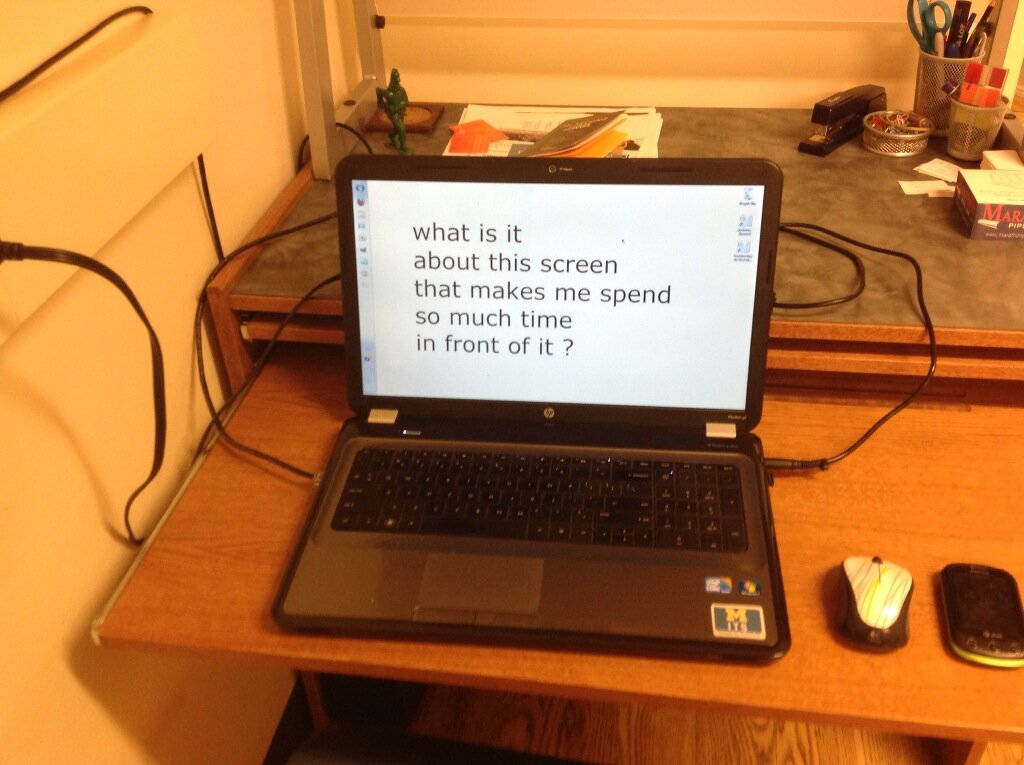
Most often, these pieces of art are beautiful depictions of the real world, whether it is a panoramic view of mountains or oceans or a photo of family or friends. These pictures can be cycled and rotate, becoming abstract shapes and designs, but in whatever case, they are what we perceive as visually pleasant. If these images are constructs of actuality, as art is most often based off inspiration found in the real world, why is it that they make such a dominant presence in our virtual existence? Perhaps we are setting up a home in the screen, a place to find peace or silence when the world is loud or find action and life when reality goes dim? If computers are the places for our minds to explore and wander, the world is left to be a simple provider. Rather than be enjoyed or explored as a primary passion, it is a place we are simply stuck in and thus escape to the virtual realm. Beautiful desktop images serve as enjoyable views when glued to the screen. These pieces of art can be seen as indirectly evil, as they are offering a Land of Lotus leaves to our visual senses, enticing them to spend more time before the screen. For this reason, I have set my desktop to the most atrocious scene I could spawn:

Rather than waste away my years before a screen, lulled into satisfaction by misleading visual art mimicking the true beauty of the real world, I hope to spend less time in front of the screen and more time in reality. Despite the many great tools it can provide, the computer is a double-edged sword. We ask it questions and it answers them. If we ask it why we should spend more time in reality, it will give us an answer, perhaps even a good one, but it will lure us back to our virtual desktops.

Google, why do I ask you my life questions? And how does Yahoo always have the answer?

Maybe that’s why I spend so much time in front of this screen?

Film vs. movies and Literature vs. Books: End this war!!

The other day, I went home for the weekend and to catch up on sleep and on Saturday night, catch up with my older sister.  We were sitting on her couch contemplating what to do for the rest of the night when suddenly, she got this mischevious look in her eyes that made her look like a third-grader with a secret to tell.

“What is it?” I asked.

“Oh nothing,” she said, like there was definitely something.  “Just…I feel like watching a really girly, really sappy movie.  Would you be up for it?”

“You bet!” I remember saying.  I was relieved that she didn’t tell me she had cancer or something.  But afterwards I thought about the trepidation she must have felt before asking me about what to do for the night.

And it got me thinking, as an avid cinephile and bibliophile, why are some people so ashamed of watching films or reading books that are in a genre?  What’s so bad about chick-flicks and chick-lit that makes normal people scrunch their faces and avoid asking you to watch them?

Does calling a movie a ‘film’ elevate it to some sort of high status?  Does ‘Literature’ confer a sort of sacredness to texts that ‘Thriller’ does not?

As someone who loves serving up some Austen, Tolstoy, Baudrillard, or Borges from time to time, I will also admit that I have read ‘Bridget Jones Diary’ waaay too many times to count.

And I’ve laughed out loud every time.

Gets me every time.
Gets me every time.

That is something that reading Baudrillard has never made me do (except when I’ve laughed at Baudrillard to avoid crying because I have no idea what he is saying).

This man has never made me laugh.
Never gets anyone laughing, but is lauded for dissing Disney World.

I am not saying that one is better than the other.  From time to time, I NEED challenging literature in order to assure me that my liberal arts brain can still function.  But from time to time, I think even the liberal artsy should get down from their marble column and descend into the pages or film clips of the genre book or movie and not be ashamed of it.

The Seriousness of Fashion

In response to “The Circus of Fashion” by Suzy Menkes, I’d like to address the “seriousness,” or lack thereof, of fashion moguls and the level of austerity that is expected of the truly fashion elite.  Menkes explains that those truly dedicated to the art of fashion are, and should be, adorned in nothing more than black looks head to toe, in contrast with the fire-heeled, Margiela masks, and intergalactic sweatshirts of late.  The forefront of fashion, according to Menkes, has shifted from these serious types “into a zoo: the cattle market of showoff people waiting to be chosen or rejected by the photographers,” referring to the recent surge of Street Style celebrities captured by Tommy Ton, Scott Schuman, or Leandra Medine.  It seems as though Menkes believes that shows are meant for those of true fashion professionals: editors, buyers, and stylists;  those who peer off Style.com or Nowfashion are not worthy or fashionably educated enough to offer critique .

Yes, I agree that much of fashion “blogging” and amateur attempts at influencing fashion via the web are lackluster (read lookbook.nu and the oceans of unoriginality and sponsorship that follow).  And yes, the successors of Project Runway type shows do follow a somewhat ridiculous “American Idol”-style initiatives, in which a public vote selects the fashion winner.”  But to criticize the public availability and creation of opinion of fashion is itself even more ridiculous than all the rest.   What would art be if it were only meant for art collectors, and those “truly serious” about craft? Isn’t the purpose of all artistic forms to express a feeling or emotion, and emote that to the world?  And aren’t all collections ultimately at judgment of the public?  Yes, those who have been in the industry may be able to understand the originality or cohesion of a collection “better” most. However, this should not change the fact

bonus pariuri sportive online bonusuri case de pariuri case de pariuri sportive licentiate

that I am also entitled to view and form personal judgment. Without Style.com or NYMag or Refinery29, I, someone who is interested in fashion, would never have access to something that I am passionate about. The rise and importance of the social media generation has only helped to quickly spread information worldwide. How can fashion then be mutually exclusive from this sphere, where technology rules all, and anything remotely public spreads virally?

03__55A1712

In that same light, aren’t those who blog about personal or street style attempting to tap into their own artistic expression via sartorial means? If an aspiring artist were to show the world her newest painting on the web, would she be subject to similar sentence?  Menkes contrasts the “circus-like” showing of show-goers outside fashion tents, those sporting high contrast prints, sky-high shoes, and surreal headgear,  with “the opposite of look at me fashion,” wearing the most basic but craftfully structured pieces.   But who is to say that fashion is meant to be entirely serious? What is the point of it all if we can’t live our lives in it? As a person entering the fashion arena, why is it that the Dedicated pros” must only be “dressed head to toe in black?” It seems to me that Menkes, and those who criticize, are missing the point.

Smile Baby

Gurgling in my stomach

making its way up through my chest

until its clenched in the back of my throat,

wanting a new location knowing there’s only one way out.

Starting off as a cackle it grows depth

it grows deep

it becomes as loud as the bell

interrupting much-needed sleep,

it has rhythm, soul, grit.

It escapes with a vengeance

searching for its heartless victim,

yet it will come out long, hard, strong, peaceful.

It pulsates, strengthens from the inner glow

lined with dreams and hope within the core of my body

connected like an invisible string.

It will flourish, when I flourish

Let’s be honest,

sometimes it takes every inch of every bone

in my carelessly contorted body to hear it again.

It tries.

Starting from the back of my throat,

a meek squeak escapes,

sucked clean of all soul,

a dry towel looking to quench another’s

dying desire for it’s presence.

My mouth brick ups, I tell myself

“just smile baby.”

Hip Hop’s Knowledge

After my second workshop with high school students as a part of the Hip Hop Academy, I officially feel outdated in the Hip Hop world. Not to say that I do not stay up to date with the current Hip Hop releases and activities, but it is clear that the same artists and music that caused me to fall in love with the culture are irrelevant, if not unheard of, according to teenagers just four or five years than me. Common, Talib Kweli and Jay-Z have been replaced by Meek Mill, Drake and Kendrick Lamar. While there are positive qualities to be discussed regarding these contemporary rappers, (particularly in terms of Kendrick) they distinctly lack the 1990’s style of early Hip Hop that defines the genre. These rappers helped establish true Hip Hop, and albums such as Mos Def and Talib Kweli Are Black Star, Reasonable Doubt, Illadelph Halflife and Resurrection embody the fifth and most essential pillar of Hip Hop: Knowledge, more than anything Drake or Meek Mill has produced. So even though Biggie Smalls and Tupac are still synonymous with early Hip Hop, Nas, The Roots, and the A Tribe Called Quests of the 90s are no longer discussed or noticed.

Comparatively, this is a shame. The majority of Drake and Meek Mill lyrics focus on drugs, money and women, and the glorifying fame this lifestyle brings. Of course, Common, Nas and the rest were rapping about these topics as well, but they were doing it in a much more socially minded, creative manner. For instance, one of Common’s most famous tracks, “The Light” serves as a platform for Common to discuss how his love for a woman extends beyond a purely sexual relationship, and how he would never use sexist terms such as “Bitch” directed at her. Meek Mill’s song “Amen” featuring Drake features lyrics like, “Shorty wanna f**k me, I say get on top and roller coast.” Not the most intellectual statement about women ever delivered in music. The same topics of drugs, women and fame have transitioned from forms of economic hustle, entrepreneurial spirit and meaningful relationships to testaments of power, success and male dominance, which perpetuate the negative stereotypes against Hip Hop culture. Any critic examining Hip Hop today would obviously assume that the genre of music promotes taking advantage of women, abusing drugs and alcohol and irresponsibly partying, as that is what the majority of Hip Hop says today. This is a shame, because Hip Hop has always, and always will, stand for so much for more.

However, it is not surprising that today’s youth idealizes Meek Mill and Drake. They produce catchy, attractive music that offers an identity and culture to which to attach; and not all of it is bad. Meek Mill promotes a life outside of prison (having gone to jail and sworn never to return) and Drake has said something intelligent here and there. Kendrick Lamar, while producing aesthetically different music than the 90s rappers, preserves their habit of writing creative, intelligent and socially conscious lyrics. As much as I would love to share my love for the artists that, for me, define Hip Hop, I unfortunately cannot force 10th graders to see it the same way. I am left with the only prospect of finding the same values, creativity and genius in today’s rap if I hope to support Hip Hop’s last and crucial pillar.