Ann Arbor-ing at its Finest

I was in Clarkston. I was in St. George. I was in Las Vegas (airport…).

None of them are quite like Ann Arbor. I live in this weird not-city city where hippies dance outside, maybe-professors play weird instruments on the diag, hipsters angstily smoke through campus, and I model-walk down State St. all while my circle scarf blows in someone else’s face.

But I thrive here. In this magical haven/hell.

I got back from break, unloaded all of my belongings, and then blared Bastille mash-ups while I lit incense, steeped some herbal tea (the one instance my life isn’t caffeinated), and read Hardt’s book on Deleuze. Some people have the gall to tell me that I live a delusional life that once I leave Ann Arbor I will never be able to function in society.

And to them I raise my wedding-ring finger, which in my book is as dirty an insult as it gets.

This city builds people who will run corporations—sure—who will cure cancer—woo-hoo—and who will build really tall buildings—gasp. This city also creates those that will be on Broadway, write the next Howl, and describe this post-postmodern/whateverthehellyouwanttocallit society we live in. It creates people who make culture and those that destroy culture. And thankfully, all so humbly, I hope to leave here creating and critiquing “culture.”

Or ontological variations thereof.

It’s also way more than this. Ann Arbor is an emotional feeling. You can’t deny that pulling off of M-23 and heading your way to Main Street doesn’t bring a certain joy to your heart (a certain burning to your bosom—which is often 3am pizza). It’s the feeling walking across the diag in a herd of people and trying to run one floor down Dennison and almost being late to class. It’s the feeling where I have a community of friends I can turn to and a community of strangers I will just maybe meet.

But let’s not get utopian too fast.

Conceptualizing much on a deep level on any type of plane is still difficult. I still scream to myself on the streets and still see violent acts of racism, sexism, homophobia, classism, ableism, ageism. I feel uncomfortable walking home alone whilst wearing beadazzled short shorts and for good reason—people throw insults like/with objects from cars. And I’m privileged in all ways except for identifying as gay. How would it feel to not have all of this privilege?

Ann Arbor allows for conversation. In some spaces a safe dialogue is all I want and usually get. In classrooms I can actively debate those that I unapologetically oppose. In hookah bars and coffee shops and discotheques I can converse. Above all, Ann Arbor is a place that I can talk to people and usually be heard (even if it is only myself that will ever listen).

My thoughts are “free” here.

But it’s not just about me. There are so many poetry readings to go to where people’s words, if but for an instant, are free to be heard. We have art galleries (UMMA to unknown) that have Monet and have porn folded into paper sculptures—images are free to be seen. We have boom boxes and spoken word and symphony orchestras and jazz combos and acapella where notes are free to be felt.

In the most cliché of ways: Ann Arbor is a place where the cage is semi-loosened. The bars are bent just enough so I can stretch my limbs. And it feels so nice to be home.

Years


It’s difficult to lay a finger on how Bartholomäus Traubeck’s deceivingly simple “Years” manages to be so curiously evocative. The piece, quite essentially, consists of a modified record player that reads slices of wood, translating year ring data into music. Grain and ring density and color and width are converted into piano tones— every slice of wood will, then, produce unique music. There are years and years of history ingrained in any given cross-section, decades, perhaps even centuries. Tree rings reveal an entire chronology of climatic phenomena, of course. But “Years” acknowledges that data and continues outwards; it is a passage of years, a flow of time, the gathering of individual events that become trivialized within the sheer scale of the entirety.

What is interesting about Traubeck’s piece is the relationship between the concrete and the abstract, the input and the output. Reading yearly rings is on the whole fairly objective, and once the translation has been coded, the process is straightforward, transparent. Yet how the sure bts soccer tips.com artist chooses to make the translation is entirely within his control. What qualities in the cross-section will become what qualities in the music? How far, which way? The relationship is arbitrary, up to the artist’s discretion. As a critic succinctly phrases, “the design object is at once material— an interactive sculpture— and immaterial, interpreting an inanimate ‘fossil’ into arguably the most abstract art form,” music.

The finished product is deep, sparse, heavy. There is a certain dignity about it, something in its air that is greater in scale than a record player and a bit of tree. Our ears pick up the sounds, sometimes nearly careful, sometimes discordant when it hits a knot in the wood, and join them into something conceptual, something not physical. We’re reading history, reading time, constructing a tentatively cohesive narrative— only not with our eyes, but through our ears.

Silver and Gold

The other day I finally did what I’ve been meaning to do for a long time – take off all of the music on my iPhone and replace it all with christmas music.

I consider myself to be fairly fond of Christmas music. I am always excited for Thanksgiving to be over so that the music can start to come in and I can enjoy myself for the month of December. It’s part guilty pleasure, part fascination, and part nostalgia.

So needless to say I’ve been listening to a lot of Christmas music, particularly on my walks to and from class. It’s given me a lot of time to really think about what it is that I’m listening to, why I like it so much and why it has injected itself into our mass culture to the extent that it has.

Within the whole of Christmas music, I have a good deal of fuzzy memories. I remember the family gatherings during the holiday breaks, I remember a christmas tree and for some reason I remember being warm. Very warm. The warmth that is stifling and unbreathable, and yet at the same time entirely safe. I can’t breathe, but I don’t want to breathe.

But to dig deeper than pure nostalgia, the music fascinates me because it is so ingrained in our cultural consciousness. Pop music does this to an extent, too, but not with the width of Christmas Music. Where else in our culture do so many people share a knowledge of such an extensive songbook? People who don’t celebrate Christmas, people who do, the old, the young, the different. We all know these songs. And (I’m sure) some people don’t want to know the songs. But you can’t avoid them. They are everywhere. Christmas has invaded our culture so much that Sava’s has a huge Christmas tree up and doesn’t stop playing Christmas music and I don’t think twice about it. Christmas is an institution, a huge monolith of power and cultural presence. Christmas is about values and about togetherness but Christmas is also about the pressure of culture. It is about commercialization and capitalism and faux-values preached by public figures and about this ambiguous large man in a red suit who invades your home, steals your food, leaves gifts, and runs away with magical flying deer. It’s an absurd institution that is entirely and brazenly secular, despite its intense religious connotation for many, many people. Christmas is an institution born of religion, but that has now gone to college and rejected its parents and got a moehawk because it thought it was edgy.

Of course, Christmas means something different for everyone and everything. But. You know.

And then there is the music. An emblem of the season but also an institution within itself. An exclusive group of accepted holiday songs that are covered and repeated and sung and caroled and mutilated and ripped and sewn back together. It is music, it is the man, it is false nostalgia and it is real nostalgia. It is an immovable obelisk of money and fame and real passion and fake passion. Christmas music is the victim and the perpetrator of its own bastardization. And that makes me love it.

I think of the new Sufjan Stevens Christas box set and its epitome – the magical song “The Christmas Unicorn.”

I’m a Christmas unicorn
In a uniform made of gold
With a billy goat beard
And a sorceror’s shield
And mistletoe on my nose

Oh I’m a Christian holiday
I’m a symbol of original sin
I’ve a pagan tree and magical wreath
And a bowtie on my chin

Oh I’m a pagan heresy
I’m a tragic-al Catholic shrine
I’m a little bit shy with a lazy eye
And a penchant for sublime

For you’re a Christmas unicorn
I have seen you on the beat
You may dress in the human uniform, child
But I know you’re just like me
I’m a Christmas Unicorn! (Find the Christmas Unicorn!)
You’re a Christmas Unicorn too!

It’s all right. I love you.

And to all, a good night.

Finals Relief

You’ve been sitting in this chair for five and a half hours. Three trips to the bathroom, one to Pita Pit and two to the vending machine. Five different groups of lecture slides are open, sticky notes are everywhere and a combination of binders, calculators and textbooks are sprawled in every direction. You have just reached the point where you might be able to finish the entire review sheet if you skip dinner, turn it into four days without showering and make your friend (who has officially checked out and won’t stop talking) leave, please. On to the afternoon’s second cup of coffee and time to finish strong.

But wait. I have another solution. Instead of mad-dashing it until 3am, consider taking a few well-timed breaks in your studies. Turn off your phone, dim your computer screen to darkness, close your eyes and breathe easy. Put on the headphones and use these relaxing songs to ease your pain. A quick 3-minute break here and there can go a long way.

To start off, get a little funky. You need something to shake things up, staring at C-tools certainly isn’t the spice you’re looking for. Check out Lionbabe, a hot new group from NYC who brings the 1970s funk into modern house music. Watch the music video if you really need a distraction. https://soundcloud.com/lionbabe/treat-me-like-fire

Next, stay in the city and take a look at Brooklyn-based San Fermin. This group has been getting a ton of play on some popular music blogs, and are about to drop their new album in a month or so. San Fermin has tracks with musicians from the likes of Bon Iver and ACME. Let these stunning vocals and unique rhythm soothe your tension. https://soundcloud.com/teamclermont/san-fermin-sonsick

Now try an alternative to the traditional pump-up jam. This slight re-work of Edward Sharpe’s ‘Man On Fire’ will leave you energized, empowered and glowing. Make sure you close your eyes for this one- actually, go ahead, put your head down for a few minutes – the snaps will wash out all of the stress. https://soundcloud.com/edward-sharpe-mag-zeros/man-on-fire-little-daylight

Finally, open your eyes and enjoy this exceptional live performance. This is Hip Hop at its prime. http://www.youtube.com/watch?v=e0HYp8d-RmE&

Psychedelic Boat Ride

I’m a media buff if you haven’t noticed by now. I find art to be most interesting in the way it has developed with technology and is presented to the masses. In the 70’s original version of the highly-acclaimed Willy Wonka and the Chocolate Factory, there are many elements of artistic innovation that have never been done before. The candy room, the orange oompa-loompa’s that belted out impromptu jams at the drop of a chocolate bar, and the most intriguing scene to me—the boat scene.

The psychedelic boat trip captures all I ever expected the 70’s to be plus an ontological approach to questioning life. I love that this was a kid’s movie. The boat trip uses a creepy Dr. Suess adapted tune, the flashing of bright lights in a dark tunnel, the indistinguishable images of monsters, and the complete fear of the passengers, to create an artistic message that what we fear is always with us. However, we choose to live in this blind oblivion with candy and the beautiful aspects of life to avoid our fears.

I find the art in the scene to be the true grit of what is visually happening, and what Willy Wonka is saying. He’s not sugar-coating his words, no pun intended. The insertion of the Psychedelic boat scene in the midst of all of the happy and carefree feelings that the movie permits, makes the scene even more noticeable and questionable.

I’m not quite sure what the scene exactly is saying through the visually graphic and trippy images, and I don’t think anyone will ever know unless they ask the writers of the film themselves. My little interpretation of the scene is that it utilizes art as a means to evoke fear and change within people, but we all know from the story only one child truly captures that change.

Here’s the scene in all its glory:

Willy Wonka and the Chocolate Factory: Psychedelic Boat Trip

The Downs

That morning, when she wipes at the frosty window with a sleeve, the oddly bruised dawn light and hazy purple of the hills beyond beckons.
Come, come.
So on go the jacket and the grubby boots by the door, and the lock catches with a soft snick. She gets on the number seventy-nine down the road. It winds its way out of town, leaving behind the houses and the shops and the people trudging up the street. Today, it’s just her and an old man wearing a pair of field glasses over his flannel, just the two of them and the driver. The bus climbs up the quiet lane and around the bend, and soon enough, they’re deposited into an empty gravel lot. She stands, uncertain, for a minute in the chill air. The old man has already started down the lane, and that’s not what she’s looking for.
But- ah! That, that is. There’s a stile half-hidden in the scrubby little trees on the far side of the lot. She plants a foot on the worn step, swings herself over, and hops down into a grassy field, onto a much-trodden path. No one else is here, though, and the road is already invisible from here. She follows it up the ridge for a while, while empty fields slope down one side, and long grasses flank the other. There would be something, eventually. Now there are cows. She pauses at the fence, observing them for a moment, while they gaze back at her with ruminant disinterest- it’s very quiet up here, and it feels odd that she could be not entirely alone.
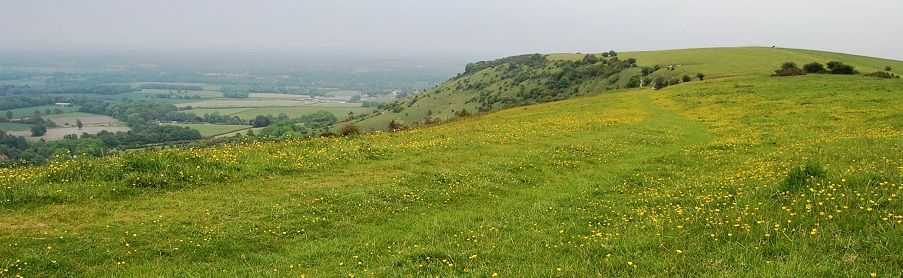
It is some time, then, before she makes it up to the crest of this ridge. And here the land drops away before her, down to the lowlands where homesteads and farmsteads lie scattered. The air is brightening, the odd hue from the early morning leeching away and giving way to a soft, opaque blue-grey that blankets the distance in uncertain certainty. She imagines, on a clear day, that you’d be able to see clear to the sea, the city glittering on the coast, the hilly land a study in early morning contrasts, burnished bronze and deep powdery shadows.

That morning, when she wipes at the frosty window with a sleeve, the oddly bruised dawn light and hazy purple of the hills beyond beckons.

Come, come.

So on go the jacket and the grubby boots by the door, and the lock catches with a soft snick. She gets on the number seventy-nine down the road. It winds its way out of town, leaving behind the houses and the shops and the people trudging up the street. Today, it’s just her and an old man wearing a pair of field glasses over his flannel, just the two of them and the driver. The bus climbs up the quiet lane and around the bend, and soon enough, they’re deposited into an empty gravel lot. She stands, uncertain, for a minute in the chill air. The old man has already started down the lane, and that’s not what she’s looking for.

But- ah! That, that is. There’s a stile half-hidden in the scrubby little trees on the far side of the lot. She plants a foot on the worn step, swings herself over, and hops down into a grassy field, onto a much-trodden path. No one else is here, though, and the road is already invisible from here. She follows it up the ridge for a while, while empty real soccer predictions fields slope down one side, and long grasses flank the other. There would be something, eventually. Now there are cows. She pauses at the fence, observing them for a moment, while they gaze back at her with ruminant disinterest- it’s very quiet up here, and it feels odd that she could be not entirely alone.

It is some time, then, before she makes it up to the crest of this ridge. And here the land drops away before her, down to the lowlands where homesteads and farmsteads lie scattered. The air is brightening, the odd hue from the early morning leeching away and giving way to a soft, opaque blue-grey that blankets the distance in uncertain certainty. She imagines, on a clear day, that you’d be able to see clear to the sea, the city glittering on the coast, the hilly land a study in early morning contrasts, burnished bronze and deep powdery shadows.