
Is Awkwafina Problematic?

Actress Awkwafina (Nora Lum) recently made Golden Globes history by being the first Asian American to win Best Actress, for her role in “The Farewell.” In “The Farewell,” she plays a Chinese-American struggling to figure out her own identity while attempting to protect her grandmother Nai Nai from the actuality that Nai Nai has only weeks to live.

Awkwafina has made quite a splash in the last couple of years, especially for her parts in “Ocean’s 8” and “Crazy Rich Asians.” She is notorious for releasing a song called “My Vag” in 2012, and other humorous and inappropriate rap songs. Part of her fame stems from her identity in opposition to the model minority stereotype, in which Asian Americans are expected to be quiet and submissive. Awkwafina’s performative personality in her music and acting roles have consistently portrayed her as loud and in-your-face, spunky, and refreshingly brash–a milestone in representation for Asian Americans.

Hailed as an irreverent, hilarious popular figure, some critics have attacked Awkwafina for building her celebrity upon appropriation of black culture. Is she simply a standout example of an Asian American who has garnered fame for her in-your-face persona, or has she actually profited off problematic cultural appropriation? While the answer may be tricky, I wanted to explore this issue further.

One writer explains that Awkwafina’s role as Peik Lin in “Crazy Rich Asians” demonstrates the appropriation of the “blaccent.” With wagging fingers, language such as “bawk, bawk, bitch,” and the use of “be,” and an overall sense of swagger, Awkwafina’s depiction of Peik Lin shows a cross-cultural connection to black vernacular. Yet, is she just portraying a character or is she complicit in a perpetuation of anti-blackness? The writer also suggests that maybe the quirkiness of Peik Lin’s character doesn’t stem from explicitly black language.

Cultural appropriation is not a new issue. Through media like Nicki Minaj’s “Chun Li” or Post Malone’s rapping, famous artists are no strangers to accusations (perhaps deserving) of stealing from other cultures. To some, cultural appropriation only occurs when someone from a dominant culture/ethinicity takes something from an oppressed culture (such as white people portraying black stereotypes).

Vernacular invented by people of color, notably black and brown folk, is commonplace among young people. Can a culture own language? This issue is particularly tricky to discuss in the current era–with the mixing and morphing of all dialects and accents in 21st century of America, the cultural diversity of people is abundant. I think this meshing of cultures is quite beautiful and is what makes our country so unique.

However, what is truly problematic about Awkwafina is the fact that her entire portfolio relies on the flamboyant, swagger-filled potrayal of a common stereotype of African Americans. This usage of African American Vernacular English and black mannerisms unfortunately has real-world harmful consequences for black and Latinx people, who are often discriminated against for not using Standard English, which is ethnocentrically thought of as culturally superior. While I am proud of the Asian American representation Awkwafina has helped achieve, it’s worth noting that her fame stems from a derogatory caricature of black people, which is inherently problematic in itself, no matter who the perpetrator is.


*As an Asian American woman, I obviously do not speak for any entire culture. These opinions are entirely my own.

Monument Valley

The history of mobile games is volatile at best, built on cheap gimmicks and popular trends, as seen in games such as Fruit Ninja, Angry Birds, and Flappy Bird. Overall, mobile devices have long been abused and misused as mediums of quality artistic expression, lacking notable works of art and remaining barren of any significant creative expression. It is certainly not due to any inherent limitations of the medium; most modern smartphones can compete with modern laptops and computers relative to graphics and hardware capabilities, but more likely due to the precedents set by the first mobile game gold rush, started by simple, cartoonish games that relied on repetition in order to increase advertisement time. However, one game series stands apart from the rest in every single way: Monument Valley is a stunning and surprising work of art, featuring an amazing style, atmosphere, and complementary soundtrack, all relying on a simple yet endlessly fun and fascinating gameplay. Not only does it demonstrate the true artistic capabilities of the mobile medium and set the bar for future artists and developers, it does it all without relying on cheap ads and gimmicks.

Image result for monument valley game"I discovered Monument Valley when it was first released in 2014, as I was scrolling through the home page of the Apple app store. It was praised as a truly unique puzzle game of “impossible geometry”, and it featured a minimal yet beautifully crafted art style. It was actually the first mobile game that I paid money for, which was certainly unusual at the time, especially considering it was $2.99. In hindsight, I find it fascinating how quality mobile game studios are forced to sell their games so cheap relative to console games, which often range anywhere from $20 – $60, just because the mobile market is dominated by cheap games that depend on adds and in-app purchases. Needless to say, it was the best $2.99 I ever spent: since I first opened the game I couldn’t stop playing, I was completely immersed in the colorful and intricate world of Monument Valley.

The game relies on a simple tap to move mechanic, as the player tries to guide the protagonist Ida to the end of each maze-like architectural wonder. My favorite part is the clear care and detail that went into every level of the game (of which there are only 10 levels), as seen in the design, art style, atmosphere, accompanying soundtrack, and subtle plot that is developed throughout, as the player discovers more and more about this forgotten world of impossible geometry. Compared to other mobile games, its simplicity is its greatest strength: it features a few main characters, a simple mechanical concept, and puzzles that are challenging but never impossible. However, it sets itself apart in its quality and artistic craftsmanship, where each level is its own world, full of clever tricks and beautiful geometric design, which perfectly complements the game itself while also making every frame a work of art in itself.Image result for monument valley 2 game"

Monument Valley is entirely unique and deserves to be recognized as a work of art, just as significant as any great album or famous painting, if not more so for its role in breaking the expectation of what a mobile game has to be. It is not meant to be played endlessly and mindlessly, but instead appreciated and savored; it is not a pitiful attempt at money grabbing, but a beautiful artistic concept that was perfectly executed through the mobile medium. The developers continued to build on the exceptionalism of Monument Valley with Monument Valley: Forgotten Shores, and Monument Valley 2, which I both equally recommend (Monument Valley 2 deserves its own post, considering how it expands on the themes of the first game while completely revolutionizing its art style). I would love it if these games could receive more recognition, not only because they deserve it, but because they represent everything that mobile games should be.


Eating Animals

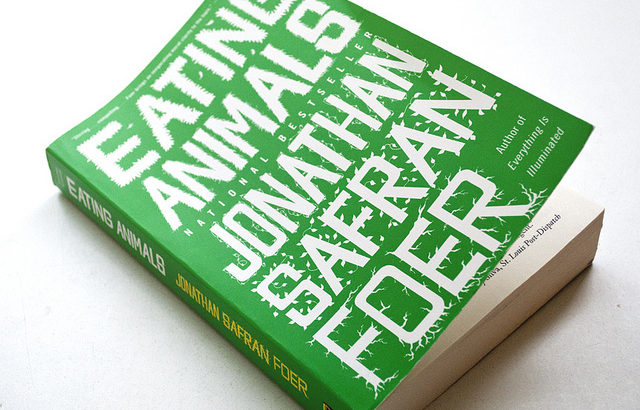
I recently re-read a book by one of my favorite authors, Jonathan Safran Foer, called Eating Animals. Originally published in 2009, Foer’s book is an intriguing look into why humans eat meat, and the environmental, ethical, and moral implications of consuming it. The idea came about when Foer’s son was born, and helps him to decide whether or not he raises his son on a vegetarian diet or not. As the new year begins, I hope to be more mindful of what I eat, and consume less meat–for both ethical and environmental reasons.

I also saw Foer speak at Rackham this past fall, presenting his new  title We Are the Weather: Saving the Planet Begins at Breakfast. A seasoned fiction writer, Foer now turns to discussions of how diet choices affect climate change and writes from an honest and personal point of view.

In Eating Animals, Jonathan Safran Foer utilizes many sets of stories to illustrate powerful points: he describes in gory detail the conditions of modern factory farms which kill thousands of cows, pigs, chickens, and turkeys, but also interviews owners of small family farms whose practices are more ethical but dwindling. Foer eventually comes to the conclusion that eating animals is a sort of negligence of our own humanity, because both humans and animals can suffer, yet one species is deemed superior to the other.

In an era where people are becoming more conscious of their food and where it comes from, Eating Animals is a stark but real look into the industrialized farming complex within the United States. While switching to a totally vegetarian or vegan diet can be a lot for some people, Foer urges that even small choices such as not eating meat for one meal or one day still carries a significant impact, especially if many people do so. If you are thinking about decreasing your meat consumption, or simply want to learn more about the meat industry and its effects, I strongly encourage you to pick up a copy of Foer’s books and dig in.