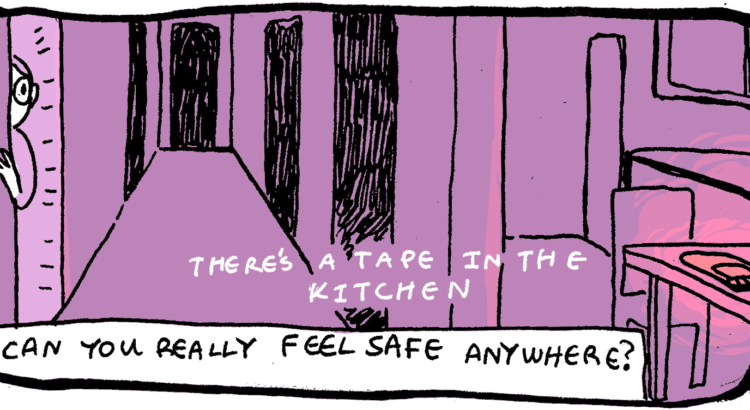
Continuing the spooky theme with a little comic about my favorite horror game! I don’t want to spoil it too much, but needless to say it’s a really amazing game with an atmosphere like no other.
(This video by Jacob Geller also really hits home why I love this game so much, check it out!)
While I’ve always wanted to either major or minor in creative writing, I didn’t expect to make it official when I walked in to my advising appointment today. Planning ahead, I had made the appointment to go over some questions I had regarding the major. My advisor and I went over distribution requirements, course options, and my track to graduation. At the end, since it was pretty evident that I was going to major in creative writing, my advisor asked if I was interested in declaring. A signature later, I was officially a creative writing major. I even received my major shirt, a purple spectacle that would let everyone know I’m majoring in creative writing through the Residential College.
The truth is, I am currently taking my first creative writing class this semester. So far, I’ve absolutely loved it, enough to declare my major on the topic; however, my love of reading and writing started long before my adventures here. Since I was young, I’ve loved to write stories. In middle school, I made it to 70+ pages in two or three novels each before abandoning them. Yet, as time went by, it became harder and harder to write for non-academic purposes. By my sophomore and junior years of high school, my creative writing practice stood at a halt.
Last year, becoming a blogger for arts, ink. was a great opportunity to start writing again. The work I feature here isn’t so much my normal writing as it is a stream of current thoughts, but it has still been a great creative outlet. This year, Narration (RCHUMS 220) has acted as a revival of sorts for my love of creative writing. While I’m pretty rusty, it feels good to write again. Whether reading other students’ work or creating short stories of my own, this class has been a nice balance to my other ones. Whenever I am feeling particularly stressed, working on homework for this class — of which typically entails crafting short stories, responding to other students’ work, or analyzing famous pieces — is something I look forward to. I’m very excited to take future courses surrounding literature and creative writing.
In majoring in creative writing, I’m pursuing a passion more than money. Believe me, I’ve heard plenty of comments regarding a creative writing major and the decision to pursue a “useless” or “unrealistic” degree. Sometimes, the same is also said about my other intended major, Sociology, though not quite to the same degree (people typically just don’t fully understand what it is or what students can do with it). I accept this as reality, but while I understand and appreciate where people are coming from, I also believe certain areas — such as creative expression and the humanities — might hold more merit than they are given credit for.
Even if not directly translated into a job, the skills I will develop though a creative writing major will be beneficial wherever I end up. I see the major as a unique opportunity to build skills not just for writing as a hobby, but for clear and efficient writing overall. Storytelling, critical analysis, and effective communication are just several skills gained through the major, not to mention persistence, initiative, and humility as individual traits. Throughout the years, creative writing has been a huge part of making the world a better place, and even if I don’t change the world with my writing, it will have impacted me for the better. Overall, I’m glad I declared my major today, and I’m ecstatic for what the major has to offer.
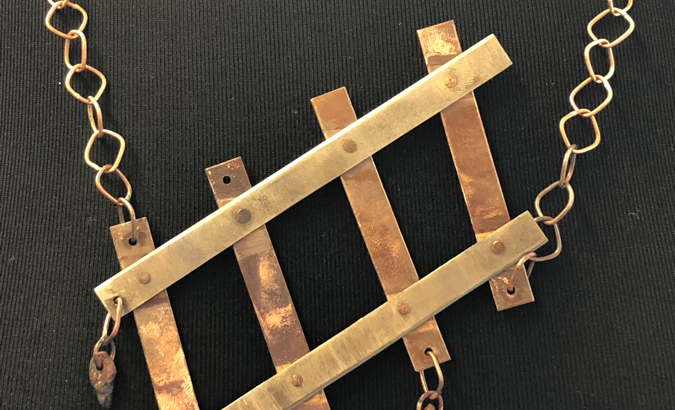
Nicky Billovits is a junior studying Computer Science and Art & Design at the University of Michigan hailing from Midland, Michigan. A computer scientist “in practice,” Nicky also a talented artist who enjoys creating unique jewelry and learning about ethnical technical design.
He first got his formal introduction to art in high school, when he had some free space senior year and decided to take a 3D art class. He gained experience working with sculpture and metals, which sparked an interest in pursuing art further in college. To him, art is an escape from his technical studies, and allows him to “pursue a study into form and intentionality.” Although he doesn’t particularly see himself as an artist “inside” the art world, his he likes using his diverse perspectives and draws inspiration from others.
Nicky is also inspired by the environment around him–particularly society, nature, and humanity. He is intrigued by the future of technology and its growing role in our daily lives. One of his favorite projects was a collaborative effort with guest artist Chico MacMurtrie among other students that involved creating a large inflatable robotic sculpture. Nicky says, “It was the first time I had my two realms, computer science, and art, combine… it was something I found deeply fulfilling and enjoyed it a lot.”
As for the future, Nicky sees himself as a software engineer by day and perhaps starting a jewelry or rock-carving business on the side.
When an average person thinks of graphic design, usually they rarely think about the type of text used. An individual usually focuses on the greater message that the poster, ad, etc. conveys. However, text design plays a bigger role in what is and is not noticed by the viewer than one might think…
For example, if I were to look at a poster with good type, I would look past it and instead focus on the graphics displayed. On the other hand, if the type was presented poorly I would be stuck on the fact that the text is bad rather than looking at the poster as a whole.
During the process of choosing the overall type of a project, many factors are involved. One must first think of who their audience is, what they want to say, and/or what they are literally saying in the text itself. You must consider what you are printing on, the colors of the type, the colors of the background. Do you want the text to be legible and readable? What spacing and alignment do you want? How will this affect the overall look? What do you want the shape of your text to look like and what emotions will that evoke? What about the tracking and kerning? How will you alter those to contribute to your piece? Furthermore, one must think of text size, line length, leading, and a million other characteristics when creating their text design.
Before heading into my typography course this semester, I never even knew there’s a difference between a font and a typeface. Did you not know there was a difference either? Well, font refers to if the type is roman, boldface or italic type and typeface is the design of a set of characters; usually referred to as what family the type’s style is in. So when choosing the type you think of what typeface or family your text should be in and you also consider what “member” of the family or font you desire. For an example, in this blog post, I am typing in the Georgia Pro typeface and the roman font style–the default typeface for WordPress hoorah!
A typeface that leads to a huge controversy is Comic Sans. Initially created to present a warm, childlike, and innocent feel, it has been used in comics but also used very inappropriately in other text designs. When it was “born”, the typeface went global and was used immensely. However, since it was used too much, people started to have a “hatred” for it which proved the typeface’s limitations. Without hesitation, a majority of people can tell when Comic Sans is used properly or not well. Since the typeface portrays a comedic-like feel, when used in other scenarios than children’s books or cartoons it seems very very veryyy wrong. See below.
If I have learned anything from my typography professor(Audrey Bennett… a true icon), it is to never use comic sans.
Since I have been in my typography course, my eyes have been opened to a whole new world, an overwhelming world at that. Now that I have knowledge of all that goes into picking a typeface, it is even harder for me to select one. I used to just be like “Alright I guess this seems right.”, but now I go through questions like, “Does the alignment look right?”, “What type weight do I want to use?”, “How is my kerning?”, “Does this have enough gestalt?”.
Most individuals don’t typically consider type an art, but boy are they wrong. Not only are there so many aspects of choosing a font, but there is even more when creating one. Some fonts have been revolutionary to society and the art world especially. Take Helvetica. With its simplicity and elegance, this typeface is multifaceted and allows people to show their message in a straightforward manner. Helvetica is the face to thousands of businesses, companies, and brand logos. It is one of the most significant fonts in history and shows how vast the world of typography is and how it links everything together. I mean, the typeface even has its own documentary.
Whether or not you agree typography is an art or not, it is the core of how humans communicate with each other and there is no arguing that. Typography is one of the most influential factors in our decision making but because it has become second-hand nature, we have come to think of how it affects our life subconsciously. If one were to take a step back and observe how much type is around us and how it is being presented, surely they could create a discussion that could last an infinite amount of time.
Typeface and the study of typography are usually not seen as art to the average person. However, it is important for us to reflect on how typeface is something we interact with every day and what art is truly defined by.
This week, I encourage you all to ponder if typography is an art and maybe do some light research on how much goes into type design. And with that, I shall say, “See ya next week!” and also, please don’t ever use Comic Sans. It’s for everyone’s sake.
This last summer I made it a goal to read more, and to ultimately fall in love with reading again by reading something truly amazing. I hadn’t read anything that I had picked out in awhile, mostly just epic poetry for school, and although that’s all great writing and storytelling, it just feels so stale and monotonous, especially when there are deadlines that force you to skip half of the chapters. I was determined to find something fresh and exciting to read over the summer, but it ended up being much more of a challenge than I anticipated. I started out by trying to read Don Quixote, a famous and classical book about a man with grand delusions of knighthood, set off on a quest of comedy and heroics; this was a huge mistake, as the book is dense and over a thousand pages long. I wouldn’t even care to admit how little I was able to read before I couldn’t bear to pick it up. That endeavor being a failure, I decided to pursue science fiction, a genre well known for being unique and interesting; specifically I wanted to read the works of Philip K. Dick, who wrote the short story Do Androids Dream of Electric Sheep which inspired the Blade Runner movies. I picked up a book of his collected short stories and got to work. Although they were all great standalone stories, with fascinating concepts and tough philosophical questions, I quickly got tired of them, simply because they were so short. I wanted an epic story, where I could connect to the characters and watch them change and grow, while on some long and exciting journey.
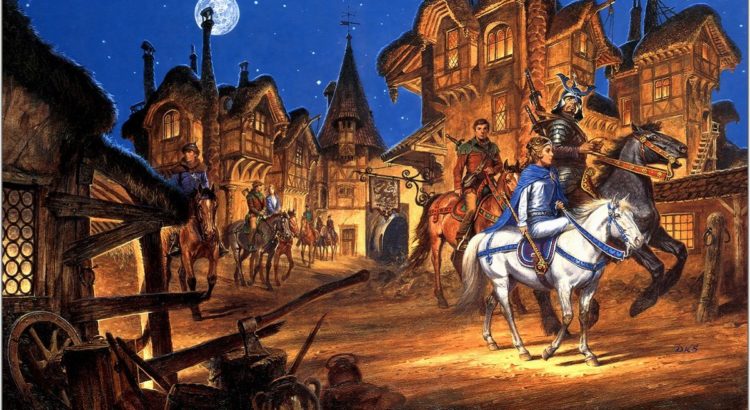
Eventually this led me to the fantasy section at the local bookstore, and about an hour of comparing different obscure and mediocre sounding titles. I never realized how small the fantasy genre was for adults; when I was a kid, all I read was fantasy and it seemed like there was enough to last a lifetime. The most advertised and well known was of course the series A Song of Ice and Fire by George R. R. Martin, which was adapted to the wildly popular TV show, A Game of Thrones. I was already against reading the series however: I had heard that the books were boring, drawn out, and dense, but most of all I knew that the series was unnecessarily vulgar and sexualized. I wasn’t looking to get invested in such an infamous series, especially when I already had such a negative feeling about it. This pretty much left me with one other choice: The Wheel of Time series by Robert Jordan. I knew nothing about the series, my phone was dead so I couldn’t check reviews, and the book didn’t even have a summary on the back or inside, so I had to start reading it right then and there, just to get a feel for what it even was. I read the prologue and I was hooked; even knowing the bare minimum about the story I was drawn in by the classic fantasy writing style and the mysterious lore that raised so many burning questions. All in all it seemed like exactly what I was looking for.
After buying it, when my phone was working again, I checked out the reviews and my excitement was instantly dampened: “it’s a ripoff of The Lord of the Rings” the critics and internet exclaimed unanimously. As somebody who had read the entirety of The Lord of the Rings already, I was definitely dreading reading somebody’s cheap knockoff of such a masterpiece. Having just finished the first book of The Wheel of Time series, The Eye of The World, I can confidently say that the series stands alone and successfully defines itself against the writings of J.R.R. Tolkien. The Lord of the Rings is an amazing epic, focusing on one long journey featuring a cast of important characters, but as a result it is slow and drawn out, with the few exceptional events all blending into one general idea. Jordan contrasts this style in almost every way: his story is fast-paced, featuring a large cast of constantly changing characters going through non-stop events, hardly catching a break to breathe, while he paints an entire world around them, featuring lore and world building that even rivals J.R.R. Tolkien.
I can see how Jordan’s work might be seen as less distinguished, cheaper, and more focused on quantity over quality writing, but I would strongly disagree and argue that it only seems so in comparison to The Lord of the Rings, when really they are two completely different approaches to the fantasy genre. I can’t even begin to argue whether or not one is better, since they both establish themselves in completely different ways. Regardless of the comparisons, Robert Jordan does not disappoint: he completely satisfies my need for a unique character and lore driven journey of epic proportions. I find myself stuck to the page again, loving every word, from the writing to the story to the entire world he has built. It’s an amazing feeling, and I’m overjoyed that there are 14 books in the series, since I already know I’ll be wanting more when I’m finished. If you have been looking for a book to dive into, or are an endearing fan of high fantasy, look no farther: The Wheel of Time turns for you.
Hi Everyone!
I’m back again, this week, to share some of my experiences as an architecture student here, at the University of Michigan’s Taubman School of Architecture and Urban Planning!
This week, the topic is introductions.
Yes, introductions…. like, Hi, my name is ____, I major in ____, how about you?
Ever since I started college here, I’d always say that line above, with “architecture” in place of the blank, and I’ve always gotten responses like OMG wow that’s SO cool! Is there a lot of math involved? or Wow that’s so cool, I remember when I was a kid, I thought architecture was so cool, and I used to want to become an architect too! And when I say always, I mean ALWAYS! I ALWAYS get such replies!
Ok, I get it, some people just say that since it’s a standard thing to say to express courteous interest in getting to know someone and their passion. But COME ON! I’ve gotten those responses, from mostly non-design majors, from at least A HUNDRED people now. To be fair, that’s a pretty small number in comparison to the total number of humans at Michigan. BUT, in architecture, which I find to be a very selective, niche field, that’s a huge number. I mean, maybe I just lived in a very sheltered environment as a child, but growing up, I was maybe aware of buildings, but I was probably only aware of architecture as a serious discipline by high school. There’s barely any architects in the world, in comparison to the number of people working in the other disciplines, so to me, when many people express that they “used to” want to be an architect, it’s kind of like the equivalent of saying “I used to like that flavor of soda.”
And then, the conversation would usually carry on to people asking me what kinds of classes I have to take (ahem, is math one of them?), where are my classes located, is it in LSA, if I enjoy them, and if they can see some of my work (which I’m happy to share with you!!).
So, as a first year (undergraduate), you will be taking mostly prerequisite classes, just like students of other majors, a “basic” drawing class (quotation marks because it was NOT basic to me, it was straight-up still-life drawing freehand, and some training to use design tools and training our eyes to recognize angles, and having a steady hand to draw straight lines without a T-square or erasure), along with a first year architectural seminar that started introducing some design terminology and attempted to teach us a first-pass way at reading building plans.
The second year, you may need to take a few more prerequisite courses, but you will be getting into some more introductory architectural courses, including introducing drafting (like scaled drawings) which naturally leads to first-pass at creating physical models in attempts to demonstrate specified concepts, and working with modeling materials and learning modeling techniques fit for ourselves. The semester after that, you’ll get introduced to virtual modeling software programs mainly Rhinoceros, along with the Adobe Creative Suite (mainly Photoshop and Illustrator), which leads right into learning how to use software along with our prior drafting knowledge to best represent our projects and their concepts.
Then comes the third year, where you’ll FINALLY get into a real studio- this is what people will usually refer to it as the weeder course of architecture, since you really put all of those design techniques and knowledge to use, and the curriculum of studio continues to pick up the pace, since you’re already expected to have learned and mostly mastered the skills you’ve picked up from the previous courses. I personally found the weeder course (it’s called UG1 and stands for undergraduate studio #1) intense, a ton of work, yet very rewarding, since I’d been itching to build models since my first day of freshman year! I’d also say that it really depends on who you get matched with for your instructor. I was lucky to have a really amazing instructor, Melissa Harris, who really helped me find my voice in representing architecture and what I liked or did not like to do, for my own modeling and representation methods. I definitely practically lived in my studio desk, I did my projects day-in, day-out, it was the center of my classes at the time. I’d get my other course work as quickly done as I could, as to make as much time as possible for studio. Of course, it was also my first time in such a setting, still learning what works and what doesn’t work for me.
But yes, time management has gotten better for me over time, and I am currently surviving my studio, and actually kind of enjoying my classes for once, since as a fourth year, you are required to take architecture electives along with a structures course (which is more like an applied-physics course), which I find I am really enjoying more than I expected! And if you’re a math-y student, you’re in luck, because you cannot ever fully escape physics or math, or even reading and writing for that matter. (Believe me, I’ve tried.)
********
So I’m curious, how many of you, (be honest please) have caught yourself responding in such a way when being introduced to a design student? And how many of you actually literally meant it? And if you did, what was your exposure to architecture like from your childhood, and what affected your collage career decisions in such a way that steered you away from architecture, or just any design-related field in general?
And if you’re a fellow architecture student, or another design major, or prospective student, let me know your thoughts! I’d love to hear your thoughts! Follow me on instagram @themichiganarchitect ! I’d love to see your work as well! :0
Thank you!
Stay tuned for more architecture with me next week! 🙂