Mary Kathryn Nagle on Native Theater in the 21st Century

Tonight I attended the 4th Annual Berkhofer Lecture hosted by the Department of Native American Studies. This year’s lecturer is a citizen of the Cherokee nation, a lawyer and playwright named Mary Kathryn Nagle. Throughout the lecture, Nagle referred to various pieces of legislation that have affected Native American tribes through the years, particularly Native women and children who are victims of domestic abuse and sexual assault. Native American women are the most at-risk group of women to be affected by domestic violence and abuse, and nearly 97% experience this abuse at the hands of non-Native people.

Native Americans did not have any jurisdiction over non-Native people who committed crimes on tribal land because of a 1978 Supreme Court case “Oliphant vs. Suquamish Indian Tribe.”  To this day many Native American tribes are still affected by this law, but the 2013 amendments to the Violence Against Women Act slightly expanded their rights on tribal sovereignty, and if the current reauthorization of VAWA goes through in the Senate, the situation will continue to improve.

Mary Kathryn Nagle has written about a half dozen plays about Native American stories from a range of different tribes. She is honest in admitting that many American theatre companies do not want to take on Native plays. Many theatre administrators believe that the audience for such plays would be too small, and they have to “think of the box office.” However, Nagle has been able to get her plays picked up by various companies in Oregon and New York and a few places in between, and she insists that the box office does not suffer in the slightest! She emphasizes the idea that by inflitrating the arts and media with stories of Native people, non-Native people will gain an understanding and perspective of a group that has been oppressed for far too long.

When asked why she has specifically chosen the medium of live theatre in which to tell these stories, her answer is compelling. “By having a Native person stand in front of you and tell their story, you are far more likely to understand their point of view.” She is right. Live performance is a medium unlike any other form of art. Reading something on a page or watching something on a screen does not command you to give the subject your undivided attention. Her argument is that by creating cultural visibility for Native Americans in American society, the visibility will in turn affect legislation and the general public’s treatment of Native American people. I was incredibly inspired by her speech, and it gave me confirmation and hope that the arts truly can make a difference in people’s lives.
Stamps Senior Studios

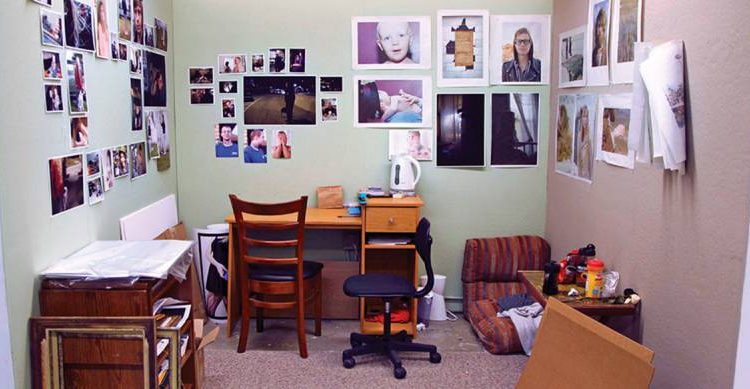
Last week, my sophomore studio and I had the chance to roam around the Stamps IP studios, which are reserved for senior BFA and BA students. Upon entering, I was immediately impressed and shocked at the rows and rows of cubicles. Exploring the area, which is a lot larger than it looks from the outside, splashes of color and personality popped out from white walls. There were door-sized paintings, and couches, and of course, a “F*CK STAMPS” sign lovingly placed on a student’s desk.

Each student has their own individual work area, equipped with a white desk, a chair, and plenty of wall space to hang up art. What was most interesting to me was the diversity in each person’s alcove. Some students had big photo prints or oil paintings posted, while others had strewn up various fabric swatches. Some areas were  barren except for a few scattered belongings and boxes of coffee shots, and some were totally decked out–complete with bean bags, armchairs, lights, and rugs. One student even invited me to take candy from her communal bowl. It was endearing to see that students had essentially crafted a personal homey workspace for themselves, and were still able to collaborate with others around them.

Honestly, I wish I had more senior friends in the art school, so I could hang out and work in their studios. It seemed as if I were stepping into another world, where the next creative geniuses were diligently at work. I’m excited to continue my art and design journey and looking forward to getting a studio space of my own, placed among talented peers. If you haven’t visited the Stamps senior studios yet, I highly recommend you do so, and immerse yourself in creativity.

The Universal Language

Recently, I had the opportunity to portray “Dawn” in a production of The Universal Language by David Ives. The Universal Language is a short comedic play that features two characters, Dawn and Don. Dawn, a shy woman with a stutter, meets Don, a con artist aiming to trick customers into paying for lessons on a made-up language. Don teaches Dawn about Unamunda, the fraudulent language, until the two find themselves enthusiastically creating the language along the way. Gradually, Don and Dawn also learn more about each other, ultimately falling in love. This short play piqued my interest for several reasons. For one, I enjoyed performing and learning more about the comedic style of playwright David Ives. I also liked developing my character and learning about the real-life universal language. 

I enjoyed playing my character, Dawn, and diving deeper into her motivations. Dawn had a unique dynamic with Don. She was naive but smart. Despite her apparent timidness, she displayed courage when initially going to Don’s “School of Unamunda.” Her stutter affected how she was viewed by others, but she took initiative in coming out of her shell and reaching out to Don. Her purpose in doing so was a result of her poetic and optimistic view of the world. At one point, she revealed the reasoning behind wanting to learn Unamunda – she held the belief that language was a form of music and communication, a vessel for uniting humans and thus eliminating loneliness. Dawn’s pure-hearted motive, drive, and curiosity in learning Unamunda negated her foolishness in originally falling for Don’s scam. In the play, she started out shy but ended up more confident and outspoken, thanks to Don and their newly-acquired language. I commend her kindness and passion for learning that even swayed her scammer into falling in love with her. In playing Dawn, I enjoyed conceiving this character from my own interpretations of the play. In addition, incorporating a stutter that gradually faded as time went on was challenging but interesting to work with. I also thought it was interesting to develop fluidity with Unamunda, and to overall perform a piece centering on a made-up language.

Throughout the dramatic process, both the challenges experienced and the research done pertained to the “universal language” in the play. Memorizing lines was particularly tricky because the words were made-up, and this unfamiliarity made a typical task into a bit of a chore. The seemingly hodgepodge of words and sounds resembled a mix of English, Spanish, German, French, and Latin. The language also referenced old slang and included allusions to pop culture, such as names of actors (“Johncleese,” “Melgibson,” etc.). Yet, while Unamunda is made up, there is an actual “universal language” called Esperanto. Esperanto is an international language that was designed to be easier to learn than other languages. Created by Ludwig L. Zamenhof, its goal was to foster communication between language communities and people from different countries. Interestingly, the language has sixteen regular grammar rules with no exceptions like irregular verbs. This simplicity makes it practical to teach internationally. When learning this, it surprised me how much the language is still used to this day. There are books, films/videos, and broadcasts in Esperanto. There are hundreds of Esperanto organizations and two million speakers worldwide. In additional to Esperanto associations, there are various apps, websites, and other tools that teach Esperanto and allow speakers to connect to other speakers across the globe.

Click here for more  information about Esperanto


Swimming: Before and After Mac Miller’s Death

When Swimming was first released in 2018, I was quick to listen to it. . . and was quick to forget about it. It wasn’t that it wasn’t good, I just didn’t find it very interesting; it seemed monotonous and there was a lot more singing than rapping, which Mac Miller was known for. I saw it got a lot of negative reviews by music critics as well; one even gave it a 3/10. I remember around that time thinking “Geez, this isn’t a great year for Mac”, and the next thing I heard was that he had died from an apparent overdose. To me, the saddest part was losing someone so young who had so much to give, and who had always tried to make himself and others happy. The more I thought about how tragic his death was, the more I started relistening to his music, and eventually I came back to Swimming. I approached it with a new perspective, realizing that this was his last gift to the world, and it was a completely different experience. Suddenly it all made sense; his singing was heartfelt and authentic, and even though it was off-key (which critics emphasized in their reviews), it was a refreshing break from the over-autotuned rappers of today. The instrumentation was also incredible, featuring trumpets, pianos, and violins, along with great production value, proving just how much Mac cared about making Swimming a thoughtful and genuine album.

Most important though were the lyrics, in which he talks about finally having reached a peace with the world. He had been known to struggle with drugs before, and he talks a lot about dealing with his inner-demons. It takes on an existential attitude as he talks about living a simple life and realizing that what he had been looking for was looking for him all along. In the end, Swimming was his most mature album yet, and yet nobody had seemed to realize it. Some part of me feels as if Mac knew he wasn’t going to live much longer, and that this last album was going to be his meditations on life before death. However, it’s sad that it took his death to fully appreciate this album. It begs the question: would it be better if he had chosen a simpler life and lived, or should we be happy that he gave so much to the world through his music while he was alive? Overall, I can’t recommend enough listening to this album, it’s a masterpiece. My favorite songs are Self Care, Jet Fuel, 2009, and So It Goes, which is the closing track of the album. These songs are the core of the album and show the real depth of Mac Miller, both musically and personally. Hopefully you find the album to be as genuine as I did, or if you listened to it before and weren’t impressed, try listening again. Either way, Mac Miller will always be remembered by the music community, and also by the people like me, who were fortunate enough to realize how wise and kind-hearted he truly was.

(Image Credits: Google Images)

Relaxation

With final exams around the corner, now is the time of year that students are the most stressed.  There seems to be no free time during exam season, and the little free time that you do have is spent studying in the library.  There are some easy and fast ways to relax that will also destress you, which is perfect for exam season.

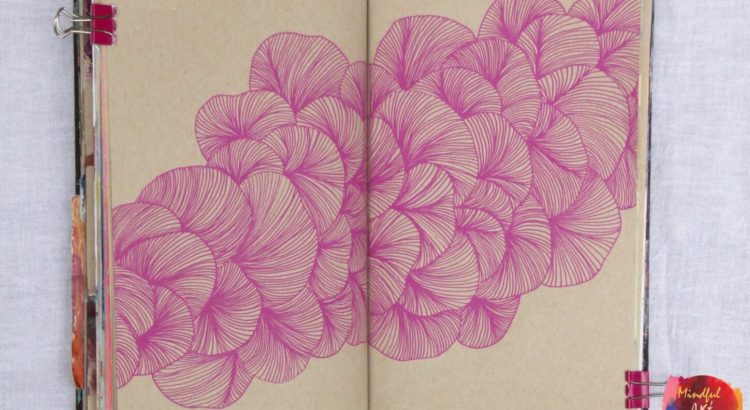
One easy way to relax that you can do in between studying, or even if you take a 10 minute break from studying is to create a pattern to draw all over a page.  You pick one design (bubbels, diamonds, spirals, etc.) and you fill the page with it. This allows you to focus on one thing while you take a break from studying, so your brain is not swirling around thinking about everything else you have to do before the end of the year.  It allows you to put all of your focus on this one task, which can be very relaxing because you are not stressing about anything else. This is also a great relaxation task because you don’t have to finish in one go. You can continue the doodle everytime you take a small study break.

Meditation is also a great way to relax and de-stress.  It is a great way to clear your mind and to make your body less tense.  Meditation can also be done during a study break, or it can be done in the morning when you wake up and at night right before you go to bed.  This way you start and end your day relaxed and on a positive note. There are many ways to meditate and different ways work for different people.  A popular tool is the mindfulness app, it is great for beginners and will walk you through many different medications. It also has meditations for different situations, like not being able to fall asleep.

Art outside of UMMA and the DIA

The Stamps Gallery is a new arts initiative through the University of Michigan Penny W. Stamps School of Art & Design aiming to provide an accessible, ever-changing space to the community. Disclaimer: this gallery is NOT on north campus! It is smack in the middle of downtown Ann Arbor on South Division Street between Wilma’s and Bar Louie, and coupled with free admission, there is absolutely no excuse to leave the place unexplored.

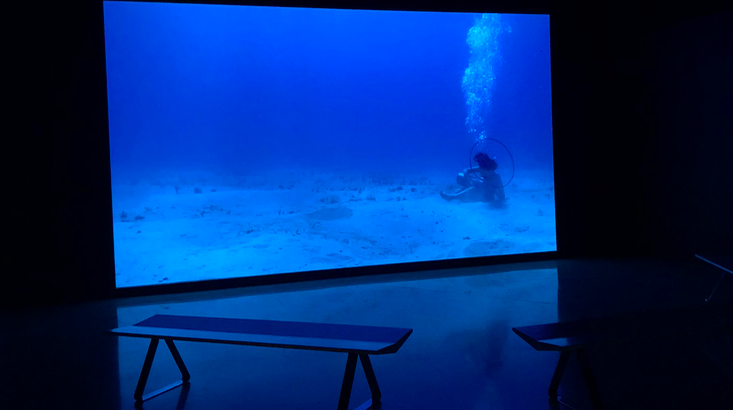
This past week, an MFA thesis exhibition named Dry Socks in a Submerged Canoe highlighted the works of graduate students Masimba Hwati, Laura Magnusson, Bridget Quinn, Rowan Renee, and Mayela Rodriguez. All evocative and visceral pieces—there were great examinations of cultural intersectionality, social justice, and ephemeral natural beauty. In the corner of the room, quietly hidden, were faint lights of blue bleeding onto the wall. That’s what lured me into Blue by Laura Magnusson.

Blue is a single channel video that locates the artist on the seafloor, arduously moving, exhaling, and burrowing through the afterlife of sexual violence. The medium of water, with its destructive potential and capacity to heal and the weight of an air tank, with its promise of survival and threat of impending emptiness, hold the fullness of traumatic experience. In this silent, psychic landscape, Magnusson bears witness to the complex nature of trauma and the ongoing process of recovery.”

I entered the dark room to be welcomed by two benches facing a seascape, which I soon realized was a short, silent film. I sat and watched the whole thing through twice. My body was paralyzed by the sheer strength that Magnusson evoked in her work. Wearing nothing but a coat, underwear, and snow boots, she braved the newfound gravity that accompanies full-submersion. She buried herself, her belongings, her experience in the seafloor—the only evidence of life was the constant flume of bubbles from her oxygen tank, surely a byproduct of breathing in a place unwelcome to doing so. As day turns to night turns to day again, Magnusson grapples with the upheaval and swelling of coming to terms, and then recovery.

There was no sound component, only silence. Much like the silence of victims of sexual abuse. Any witness to Blue was challenged to listen in other ways, observe the nuances of other sensory stimuli, and bear support and space for those who aren’t strong enough for themselves yet. Taken further, Magnusson urges the message of respecting silence. Too often, we feel the need to fill the silence: with empty conversation, with a needless hobby, with simple fidgets. In something as delicate and serious as trauma, talk is cheap. Having a voice is obviously critical in the matter, but not if its premature. We are capable of listening in other ways; listen with your eyes, listen with your hands, listen with you heart. Blue was a deepening exercise in empathy that reinforced the notions that there are other ways of communicating and healing past the verbal medium.

Here’s a MFA spotlight video on Magnusson: https://www.youtube.com/watch?time_continue=14&v=KXfkloGzh9Y

Here’s a link to current and upcoming exhibitions coming to the Stamps Gallery: https://stamps.umich.edu/exhibitions/