Moral Compass

I’m sure most of us have lost our way even with our moral compass in sight. Even so, that is the point of a compass, to guide us to the right way even as we stray away from the path. Our moral compass can be our religion, principles, values and beliefs we hold close to heart.

For me, my moral compass is mostly composed of my religion. Some times I’m glad I never really had to decide what I feel about certain things because my faith has decided that those things are not okay to do. But even so, it demands me to be kind, compassionate and forgiving towards those whose actions I don’t necessarily condone. My faith demands that I do not judge people for their actions, because I don’t have the whole picture.

Even as I err, I don’t condone my own mistakes or actions. I don’t tell other people it’s okay to do certain things, because it simply isn’t (in consideration of my own principles and beliefs). I believe people should be smart enough to make their own decisions based off their own personal choices and after some rumination.

Morality is relative. However, be sure to know that even if you stray away, you can always refer back to your moral compass or change the direction of your moral compass, if the need arises.

(Image credits: Google Images)

how to write as a non writer

If you’re an individual like me who intends to hop into the pool of people who can smoothly formulate words, you must sound as confident as they do. Although you might sound like an imbecile, accept it but act like you don’t know. Act like you are right and that your opinion means something. Don’t try to use semicolons, colons, dashes, or even commas if you don’t know the proper way. Pretend that by leaving them out, you are shooting for an eerie and interesting writing style. For a good piece, write how you would speak. For a great piece, write how you would talk. Sound assertive, curious, and with your own little twang. Use thesaurus.com. Trust me, you will sound like Ernest Hemingway’s protégé. Okay, maybe not his protégé, but at least a fan of his. Use slang. This will help you sound like you have an in and allow you to connect with an audience by making them feel comfortable. Lastly, always believe that you can and deserve to write. Whether your writing makes sense or is a jumble of words written down, at least you have ideas. Ideas are always the start.


Reading Party

How do you incorporate creativity into your social life?

Tonight, I’m heading to a friend’s house for a “Reading Party.”

Beverages and snacks are included of course.

For the first 30-40 minutes we are to engage in silent reading with a book of our choice, then move on to an open mic session where people are invited to play instruments, read something, sing, act, etc.. In a way it’s kind of like the anti-house-party. It’s still a social gathering, but it gives people to focus on themselves and engage in sharing art.

It’s still a “party” though, so it’s necessary to end the night with some karaoke.

A few blocks away, my girlfriend’s co-op is hosting a “progressive” party, meaning that the house collectively agrees to a party theme and each person decorates their room to fit their own interpretation of the theme. Everyone in the house starts in the same room and progresses to the next room at the same time. Tonight the progressive theme is “Powerpoint Presentations.” The prompt exists on its own with no rules or limitations, so everyone in the house is able to get creative with their decorations and in-room activities.

I think the key to a really great party is a solid theme. I would argue that dedication to a theme allows both the party planners and guests to express themselves in creative ways that they would not otherwise have. My roommate turned 21 this week, so tomorrow we’re hosting a disco party for her in our basement. As hosts we have the responsibility of turning our dingy basement into a boogie haven, and guests will only be allowed to enter if they are dressed for the disco.

In this current pre-Spring Break slump, it’s important that students find ways to relax on the weekends. Even though many of us are still busy, we have a little bit more time in the day to practice self-care. I think socializing is a really important aspect of self-care, and attending/hosting parties/hangs with friends is an easy way to accomplish that. Adding a creative twist or theme can make the whole experience all the more memorable.

There are also plenty of ways to practice creativity that have nothing to do with socializing or partying. What are you doing this weekend?

Are Water Bottles a Status Symbol?

Water bottles–they’re an essential daily item that nearly everyone uses. But a number of magazines and websites have questioned the object themselves, as it appears that expensive reusable water bottles have become a status symbol among young people in the current era. Just as items like headphone brands or winter jackets, people carry around certain brands of water bottles that are intended to suggest a specific type of lifestyle and personality.

I think it’s intriguing how different social groups may adopt niche trends–namely water bottle trends. At my high school, the cool, sleek thing to have was a S’well bottle. Among the outdoorsy, active groups, you’re more likely to find a large Nalgene or Camelbak bottle. Among well-off students of all kinds at the University of Michigan, Hydroflasks are the big must-have item. Reusable bottles in general can suggest a variety of things–for one, the person cares about the environment–and that’s a great thing. Perhaps the person lives a very active lifestyle, and needs constant hydration. If the water bottle is pricier, it suggests that the person has the financial resources to afford such an object. With the addition of stickers, the personalization opportunities open up a whole new world of status.

Of course, expensive water bottles are also functional–they boast hours of insulation for cold and hot beverages, durability, and a long lifespan. It’s worth looking at the division between needing a well-designed water bottle for daily use, or purchasing an expensive, aesthetically-pleasing bottle because everyone else has the hottest trend and you want to fit in. I’m still not sure where I stand on this issue, I think it’s more complicated than a simple answer. What do you think?

Valentine’s Day & Homemade Cards

Valentine’s Day: a day some adore and others abhor. Oh, and a holiday that sends Hallmark cheering for joy. Some couples use Valentine’s Day to express their love, whether it be through gifts or a romantic dinner. For them, celebrating Valentine’s Day may include exchanging chocolates and a night out on the town. For others, Valentine’s Day may evoke mixed feelings due to increasing commercialization and the need to show off; however, the night is not exclusive to couples or expensive gifts.

Valentine’s Day can be a great way for people of all ages to show appreciation for loved ones, like friends and family members. In recent times, the day before Valentine’s Day has even been termed “Galentine’s Day” in celebration of girl friends. For children, the holiday often means school parties and heart-shaped cookies. Some of my fondest memories from elementary school include those of making card boxes out of shoe or cereal boxes and exchanging cards with my peers. Cards may have included candy, stickers, or temporary tattoos. Yet, my favorite cards were those made out of construction paper, adorned in Elmer’s glue, glitter, and stickers. To this day, I find handmade cards a great to show your appreciation for someone without breaking the bank.

While the thought of making a card may seem juvenile or daunting, it can be a fun, easy way to show someone you care. If you don’t want to spend the money or can’t find a store bought card to your liking, handmade cards are perfect for sending the ideal message to your friend, family member, or significant other. Taking a little time can result in a heartfelt gesture that demonstrates your love and care. Do you want something funny? Add a meme or a pun. Would you rather have a card a little more meaningful? Write a poem or a message. Adding in a cheesy note or other form of personalization can make the card extra special, and if you can’t come up with anything, Pinterest and Google have plenty of examples for some inspiration. With handmade cards, you are free to do whatever pleases you. This year, I added some puns on the back of my cards relating to my friends’ favorite candies (with some attached, of course). Below are the fronts of some of my cards.  However you celebrated Valentine’s Day – or perhaps you didn’t – I hope you had a great one (and that you enjoy the upcoming discounted candy)!

Kurt Vonnegut: A Different Kind of Fiction

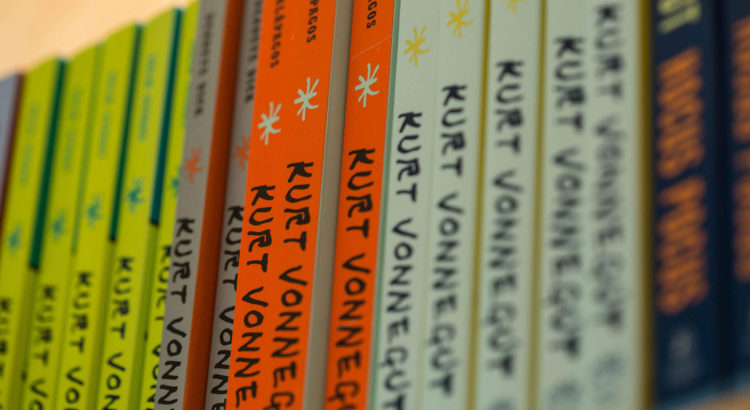
If you haven’t read anything by Kurt Vonnegut, what have you been reading? That might sound bold, but if you’ve read Kurt Vonnegut, you know where I’m coming from. For me, its a combination of his dry and satirical humor and his unique way of presenting a moral that set him apart. In this context I’ll be focusing on three books: Slaughterhouse-five, Cat’s Cradle, and Mother Night, which I all wholeheartedly recommend. This is also the order in which I first read them, and approaching them linearly will hopefully help you follow my train of thought.

I first read Slaughterhouse-five my senior year of high school, outside of my English class, and I ended up finishing it in two days. For a fictional book that combined seemingly mutually exclusive topics such as war, time-travel, and aliens, I wasn’t expecting to like it. To be honest, I only picked it up because I knew it was a classic and that it was frequently referenced in literary culture. However, I was surprised by the unique writing style of Kurt Vonnegut; there is something so genuine and authentic about how he tells a story. He doesn’t seem to care so much about plot holes and accuracy, but more about the overall message of the story, and that was so different than what I was used to (considering intricate books such as The Lord of the Rings by J.R.R. Tolkien). Slaughterhouse-five was especially good at displaying how Kurt Vonnegut uses dry humor to understand humanity in the face of tragedy. A common phrase in the book is “so it goes”, in reference to everything from the end of the universe to the absurd and irrational murder of the protagonist’s companion. At first this sentiment just appears cynical, but after you finish reading you understand what Kurt Vonnegut is really trying to say: in the face of senseless human tragedy, humor is a way to cope with the truth, and to ultimately shift focus to the beautiful parts of existence.

Next I read Cat’s Cradle, and if I thought the plot of Slaughterhouse-five was bizarre, this book took it to another level. The main plot point is the existence of a dangerous material called ice-nine that turns any liquid into ice. However, the story follows a simple protagonist named John and his strange journey that eventually converges with the story of ice-nine. It also features a strange island with an outlawed religion called Bokononism, which is central to the themes of the book. Essentially it is a nihilistic and cynical religion, and Kurt Vonnegut uses it as a punching back to criticize the concept of religion as a whole. In doing so, Vonnegut expands beyond the traditions and beliefs of religion and reveals a human element in understanding life. Through his character development and use of humor, he shows how absurd humanity is, while simultaneously showing how the journey is more important than the destination. Even if everything ends in tragedy, as things often do when people are involved, the story is what teaches us how special it is to be human. This alternative perspective on life is so genuine in Kurt Vonnegut’s writing that you almost forget you were reading fiction.

Last but not least (in fact to many it is Kurt Vonnegut’s best work) I read Mother Night, a story about a spy named Howard W. Campbell, Jr. who works for the U.S. during World War II as a German propaganda radio host. After the war he is put on trial for war crimes, and the book is written as he is living in an Israeli jail. This is the least bizarre of the three books, featuring a pretty straightforward plot and only a few outrageous people and events. This book is also unique in another way, as shown by the first lines of the book:

“This is the only story of mine whose moral I know. I don’t think it’s a marvelous moral; I simply happen to know what it is: We are what we pretend to be, so we must be careful about what we pretend to be.”

Having already read Slaughterhouse-five and Cat’s Cradle, this was a surprise to say the least. I loved Kurt Vonnegut because he didn’t hold your hand and spoon-feed you the moral of the story like other fiction writers, he made you work for it. I can only speculate why he did this, but after I finished reading the book I realized that this was only one of the morals. Perhaps he was just being ironic, because he knew that this wasn’t the full truth. Although this is definitely a lesson from the book, the true moral is revealed in the same way as the other two books: through his authentic characters and ability to draw profound truths from fiction. I don’t want to spoil the ending, so I won’t, but after I finished reading, I had no idea what I felt. The ending was tragic to say the least, but it went deeper than that; it wrestled with concepts of guilt and justice in the most profound way. Similar to Slaughterhouse-five and Cat’s Cradle, he managed to show the complexity of humanity and also challenge our pre-held conceptions of what it means to be alive. It’s a moral that you can’t put into words because it’s so universal that it doesn’t exactly mean one thing. Kurt Vonnegut’s writing almost transcends traditional literature because he offers an entirely new perspective on life. Overall, after reading all three books, I feel as if Kurt Vonnegut is an entirely new kind of fiction: one that leaves the conventions of the genre and instead recognizes what makes it so powerful to begin with. I definitely recommend all three books, and I hope you can see the importance of his writing as I do. As for myself, he’ll always be on my list of favorite authors, and I hope to read more works by him in the future.