
A Little Themed Tour in UMMA: What Clothes Tell Us

Exploring UMMA is one of my favorite things to do in my spare time. I enjoy wandering in the quiet and cozy museum, stopping by whichever painting that draws my attention, and trying to appreciate it by looking closely at it and reading the label. However recently, rather than try to learn more about each painting, I found a more interesting thing to do: to look at several paintings together, to compare them and to find the subtle similarities or underlying relationships among them. Today for my little themed tour, I picked four portaits in UMMA, in each of which the costumes of the figures can tell us the story behind the painting itself.

The first painting I’m gonna introduce is Portrait of a Lady by Johann Tischbein, which is located in the European Gallery on the first level. It is a portrait of a well-dressed lady. We can see her elegant blue silk dress with delicate lace cuffs, her resplendent earrings and necklace, her elaborately braided hair and the matching hair ornaments. Although we don’t know her exact identity, but from her costume we can infer that she is a lady from high social class. She is also holding a fan in her right hand, which may give us a clue of the fashion trends back the time she lived. Fans became fashionable decorations for women in 18 centuries and can be seen in many portraits in that period. Ladies used fans not only to cool themselves but also to enhance body languages.

Right next to this portrait is another portrait of a man. Like the lady in the former painting, he is also dressed in a sumptuous way. His red coat and waistcoat seem to be velvet, with rich gold embroideries on them. His powdered wig is also noteworthy. Pamela Reister, one of the curators in UMMA, once told me that the size of the wig could reflect the man’s rank to some extent. She said bigger wig would suggest higher social rank of the wearer, and was also considered to be more fashionable. The identity of the figure is indeed Pierre Bachelier, the director of customs at Lyon, according to the title of this painting. Therefore, the outfit of the figure in this painting can tell us much about his profession and also his social status.

One of the most eye-catching pieces in the apse is Portrait of Maximilien-Sébastien Foy by Baron François Gérard. Maximilien Foy was a French general and statesman. According to the label, Gérard painted this portrait after the death of General Foy, in other words, the painter didn’t have General Foy posing for him as a model but painted this portrait based on his memory. Thus, the choice of the painter to paint the general in French army uniform could be explained as an attempt to emphasize the figure’s identity as a former military leader. His cloak billowing to the wind reminds us of the famous portrait of Napoleon by David, who was shown as confident and ambitious. The medals on his uniform imply the honors he received as a general, who was severely wounded 15 times and eventually died on the battlefield.

Costumes could be deceptive sometimes, too. If you go upstairs and turn right, you would easily spot a portrait on the balcony of a woman in a blue dress. The lady is shown in a elegant position, with her head raised a little bit and his eyes confronting the viewer with confidence and dignity. Her dress doesn’t even look outdated now, which was probably of the highest fashion back the time the painting was made. However, if you are guessing she was a bourgeois woman, you would be surprised to find out that she was actually a working class widow who could find no other jobs but modeling for the painter. She was in poor health and could hardly pay for the medicine or support her two children. The discrepancy between her dress and her actual identity makes this painting more intriguing and thought provoking for the viewer.

Ok. Here ends my special tour of UMMA:) Btw, you are welcomed to come to UMMA After Hours this Friday (which is Oct.15 and I’m gonna be a volunteer, too!). And if you come, don’t forget to check these paintings out!

Finally Home

A few blocks into my walk, I realize that this is a bad idea. I don’t know why it hadn’t hit me before—walking alone at night, in a city that I hadn’t been to in 10 years, heading towards an unknown destination. The rest of my friends had left about 7 hours ago, and they had already made it back safely. It felt just right when I was booking the ticket, a midnight Megabus ride from Chicago back to Ann Arbor. It would give me a few extra hours in Chicago to catch up with a high school friend, and I could sleep on the bus and spend the next day being relatively productive (which, by the way, did not happen).

But now, swimming in an endless pool of eerie orange streetlights, I feel like a to-be subject of a crime report. “MISSING GIRL: Ann Arbor Police seeking 19 year old girl last seen in Chicago. Friends and family are desperate for answers.” Accompanying photo: my horrifyingly unflattering, jetlagged MCard picture. Nope, when I make it into the paper, I want good lighting, makeup, and Photoshop—the whole nine yards.

I’d never realized that being alone could be scary. Then again, I’d never been this alone. I wanted to leap forward 7 hours in time; I wanted to be back home.

Wait, home… as in my cramped dorm in Bursley, not all the way back in Korea. It was the first time that home truly meant Ann Arbor. It was an odd feeling, realizing that ‘home’ would probably never mean my old childhood room again. During my imagination-induced panic attack, I called my floormates for moral support, not my parents to come pick me up. Huh.

As I settle into my seat on the not-at-all sketchy Megabus (I made it alive!), I think about the last time I was in Chicago. I’d been with my parents—we filled up on Korean groceries, my dad got a haircut and we had sushi at a Japanese restaurant we were regulars at. It was a routine trip; with destinations planned out in advance and a car to drive on roads we had taken for three years by then. The city almost seemed small, because we only went to the places we always went to.

This time, I had made the journey with three members of my new Michigan family; we had no specific destinations, no car, and just Google Maps. At the beginning of the trip, I was confident that I knew the city pretty well—I was welling in nostalgia, thinking of the ghosts of the old me that I would meet up with in memory-laden parts of the city. And in some places, I did. I saw the 10-year-old me climbing down the steps between the 2nd floor botanical gardens and Children’s Museum at Navy Pier. I remember trying to measure the height of the Bean as a school project in 4th grade, and buying a giant Hershey bar at the Water Tower as a souvenir.

But most of the time on this trip, it was a rediscovery of both the city and myself. I’d never before realized how pretty the Chicago skyline was, but after a month in art school I found myself trying to see and capture the beauty of the buildings. I’d never seen the sunrise at Navy Pier, with friends giddily drunk on the magic of the early morning hours. I’d never had Ghiradelli’s Nob Hill Chill (heaven in a cup). I’d never ‘Eggsperienced’ the fantastic 24-hour brunch restaurant (called Eggsperience), nor had I walked there across the city at 4 in the morning. I’d never realized how eerily deserted a large city gets at night, how all the lights are on but no one’s there, making you feel empty yet misleadingly powerful at the same time. I’d never had to force myself to muster courage to conquer my fears ofsomething unknown. As I left Chicago with new memories and new discoveries, I began to wonder what the next trip will bring.

“…You came to take us

All things go, all things go

To recreate us

All things grow, all things grow

We had our mindset

All things know, all things know

You had to find it

All things go, all things go…”

-Sufjan Stevens, “Chicago”

[youtube=http://www.youtube.com/watch?v=KFrG6S0GnhU]

Art Meets Business

If you look hard enough, you can find art in places you’d least expect it. Dank alley walls covered in used chewing gum, musical boulders in the Huron River, even the Ross School of Business – all are places where we can see something out of the ordinary if we just look hard enough. The stunning architecture of the new-ish Ross building in combination with the highly competitive nature of its bustling inhabitants makes the B-school an intimidating place to walk past, let alone wander through. But exploring the surprisingly expressive collection of artworks inside its formidable red-orange brick and glass facade is well worth it.

Ross is home to work in a variety of media; from anthropomorphic sculptures made of skis to textural paintings spanning entire walls (courtesy of Art & Design professor Jim Cogswell), as well as work by renowned artists like Claus Oldenburg and Robert Rauschenberg; there is a multitude of interesting things to look at in the well-lit atrium. Sunlight is distributed evenly throughout the space by mirrors fixed on metal posts, directing the eye to sweep across every glass surface and splash of color animating the furniture and walls. Walking around inside, one can forget that they’re in a place of competitive learning and not a new art museum on campus.

Scared of B-schoolers staring you down? Don your sharpest power suit; you’ll blend right in. If by some chance they manage to see through such a clever ruse, at least you won’t attract as much attention as the performance artists/A&D students who staged a drawing studio class in the lobby last year. They didn’t even have their clothes on. And if they can brave austere architecture and calculating stares in the name of art, so can you.

#mce_temp_url#

You can see the extensive Ross collection online here – but we all know that the art is better in person.

#mce_temp_url#

Art (Un)Appreciation: The Most Under-appreciated Art Forms

In the commercial world, not all art is created equal.  Action films may not be the first thing one thinks of when one thinks of “Art” with a capital ‘A’, but they rake in enough money and have lasted through time long enough to have earned a spot as a filmic genre that isn’t leaving the mainstream any time soon.

On the other hand, other forms of art, such as slam poetry, may be older in form, but rake in little value as commercial commodities.  So for this week, I want to highlight a few areas of art that I think are underappreciated, under attended, and in many cases, underfunded.

Slam Poetry

Poetry is often viewed as a nebulous and exclusive art only created by people who speak a different language from the everyday.  But after viewing my first slam performance, my own perception of poetry changed.  Instead of viewing it as something flowery, abstract, and confusing, I saw it as something gritty and tangible and as close to the everyday as spoken words can be.  Ann Arbor and the University have loads of slam poetry competitions and many English Ph D students who would be happy to hear that someone is curious about their work.  If you have never considered slam poetry as something entertaining or even as something within your reach as a non-English major, watch this classic slam poetry performance by Taylor Mali on why he teaches.

Opera

Once praised as the highest form of theatrical and musical entertainment, opera is now only frequently by the old and classically trained set.  When a new book or movie comes out, wordsmiths are not flocking to turn it into an opera.  A musical, maybe, but never opera.  It’s understandable that opera falls into the same foreign language category as foreign films, but if you ever get a chance to experience opera in any language, I recommend that you take it.

For one, you will never hear live vocals that have the same range, control, and variation as opera singers.  To be classically trained means that a singer has definite musical chops.  With their arduous hours of classical training, opera singers are like the Navy SEALs of singing.  They have lived through hell week and they are constantly stretching the limits of human abilities on a daily basis.

If you think opera is a stuffy art form that doesn’t interest you, I recommend at least checking out some of the great arias (even if it’s just a sample on Youtube…like this one).  And FYI, an aria is any piece of operatic scoring with a vocalist who can be either accompanied or unaccompanied by instruments. Aria is melodic and sounds like music, while recitative is closer to spoken word.

Architecture

Granted, architecture is a very broad category and encompasses many artistic movements and geographic influences.  But people are affected by architects and architectural choices every day.  If you live in a house, you are affected by architecture.  If you go to work in any building, then you are guided through the building by architectural intentions. Luckily, Ann Arbor is full of architectural gems. From the Oxfordian Law School to the imposing Power Center, there are loads of revival styles that mesh together to create the world of the University of Michigan. Not to mention the Big House, which is not merely a sports beacon of the ‘leaders and best’ but is also a solid feat of architectural engineering.

Graffiti


An art that is centuries older than oil painting, cinema, and dub-step, graffiti is not only under-appreciated, in many cases it is condemned.

My question is: have city planners ever considered the thought ‘If you can’t beat ‘em, hire ‘em’? What a collaboration that would be.  Imagine if cities picked their best Graffiti artists to do rotating coverage of certain city surfaces.  Or even temporary coverage of places deemed for destruction. If you want to experience some great graffiti in A2, then check out Graffiti Alley.


Garden/Landscape Art


I wanted to take a Chinese Landscape class this semester, but it didn’t pan out.  I will be the first to say that I don’t know the first thing about landscape art or design, whether it be English, French, or Chinese.  However, the older I get and the more digitally involved I get, the more I want to disconnect from my electronics and reconnect with the outdoors.  Garden and landscape art is like wild woods that have been ordered and beautiful flowers that have been classically trained in ballet to look like a choreographed ensemble of color.

My mom has always been more of a gardener than me and I have been known to be an orchid killer.  But in terms of touchable, tangible, and accessible art, I think landscape and garden art has the most potential for public outreach and awareness.

Around Ann Arbor there are three spots that I love: the Matthei Botanical Gardens, Fairy Woods (a whimsical makeshift art installation created by those ages 3+), and the Wave Field.

A Goodbye

It’s too quiet, I can’t stand it.

We rode in the car one day,

your head bobbing above the seat as we

twisted and turned and whirled

through an eternal wind tunnel.

Your voice.

Like a vacuum sucking up cracker crumbs,

crack crack waaaaaa.

I couldn’t hear you

I wish I could hear you.

Now it’s too quiet I can’t.

Your voice.

Like a cooing baby’s when you wanted to be sweet, I hated it.

I shriveled down two years every time you sprinkled your sweetness on me.

I love it.

Tight hugs, ripped shirts, wet embraces.

You needed that hug.

I need that hug.

You named me after a Disney character who liked honey

and a snack little kids smack between their cheeks,

I imagine

while I write this

those names will fall down on me

from upstairs from your room

It’s too quiet, I can’t stand it.

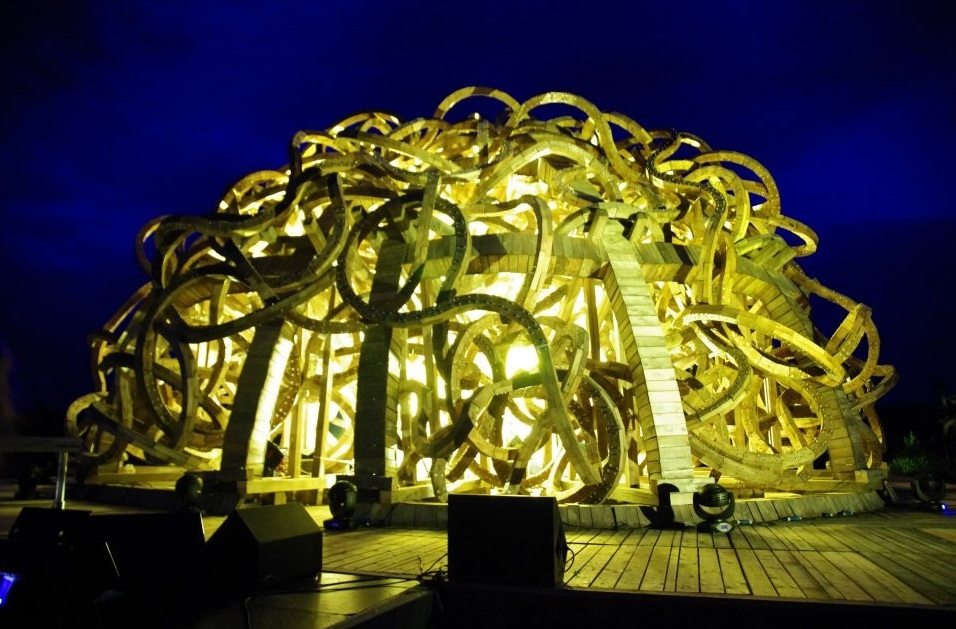
Russian Woodsmen Revival Style

Modern. Whimsical. Organic.

Where on earth would you find a place that fit those descriptors?

In the Russian village of Nikola-Lenivets in the national park of Urga, that’s where.

It’s the village where Nikolai Pollisky decided several years ago to create gargantuan landscape art that can be seen and marveled at from great distances, and that he now creates for architectural festivals and installations all around the world.  Once an abandoned farm collective where persistent vodka use had all but wiped out the villagers, Nikola-Lenivets, has now found rejuvenation through artistic collaboration. Pollisky himself is a white-bearded, t-shirt and suspender-wearing artist who would find himself right at home in a tavern amongst groups of lumberjacks and carpenters.  He’s a far cry from the tight-suited, salon coiffed metropolitan art types that perpetuate the myth that good art should be inaccessible to some.  Pollisky on the other hand, believes that “art should be understood without any explanations.”  He pays his villagers for their contribution, giving them both life and a practical livelihood.

Here are a few of Pollisky’s collaborative creations.  Some look like alien constructions, while others harken back to a time of nymphs, elves, and ancient tribes.   Yet, there are others that wouldn’t be out of place at MoMA with their sharp edges and refined lines.  All the pieces are united by their landscape and the inescapable naturalism that oozes through their materials.

Image Credits: http://bloodandchampagne.com/images/bloodandchampagne5062.jpg, http://russiatrek.org/blog/art/art-park-nikola-lenivets/