The Art of Blank Space

First, I’d like to introduce myself to the wonderful machine of information that is the Internet. My name is Taylor Portela, I’m a junior studying English and Philosophy, and I work at the Spectrum Center. I love cheese, I read everything I possibly can, I dance and sing on the way to class, and I’m attached to the elliptical most days. But for this brief time, every Friday, I will discipline myself to keep my fingers typing, words a-spewing, and thoughts forming into a web so dense that it might, just maybe, make sense.

Living in Ann Arbor has many great advantages: the food, the trees, the people, the free things. However, one thing that is lacking in most places is blank space: the one wall that extends forever in a rhythm constant and defined by one color. Or no color. Or the sky that has no clouds in it that looks as if you are looking at the bluest blue. Or the ground without grass, without dirt, but only a foundation to stand on.

October 19th is stressful and hectic for me, shoot, this whole “mid-semester” business is. When I try to escape to the library, I’m bombarded by signs on the wall, when I flee to the café, I’m surrounded by people, and when I go home, I’m encased in vegetables. There is no finding blankness in life, so I crave blankness in art.

Now I am no stranger to the critiques of so-called contemporary art: the loosely defined squares, the canvas with nothing on it, the lone light-bulb hanging from the ceiling. But it is no critique of mine. Now I will withhold, for the present, a lengthy theory-ridden discussion of why it not only is art, how they could be deconstructed further, what meaning is even there, or what that upside-down-urinal says about your unconscious, instead I will say that what they all have are  instances of blankness.

Why blankness? Why is the absence of color, of shape, of obvious meaning, of everything so important to living? (Yes, bold claim, but just wait….I’ll get bolder.) Because we get no space that is just pure space. Even outer space isn’t space, dammit. There are comets and planets and dark matter and aliens and before long there is more out there than in here and then there is nothing else to do besides light a candle drink some tea and cry as you listen to Tchaikovsky. Once that gets old though, and believe me it does, I’ve looked for the supposed instances of “empty.”

The third floor of Angell Hall, near the English Professors offices, and the large room on the second floor of UMMA in the travelling exhibit space have some of the blankest, emptiest spaces I have stared at.

“What are you doing? Are you ok?”

“Oh yes, I’m just staring into the blank, into the void, no worries.”

So, I admit that I’m crazy. If you see someone staring at nothing, surprise! It’s me. But there is something so exhilarating and so calming to look at nothing. The nothing acts as the medicine I need for modern day society. If I have to continually look at naked people trying to sell me plastic bags or animals trying sell me cars that don’t guzzle gas like I guzzle coffee, I’ll let the world on fire! So to tame the beast that is my troubled soul, I stare at nothingness.

Blankness allows you to project your own images on them. It allows you to slow your breathing and calm down. It lets you take a pause from the day. It acts as an extreme form of meditation in that I’m not in my mind, or outside of my body, there is no me involved but I’m embedded in the act of gazing at surface. It is the ultimate transcendence rooted in pure aesthetics of the other.

Or it really is just blank space.
Ampersand

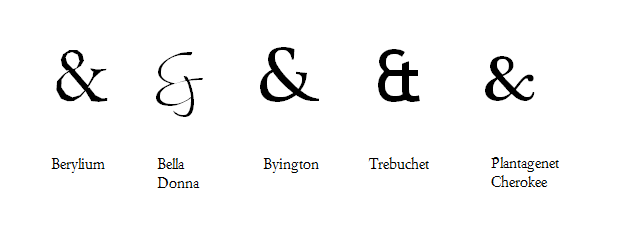
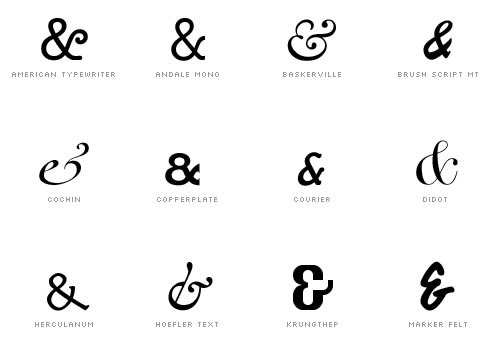
The ampersand is one of the most flexible symbols in our alphabet, allowing an impressive range of interpretation and aesthetic freedom. But how can the appearance of this swirly bit of confectionery be related to its function but in an arbitrary way?  What’s to stop someone from drawing an elephant, for instance, and declaring it to mean “and”? There is, as it turns out, a surprisingly logical history. Concisely put, the ampersand is literally the physical representation of the Latin et (et cetera, et al.)— “and.” In some typefaces, this is still visible.

In the second and fourth examples, the letters e and t are distinguishable. The other fonts are, essentially, variations upon variations of the same basic design. What appears to be a single symbol is in fact a ligature, which is something consisted of two joined graphemes— basic written units (letters, in the case of English). In turn, the ampersand as a whole is categorized a logograph, a symbol that represents an entire word.

And the word itself, “ampersand,” comes from “and per se and,” from when “it was common practice to add at the end of the alphabet the “&” sign as if it were the 27th letter” [wikipedia]. After z would come “and” by itself, or per se and— hence, “and per se and.”

Using the ampersand in writing is usually an informal and dashed affair, such as one might do when taking notes in shorthand. A quick little e with a line cross it, perhaps. In formal writing it is little used, except in titles and names. Yet this symbol can be a oddslot template that allows a great deal of artistic license. The construction of the ampersand, like any other letter of the Latin alphabet, must be recognizable, but outside of that, can manifest itself in any fashion. It might have fewer constraints than any of the twenty-six letters, even, because its appearance does not have to be legible, immediately recognizable, able to be processed in conjunction with other symbols. And in the end, really, the ampersand is easily one of the characters with the most creative potential.

New Blogger!

Hi! I’m Victoria and I could not be more thrilled to be one of your new arts, ink. bloggers. I’m a senior studying English and Art History, with hopes of one day becoming a museum curator. When not in class or staking out in the Ugli, you can find me running, doing yoga, being a student docent at UMMA, editing the Hillel newsletter, and trying to soak up every last minute of my tenure in Ann Arbor!

I am an art enthusiast and museum groupie, I can spend hours (and hours) in a museum without tiring (and go back the next day to do it all over again). To describe my love for art as an obsession is an understatement. De Kooning, Matisse, Koons, Warhol, Picasso and Rosenquist are among my favorites, although I could spend hours pouring over a Gauguin or a Whistler (my artist crushes are seemingly endless!)

I hope to take you along my exploration and discovery of art at Michigan, from exhibitions at UMMA to student work, as I learn about the incredible artistry that this campus has to offer.

Our Noble Steeds of Steel

Street Signs of Bike Cognizance
Adaptations for bicycles

Like most college towns and urban areas filled with high pedestrian traffic, bicycle lanes and parking structures encourage the inhabitants of an area to bypass automobiles. As a result, the bike has become a pivotal tool used by the residents of Ann Arbor. Like any well-used tool, a relationship comes to form between the user and the object. Not like some Golem-esque petty obsession where the owner screeches ‘my precious’ upon interacting with an object, but a meaningful mutual relationship. By providing the object with respect and TLC, the object can provide proper working condition to its user.

If only this was the case for these poor specimens of abuse…

*WARNING*

The following images are graphic and may be disturbing to some viewers.

When we become drones of day-to-day living, ants marching about our mundane existence, we tend to overlook the violent disregard of our environment. We are desensitized to the mangled machines and twisted tools we have so carelessly disregarded and left to waste. What were once stallions to carry us through our daily routines, we let our bicycles take a downward spiral and succumb to rust and decay until they are no longer usable, like great horses put out to pasture in a desert.

As I walked outside Mason Hall yesterday afternoon, I could not help but notice the rusted bicycle chained to a pole beside one of the common walking paths. Ever since my first day at the University of Michigan, over a year ago, this bicycle had been tethered here. The tires were deflated to noting. The rims were speckled in blobs of orange rust. The chain had deteriorated off the bent gears. Forlorn, the bike remained bonded to its pole beside the cement path. Hundreds of students passed by it every day, but none held the key to its lock. Nobody cut it free. Just like nobody had come to grease its chain or fill its tire. It filled me with sadness.

I wanted to tear it free from the pole, give it a new chain and scrub the rust from its rims. I would slip on a new tire and polish up its finish. I could install a new seat or replace the handlebars. Refurbish this decaying beast and transform it into my noble steed of steel (if that’s what bikes are made of). Cruising beneath the late-afternoon sun, I would go about my life and draw attention to my stallion. My journeys to class or work would become a daily display of art.  It would instill a sense of pride in my life, in something as simple as a bicycle.

As it turned out, I would not be the first to perform this rejuvenating act. As I continued on my walk, my feelings heightened with this fantasy of restoration. I became even more inspired by the wonderfully original bicycles in motion. Many of these were minimalistic in design; single speed, thin tires, no brakes, no stickers on the frame or unnecessary accessories. Standard hipster bikes. Some adopted more vintage features, with unique paint-jobs and varying seat styles. Some had baskets or uniquely-shaped handlebars. They were each beautiful in their own way. Each a piece of art.

While they are simply tools, vehicles to aide in the day-to-day transport of our lives, these bicycles embody something more. They are a part of us. Let us treat them appropriately. And make them into something beautiful. Something we can call art.

Arts-Related Nostalgia and Goodbyes

It’s the last day that I will be taking classes at the University of Michigan.  This called for some grade-A, mascara-running, life-pondering, empty-feeling nostalgia and sadness.  Instead, I have decided to blog about just how lucky I was to experience this university, this town, and all of the art is has to offer.

So, here it is.  A list of the things I am glad to have experienced and sad to leave behind (in no particular order):

UMS.

UMS is a truly unique program for the University of Michigan.  Through UMS, we are able to see some of the best performers in the world for as little as $10.  That is just cool.  Some of my personal favorite UMS performances have included: Bill T. Jones’ Fondly Do We Hope…Fervently Do We Pray- I think this was my first UMS experience and it turned my expectations of dance and dance theatre upside down; The Cripple of Inishmaan, which showed me how simply great theatre can be done and proved to me yet again the power of good writing; Audra McDonald who I had been wanting to see perform live for at least 10 years and was not the least let down by; and Einstein on the Beach because I had never before seen something of such wide scope, innovation, or ambition.  My only regret is that I did not take more advantage of these wonderful opportunities.

The Ark.

I first went to The Ark my sophomore year to see one of my favorite bands, Blind Pilot.  The Ark is one of the most genuine spaces to see live music.  If you don’t know what I mean by that, you haven’t been there.  There is something so personal about having a staff made up of volunteers who have themselves been going to the concerts for years.  The space is intimate and bands seem to really feel at home there.  Additionally, one of the more Ann Arbor-y events I have attended in my time here was last year’s Folk Festival.  Getting to experience that classic model of folk shows that goes on for hours, ended by an out of this world set by The Avett Brothers was an experience I will never forget.

The Blind Pig.

While the atmosphere at this venue is very different from The Ark, the intimate, honest performances remain the same.  The Blind Pig feels like a space from a different era.  It’s like a safer CBGB’s- there’s a grittiness and friendliness that permeates the air.  And also, on my own nerdy level, I feel way cooler when I’m at the Pig.  And that’s always a good thing.

Porch music.

I was reminded of this in the best way possible the other night when walking back from The Rude Mechanicals’ aesthetically amazing production of Machinal.  It was a beautiful night, and as I walked down my street, I heard some really skillful bluegrass coming from the porch of one of the co-ops.  In that one moment, I felt like I was fully experiencing spring in Ann Arbor.  I am not a musician myself, so being able to just walk by really talented people playing because they feel like it and love what they’re doing is comforting and purely joyful.

Basement Arts.

I’ve expressed my undying love for Basement Arts on this blog too many times to subject the readers to that lecture of adoration again.  I will just say that Basement was my gateway into the theatre world on campus, I have made some of the best friends I have ever known through Basement, and I admire the daring spirit of all hands on deck free theatre that is present in Basement.

The Michigan Theatre.

The Michigan is one of the most beautiful buildings I’ve ever entered.  When you walk in, you feel as if you’ve been transported through time.  The sounds of the organ floating through the air, the buzzing audience awaiting a really great lecture, movie, or concert, the brilliant tapestries and paintings filling the space– there’s really nothing like it.  I’ve seen some great movies and invigorating talks in The Michigan and the combined intellectual and visual stimulation with the beauty around me made me feel, “This is how it’s supposed to be.”

The music and dance departments.

I put both of these departments in one category, because, unfortunately, I have not experienced them as much as I would have liked.  But I have deep admiration for the students and professors in these departments who consistently turn out professional products. They explore a beauty and vulnerability that has really touched me.  I can’t wait to see what they’ll go on to do .

Witt’s End.

Now we’re getting to the personal part of the blog.  I just joined the improv group Witt’s End, and it was one of the smartest decisions I have made.  Being surrounded by these funny and smart people has made me a better and more interesting person.  I have become a more spontaneous and gut-driven person.  I am more quick on my feet.  I have learned to trust myself, and I happened to make some really great friends in the process.

The Theatres- Mendelssohn, Power Center, Arthur Miller, and Hill.

I feel so lucky to have been able to both be an audience member and somehow involved in a show in each of these spaces.  There is something incredible and otherworldly about standing on these stages.  During my time here, I have also had increased respect for the audience.  I really enjoy being an audience member.  There’s something so communally beautiful about going on a journey with complete strangers.  These theatres have become my home away from home the past 3 years, and I will really miss that safe space to explore and shape my artistic sensibilities.

The Department of Theatre & Drama.

My family.  My companions through this coming of age stage.  My collaborators.  My teachers. My friends.  I do not know how I can possibly leave all of this behind.  I have learned so much from every single person who has passed through this department in my time here.  I know that I will have the opportunity to work with some brilliant people in my career but I cannot fathom how any experience can match the emotional and intellectual depths of the personal and professional relationships I have made in this department.  I have undying gratitude.  I have learned so much from my successes and failures in the Walgreen and around campus.

It’s going to be very hard to leave all this behind.  In tough moments like these, I always return to the incomparable Tony Kushner and his words from Angels in America: “Nothing’s lost forever.  In this world, there’s a kind of painful progress.  Longing for what we’ve left behind and dreaming ahead.”

Performance Art

I’ve been thinking a lot about performance art lately. This may or may not be related to the fact that I just recently performed in a piece that might be called performance art, but I don’t know for sure. Its a topic that has fascinated me for a long time. In case you don’t know what “performance art” is, here’s how wikipedia defines it:

In art, performance art is a performance presented to an audience, traditionally interdisciplinary. Performance may be either scripted or unscripted, random or carefully orchestrated; spontaneous or otherwise carefully planned with or without audience participation. The performance can be live or via media; the performer can be present or absent. It can be any situation that involves four basic elements: time, space, the performer’s body, or presence in a medium, and a relationship between performer and audience. Performance art can happen anywhere, in any venue or setting and for any length of time. The actions of an individual or a group at a particular place and in a particular time constitute the work.

That might be the least helpful definition ever. But it’s ambiguity is central to what makes performance art just so interesting and engaging. It can be anything. There are no rules. Just make some art. And that makes performance art awesome!

And performance art is, like, Yoko Onos thing. And who doesnt like Yoko Ono?
And performance art is, like, Yoko Ono's thing. And who doesn't like Yoko Ono?

Perhaps the most well-known of the performance artists (that I’m familiar with) is Laurie Anderson, a wonderful musician/spoken word artist/visual artist/performance artist. She plays the violin, but only sometimes. She also plays the electronics…pretty much all the time.

So is this video performance art? Maybe. You are the audience. You are watching it. But it certainly is recorded and doesn’t exist in space so much. But that distintion really doesn’t matter, I suppose. This song(?) is Anderson’s biggest hit, her breakthrough single. It’s a pretty solid representation of the kind of work she does.

But this is all around the central point which is that I love this. There is so much humanity in it all-it’s just this woman telling a story. But she’s not even telling a linear story, she’s a mother calling for her daughter and then she’s not anymore and superman and wars and what? It’s beautiful though. The music. The words. The vocoder that makes her seem like a human but also not a human and is technology the distance between us or the rope connecting us? It all raises a lot of questions, but questions that don’t necessarily have answer or want to be answered.

Anderson came to the Power Center last year and stupefied me through her piece “Delusion.” It was one of those experiences that I couldn’t quite shake off. I loved the newness of it all, but also the power of it all. She told stories with musica accompaniment for the duration of the entire show. Some were connected, others weren’t. But it created a plot. Not a narrative, but  a sense of emotional journey during the show. I can’t remember the details anymore of it all, but I do remember the feeling after seeing it. Like I found something amazing and whole and unique. Like I witnessed an art form that has never been seen before.

And I suppose that’s what performance art makes me feel like. Each piece is it’s own little world and has it’s own little rules. But it is beautiful. Or at least it is to me.

More on this later…