Discovering innovative new uses for space has become a new trend among contemporary artists and architects. For those people working in cities where the densely packed urban environment leads to smaller confinements of space and limited building sizes, space becomes a hot commodity and so does creative thinking.
For one architect in Hong Kong, this issue of space became highly problematic in one of the densest cities of the world. Gary Chang, coping with the tight space wasn’t necessarily a towering obstacle; rather it became another problem to solve in his field of design. Desiring to live in the tiny three bedroom apartment formerly owned by his family, he decided to take space into his own hands. Creating a “futuristic” system comprised of wheels, tracks, and much glass and metal, Chang transformed his cramped home of childhood into a highly efficient and eco-friendly adaptable apartment. With moving walls and furniture, Chang is able to create 24 different rooms and designs in his small 33x10ft (approx.) flat.
Halloween is one of my favorite holidays. Â At what other time of year can you see a hippie, a whack-a-mole, and the jolly green giant proudly walking down the street together? Â I love seeing the clever costume ideas people come up with at Halloween, and all of my favorites have been homemade.
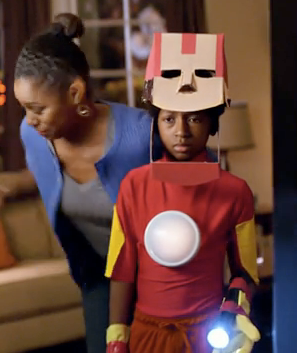
In Target’s Iron Man costume Halloween commercial, which can be watched here, we’re shown a kid in an Iron Man costume his mom made. Â The premise is that the costume is much less cool than the store-bought version. Â As much as I love Target, I just don’t “get” this ad; I thought the kid’s homemade costume was awesome! Â Sure, the push light on his shirt fell off part way through the commercial, but with a little ingenuity, that could easily be fixed. Â The homemade costume may not have been the most accurate representation of Iron Man ever, but it was cute, clever, and 100% unique.
I just don’t think you can beat a homemade costume. Â Not only does making your own costume force you to be creative in bringing a costume idea into reality, but it also gives you so much more freedom in deciding what you want to be for Halloween. Â Anyone can walk into the store and pick up the latest witch’s hat, but when is the last time you saw a whack-a-mole costume hanging on the supermarkets’ shelves. Â Most costumes are fun, but homemade, super-creative costumes will always be the best.
Space chords are perhaps among the most beautifully chilling sounds in existence. Like a proclamation of terror and enlightenment, of omnipotence and microcosms, of everything and nothing at once, space chords are nothing short of awe-inducing.
Observe, the Blue Devils at warmup:
(Skip to 1:08-ish to cut straight to it.)
To be honest, I know little about this musical phenomenon. A quick Google turns up nothing particularly explanatory, and it seems that the majority of results are of the brass section of some professional drum corps going away at their warming-up or tuning exercises with impressive skill and precision.
I’ve always wanted to know how these chords were constructed, but never, never, could I pick apart exactly what notes were in there (I’ve a bad ear for that sort of thing). Somehow, “simultaneously playing every note in existence†did not seem like it would achieve the intended effect. Apparently, space chords are particularly finicky and there is a finesse to getting them in tune.
Consider: that’s not only a bit of dissonance, such as one gets by playing two notes very close to one another at the same time (like the jarring wails of sirens and alarms), but it’s dissonance on top of dissonance. They cannot be so messy so as to be a meaningless jumble or sound, nor can they fit too well and become suddenly harmonious. It’s a tricky one to balance.
But what defines the allure of the space chord? It is in human nature to shy away from discord and conflict, from clashes and horrid sounds that grind and screech against one another. Harmony offers a path of less resistance, seems natural and pleasing to the ear, and does not require shoving a shoulder against the offending sound with a lopsided grimace and proclaiming, “of course it sounds beautiful!†In medieval times, the tritone, a far simpler and more common form of dissonance, became associated with the devil and was subsequently banned by the church. The space chord? Like a tritone, multiplied tenfold. Even I occasionally wince a tad upon hearing one. They are, admittedly, an acquired taste.
That, perhaps, is what one might see in these unusual chords. There is a sort of otherworldly, indefinable quality to them, something that is off but not off, something that is almost right but not quite. The sound, the eerie feeling, is everywhere and nowhere all at once, now and in the past and the future. It might foreshadow something ominous, but is so much greater than you, so beyond the scope of your comprehension and your ability to do anything about it, that there is naught to do but to listen. It’s strange, and it’s beautiful.
For some people, Facebook is their method of procrastination. For me, it’s YouTube. A few of you may know my love for a good Youtube cover (Gabe Bondoc, anyone?), so I have decided that for this week’s blog I would share with all of you another one of my favorites.
Her name is Meghan Tonjes and she has a truly soulful voice. A Michigan native, Tonjes does both regular covers and clever mash ups. Some good ones include her mash up of Taylor Swift’s Innocent with Kanye West’s Runaway and of Taylor Swift’s Mine with Katy Perry’s Teenage Dream and Ellie Goulding’s Starry Eyed. I also love her weekly Glee sessions where she covers songs featured on that week’s episode of Glee. However, if you are looking for some new stuff to listen to, Tonjes also has a lot of good originals to choose from such as The Weight Of. Part Ingrid Michaelson and part Jewel, Tonjes is definitely one of those artists who can get you through a tough night of studying! Here is a sample clip:
In 2009, a huge hubbub arose when a Danish comic artist portrayed the Muslim prophet Mohammed with a bomb on his head in place of a turban. Muslims, whose Islamic law forbid any visual representations of their God (to avoid idolatry), became extremely offended by this obvious suggestion of Mohammed as a terrorist. Thousands of Muslims worldwide protested the posting of this drawing in all forms and many threatened the artist and any involved members of Danish newspapers that printed this image.
A Saudi Arabian law firm filed a suit against all of the Danish newspapers that published this cartoon. The letter stated that the drawing was offensive and insulted the many ancestors of Mohammed, as well as his followers and demanded an apology and removal of any offensive material. Recently, one newspaper organization, Politiken, apologized for the reprinting of the cartoon and stated that it was never an expression of the newspaper’s beliefs or opinions, but a mere transmission of regular news content.
Upon hearing about this incident when it first broke out, I could see both sides of the issue. On one hand, yes, to be a Muslim and to see this kind of image would be very offensive to me, especially because it presented a negative view of a part of my belief and culture that was highly integral to me and my life; and should this comic have depicted something or someone as important to me as Mohammed is to Muslims, I, too, would pissed off.
However, as an art historian, I believe that a drawing like this is acceptable. It is not pleasant, to be certain, and it is certainly not flattering, but in its essence, it is art. Art throughout the ages has always been inflammatory and highly contentious; from the “Castration of nudes” in the Vatican (i.e. removing penises and putting fig leaves on the genital regions of statues) to increasingly sexualized images in photography during the 1980’s, art has proven to provoke debate and incite wrath upon itself.
Everyday, I see images that intrigue, infuriate, and entice me. Some images evoke more emotions than others and lead me to ponder about the issues presented and others pique my interest only to die down immediately after. Theoretically speaking, if art, as many say, is just a means of self-expression and as human beings we have the right to express ourselves, then why shouldn’t someone have the freedom to draw and say what they wish?
Yet this kind of thinking is reserved for the purely ideological realm; in the real world, everything is mired by politics and bogged down by personal motivations that often the lines of freedom get blurred and the definition becomes hazy. We all want to be politically correct so we censor ourselves and hide our real thoughts and intentions. We realize that it is not appropriate to say or do certain things in various contexts, but we are cognizant of the fact that even these norms change with time and cultural shifts. Right now, in this time, the world is not prepared for this kind of drawing and perhaps it will never be. But I don’t think that means one should not create such things; merely that one should be more careful about the avenues by which they display their work and more considerate about the people it may affect.