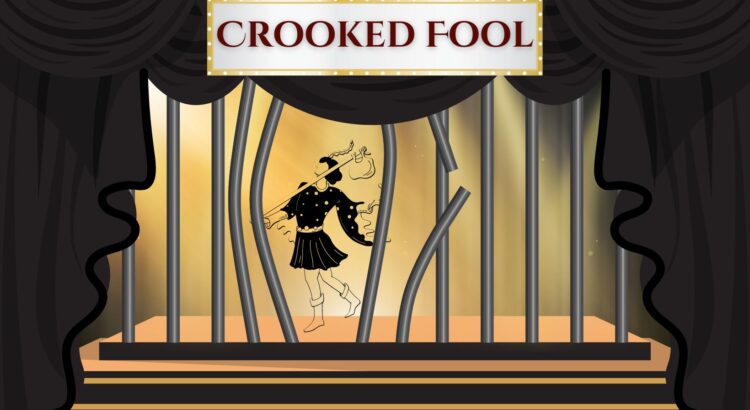
Crooked Fool: Who are the “real” artists?

I recently closed a professional, devised show in Detroit. For anyone who isn’t familiar with this type of theatre, it basically involves a group of performers building an original show from the ground up, often utilizing games and improvisation. When we were rehearsing one day, I started moving along with a poem being read by another performer.

And then the question came: are you a dancer?

And oof, that’s a tough one.

So first of all, because I am stubborn, yes. In small part due to a random smattering of dance classes, mostly in adulthood, and in much larger part due to some pretty extensive physical theatre training, I have a degree of body awareness and creativity, and I move to express beauty and tell stories. So yes, I dance.

But that’s not what I told them.

“It’s complicated.”

I’ve taken some dance classes. I’ve tried out a lot of styles. I’ve done some work developing stamina, flexibility, and somatic awareness. But, despite the way I think about my own identity as an artist, I’m also keenly aware that there are plenty of people – many of them dancers – who would not view that label as accurate.

As a child, my dance training was limited to a few classes at the Y. I did not spend years in ballet or modern technique classes learning the correct ways to position my feet or perfecting my placement. Instead, when the theatres all closed during the pandemic and I ended up with a bunch of free time on my hands, I started taking adult dance classes. It started with various hip hop styles, such as popping, locking, and breaking, then branched into the somewhat scarier and certainly more daring circus arts, like silks, pole dancing, and parkour, before coming back down to Earth with styles like modern and contemporary. Even now, if somebody tried to verbalize some kind of choreography to me, it’s still a crapshoot whether I’ll have any idea what they’re talking about. Though it’s worth noting that I can do quite a lot if somebody explains movements in terms of body mechanics instead of dance vocabulary.

So, this time, I’ll pose the question to you: am I a dancer? Can I call myself a dancer if I didn’t spend my entire childhood learning technique and then ideally perfecting it in college? If my aesthetic is less “point your toes” and more “let’s try this weird thing and see if it looks cool?”

There’s a lot at stake in this question. How should I think of myself artistically? What are the “right” labels?

But most importantly: who gets to call themselves an artist?

Because if the only people who get to be artists are those who can afford thousands of hours of classes and do things the “right” way according to the standards of the dominant culture, that’s a really big problem.

First: how many hours of dance classes does it take to perfect the minutiae of technique? And more importantly, how many people can afford that many dance classes? As a kid, I sure couldn’t. I don’t necessarily think that there’s anything wrong with learning technique in dance or any art form. There’s definitely some benefit to have more tools to pull from when creating. But I do think there’s something inherently elitist and exclusionary in saying that there’s only one right way to create, and that only those with enough money and resources are allowed access.

The some obvious unfairness to telling people that if they can’t afford “real” training, they can’t be artists. But there’s an even bigger problem: by telling people that only those who can afford extensive training get to be “real” artists, we’re ensuring that art remains a domain only for the wealthy and powerful.

Narratives govern our lives. Tsubasa Yamaguchi famously said, “Art is a language without words,” and I’m inclined to agree. Because we can say more through the arts than we might be able to with words alone, making and sharing art in its various forms allows us the chance to challenge dominant narratives. If we tell ourselves the story that everything’s fine, nothing will change. But if we can alter the story we tell ourselves to say that change needs to happen, there’s some chance that it actually will. People will only try to change things if they believe something is wrong. Change the story, change reality.

So here’s the thing: if only the privileged make art, privileged narratives are perpetuated.

Part of moving towards a more just world is being open to expanding our ideas of what counts as normative, good, and beautiful. And in all of these cases, but particularly in regard to beauty, the arts have a unique ability to challenge entrenched ways of thinking and help us to see beauty in new places. By taking away the gatekeeping around what counts as a “real” artist, we allow more people the chance to challenge narratives that fail to acknowledge the beauty and goodness in those who don’t fit our reductionistic, colonized ideas of who “deserves” or has “earned” these labels, based either on having inherent traits that are favored, or by developing normative traits through conformity and compliance.

So what does it mean to tell me that I’m not a dancer? To say that because I move differently than I might if I had trained in more conventional ways from childhood, my body can never fit within the imposed parameters? What does it mean that my body, ever crooked due to scoliosis and sometimes uncooperative due to chronic illness, will never hold itself the exactly the way a dancer body “should?” If I can’t dance right, should I never dance at all?

Movement has been my primary means of managing chronic pain for years, and for this reason among many others, I refuse to believe that my identity as a creative mover, a researcher of my own body, as a DANCER should be locked up in an ivory tower that I can only access if I force my non-normative body to behave itself and cough up money and resources that I don’t have. Because then my body would just be another “weird,” “ugly” body that would never get to move at all. Movement should not be a privilege reserved for the white, cis, straight, or able-bodied.

George Washington Carver said, “Education is the key to unlock a golden door of freedom.” And I don’t necessarily disagree. I can still see the value in working with great teachers, getting feedback, introducing yourself to new ideas and aesthetics, and pushing yourself as an artist. But given the power dynamics and barriers still inherent in education and training, I don’t think it’s fair to lock people out and tell them their creativity and perspectives aren’t legitimate if they can’t access these things.

So yes – because I have put in the work to study my own body and explore various styles of dance, and because I am challenging notions of what physical beauty and expressive movement can be – I am a dancer.
From nothing

Joy is, in itself, a worthy cause

But even it needs to be created

We are told that our feelings are somehow superfluous

Not real

Yet they can be altered

Changed

By outside forces

You tell me that this strange spirit on the stage isn’t real

Yet I see

The body move, gesture

Breathe

And is something in me not changed in seeing it?

Bodies moving

With each other, and not

Gesture

Breath

Voice

Move into the light

And that’s already a change.

Move downstage

Change

Ensemble in formation

Grasp onto another

Change

Lament

The gaze moves

Change

Meet an audience member’s eyes

And they are changed

A tear

Change

A laugh

A moment to the next

Draw breath

Maybe the soul on the page has never lived

Or maybe they’ve lived and then moved on

But now they breathe again

Exhale

Once I was you

Someday you will be me.

Are you angry yet?

Sad?

Joyful?

Relieved?

Have you yet been changed?

You will be.

Step into the light

Draw breath

Fill the body

Wake up the spirits

Don’t tell me magick isn’t real

This space is charged with light

Buzzing

Every body overfilled with life

And you are a story made flesh

Move, speak your spells right now

There are even witnesses

Invite them in

Mistakes are easily forgiven

Only one thing really matters:

Conjure.

A Crooked, Queer Meditation on The Fool

The first tarot deck I ever bought was the Fountain Tarot, and their description of the Fool reads:

“Suspended between spiritual and Earthly existence, the beautiful Fool is the newly born soul embarking on a bright adventure…Though some find his quest absurd, he is not swayed. With an open heart, he is led by the inner voice of his true Self.”

In the major arcana, the Fool comes first in the deck, before many other archetypes such as The Priestess, Magician, Devil, and so on. The Fool has yet to experience either the highs or the lows of their journey and relies on their inner compass to guide them. Because they don’t have much experience to draw from in their journey, they have to become comfortable living in the unknown.

The Muse Tarot, a favorite of mine, includes a poem at the end of every card description, and for the Fool Chris-Anne writes:

Fearlessly jump into

The sea of the cosmos,

The spinning potentials are calling

maybe a little foolish today

yet better done fool-like

than stalling

Chris-Anne reminds us that sometimes we don’t have the luxury of knowing what’s going to happen or what the right course of action even is, and we still need to act. The show must go on.

One of the greatest steps I took in my artistic journey was embracing the fool. This was both an act of taking the pressure off myself to know everything, and acknowledging the ways in which I’d have to trust myself and my own inner knowing over industry norms that want nothing to do with a Queer, Disabled, Deformed femme actor. The rules as they existed left no space for me.

My own Fool journey was one of coming into deep understanding of the power of transgression. When I was training as a clown, one exercise involved thinking of a common activity, and then coming up with as many ways as possible to screw it up. How many ways can we do the most basic thing wrong? And where is the joy in doing so?

The Fool often doesn’t know how to do things “right” and may not even have any concept of the socially sanctioned ideas of right or wrong, good and bad, acceptable or not even are.

I think back to my childhood self. I was viewed as “crazy” for laughing too loud and too much, or just making weird noises in general, particularly when I wasn’t supposed to. Simultaneously, I was viewed as “angry” because I just couldn’t accept things that I knew deeply to be wrong. Whether it was through laughter or soapboxes, I was calling out absurdity.

Britannica describes the Fool as “a comic entertainer whose madness or imbecility, real or pretended, made him a source of amusement and gave him license to abuse and poke fun at even the most exalted of his patrons.”

The entry goes on to say that the Fool is “often deformed, dwarfed, or crippled…”

You’re telling me…

I spent the first decade of my time in theatre with a 90-degree curve in my spine. This was never meant to be a statement on anything; we perform with our bodies, and this was the body I had.

This Fool asks: Who determines beauty, and why can’t it include me?

Judith Butler said, “Gender is a performance that is repeated and becomes constructed through time.”

In this quote, Judith Butler is addressing the concept of performativity, which they discuss often in their writing on gender. Though it may be tempting to think of performance as something imaginary and fundamentally unreal, Butler argues (as paraphrased by me, a Fool) that performance affects very real change. To perform is to change something. Performing gender makes it real. By taking actions associated with and attempting to look like a given gender, human beings create gender. And it can be recreated anew, and it can look different than before. (It’s worth noting here that the Fool archetype has a long history of breaking down gender norms; my own clown, Pookie Ra Ra, is meant to be a teenage boy, but has noticeable breasts because I don’t like binding).

The Fool asks: What else can be performed differently? How can we change the show? What can we make and remake?

The Fool doesn’t necessarily have the answers. But they are not held back by what is. They remind us that where we lack answers, we can create them.

The Fool reminds us to embrace the unknown.

What the Fool offers us is hope.

“Hope locates itself in the premises that we don’t know what will happen and that in the spaciousness of uncertainty is room to act.” – Rebecca Solnit

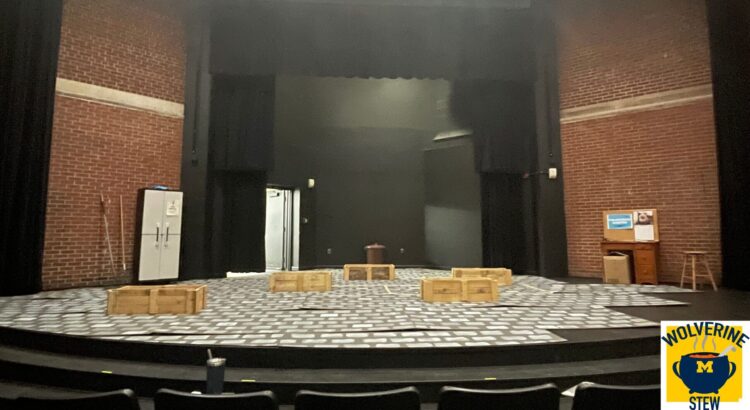
Wolverine Stew: To The Keene

Tropical shirts and impromptu strings

And a dragon to watch over it all

Plastic ivy wrapped round found/fashioned staves

Tipped with hot-glue pinecones

Dancing screams filling the aisles

Green stars shooting into my eyes

Onto the curtains behind

A place where a rubber chicken

Is a great and terrible power

Paper carefully planted in plots

And watercolor paints

As a library is carried to the seats

And very soon that paper will bloom from

Blank black floors of the stage

That rise to fill the space

When the lights go out

And when they return

The dust rises in a dozen beams

And the show begins  

Looking Forward: Department of Musical Theatre

Happy Friday, arts, ink readers!

Courtesy of SMTD Website

This week I had the pleasure of speaking with Vince Cardinal, Professor and Chair of the Department of Musical Theatre here at the University of Michigan. He offered insights as to what the department does in a typical year, how they’ve been adjusting to the restrictions of this semester, and how students can still view and participate in theatre on campus!

If you didn’t already know, the Musical Theatre program here at Michigan is one of the best in the country. Professor Cardinal told me they accept less than 2% of applicants — roughly 20% less than Michigan’s already-competitive acceptance rate. This is, in part, because of the department’s incredible reputation; they are one of the most represented schools on Broadway and are increasingly being featured in TV and film productions as well. A typical MT major’s schedule is around two-thirds filled with musical theatre courses, with the rest left for general requirements, minors, or even dual-degrees. Through their involvement in University Production shows, as well as participating in a variety of student productions, MT students gain experience performing a wide variety of genres and become equipped for whatever opportunities come their way after graduation.  Check out this video featuring some Maize and Blue alumni:


Of course, like most programs, the Department of Musical Theatre has had to make some adjustments in their teaching and performing this semester. Almost all of their current curriculum has been moved virtual, except for dance classes, which have been reduced in density while utilizing masks and social distancing. Although having to teach and learn the performing arts online is obviously not ideal, Professor Cardinal told me that there have been some silver linings in all of it. For example, they’ve been able to bring in top-tier talent to help their students – including Andy Blankenbueler (the choreographer for Hamilton) and representatives from the Fosse Legacy. The increased access to such impressive professionals via video calls is something the department hopes to continue utilizing in the future. 

If you’re like me and the musical theatre productions on campus are something you look forward to, you may be disappointed that you can’t see them in action at the Mendelssohn, Power Center, or Arthur Miller Theatre. The good news, however, is that there are exciting opportunities to come! The department has been working to film a series of performances by their students called MT Ghostlight 2020, asking them to respond as artists to what’s happening to them at this point in history. These will be streamed on the first three Fridays in December – the 4th, 11th, and 18th – so mark your calendars! If you’re missing theatre in the meantime, you can check out the Senior Entrance of MT21

If you’re interested in participating in theatre on campus, Professor Cardinal recommends auditioning for one of the many student groups on campus such as MUSKET, Rude Mechanicals, Basement Arts, and so many more. He also noted that the Musical Theatre Department sometimes needs crew help for their shows. This semester, specifically, they are in need of videographers, sound editors, and other digital media creators to help them produce content in this new environment. Be sure to follow their Instagram @umichmusicaltheatre to stay up-to-date with what the current MT students and alumni are up to!

That’s all for this week. Special thanks to Vince Cardinal for taking the time to speak with me. Check back next week for a feature on the Shapiro Design Lab!


Stay safe!

Lucy

The Backstage Experience Part 2

This past week was the tech week of the fourth show I’ve done crew for this semester. That means that for four weeks I spent basically everyday from 6pm-12:30am in rehearsals backstage during a performance.

What was different about this one was the energy. I was on costume crew for Musket’s production of the show BARE. BARE is a show I already knew and loved, compared to the other three shows I’ve worked on this semester. Plus all the people involved were so dedicated an excited that it made me extremely happy to be there. BARE was the first show I’ve worked on in college that I’ve felt 100% invested in.

With the other three I just made sure everything with costumes happened correctly, and answered questions/ fixed things if they broke. While I still did that for BARE, there was the added fact that I really cared about the show itself. It made me more invested in the changes and overall process because I knew the story and the the importance of telling it. It was the first time I actually felt the opening night energy and closing show sadness when working on a show here, and that really showed me a lot.

Some of my favorite moments from working on this show were when a quick change (There were many in this show!) would go right and all of us on costume crew would be so excited and proud giving high fives and cheering silently!

If you didn’t get to see BARE you really missed out on some incredible performances by both cast and backstage crew in making the show come together!