REVIEW: The Future Is With Our People: Sustainability Art Exhibition

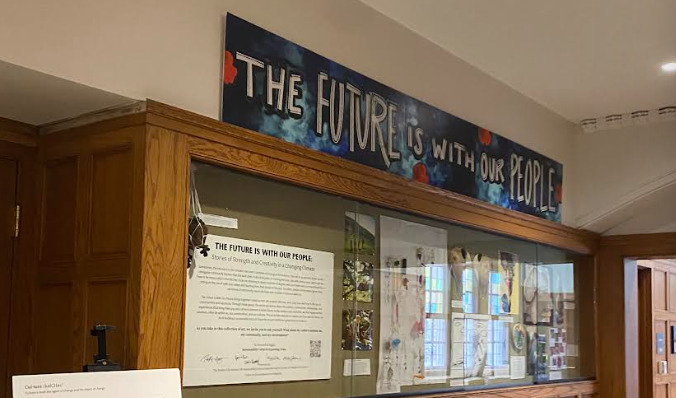
On the first floor of the Michigan Union there is a showcase full of stories, small moments captured in time that discuss the complex, yet integral, relationship between students and the environment. Amidst a time of climate crisis, this exhibition aims to remind us of the essential ways that we can heal through community, culture, and relationships, and how through these experiences we may discover paths to a better future. “The Future is With Our People” is an art exhibition created by the Student Life Sustainability Cultural Organizers and I cannot recommend it enough. Seriously. Go spend time with it. While you are at it, check out the Cultural Organizers and get familiar with who they are and what they do here — you will not want to miss out. 

The opening ceremony of the art installation, held in the South Lounge of the Union last Monday, was filled with music, storytelling, laughter and community. A group of ~10 students and members of the UM community, called to share stories of strength and creativity in a changing climate, came together to share these pieces of themselves. It was the perfect extension of the exhibit itself, allowing the flow of stories to seep into the audience through different forms of performing arts. 

“Labu Sayong” and “Peanut” by Shiryn Anissa Noor Affendi

The exhibit, on display until February 24th, is a collection of art through a variety of mediums that showcase the artistic ways we can have a conversation about climate and our place within it. The driving question behind the work is this: What about your culture sustains you, your community, and your environment? It is a beautiful web to weave between the shared sustainability between peoples and their environment, each being essential to the other. The artists that are featured allow the audience to look into what this relationship looks like for them. Although I wish the exhibit was given a larger space, its impact cannot be understated; I guarantee that each piece will make you think differently about how people connect with the environment, and the importance of culture and community within that. 

“N’Zaagidiwin biish” by Zoi Crampton

Each participating artist had their own unique piece of art and story to tell. Artist Shiryn Anissa Noor Affendi used clay to sculpt one of her pieces, “Labu Sayong,” representing a traditional Malaysian method of using a hollowed out gourd as a water container. She discussed the ways she must find connections between her heritage and her experience at Michigan in order to stay centered. Another artist, Zoi Crampton, collected plastic from the Great Lakes and threaded them together with intention to make a jingle dress, a teaching rooted in Crampton’s Anishinaabe culture, to send prayers toward healing community. Crampton ties this form of art to the healing of the Great Lakes.

I could go on and on about these artists and their stories, but it would make much more sense for you to go see it yourself. This exhibition deserves more time and space at our University, but I am glad to see it for the time that it is here. Thank you to the Cultural Organizers and every artists that participated and created this absolutely beautiful space on our campus.  
REVIEW: FASA’s Philippine Culture Night

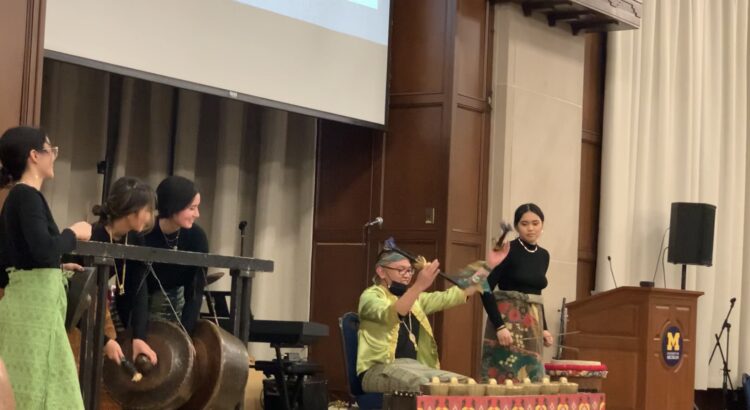
The featured image above is a performance on a musical instrument called a kulintang, and the weaving of the mallets represents the motion of weaving a basket.

Saturday night, the Michigan Union was bustling with activity for FASA’s long-awaited PCN. Everybody was elegantly dressed in long gowns and suits. The audience consisted of not only students, but friends, families, alumni, special keynote speakers, and even Filipino American student associations from Universities in Grand Rapids, Oakland County, and Dearborn.

FASA prepared multiple acts, such as various live singing performances (including a featured performance from FASOU, a student band from Oakland University), traditional instrumental music accompanied by dance, a poem reading, and many more.


A cover of “All I Ask” by Adele

This was the most memorable live music performance for me. The students covering the song showcased so much musical talent in their harmonies and synchrony with one another, and they’re not even an established music group. I don’t even see the same chemistry or skill in groups that focus on live singing.


The traditional music ensemble


The fan dance performed alongside the ensemble

What interested me the most about this dance is the lack of facial expressions on the dancers. Normally, facial expressions are a key focus in dance, because it’s the most blatant way to express emotional depth. In this case, the poker faces created a very elegant atmosphere.


Dance incorporating modern music with a cultural twist

This was another performance that really stood out to me. It was so much fun seeing how modern and cultural art can collaborate with each other. As they performed the traditional dance steps, students showcased goofy and joyful facial expressions in contrast to the fan dance performed just previously.


FASA’s band


A hip-hop dance to American and Philippine pop music to end the night


Unfortunately, there were serious sound issues at PCN. The mics often rang and that really took away from the experience. In addition, the technical difficulties dragged the event to become an hour longer due to frequent awkward pauses between and even in the middle of performances. Overall, it was an amazing, lively, and lovely event to attend. However, I’m not sure if I would come back to PCN next year because of how long it was. That doesn’t mean I wouldn’t consider going again, though, and I highly encourage anybody interested to attend the event next year!

REVIEW: Into the Labyrinth: A History of Physics From Galileo to Dark Matter

8:00pm • Friday, January 27, 2023 • Keene Theater

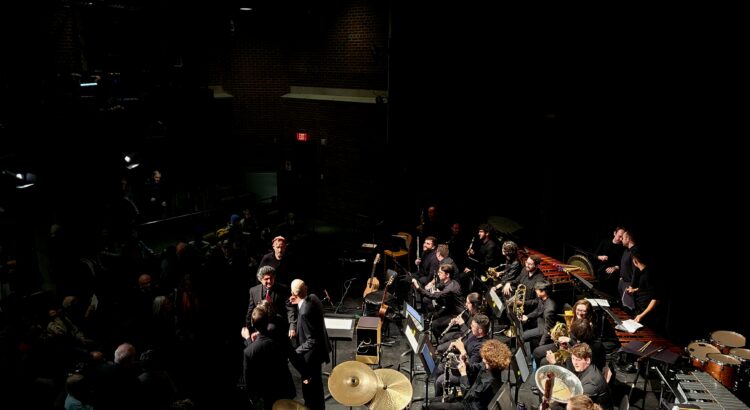
Into the Labyrinth was a mind-boggling musical experience, most of which shot straight over my head and toward the stars. The concert was a dynamic fusion of the history of physics, Argentinian folk music, jazz, experimental decaphonic guitar, sung poetry, and spoken word. The evening was structured chronologically, beginning with Galileo’s ponderings about the knowability of the universe, moving onward to Newton’s Laws of Motion, to Clausius’s definitions of thermodynamics, to the work Maxwell, Curie, Einstein, and other physicians who I didn’t learn about in 10th grade, to the physicians who pioneered the theory of quantum mechanics and electrodynamics. This brief history of physics was conveyed not only through direct quotations, but also through poetry and excerpts from Elfriede Jelinik’s play Kein Licht (“No Light”).

At the beginning of the program during a Q&A, Alberto Rojo, the work’s primary composer, explained how carefully he had chosen different styles of Argentinian folk music to represent the different eras of our understanding of physics. Again, most of this went over my head, because I have zero background knowledge on either subject. Instead, I related closely with Michael Gould, the work’s arranger, who in joking reference to the complexity of the piece said something like, “You just have to let it wash over you,” which I did.

My favorite movement was the last, which Rojo describes as “an open-ended appeal to continue the search for understanding.” The movement featured a “decaphonic” guitar that Rojo constructed as a way to explore different ways to divide up the musical scale. Typical Western music uses a seven-step scale, the one you’re familiar with if you’ve ever heard “Do-Re-Mi” from The Sound of Music. Rojo’s guitar took one interval of sound (the distance between Do and Do, if this makes any sense to you) and divided it into 10 equal parts, resulting in a sound that he described as “the music of a culture that doesn’t exist.” I loved how the idea of “discovering” an unfamiliar scale connected with the theme of scientific exploration and the unknown.

My overall impression of the concert was that of a wild experimental musical. I wish I could watch it a few more times over, to really dig into the details of the quotations and the music. I feel privileged to have been at its world premiere, and I hope Into the Labyrinth will see a successful future in front of further audiences.

PREVIEW: Into the Labyrinth: A History of Physics From Galileo to Dark Matter

What: the premier of an interdisciplinary musical performance narrating the history of physics and exploring the connection between science and the arts

When: Friday, January 27, 8:00pm

Where: Keene Theater, East Quad

Tickets: free & open to the public!

Into the Labyrinth is part-recitation, part-play, part-concert, a dynamic performance demonstrating how science can be interpreted and shared through the arts. A Q&A with three of the creative minds behind Into the Labyrinth–Alberto Rojo, Michael Gould and Nicholas Balla–precedes the show. Afterwards, the evening will feature a combination of narration and songs. The narrator, Michael Tulip, will read a combination of excerpts from the works of famous physicists and the writing of Elfriede Jelinek, a Nobel prize-winning Austrian author. Interspersed with the narration will be music for voice, guitar, drum set, and chamber winds, brass, and percussion. I look forward to seeing how the creators of Into the Labyrinth weave together the words–and worlds–of authors from the realms of physics and art to create an engaging performance that gets audiences excited about science.

PREVIEW: FASA’s Philippine Culture Night

We’re still in the beginning of the semester but various organizations are already throwing events. You’ve probably heard of the one coming up this Saturday: FASA’s Philippine Culture Night. Their pre-sale tickets went live last semester and sold out within 30 minutes! After various struggles and being put on a long waitlist, I finally managed to get my hands on a ticket to the overflow room. Unfortunately my seat isn’t the best, so I’m not sure if I’ll be able to get any good pictures.

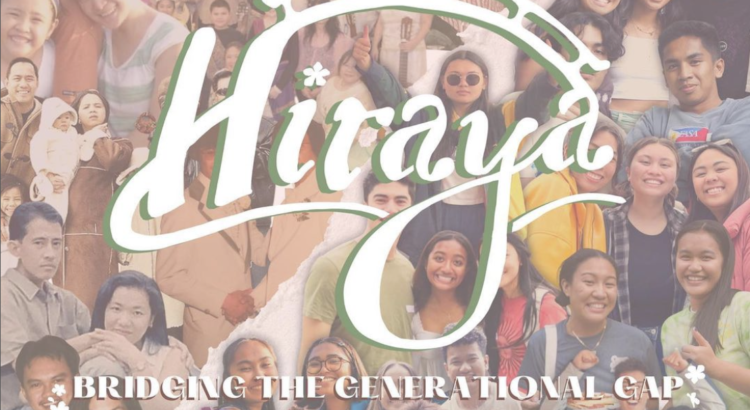
Here’s the description written on their instagram account: “This year’s PCN is themed Hiraya: Bridging the Generational Gap. With this theme, we want to honor our parents and those who came before us by highlighting our intergenerational differences in dreams, journeys, and aspirations. With this, we hope to spur forward-thinking conversation through dance,  performances, speeches, and more.” – @fasa_umich

Before coming to the University of Michigan, I didn’t know many Filipino people or anything about Filipino culture. It’s amazing to see how large and passionate FASA is as a community: FASA has been practicing at the Mason Hall posting wall for months now, and their dance team is extremely large. I believe modern and cultural dances will be performed on Saturday night, and it’s what I look forward to seeing the most at their event. This will be my second time exposing myself to Filipino culture (the first time being a traditional music ensemble performance), and I look forward to learning more!

I’m still unsure if tickets are viable at this point, but good luck to those trying!

PCN will be from 5:30-9:30 PM (doors open at 5 PM) in the Michigan Union, Rogel Ballroom (second floor).

REVIEW: The Plastic Bag Store

I had no idea what to expect when going into the Plastic Bag Store. Literally. After seeing marketing for it, I had been asked to go and said yes to see what it was all about; I can very honestly say that it was not at all what I expected. The installation that is the Plastic Bag Store is a mix of art installation and immersive puppet play – unlike anything I had seen before. 

The installation, a grocery store filled with foods made entirely of plastic, was surreal to step into. The resemblance to any other grocery store was striking, and at first glance you wouldn’t think twice that that is exactly what it was. However, upon further inspection you will start to notice… the spinach is made of green plastic bags from Earthbag Farm. What you may have thought was a box of Lucky Charms cereal was actually Yucky Shards cereal with the mascot of a sea turtle holding a six-pack plastic soda ring. Right before you start getting used to it all is when the next phase of the event begins and you are asked to take your seat on the cardboard boxes that have been placed in the center of the store. Cue the puppet show.

Artist Robin Frohardt specializes in her puppeteering art form and the medium shines in The Plastic Bag Store. A stunning and interactive story unfolds from the beginning of single use vases in Act I, to the modern day plastic bag in Act II. Act III of the play is held through the doors of the frozen food aisle and plastic snow is rained on you from above. The third and final part of the play takes place in the far off future and centers around a scientist finding relics of the past in all kinds of plastic held under the sea: plastic bags, tooth brushes, bottles, and straws. I won’t spoil the ending, but it is unnerving to say the least; to return to your world and realize that the grocery store full of plastic was not a far off recreation of our own world is eye-opening. 

While the art and storytelling was undoubtedly phenomenal, I found the message of the piece to be a bit lacking and even misinformed. There was little to no actual discussion on the harmful effect of plastic remains, just the plastic was to seemingly last forever on Earth and that was a bad thing (even coming to that conclusion feels like a stretch). The reality of the plastic issue is far more complex than this and I personally would’ve loved to see this expanded beyond the simplicity of plastic being bad. In a Q&A following the event, Frohardt mentioned that she intentionally did not want to sway the piece to say anything specific about the environmental issue, but instead wanted the piece to simply make the audience think and reflect on the consumerist world we live in today. I think in that sense, the exhibit is a success.