Beyoncé…Enough Said

Beyoncé 'XO' video still

On December 13, 2013, Beyonce did something no artist has ever done before. Hard to believe right? She released her self-titled 5th album strictly to Itunes without any prior promotion whatsoever. No interviews. No single releases. No album leak 3 weeks before its release date. Nothing. Simply posting a 15-second video on her Instagram, Beyonce revealed shorts clips of her 14 new songs AND 17 music videos that can be found on her new album. Not only has an artist never had the guts to release their album without any prior promotion, but no one has ever released a music video for every single song on their album…and then some.

I must admit I adore Beyonce and after the frenzy of this album release I think we should all give some credit and hail Queen Bey; some of the songs on her newest album, however, are hit or miss for me. The songs Mine, Drunk in Love, and XO are some of my favorites featuring a more hip Bey as she incorporated rhythms and beats from the hip-hop and R&B genres today. There also is Beyonce uniqueness that these songs carry, with her careful lyrics and sultry voice, it’s hard not to fall in love with Jay-Z in Drunk in love, or sing with your eyes closed and hands in the air with Drake. I mean, either choice is fine. Yet, some records didn’t do it for me as much. Haunted and Jealous are two very different musical sides of Beyonce that we haven’t seen before, and the flow and message of the songs didn’t hit me as powerfully as I wanted them to.

But of course, the most innovative aspect of this story is the visual album that Beyonce compacted for her listeners. Every song has a video to complement it, along with 3 bonus videos also accompanied by new tracks. First impression? I was completely overwhelmed by the artistic and symbolic elements that Beyonce brought to each video, some filled with dancers twirling in long, chiffon dresses against a black background, and others with Victoria Secret models flaunting gold grills. Her visual album was a product of her ability to “see the music,” for Beyonce “it’s more than just what [she] hears,” according to the New York Daily News. Her inclusion of these visualizations of music for every song,  isn’t so groundbreaking in my eyes, but more simply about an artist (with a lot of money) going against what has been the norm for decades, and creating music how she sees fit.

Although I think Beyonce, has had better songs on past albums, I think that her delivery and her work ethic are far beyond any musical artist out there. A part of what makes an artist stand out is their fearlessness when it comes to their work, and I think we all could learn a thing or two about being fearless from the Queen Bey.

30 Second Clips of 3 Music Videos:

Beyonce – Haunted

Beyonce – XO

Beyonce ft. Drake – Mine


Asymmetry, Oddity, Figure Drawing

At the beginning of this semester, as I worried about distribution requirements in my political science advisor’s office, I assured her that the Beginning Drawing class I had in my registration backpack had been put there on a whim. To my surprise, the advisor was delighted by my whim and urged me to keep the class on my schedule, eventually mysteriously manipulating something on her computer to help me fill a requirement. I was reminded of the nonchalance of my nuclear family’s emphasis on art – an art class, she felt, would obviously do me good.

She was right. Drawing is a constant tic for me, an activity that I can engage in almost unconsciously – so being forced to devote three hours, twice a week, to developing my skills and ideas has felt enormously cathartic. Although I wasn’t a ‘true’ beginner in that I could already draw fairly accurately, I hadn’t tried to really make progress in developing my abilities in a long time.

My favorite part of the class was the month long segment on figure drawing.

I love figure drawing for so many reasons, but mostly because it forces you let go of so many anxieties about the human form. In order to draw the hand, face or torso in front of you, you have to get rid of previous conceptions about what how those pieces of the body look, or ‘should’ look. Each individual’s body is an accumulation of their history that exhibits itself most obviously in scars and tattoos, but also in certain postures, masses of muscle, accumulations of fat, and tones of skin. This is why books that teach figure drawing tend to only impart generalizations – abstract instructions can only guide you to draw a perfect hand, an ideal profile, a measured bicep, pieces that sum up to a perfectly proportionate but fictional body. But when you draw from life, these rules (i.e., figures should be nine ‘heads’ tall, with shoulders three ‘heads’ across) are often confounded by perspective, space and the oddity of physical variation.

My favorite model was large, with rounded belly and breasts that the class delighted in suggesting with a few animated strokes of the pencil. Her mass filled up our papers (or dwelt a little off to the side, depending on whether I remembered the lessons on composition), and the smooth round shapes of her body lent themselves to broad gesture. The woman’s poses were the product of heavy, stolid efforts, accompanied by coughs, but her weight was consistently grandiose and powerful on our newsprint pages. As she doggedly raised her hands in the air for a five-minute pose, our drawings reflected how gravity appeared to be pulling her body downwards; as she sat or lay down we scribbled to describe the bows and bends of her protruding curves.

As the class progressed, our teacher suggested that we use our non-dominant hand to suggest the pose, or that we use multiple utensils bunched together in our fists. To my surprise, I loved my left-handed drawing, finding that my crudest attempts sometimes expressed the figure the most accurately. The gestural exercises that looked more like lines and less like humans captured something important about impermanence in their very lack of development: the human figure can’t be divorced from its vast potential for action and movement, not even if it holds very very still. The dead flowers that we contoured, the paper bags, the bottles and boxes and chairs – they had the potential to move but we were too unskilled to see or incorporate it. You can draw an acceptably ‘accurate’ still life without thinking about the potential motion of your fruit basket, but figure drawing somehow necessitates deeper perceptions of motion and mass.

And it’s much harder to form a smooth, developed drawing without losing some of the immediacy that comes in identification between the quick mark on the page and the impermanence of human motion or stillness. Some of my longer figure drawings turned out labored and disjointed because I felt like I had the time to slowly develop pieces of the body separately instead of making quick marks that suggested the figure – but without those initial, abstract descriptions, the pieces of the body failed to unite. When I consequently built my developed drawings on a foundation of gesture drawings, the unmeasured, instinctive marks gave my figures presence.

Within (or maybe above) these struggles, there’s something so amazing, so fascinating about drawing a human body – as my teacher commented, “it’s so hard to draw them, because they’re us.”

It’s hard, but it’s also incredibly fulfilling. Embracing the human form’s oddities is strangely soothing to me, as I am no stranger to physical asymmetry. I was born with a cleft lip (I had my final repair four years ago), and I also have a permanently torn tendon in my right knee that has changed my posture and given me a much stronger, bigger left leg. Physically, these events have left only faded scars, a slight difference in the length of my legs, a minor irregularity in the shape of my nostrils. But to me, a lifetime of understanding self-worth as independent of beauty is intertwined with the scar tissue above my lip; my first encounter with age and permanence bound up in my uneven gait.

I used to consider it a kind of failure that I only wanted to draw people, that bodies engaged my artistic attention while I could only be bored by trees and buildings and tables and apples. But drawing people is essentially different. In class, our poorly drawn figures were sad little beings, slanted and un-souled and hilarious in their misery, but successful figures felt important beyond reason.

For our last self-portrait of the semester, we were only allowed to use our feet. Some people taped pencils to their socks or shoes, others held the pencil between their toes, some looked in the mirror, some didn’t bother. I held the pencil in my toes, and as my leg began to quiver from exhaustion I found that the shaking produced gentle, smooth shading. Slowly, I developed an oval. The drawing was meant to be a funny, loose exercise, and we spent most of the time laughing. But when a human face appeared, beneath my very foot – I can’t explain it, but I could have wept.


Some Jimmy Fallon Cheer

Once again comin’ atcha with some quick finals breaks and necessary distractions. Who better to bring some quality laughs and antics your way than the man himself, Jimmy Fallon. To be honest, I know nothing about him or his show, or any of those late night-one-man “news” (?) shows of which there are so many, but Jimmy Fallon certainly looks funny on youtube.

One of his best recurring segments is the “History of Rap” routine with Justin Timberlake. Together, the two provide the vocals for a mashup anthology of rap– approximately four minutes of song snippets beginning at rap’s origins and moving through at  hyper speed to the current state of pop-rap, all the while covering everything in between. Besides being unexpectedly good at rapping, Jimmy and Justin clearly treat this bit with nothing but a relaxed and carefree attitude. And true to all of the best Jimmy Fallon clips, The Roots are the driving force behind its brilliance. As integral parts of the History of Rap, themselves, the goal of reenacting a full timeline in under five minutes is only made possible with their help. There are four installments of this hilarious routine, but here are parts 2 & 3, in my opinion the best ones. Highlight: their back-to-back duet of “Killing Me Softly.” Take a few minutes away from your notes and clear your mind with these antics. If two white comedians are going to try to cover the history of rap, one of them for sure better be Justin Timberlake..

History Of Rap

For a more festive touch, here’s Jimmy Fallon singing the classic “All I Want For Christmas” with some help from Mariah Carey, The Roots playing children’s musical instruments (apparently straight from a FisherPrice toy collection) and some children themselves. Happy holidays, y’all.

All I Want For Christmas Is You


My New Friend, Picasso

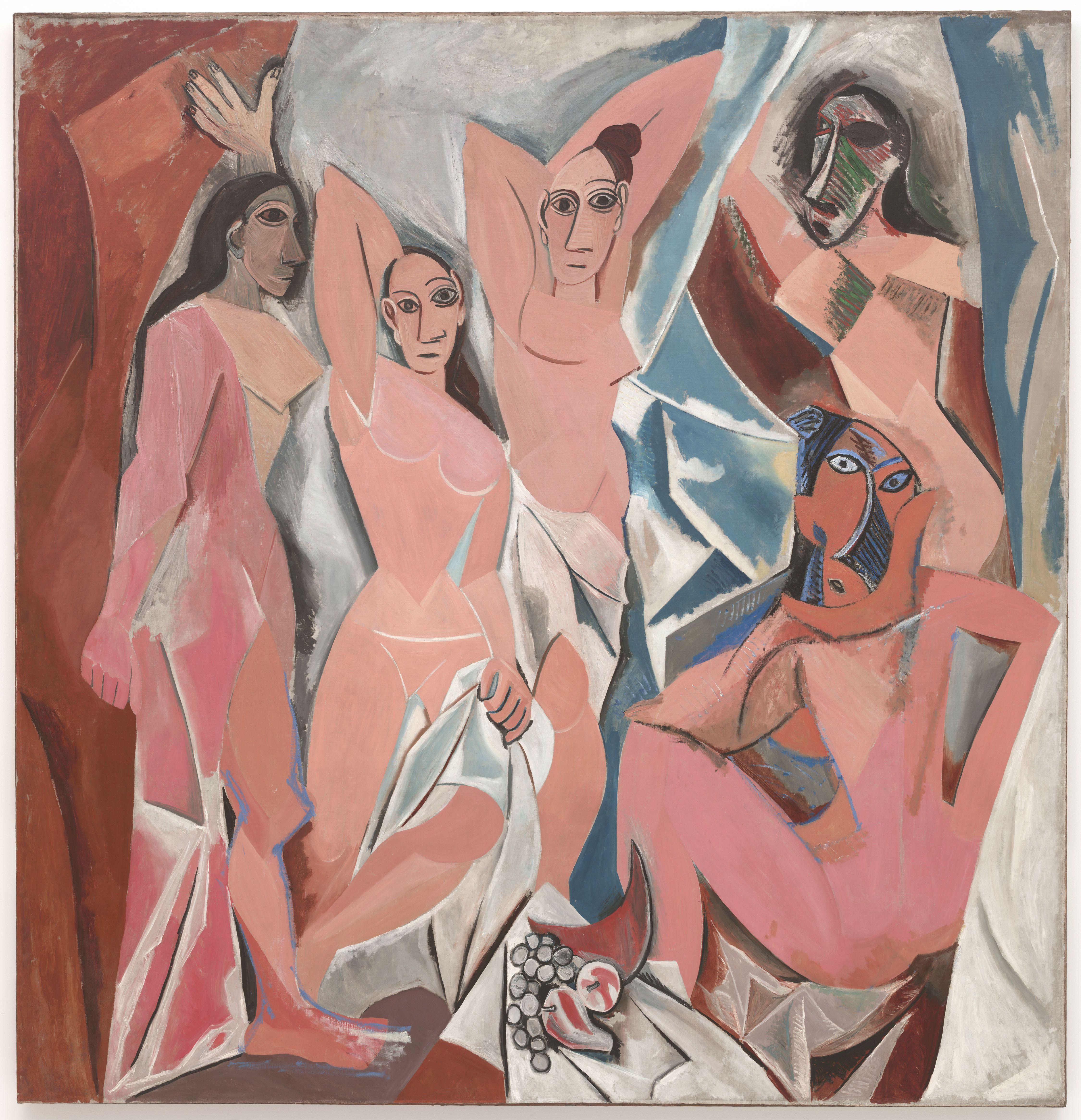
After my final lecture in Art History for the semester, I decided to take on the brave and daunting task of art interpretation without my dear professor’s brilliance. Instead of writing my multiple papers, I’ve been staring at Picasso’s Les Demoiselles d’Avignon for the past hour or two, rummaging through article after article to see if I can come to terms with this painting’s representation of women. Many of Google’s finest declared the painting an empowering portrayal of the sexual freedom of women, but I still needed some convincing. The more I stared at it, the more determined I became to see this painting as an empowering portrayal of women and, despite Picasso’s intentions, whatever they may be, I feel prepared to defend my opinion on this painting as a breath of fresh air from the all too common highly sexualized or idealized representation of the female body.

Picasso’s Les Demoiselles d’Avignon (1907)

True, this is a brothel painting of young nude women, so it inherently associates women with sex and the body. However, through his experimentation with form and space and use of African mask influence for the faces of the women, he in a way frees them from the pressure to be physically perfect. They become objectified as shapes and lines instead of objects of desire. The human body is just that, geometry, and by breaking apart and piecing together their bodies in unconventional ways, he almost releases their true identity from their physical forms and frees them to be just what they are – people. Drawing on what I learned in class this year, I can see connections with the works of Manet and Courbet who actively work to undo the fiction of the idealized classical female nude. Courbet’s representation of women with imperfect bodies and explicit representation of what painters of the classical nude were trying to make sexy (see Courbet’s The Origin of the World, hint: it’s a vagina) is almost liberating from the pressure of these idealized representations. So, as a recent graduate of my first art history class of my life, I declare this painting a liberating release from the female body standard prevalent in most modern art (especially the modern media). Good luck on finals to one and all!

Sculpting Space

Last week’s Penny Stamps Distinguished Speaker Series lecture at the Michigan Theatre brought UK artist Antony Gormley to town, who is redefining sculpture as we know it. His vast amount of work was accurately portrayed by the few installations he discussed, exploring the relationship between human beings and the spaces we interact with.


Drawn introduces us to this particular “genre” of spatial figure sculpture, flipping the roles of art and viewer upside down – and sideways. The eight identical bodies cast with modern industrial techniques shrink into the corners of the gallery as far as possible, avoiding the probing stares of visitors, who become the real vehicles of Gormley’s concept.

MASAG-079

Horizon Field Hamburg and One and Other reinforce audience interaction as the door to Gormley’s “open space of art”, operating as two different approaches to the relationship between individual and collective responses. Horizon Field Hamburg explores the lack of control a single person can have in public spaces with a large, black-mirror platform suspended thirty feet in the air by six metal cables. The platform is capable of swinging six feet in any direction, which is constantly influenced by viewers moving around on the glossy painted surface. Conversely, One and Other highlights the power of the individual, by quite literally placing its singular form on a pedestal. Volunteers signed a schedule securing their one-hour on the plinth, which also stood at thirty feet tall. Coincidence? I think not. These brave “living sculptures” were given complete creative control, and the perfect stage to make a statement of their choosing. The crowd that gathered at the base of the plinth was subject to whatever the person decided to show them, whether it was an act of humor or sincere emotion.

4f901faba3065 529debd1dded9 4e0306e62af01

Installations like Breathing Room, Blind Light, and Model directly challenge the viewers’ perceptions of space and self by initiating a more intimate conversation with the senses. By constructing architectural forms intended to be occupied, the form of these sculptures is both vital and secondary at the same time, emphasizing the fact that art doesn’t “happen” in objects or images themselves, but in the creative spaces of the mind. The sculptural objects – or “systems” in Gormley’s case – are only there to lead the viewer’s wandering thoughts in the right direction.

1062_breathingroom_iii_2010_001_ref 0733_blindlight_2007_001 5150223cba302


The importance of these works is in the way they highlight the transformation of an art object into an art experience, defined by the appropriation of the power inherent to public sculpture. Gormley is able to transcend the traditional techniques of expression through the figure, exploring its place in an age of mechanization. His work embodies the transition from an object that relies on the coherent story of representation, and towards “objects” that are spaces to be explored creatively and critically.


To me, Antoni Gormley is one of those artists whose work you discover and experience the excitement of finding a new major influence, with an undertone of jealousy for having made such incredible objects (or experiences). I’m currently in my “making other people” phase of figure sculpture, and bumbling through the mess that is oil paint, so Gormley’s approach to “recycling” the traditional elements of art really struck a cord with me. We have to look back to move forward. We have to know our context in this strange creative space of culture that art occupies, in order to continue making relevant work. The way that Gormley simultaneously refers to and contradicts the traditional notions of space help to place him in conversation with his ancestry of sculptors, but also with everyone who is alive to experience his work in the present.


The entire hour of Antony Gormley’s lecture is available here:

Penny Stamps Lecture Series Antony Gormley


But due to the length and some technical difficulties, I’d recommend watching this one explaining Model instead, to get an equally enlightening understanding of what this guy is all about.

Model