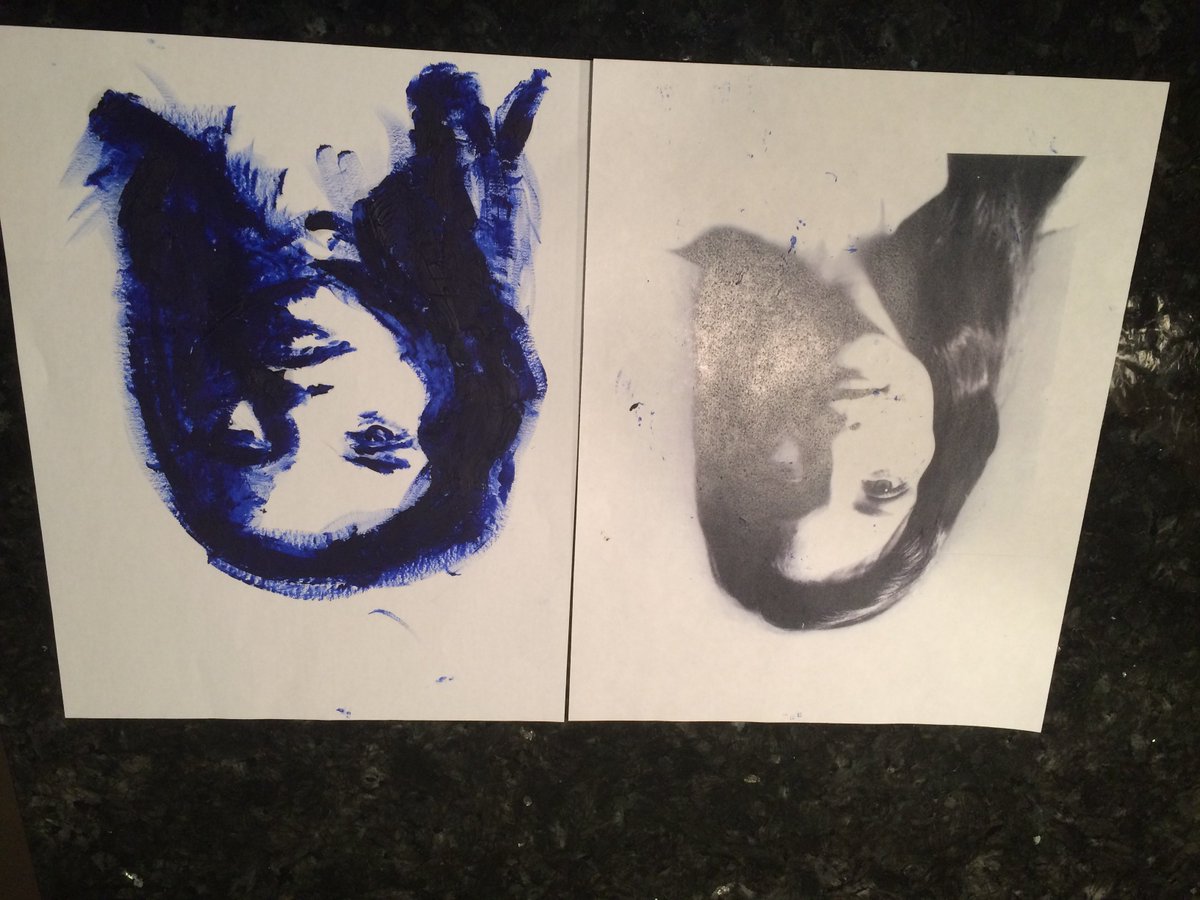
Paint Me (Upside Down) Like One of Your French Girls

Do you remember when you were young and played on the monkey bars? When you were overcome with super strength and curiosity turned you upside down? The backs of your knees hinged over the metal poles and your body trusted itself to unfold and dangle. The wood chips became your ceiling, the clouds a fluffy carpet. Your world and perspective had changed so much and yet, you were still you.

Image via arthur.wikia.com

On Wednesday, I took the first class of a term of an Oil Painting course at the Ann Arbor Art Center, a medium I’ve never worked with before. In fact, I’ve never had any technical training on painting at all. I’ve always been a more splat and spread sort myself. But like all second-semester seniors who want to absorb the most out of this college life as I can get, I decided to buck up and challenge myself, destress after classes, and perhaps come away with framable piece of art.

The first exercise was to use our paints to copy a black and white photograph of a young girl. The girl was half in shadow, save for a little triangle of light where her eye peeked through. We also were not using any water with our paints, which meant that we would have to cake a lot of paint on the canvas because it dried so quickly. And things kept getting more interesting. “Now turn the photograph upside down,” our instructor, Claudia, said.

Suddenly, the face I had just seen before disappeared. Where her shadowy eye had been was now just an imprint of a hollowed out triangle (think pirate eye patch with a hole in the center). There was a slice of light that cut through what had been the girl’s neck. Where had that been before? To the left of her visible eye was a curvaceous bump: the indent where the skull shapes the eye bone. Where did her nose go? All I could see was a black dot in the center of the face. Not only was the model photograph upside down, we were going to paint to match this upside down figure. Claudia told us, “Don’t think of it as a face. Take each part of the photograph as its own shape. What’s connected? Where is the white space? Think tonally – is this dark or light?” This was easier since we were only using one color. You either painted a section of canvas or left it alone. But, still, this was no walk in the park for a beginner like me.

Now take your computer and flip it (or do a handstand and crane your neck). I suppose that my painting has a slight haunting Victorian schoolgirl look to it, but I walked away from class quite proud. Somehow, I had created this person on the paper in front of me. The ultramarine hue was beautiful and I hope to use it much more in the class. The girl’s visible eye turned out really well, as did her lips. I know there is much more to work on, technique-wise, but I think the most important lesson is to practice perspective. Keep challenging everything that you see. An eye isn’t just an eye. It’s a line connected to another line that doesn’t touch but curves around and loops back. A shadow isn’t just a dark spot; it’s a locus of contrast, of contact, of substance. I expect that I’m going to walk away from this painting term with a lot more on my palette than just a few still lifes.

Maybe it’s time for a trip down to the local monkey bars to get some more practice on perspective.


Pushing Daisies S01 E05: Girth

This episode is the required Halloween special for the series. Now I recognize that usually Halloween specials are often cop-outs as the writers can turn off their brains and write a generic script around something “spooky”, but I love Halloween specials. In fact, I love all holiday specials. I have no idea why, but they all seem to have a charm about them that just draws me in. This one is especially good as the writers of this series always came up with the most interesting ideas.

Summary:

Another cold open with a flashback. In this one, we see Ned in a line waiting for mail. He usually gets nothing, but on Halloween he gets a postcard from his father. His initial excitement wears off as he learns that its a notification that he moved. This prompts Ned to run away from the boarding school and visit his father’s new house in costume. When there, he’s heartbroken again as he finds his father with a new wife and two new sons. The cold open then flashes back to the present and we come to focus on a man in a horse stable. His night ends early as he gets trampled by a costumed, fire-breathing horse.

After the cold open, we move to the Pie Hole where we see that Chuck has decorated for Halloween. Olive explains that its a bad idea since Ned hates Halloween. Chuck dismisses this because, as a child, Ned loved Halloween and the time they spent together. The two then discuss Chuck’s secret with Olive believing that Chuck faked her death.

Ned then enters the diner and sees the Halloween decorations. Even though he is visibly distraught, and Chuck offers to take them down, Ned lets them stay up. From this scene, we move to Olive’s bedroom and see her reveling in the fact that she knows more about Ned than Chuck does.While jumping on her bed in excitement, Olive learns of the murder of Lucas Shoemaker on the news, clearly recognizing the victim.

In the meantime, Ned and Chuck talk in the kitchen about Halloween. Ned deflects the questions about his newfound hatred of the holiday, and Chuck deflects the questions about why mentioning Olive made her visibly nervous.

After this, we follow Olive to a safety deposit box, where she takes out a large trophy and a bag of money. We return to the Pie Hole and Olive hires Emerson to investigate the murder. We learn from Olive that the victim was a farrier and an old competitor of hers when she was a professional, and quite renowned, horse jockey. This causes a giggle from Emerson, but Olive is quite serious.

At the morgue, Ned and the other two find the body of Lucas Shoemaker. Ned reawakens the body and Chuck cements herself as lead interpreter of the group since she is the only one that can understand him because of his broken jaw. Shoemaker believes that he was killed by the ghost of John Joseph Jacob and warns that he will kill again. With the other jockeys in danger, they return to the Pie Hole and tell Olive. She faints at the mention of John Joseph Jacob and the gang splits up: Emerson and Olive going to a jockey bar, Chuck going to the stables, and Ned going on his own personal, secret mission.

We cut to a flashback of Olive’s days as a horse jockey. We learn that while Olive was exceptional, John Joseph Jacob was the best in the world. At the “race of the century” where the best jockey compete, John Joseph Jacob falls off his horse and is trampelled by his competitors. Olive wins the race, but the trauma forces her to quit racing. This points us to the possibility that someone might be looking for revenge.

At the bar, we come to meet Pinky, bar owner and past competitor in the race, and Gordon, a drunk who was also in the race. Gordon believes that it was actually the ghost of John Joseph Jacob and he will come for revenge against the other jockeys. This leads Olive and Emerson to the tomb of John Joseph Jacob. While Olive comments on the cracker crumbs scattered across the floor, Emerson finds that the lid of the coffin is broken, like Gordon had suggested. They open the coffin and only find the bones of a horse, curiously with its legs missing.

We then cut to Chuck at the stables at night with Digby. While initially scared, she finds courage in the fact that both herself and Digby have already been killed once. She also finds cracker crumbs on the ground before running into Emerson and heading off to investigate more.

Before the audience heads off with them, we join Ned on his quest. We find him in his childhood home, lamenting his past and the holiday. He gets distracted and sees Chuck’s aunts across the street, scaring off local kids.

Emerson, Olive, and Chuck meet at the house of John Joseph Jacob’s mother. After entering and the mother making backhanded compliments to Olive and Chuck, we find that she has made peace with the death of her son. We also find the urn of John Joseph Jacob, the mother explaining that he always wanted the horse to have a proper hero’s burial, so she cremated her son and buried the horse in secret. The mother says she forgives Olive and the trio prepares to leave. After suggesting that they should make sure Pinky is safe, we cut to his bar, where we find him being attacked by the same horse that killed Shoemaker.

While all this is happening, we find Ned in the house of love’s aunts. We come to realize Ned’s motivations as he asks the aunts about his absentee father. Lily simply insists that his father was a jackass and he was better off without him. While sharing this conversation, Ned recognizess that the pie he was going to enjoy was actually from his diner after a strawberry rots from the touch of his mouth. He realizes that Chuck has actually been having this secret connection with her aunts this entire time. As he goes to leave, Vivien stops him and comforts him.

The audience meets up with Olive, Emerson, Chuck, and eventually Ned at the bar. On the floor in Pinky’s dead body with Olive grieving over him. Chuck takes Olive out of the bar so that Ned can perform his magic. They reawaken Pinky and find that he also believes the ghost of John Joseph Jacob killed him, though he explains the motive better, Pinky actually cut the saddle of John Joseph Jacob before the race. Olive reveals that the other four jockeys kept the sabotage secret since none of them could prove that the others did. Olive initially protested the idea, but was forced into it. When the two are alone, Chuck tries to convince Olive to confront the ghost and also thanks her for keeping the secret of her death.

While at her apartment, Olive finds a golden horseshoe outside her window. Recognizing this as a gift she gave to John Joseph Jacob before the fateful race, she climbs up to the roof to confront the ghost. As Olive reaches the roof, she finds the very alive John Joseph Jacob, only now much taller. He reveals that he had actually survived the fall and his broken legs were replaced with the horse’s. We also learn that he believes the fall was an accident and that he has been in his mother’s basement ever since. After their talk, John Joseph Jacob becomes ready to leave his mother’s basement.

We move to his mother’s house with Olive and Chuck in tow. He leaves them to grab some crackers, explaining that he’s hypoglycemic and gets angry when his blood sugar gets low. This immediately tips off Chuck as she realizes that were crackers at every crime scene. They grab the urn and check to see what’s actually inside. Olive recognizes that it is the ashes of a saddle and that John Joseph Jacob’s mother knew the secret of the sabotage all along. Just as this realization comes to fruition, a horse kicks down the front door.

We cut to Emerson and Ned in a car with Gordon. Gordon tells the two that Shoemaker had actually revealed the secret to John Joseph Jacob’s mother before he had died. They connect the points and figure out that she was actually posing as the ghost and killing the other jockeys.

Back at the house, the mother reveals her plan. The two run from her and initiate a chase. Chuck falls and Olive decides to sacrifice herself, knowing that the mother is really only after her. But at the last minute, Emerson and Ned appear and save her.

In the epilogue, we find the mother in jail and Olive has donated her trophy and winnings to John Joseph Jacob. We also see Ned and Chuck in a car in front of the aunts’ house. Ned reveals that he knows about Chuck’s secret pies and he is okay with it. He lets her visit the house in costume and trick-or-treat so that she can see her aunt’s face-to-face again.

Pros:

-This mystery is really well written. It’s complex without being too hard to follow.

-The focus on Olive is very refreshing and we get to see some new combinations of characters in this show.

-It’s always great to see backstory, and while Olive being a jockey is out of the blue, it totally fits her character and this weird universe.

-Ned backstory is heartbreaking and beautifully done. It creates a nice compliment to the forced estrangement that Chuck has with her aunts.

-Everything perfectly makes sense without relying on coincidence. The twist at the end is also surprising, but not unbelievable.

Cons:

-Not very many cons at all, the only problem is the horse’s fire breathing. It’s never explained and it’s never utilized in any way.

Overall:

This is probably one of the best episodes of the series. While the mystery isn’t very quirky and charming like they can often be, it’s very engaging and well written. The twists are completely unexpected, but make sense in context. In addition, seeing Olive in a more active role is great as she is quickly becoming one of the more interesting character on the series. The parallel between Ned’s and Chuck’s family relations is handled very poignantly without having to explain the metaphors. It also leads to the possibility of more plot threads down the line.

Rating:

9/10 Daisies

Here

Music has been my world since I was a child. My musical upbringing consisted of all the modern clichés of how an opera singer is born: “she sang before she could talk” people would say and naturally the big voice inside a small girl was discovered at church, I began piano lessons at five and was obsessed with the one CD I owned after saving up my allowance for weeks.

After that, the momentum of one opportunity brought me to next, an opportunity which I could not possibly say no to, until I ended up here. Where exactly is here? Here is my (victory lap) senior year as a Vocal Performance major at the University of Michigan. Here is having performed in over 25 productions in the past 4 years and more recitals than I kept track of. Here is having gone from uncontrollably crying in a high school counselor’s office because I was waitlisted at the one music school I applied to (a truly ill advised move looking back) to performing as a preliminary winner of SMTD’s Concerto Competition. Here is sitting on a panel this morning answering questions about my experiences as a music major to scared perspective students on the day of their audition. Here is defined. Here is expected. I’m very comfortable and very good at Here. While I may not know exactly what will come next week, I can guess with remarkable accuracy – class, practice, homework, work, recital, coaching, more homework, more practicing and an audition I may or may not go to depending on my mood. What hit me this morning is that in three months that will never again be my hectic but very predictable routine.

I can admit that I live a charmed life – part of that is my uncanny ability to always find free parking within five minutes of looking (even in Kerrytown during the middle of the day) and another part is that things just tend to work out for me. One opportunity grows into the next, somehow turning the little girl who auditioned for the church choir by singing Part of Your World from The Little Mermaid into a music major at a top university. A major benefit of this is that since I was little my life has been planned out for me, guided by the opportunities which I fell into. However, graduation is impending and my predictable musical life will soon be part of my past.

Obviously I have some semblance of a five year plan – it would be foolish to graduate from college and not – but this plan consists of large, vague brush strokes rather than neatly sketched outlines (just waiting for the details to be filled in) that I have become accustomed to. Freshman year of high school I could have guessed the majority of important details about my life in 2015, but right now I can’t even tell you where I will be living six months from now.

Sitting on the Q & A panel this morning for perspective voice majors made graduation real. It is no longer that far off, mythical event that you have heard of but cannot picture yourself being there, rather graduation is coming and it will change everything. Opportunities will be less common and more competitive. Voice lessons will cost real money and a good pianist will be hard to find. Yet the one thing that will not change with graduation is my devotion to the art form that colors my world and brightens my days.

Star Wars, Nostalgia, and Creativity

So, okay, let’s be real for a hot second: I loved the new Star Wars movie. Even though I will forever be mad that I didn’t see it at midnight, I loved this movie with a passion. I can prove it to you too. I saw it the weekend it came out with some friends while I was still in Ann Arbor…then I saw it a week and a half later, with my best friend back in Houston. And then when my mom wanted to go see it, I told her we should go again. I saw this movie three times. And if you asked me to go this weekend I’d just ask what time?

I know this isn’t a minority opinion. I was honestly glad that I saw it opening weekend because that meant that I didn’t have to wait until Monday, when I was back in Houston, to read/watch/listen to/breathe any spoilers. I didn’t even rewatch the trailer before going to see it – the last time I’d seen the trailer was back in November, when it first came out, and a lot of finals had happened between then and the time I’d seen it. I wanted to come in with a fresh experience.

But even though I loved it, I’m not sure if that’s what I got. When we walked out of the theatre my friend pointed out how the plot was the same as the plot for A New Hope: they blew up a big gun. This sentiment was echoed in other posts I read, including a podcast (with major spoilers) by some of my favorite YouTubers, Funhaus, where James said he was reserving judgement on the new franchise as a whole for that very reason.

Nostalgia, ironically, isn’t an abstract concept anymore, but a business, and a booming one at that. People are shelling out money for reboots and sequels of their favorite shows and movies. And they do well, too, and the public goes crazy for them. One recent example that’s been all over the entertainment news sphere is the new Full House reboot on Netflix, duly named Fuller House.

In a blog post a couple of years ago, I wrote an open letter to Pixar about how excited I was for the second The Incredibles movie because, of course, I freaking love that movie, but also a wariness – Pixar has been devoting a lot of its time and resources to sequels that I don’t think merit the work put in. I was pleasantly surprised and delighted with this summer’s Inside Out, but they still have sequels slated for release in the coming years (Finding Dory, Toy Story 4, The Incredibles 2). Let’s just hope Inside Out doesn’t turn into Inside Out 2  in 2018.

I definitely think that J.J. Abrams made the right decision when it came to the plot. The original trilogy, as well as parts of the newer trilogy, are about archetypes, time, and the endless circle. It is, of course, a family story, and Abrams kept it that way, if only because he borrowed a lot from the original trilogy. I’m so excited to see where our new characters go – especially Finn and Rey – and I think the first movie did its job in setting them up for the next two movies.

But as a writer, and one that values creativity over her own fangirl instincts, I have to ask at what cost did he do it?

Don’t take this the wrong way – I saw the movie three times for crying out loud – and every time I love discovering something new that I didn’t notice before. But I also want to be openly, honestly critical of an already fantastic movie so that it can become an even better one that will go down forever in the pages of film history.

So while we not-so-patiently wait for the next movie, may the force be with you (or does the force not really work that way?).

Rediscovering Music Videos

Remember back in the days of nostalgic MTV and VH1 when you could turn on the television and spend hours watching countless music videos? It’s been a long time since those channels expanded their repertoire from solely music to teenage moms and original shows. Recently, though, after delving deep into the documentary and music video world of Justin Bieber in my Digital Media Theory class, I rediscovered the joys of music videos. They’re so much more than little nothing videos you used to put on when you couldn’t find the song you wanted to listen to! Each music video has its own taste, style, and message.

Binge watching a bunch of music videos this afternoon for this post; I realized that a lot of music videos are like little movies. They have to tell an entire story in less than four minutes in a creative and entertaining way. And, they have to sell the artist, the song, the album, and the story! That’s got to be hard, but somehow, the creative minds of our world make it work. And really well might I add.

Every music video has to make hundreds of little choices in order to get to the vision the artist wants. Does the artist want to show off his or her musical talents as if he or she is playing or singing live, or would they rather show themselves dancing or going through the motions of a seemingly average or ridiculously extraordinary day? Do they want to be alone or with friends, family, other artists? What is the real message of the song, and how do they want that message to be portrayed? Should the video be shot in color, black and white, sepia? So many choices!

There are so many worthwhile music videos that it was hard for me to choose which ones to highlight, but let’s take a look at a couple of popular videos that I really like.

First, let’s all take a moment to bask in the beauty that is 1998-99 Semisonic and check out “Closing Time”.

Great video right? The split screen makes it so not only do we get to see the story, but we also get a little inside look at the band playing, too. By the end of the song, we really do feel bad for our favorite band member that he doesn’t get to connect with his love interest, just as we would after watching a 90 minutes rom-com. Don’t you just want to give Mr. Glasses a pat on the back?

Okay, moving on. Now let’s take a look at Canada’s real-life Robin Sparkles  in Carly Rae Jepsen’s “Call Me Maybe”.

I distinctly remember when my grandma told me to Google this video because, as she put it, “the ending is just so cute!” Here, we do get to see Carly singing along, but the story is almost more important to the video than Carly’s vocals. If not for Carly’s crush and the surprise ending, this music video would be a lot less interesting, but because we have all of that included, watching the music video is really fun to watch.

Of course there are thousands of music videos and these two definitely do not encompass all that goes on in the music video industry, but I hope they did get you a little more excited about the joys of these videos. Who knows, maybe your favorite song has the best video of all time and I’ve never seen it? If you think that might be the case, post your favorite music video in the comments so I can spend more of my time sitting in front of my computer jamming out to little music video movies. I’d love to broaden my music video horizons!

The Lion King at the Minskoff

The large wooden lion head, hanging from the wall directly above the escalators coming up from the Minskoff Theatre entrance, suggests that there is only one play that will grace the stage inside – again and again and again. Given that it was during the Christmas holiday season, the place was packed with tourists, many of whom, I assumed, were seeing the stage version of The Lion King for the first time.

I must admit, seeing the paper sun basked in an orange and yellow light and hearing the all-to-famous song, Circle of Life, creep, yet brazenly, ring in my ears, brought a tear to my eyes. For some reason, seeing animals with awe through an artistic medium, whilst being accompanied by appropriate music, makes me cry. I admittedly cry when I see the ending of the film The Hitchhikers Guide to the Galaxy, where the second planet Earth is jump-started and the life cycle begins. The images are rather objective but awe cannot help but creep in, causing me to have this inexplicable emotional reaction.

The Lion King was not the Disney film that I watched over and over again. In fact, the Disney films that I did find myself watching repeatedly were: The Fox and The Hound, Tarzan, Hercules, Dumbo, and Robin Hood. I specifically really liked The Fox and The Hound, and I really can’t tell you why my childish mind at the time enjoyed a rather sad film.

Seeing The Lion King live, in a theatre in New York, was certainly a new experience. I’d seen some Broadway shows prior to this event. I’d seen Wicked, Peter and the Star Catcher, and Breakfast at Tiffany’s, the last of which was particularly notable because it was the first time I’d seen nudity in a stage performance. I was sitting there, thinking, this wasn’t in the movie. Then again, I’d never read Truman Capote’s novel either, so who am I to say? Although, I didn’t complain, after all, it was Emilia Clarke playing the role of Holly.

But the category, in which all these other plays pale in comparison to The Lion King, is costume design. Seeing all the animals march down the aisles was a treat, seeing the elephants, the rhinos, the birds, etc. I noticed the costumes never tried to mimic the animals completely, but they were well thought out, remembering, regardless of how accurate they were to the real animals, it was still a person beneath it all. So the lions heads were attached to beams that hooked over the actors heads, folding backwards when they were upright and then jutting outwards over their faces when they crouched like a lion. The hyenas had the same principle, with the addition of limbs. Zazu had a puppeteer, something that was actually addressed directly in a strangely Meta moment. Timon was a puppet as well, while the costume for Pumba, was essentially, his head that covered the entirety of the actors body. But all of these costumes allowed the actors to move gracefully in perceived animal movements.
The play was very similar to the film as well. So watching the play, I kept wondering, “How are they going to deal with the stampede scene?”

Well they dealt with it, and they dealt with it well, creating perspective through layers in order to really create a claustrophobic scene that was at the same time, wildly epic due to the dynamism of the movement that was happening through the depth created via stage design. It was the first account of when I truly saw the, lets call it the z-axis, utilized so explicitly. Another case was when the giraffes leaned their heads forward, almost touching the audience sitting in the front row.

There were cheeky moments that were at once references to the film as well as a reference to contemporary Disney. In the film, Zazu, while a prison to Scar, sings It’s a Small World After All, the wildly accepted “annoying” song of Disney at the time. In the play, when I saw it, Zazu sings Let it Go. It is one of those changes that makes me chuckle, but I’m both slightly annoyed yet charmed at the same time.

There was one thing that confused me more than anything. They changed Rafiki to a girl. I don’t know why. I get that there aren’t that many female characters in the film, but what does this add? Perhaps it adds female wisdom. But I found myself more confused then thinking, oh, that makes sense. It came across as a rather trivial shift that could have been handled better to justify it more precisely, but then how can you without changing a classically adored film like The Lion King?

I can’t say that I would have hated this play going into it. I knew I was at least going to enjoy it. I never knew how to critique theatre, but I found myself seeing why some things worked and others didn’t because I had the film to compare it to. I can’t say I’m an expert on theatre yet, nowhere near that level in fact. But I certainly appreciate it just a little bit more.