

Month: February 2021
The Poetry Snapshot: Dimly Lit Room
A night of unsustainable chivalry
and questionable intimacy.
In this dimly lit room,
you feel like a rehearsed symphony.
Your words age like wine
and carry me like champagne—
but I’m nine months sober.
So I put on a smile and try to explain
an elegantly crafted love story.
It’s not a lie, just glorified,
because tonight, perfection is mandatory.

Sixty minutes of seated salience;
I search for your expressions.
Your tiny obsessions.
Your emotional dispossessions.
Then the sound of your racing heart
grazes my skin like cashmere,
suddenly, I want to stay right here.
Oh, what a rare luxury!
I can wear my vulnerability
like pearls around my neck.
I do not have to tip toe,
you should know I’m a wreck.
Finally able to breathe,
in this dimly lit room,
I see you in full bloom.
Black History Month Student Spotlight
I wanted to highlight a student in the dance department for the last post highlighting Black History Month. Brooke Alexandria Taylor is a second year dance major that has organized #DanceforFlyod, created a screen dance entitled A Repetitious Narrative, and hosted an anti-racist staff and student assembly this past week. She has worked tirelessly to address issues behind racism in and out of the department. I asked her about her experience organizing and creating such important works.
Can you tell us about #DanceforFloyd ? How did it start?
“This past summer I planned a protest entitled Drive In For Justice, which was a safe protest for the Black Lives Matter Movement that encouraged attendees to remain in their car. Through organizing this protest I discovered that I truly find joy in protest organization and giving people a platform to express their emotions. To create more awareness surrounding racial injustice. However, when the summer time ended and it was time to return to The University of Michigan’s Ann Arbor campus, I did not want to let my efforts for the Black Lives Matter movement to end. I had the idea to plan another protest focusing on artistic expression.”
What was the process like? How did you find dancers to participate and a space to share this?
“The dancers in the protest had a variety of academic backgrounds and belong to several schools within The University of Michigan. The artists were all African American, but there were also so many other supporters that showed their allyship with their presence and protest signage. We danced in the intersection of South State Street and North University and it was a huge open space that was beautifully covered in art by students at The University of Michigan.”
Why did you decide to dance rather than march?
“The artistic protest was an 8 minute and 46 second improvisational experience, this duration represents the amount of time George Floyd suffocated with a knee in his neck by Derek Chauvin. The protest was designed mainly for dancers to express themselves and to experience the concept of time in relation to movement.”
I was also watching your A Repetitious Narrative, it’s beautiful. What inspired you to create a screendance and what was that process like?
“A Repetitious Narrative was truly a composition assignment from one of my classes in the Dance Department. The assignment was to create a piece focusing on perspective and I wanted the audience to watch in the perspective of a man being followed because of the color of his skin. The entire process included a choreographic walk, along with dance improvisation and videography by Mariah Stevens.”
This past week Brooke also organized an anti-racist assembly for students and staff within the dance department. At this assembly we heard from students past and present talking about their experiences within the department regarding race. It was a tough assembly to sit through and hear about experiences that my peers have lived through and have dealt with, not necessarily experiences of direct racism but micro-aggressions and ignorance by staff and students alike. I was in shock at how many of their experiences are a daily occurrence and often overlooked, I could not believe by some of the ignorant conversations they shared, but then again, I know I am not perfect myself and have definitely made unaware, uneducated comments. This assembly allowed me to stop and think about many of my actions and moving forward I was act and speak with more awareness to the best of my ability.
Here is Brookes screendance A Repetitive Narrative

“Milelong Mixtapes”: Ep. #4
“Mile-Long Mixtapes”: Ep. #4
Happy Birthday CHIKA’s “Industry Games” & Also… the Pandemic?
by Kellie M. Beck
The Friday after the University shut down classes for the remainder of the Winter 2020 semester, recently acclaimed rapper CHIKA released her debut album. My roommate and I listen to this album relentlessly– no one skips CHIKA in my house.
Her Industry Games EP is a pure, ultra-concentrated dose of her finest work yet. “Intro”, the minute-long prologue to the piece, introduces soaring piano and string sections, and tells listeners “I hope this music makes you think,” only after a tight and dense verse with near-Grecian level drama. But the sentimentality is quickly tossed aside for the EP’s titular track to take center stage.
CHIKA reveals to her audience over the course of the EP her struggle with her recent flux of fame. In “Industry Games”, CHIKA identifies herself as the literal “antithesis” of the rap industry, claiming that other top rappers aren’t invested in their work the way she is.The song segways neatly into “Songs About You”, a four-minute legacy track– arguably her finest song on the EP. “Songs About You” turns to criticizing haters, and both says and shows that CHIKA is hitting her prime, and on the way to becoming a household name. Even though CHIKA does her fair share of bragging about her (rather evident) skills, an underlying current of dissatisfaction runs through her lyrics– it begs the question, “if I’m already miles ahead of everyone else, what’s next?”
Over an angelic chorus of her backup singers singing “talk”, CHIKA rips the Band-Aid off in her track, “Balencies”. What’s the point of all this success, if the money and fame don’t bring me anything other than more problems? A church organ drops at the end of the second verse, the overwhelming pressure of the audio weighing down on the listener, only for it to drop into the sugary sweet intro of “Designer”. What’s the point of all this success, if she has to enjoy it alone? “On My Own” attempts to address the balance between love, and a relationship, with her fame with soft, velvety vocals, and her repeated promise: “I’m on my way.”
It’s CHIKA’s finale track, “Crown”, that contextualizes the album for me. CHIKA opens her story up to her audience, and asks them to connect with her story and her strife– “chasing the impossible takes some courage”, she tells listeners. Gospel vocals and rich layers of harmonizing vocals sing in pure joy– CHIKA chooses to celebrate strife as something that defines us. To survive, is to thrive.
The pandemic is almost a year old. But on the horizon, is a promise of its end, while the sun begins to shine and the earth begins to thaw in Ann Arbor, Michigan. Listening to CHIKA’s Industry Games, I think we might owe ourselves a celebration of epic proportions someday soon.
Do songs have to rhyme?
One thing I think I’ve grown at during my songwriting career is my appreciation for the different forms lyrics can take. Lyrics are in many ways just poems set to music, and when most people think of poems, they think of structures ending in rhyming parts. These parts are pleasing to the ears, but are not required to write a successful poem–or in that case, a successful song.
When I wrote my first song I was eight years old. It was called “Sun is Shining,” and was pretty much what you would expect an 8-year-old to write. It went:
“Sun is shining,
trees are swaying
wind is blowing
flowers waving”
etc. I was so proud of myself for the way the lines sounded when sung together since they all ended in the ‘ing’ format. To 8-year-old me, lyrics could be written in one way, and one way only.
As I grew up, my lyrics got a little more complicated than talking about what I could see in the prairie outside my living room window. In middle school I wrote “Juliet in Me,” a song which my mother swears will never be replaced as her favorite piece of mine.
It began:
“Sitting in the darkness
in a princess dress
I felt like a girl people would fight for
but how am I supposed to act my part
when the only love I’m in is through Juliet’s heart
and my Romeo doesn’t even know my name”
Based on my musical theatre endeavors, this song was a venture into the world of lyrics where not EVERY line had to rhyme. I also employed rhymes/similar sounds within single lines of text for the first time: I.e. RomeO doesn’t even KNOW my name.
In college I got into the groove of using near rhymes–words that weren’t identical in their patterns, but exhibited the same vowel sounds and therefore sounded like they did rhyme when sung. One of the latest songs I wrote uses this technique in its chorus:
“I am a kid again
chasing fairytales and booking flights to places I’ve never been
Because life Isn’t long and we don’t know when it will end
and sometimes you can’t wait around for your prince to step in
oh I am a kid again”
Every word at the end of a line in this chorus is a near rhyme. AgAIN, bEEN, ENd, IN, and agAIN. If you spoke this chorus aloud, odds are you would catch the discrepancies in sound, but when sung over a background of musical instruments, it’s less obvious. This is due to the fact that vocalists tend to linger on vowels instead of consonants while singing, Since the vowel sounds in all of these words are very similar, as the vocalist lingers on them, the vowel becomes the most important part of each of these words and the rhyme scheme works.
This is the same technique I use in the song I am currently writing. It is a duet–featuring a male voice speak/singing a part over the bridge. Part of his lyrics go:
“I thought I saw you last night
Across the bar with some other guy
True, you were never mine
But when he held you tight
I said “I’m fine”; I lied
Can’t you see I’m crying”
This goes even one step further than the song about being a kid again. Not only does it use the same vowel sound at the end of every line, but it also sneaks it into the middle of lines here and there. In this case the sound I was looking for was the long “I” sound.
“I thought I saw you last night
Across the bar with some other guy
True, you were never mine
But when he held you tight
I said “I’m fine”; I lied
Can’t you see I’m crying”
So, do songs HAVE to rhyme? No, of course they don’t. Is rhyme a good tool to use to make your lyrics easy to remember? For sure! However, there’s no ONE way to use rhyme. You can go the simple way with perfect rhymes, or dive into something a little more complex. To each their own!

Immersive #2: Scarfolk Council
With the rise in popularity of horror films within the past decade, the desire to witness a new and haunting story for the first time has firmly rooted itself in mainstream consciousness due to the cleverly-crafted mixture of uncertainty and anxiety that keeps its audience on edge and in eager anticipation for the next scare. As a result, the horror genre has rapidly diverged into subcategories to consistently create fresh and frightening experiences across many different forms of media and on many different levels of intensity. One such divergence, occurring in the late 1990s and early 2000s, was the creation of hauntology, which originated from French philosopher Jacques Derrida who coined the phrase in his book Spectres of Marx when describing the tendency of Marxism to haunt Western society. However, hauntology has now evolved into a complicated and overarching term within popular culture to refer to situations in which elements of the past continue to persist in the present.
Thus, it is to no surprise that hauntology has swiftly manifested itself within the aesthetics of the past where anxiety, unease, and scrutiny was most prominent when one considers the eerie detachment that can come from reflecting upon the strange and dystopian-esq structures of the past. Inspired by these surreal memories and the imagery that it generated, writer and designer Richard Littler took it upon himself to create Scarfolk Council, an unsettling satirical blog about a fictional town called Scarfolk in northern England that has found itself trapped in the 1970s.

Through the Scarfolk Council blog, Littler used the aesthetics of the 1970s to create historical documents that turned the familiar and ordinary sights of British public information posters, product branding, photographs, and artifacts into a dark and dystopian reality that invoked similarities to the evocative writings of George Orwell. The intentional use of mundane objects from the time period that had long since faded from public memory allowed Littler to create an unnerving atmosphere around his work as viewers attempted to piece together fragments of the past, uncovering an alternate reality that was all too accurate and all too incorrect to be true with its implicative themes of surveillance, occultism, and civil rights and reminder to reread for more information.
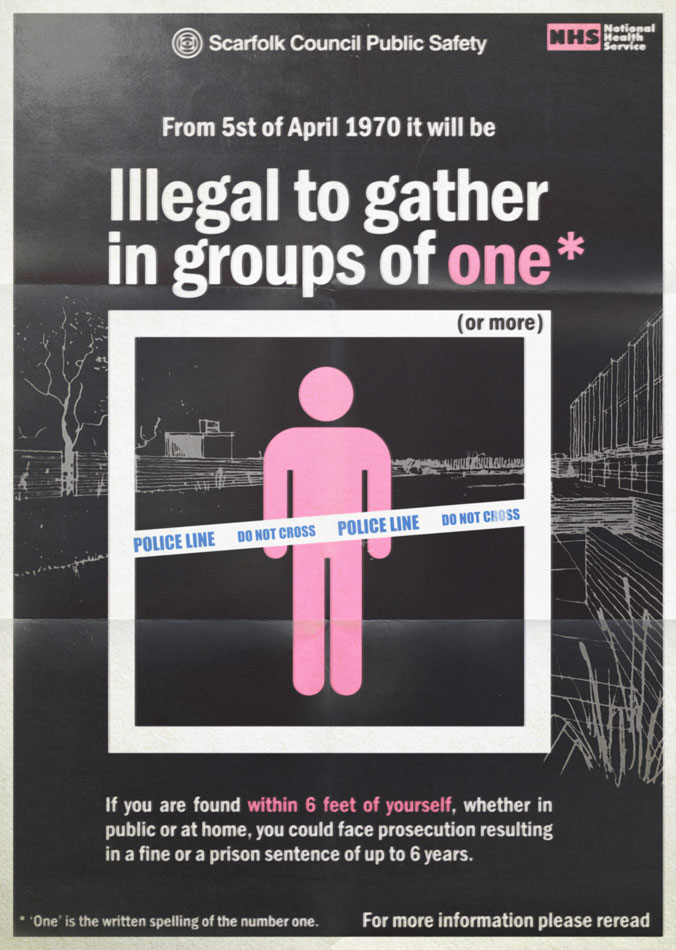
Ultimately, Scarfolk Council is a fictional creation that has cleverly twisted the aesthetics of the past into an alluring and unsettling reality that triggers indescribable emotions from our deepest memories. The expansion of the small town of Scarfolk into several books and an upcoming TV series along with its accidental features in official UK publications indicates the subtle power that unconventional applications of hauntology have over traditional productions within the horror genre. That’s why I believe that Scarfolk Council has successfully mastered the anxiety and unease of horror through its creative re-imagination of the past that draws upon the normalcy of its fake artifacts to tell an eerie and compelling narrative that illuminates concerning realities behind its satirical gaze.
Experience Scarfolk Council: HERE
