The Poetry Snapshot: Stoic Luxury

A time of milk and honey, where no one talks about money—
champagne conversations and dicty dialogues—
in a town of copied and pasted happy faces,
they find a target for their jealous disgraces.
A woman moves in wearing her silk scarf and stoicism,
eyes reflecting her wisdom like a prism.

Without warrant, their words would spread in torrent,
always giving their looking-glass logic on her loneliness.
Her diamond-pierced ears would hear ear-piercing lies,
but one-by-one she would collect them and polish them,
weave them together into a magnificent chandelier
that she hung from her mansion so proudly,
hosting galas without invites and music playing loudly.

Boulder, Colorado

Red rosy lips softly spell out her secrets,
once touched with passion, but now with regret.
She grew up hiding her pain in pressed-powder,
then created success when no one allowed her.
The day she wore hardship like high heels,
time slowed down until every moment was dusk.

She pours charisma into her glass hereafter
and walks with the scent of vineyards in her laughter.
The only time where nostalgia lies in the future.

She was raised to romanticize every view—
rolling hills nearby would bid her adieu
and the sky would blush at her everlasting glow
only one set of footprints walks along this chateau.
Poetry v. The World: I like the Rain

I don’t know about anyone else, but I get really annoyed at how much I like rain. Seriously, it’s just water… you think I’d get tired of looking at it but I never do haha.

Anyways, I was actual very hesitant when deciding to use this poem. I feel like talking about the rain (or nature itself) in public poetry is too over-done. It’s like a cheat-code for writers because mostly everyone knows the material you’re discussing. When the audience immediately knows the concept of your poem, half the battle is over and you can just sound cool for the rest of it. Writing about a natural phenomenon is a very good exercise for writers to start, but it makes it very difficult to elevate your writing to something deeply profound or personal. At least, that’s been my experience with it.

So, why am I telling you this if I just showed you a poem that I wrote about rain?? Well, I will tell you… And it’s not because I think it’s a deeply profound poem. When I took this video, I had just wrapped on a project that I was working on for the past 6 weekends. After 17 days of shooting, (nearly the amount of time they spend shooting feature-length movies) we were excited, a little saddened, and most of all exhausted. After the hardest day of shooting yet, we wrapped. Then! It began to rain and the sun was just about to set, unobscured by the clouds. I don’t think the video does it justice. It felt ethereal.

But yeah, so this occurrence happened right in a moment when I felt something deeply, and that is always a special moment. I didn’t write this to push boundaries, but I felt that I needed to express this part of my life in words and video, so I did. After all, that’s kind of a poet’s job, isn’t it?

Many thanks, I hope you all the best in the final weeks of this semester! And remember to look out a window every once in a while and get lost.

Best,

Jonah J. Sobczak

-jonahso

Study Hal: Week 41 – Spring Cleaning

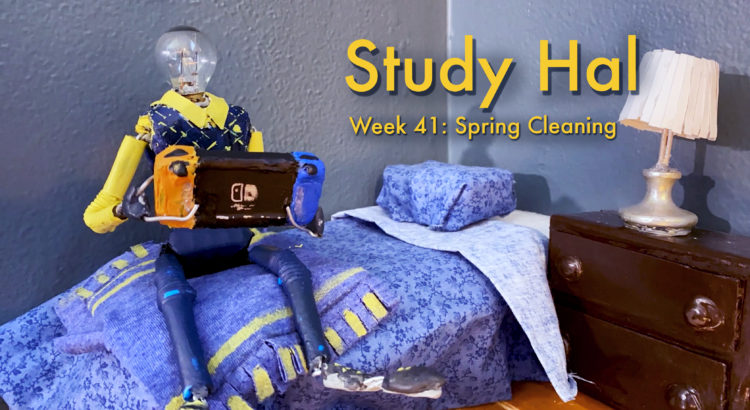
Birds are chirping, flowers are blooming, finals are just around the corner… It’s starting to feel like spring! As a study break today, Hal harnessed the springtime spirit and tried to tidy his room. It wasn’t long before he found his video game console and, well, it’s been months since Hal had time to play a game! But what was supposed to be one level turned into a whole afternoon of accidental gaming.

Hal can’t say he didn’t need the break, but he didn’t intend to take the break either. I think many students are in the same boat. With each passing day we have less energy and focus, so it becomes easier for little breaks to become the rest of the day. We gotta stay strong, though – less than a month left! After that we can all play video games together.

If this is your first week finding us, welcome! Hal is a U-Mich senior trying to get through his last semester. We’re back Tuesdays with updates, but feel free to check out our archive under the Study Hal tag!

From Audio File to Spotify

A question I got a while back was how someone would take a piece they’ve been working on and actually go through the process of putting it up on Spotify/iTunes/etc. I’d like to take this post to share how I’ve personally gone about doing this!

The song I am releasing is not up on streaming platforms yet–it’s currently under review to make sure it abides by all copyright laws, etc.–but the process for getting to this point was actually a lot easier than you might think it would be! So here we go: my step-by-step guide to putting something on Spotify:

  1. The first thing you’re going to need to do is figure out what third-party website you want to use in order to manage your release. There are a lot of good options including songtradr, TuneCore, etc. but these all require you to pay a subscription fee. I personally recommend using a website called Routenote (https://www.routenote.com/) Routenote has the option to use a free version or a paid version of their service. The free version allows you to keep 85% of your royalties, while the paid version allows you to keep 100%. If you don’t really care about the monetization of your work, then the free version of Routenote is a great plan for you.
  2. Creating a Routenote account was the second step for me. It lets you log in through Soundcloud, Twitter, Facebook, Google, or by manually signing up, so there are tons of options! I’ve found for some reason if you use an incognito window there are fewer glitches while signing up/logging in.
  3. Once you’ve created your Routenote account, you’ll be able to create a new release. You’ll give your release a name–this is the name of the album. My song is just a single, so the album was the title of the song, but if you’re releasing a multi-track EP or full-length album, you’ll have to come up with a title!
  4. After you’ve submitted your title, Routenote will send you to a page where you’ll have to edit four different things: Album Details, Add Audio, Add Artwork, and Manage Stores.
    1. In Album Details you’ll provide artist details, titles, any copyright info, etc.
    2. Add Audio is where you submit the actual audio files for your release. These have to be uploaded in a very specific format. The website only accepts MP3 or FLAC files–though this is easy to convert in Apple Music if you’re using a Mac like me!
      1. In Apple Music, go to “Music in the upper lefthand side of your screen.” Click preferences, and then “files.” You should see ‘import settings.
      2. Once you’re in import settings, under the settings menu, click “custom.”
      3. Set your stereo bit rate to 320 kbps and your sample rate to 44.100 kHz.
      4. Click okay.
      5. Now go back to your music library, click on the song you want to convert, go to “File,” “convert,” and “create mp3 version”
      6. Music will create an MP3 version of your song, which you can then drag and drop to your desktop, and upload directly to Routenote.
    3. Add Artwork is where you can upload the artwork you want to show up as your album cover. This must be at least 3,000 by 3,000 pixels, so make sure your image is big enough!
    4. Manage Stores is where you choose what platforms you want your release to be available on. I am personally only releasing to Spotify, iTunes/Apple Music, and TikTok, but there are dozens of other options available!
  5. Once all of this information is filled in and correct, you are able to confirm your release. The website will put it under review, and once this is complete, it will be sent to streaming platforms within 14 days!


That’s really it! Not too hard at all. I hope this helped, and if anyone ends up releasing some of your own work, I’d love to give it a listen!

Round green shapes of varying sizes glow against the black background. The text reads, "Immersive."

Immersive #9: Loving Vincent

Oftentimes, adaptations of pre-existing work are translated into new mediums in order to expand upon the impact and outreach that the original work holds. However, given that every medium has its own advantages and disadvantages, these adaptations run the risk of losing the insightful themes and emotional responses that the original creator sought to invoke within their work. Nevertheless, when adaptations do manage to stay true to the original message, the end result can truly add onto the original contributions of the creator’s work in a meaningful manner.

One such adaptation that takes this approach of having a deep rooted understanding of the original work while transforming it into something revolutionary is through the 2017 feature film Loving Vincent directed by Dorota Kobiela and Hugh Welchman: from its conceptualization to implementation, Loving Vincent sought to put a new spin onto the life of Vincent van Gogh and the circumstances surrounding his death by having its animation consist entirely of hand-drawn paintings, becoming the world’s first ever fully painted film.

In having every frame of the film be painted in the style of Vincent van Gogh, Kobiela sought to build upon the words van Gogh stated in his last letter: “We cannot speak other than by our paintings.” And since such an ambitious feat had never been pulled off before, the creators had to spend 4 years developing the technique that would allow them to accurately capture the fluidity of film within frame by frame oil paintings. But after they managed to hone their technique, it took the team of over 125 painters another 2 years to finish the film, which consisted of over 65,000 frames painted over 1,000 canvases. The end result would be a nostalgic yet vivid world that truly allowed for its viewers to experience what it would be like to live within the contemplative and nuanced world of van Gogh.

Adeline Ravoux Folding Napkins

Overall, Loving Vincent embodies its name within all aspects of its production, retaining the expressive style and intentions of van Gogh while inspiring new life into his works through animation: it is truly a product of love for what van Gogh stood for and what he means for other creatives and admirers who gaze upon his work for inspiration. The film also serves as an indicator on how traditional mediums can be transformed into something new and innovative that adds onto the original work without subtracting from it. It is also a reminder that love for a project can go a long way in ensuring that all elements of the production work with intention and in harmony with one another, which is a mindset that I hope we are all able to embody within our own personal pursuits and creative endeavors.

Witness Loving Vincent: HERE