poco piano: sleepy

This week was finals week and I haven’t had a lot of time to play the piano. I would take breaks from writing my portfolio (9,000 word min), and play a little piano to free up my mind from words and precision and give me some respite from the computer screen. The title of this one is “Child falling asleep” by Schumann. It’s a movement from Kinderszenen, “childhood scenes”. I played this throughout the week, just to feel some peace from the flurry of finals.

It’s a bit of a strange piece. One would think that a child falling asleep would be unfailingly sweet yet it seems rather bittersweet instead, almost troubled. The warm major section in the middle seems like dream, slightly out of reach. It’s subdued but peaceful and rocks like a cradle through the night.  It ends unresolved, as if in mid thought—the child drifts off.

Art Biz with Liz: Short Story Writing

Another semester is coming to an end, and what a weird one it has been. With classes over, it’s crunch time for final exams, essays, and projects. One of my final projects this year includes a short story collection, the culmination of a semester’s worth of work. The goal of it is to see my original creative work, which was submitted on a regular basis throughout the past few months, in a complete, polished state.

RCHUMS 325 is a “tutorial,” which is a unique opportunity to participate in one-on-one writing workshops with the Residential College’s creative writing faculty. Tutorials are meant to support students in expanding our understanding of the craft of writing. Through them, we also grow as young artists in developing our voices and creative visions. As such, the course I took centers around creating (and submitting) new and revised stories weekly, which are influenced by critical reflection done both individually and collaboratively with an instructor.

As I learned in another creative writing class, RCHUMS 220 (Narration), I tend to write longer short stories, as contradictory as that may sound. Doing a tutorial this past semester has been invaluable in writing fiction that is around 5-10 pages long, which is shorter than my “short” stories usually are. After this experience, I’d highly recommend that any writer tries their hand at writing a short story from start to finish. Why? Writing short stories can help a person further develop various writing skills, as the process unveils many of the questions and predicaments faced when crafting fiction of any length.

A short story is a chance to create a unique character and storyline, perhaps without requiring as much of a time commitment as a full-length novel. If a writer has trouble with the plot or characters in their short story, it might highlight some areas to work on when writing other works, too. Like any other art form, writing takes practice, and short story writing can help a person improve on a few different elements of general fiction writing.

While it may seem like writing a short story would be easier than writing longer works, it still comes with its own challenges and opportunities for growth as a writer. A good short story must tell a compelling story with a beginning, middle, and end in noticeably fewer pages than a typical novel. Generally, that limits the number of scenes, characters, and plot points that can be included. There’s not as much room for “fluff,” or extraneous information that doesn’t add anything to the story. Thus, writing a short story is good practice for both pacing and extensive editing. While a novel may detail years of a character’s life, a short story may encompass only a day. This was one of the biggest lessons that I learned this semester through my creative writing tutorial. In being accustomed to longer stories, I tried to cover more time than was feasible in one of my short stories, which required heavy revision to improve the storyline and flow.

It can also be deceptively difficult to make a reader feel a certain way about a character when they witness only a snippet of said character’s life. Yet, there are also some advantages to writing stories of shorter length. Shorter timelines may not allow for as an authentic evolution of certain relationships or character arcs, but they can create faster stories. This results in an opportunity to cultivate motion and tension for a more engaging plot and streamlined story. Considering this information can help a writer decide whether they want their idea to be a short story, novella, or longer work based on how much time is necessary for the storyline to unfurl to optimal result. Based on my experiences with RCHUMS 325 this past semester, this is something I’ll keep in mind moving forward, and maybe you will, too.


RCHUMS 220: Narration and RCHUMS 325: Creative Writing Tutorial are available during fall and winter semesters through LSA’s Residential College (RC). RC courses are not exclusive to RC students; however, instructor permission is needed to enroll in RCHUMS 325. Check out the RC Writers page here!
Looking Forward: Writer to Writer

Hey arts, ink readers!

I hope exam season is treating you well and you’re finding ways for self-care in the midst of all of it. This week, I spoke with Aylin Gunal, Editor-in-Chief for Writer-to-Writer. I asked her about the publication, how the organization has adjusted to this semester, how she perceives creativity on campus this semester, and how students can get involved. It was a wonderful conversation I’m excited to share with you all!
If you don’t already know, Writer to Writer is a student publication that began in the Minor in Writing program. The twice-yearly collection is open to students across campus and encourages multi-modal writing submissions (videos, photo essays, etc.). The organization’s staff is made up of students, many of whom are in the Minor in Writing program, though others are welcome. 

Thanks to technology, not a ton has changed for Writer to Writer this semester. Aylin told me that they’ve been pretty successful adjusting their regular programming to be online, including their weekly meetings. Additionally, they’ve begun to incorporate more events like writer’s workshops, which have served as community-builders within the organization. This has been especially important, as Aylin realized how valuable the small chat before meetings and between discussions was once it was significantly reduced due to zoom. In order to address this, they’ve been incorporating more intentional community-building activities this semester, including a minor-wide book exchange for the holiday season! Although it’s not quite the same as hanging out in North Quad every week, it’s a way for writers to expand their skills and make friends during this crazy year. 

When I asked Aylin how she saw creativity on campus adjusting this semester, she told me that she really missed the chance encounters that being on campus in typical semesters allows. You can walk through the Diag and see a group of students playing handmade instruments, pass the art museum and see a new exhibit, or walk by a pillar filled with fliers and learn about an acapella concert happening that weekend. Now, the information you get is much more based on following the right people or being on the right newsletters, which can limit what you’re exposed to. Hopefully, however, we find ways to bring some of these simple reminders of “normalcy” back to campus next semester. 

If you’re interested in getting involved with Writer to Writer, you can submit your work to their blog or publication here. If you’re interested in being on the staff, you can email writer-to-writer@umich.edu and attend the next weekly meeting. You can also stay up to date with their activities, including a soon-to-be-announced campus-wide writing competition, by following their Facebook or Instagram pages. 

That’s all from me this week! Good luck to everyone on finals and remember to take some time to take care of yourself! I’ll technically be on hiatus until classes return but keep an eye out… you may get a special post or two 🙂

-Lucy

Artist Spotlight: Jeffrey Cheung and There Skateboards

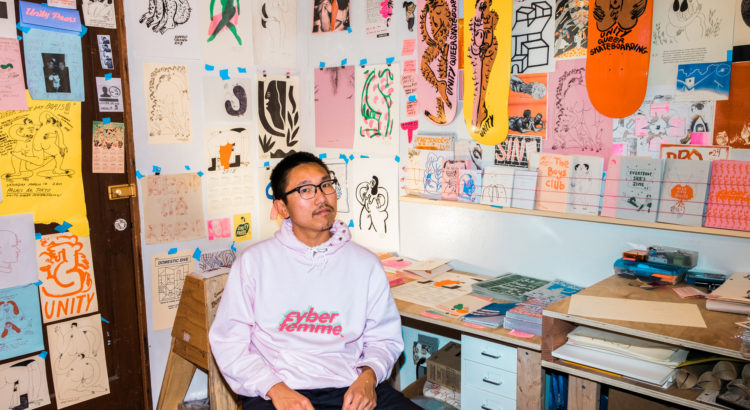
Artist, skateboarder, and musician Jeffrey Cheung, based in California, is known for his work in carving out space in historically heterosexual, white spaces, namely skateboarding. In 2017, he and his partner founded Unity, a skateboard company/community/printing press, and now runs There Skateboards, a collective also dedicated to supporting queer and trans skateboarders of color (QTPOC).

Although skateboarding is known for pushing boundaries, it is an activity that has been dominated by white men since its inception. Women and skaters of color are rising in popularity, yet skating remains rife with misogyny. Cheung’s collectives work to fight for marginalized voices and expand diversity, hosting skate sessions and art shows with different communities. There Skateboards also sponsors several pro queer skateboarders–including Cher Strauberry (who has started new brand Glue Skateboards) and Marbie Miller. Unity and There are more DIY and “underground” companies spearheaded by an authentic artist.

Cheung’s art itself speaks toward his mission; they are colorful, androgynous figures that are vibrant and dynamic. They interact with each other and seem to spread the message that self-love as well as community are important. Featuring an assortment of tees, hoodies, prints, skateboards, and even a collaboration with Adidas Skateboarding, Cheung and his company, as well as other queer skaters of color are make a big and refreshing difference in the world of skateboarding.

You All
Pink
Triangle
Unity Skateboards
Mural

Poetry v. The World: Used to be afraid of going bald

When I got that buzzcut, I was in the 8th grade, if I remember correctly. I liked it when I walked back the the lobby, but the look on my mom’s face was unbelievable. It’s actually incredibly entertaining to look back on, because she was so shocked and I had this just like “yeah, whatever” demeanor about it all. She knew I didn’t like it before I knew.

I always take a shower after I get a haircut, still pretty much to this day, to get all the little pieces off of me. And when I was just putting my foot in the shower, I looked back to the mirror. Something about being naked and vulnerable with my nearly shaved head, I couldn’t take it.

I got over it in like two weeks, but it was still the first time vanity had really taken a toll on me. The teenage angst was setting in, and it was there to stay for a while.

But!! It’s got a positive end. I still feel I’m slightly reliant on vanity for my self-esteem, but overall I’ve come a long way. When I was going through those phases, my parents and family members always told me that I would grow out of it. And young me didn’t doubt them, but it’s nearly impossible to look into the future when you’re self-conscious in the present is so fragile. So I just kept my head down.

If I’m honest, I think this poem would fit better into a collection. It kind of jumps from two large stages of growing up with little transition and minimal details. I feel the context of a piece inside of a collection is huge. Like way bigger than people give it credit for. Just in terms of emotional variance, imagine reading a poem about like… leaves falling, and then being thrown into a narrative poem bout World War II. There’s a lot of poetry just in how you structure the things you make, and I’m excited to read more into that in the future.

Anyways, please do be well and remember that vanity is nothing. [Steps off soapbox]

Sincerely,

Jonah Sobczak

-jonahso