
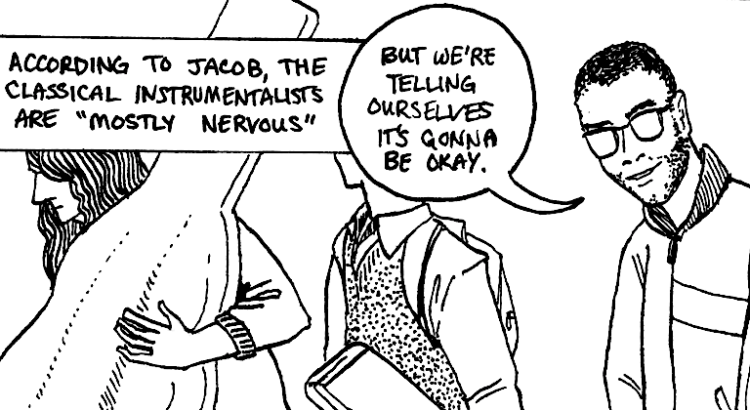
This week, I talked with Jacob Ward, a sophomore studying clarinet performance in the School of Music, Theater, & Dance. Outside of class, you can also find him working for SHEI Magazine or the University of Michigan Museum of Art.

This week, I talked with Jacob Ward, a sophomore studying clarinet performance in the School of Music, Theater, & Dance. Outside of class, you can also find him working for SHEI Magazine or the University of Michigan Museum of Art.
Women’s Vocal Arts Day, or WoVAD, is an annual choral symposium featuring The University of Michigan’s Women’s Glee Club (WGC) and various high school choruses from the surrounding areas. The day is filled with fun vocal warm-ups, choral workshops, and social activities. Up to 500 high students from around Michigan are invited to this event.
This year, WoVAD took place on Saturday, January 11th. While inclement weather threatened attendance, the day was enjoyable and educational for all that took part. High school soprano and alto voices were assembled into groups led by one or two WGC members of the same part. Throughout breaks, each group played ice breakers before returning their attention to the director, Dr. Julie Skadsem, and their repertoire. The students, both in high school and WGC, learned new songs such as Weep No More by David N. Childs and Water Fountain by Tune-Yards.
While the day was fun and relatively relaxed, preparing for the event required a great deal of communication, commitment, and organization. The WoVAD Coordinator for this year, Fiona Lynch, started planning months in advance. Lynch, a sophomore in the college of LSA, applied for the position last year at the end of her second semester in WGC. To her, the concept of sharing a day in song with students from all around Michigan–including those who could possibly be future Glee members–was very cool. She wanted to be a part of making it happen, which is exactly what she did:
“Getting to make music with so many awesome people in high school and college was really cool. The hardest part of the event was the storm warnings the day before and the day of, which required reorganizing a lot of things. Luckily, all of the WGC members worked together so well in spite of the weather to make the event a success!”
– Fiona Lynch, 2019-2020 WoVAD Coordinator
The WoVAD vocalists finished the day by presenting a joint concert with the Men’s Glee Club, who sponsored the Male Vocal Arts Day, or MVAD. Just like WoVAD, MVAD invited high school choruses to learn vocal technique and perform with the collegiate singers. The concert, which took place in the historic Hill Auditorium, featured songs learned throughout the day as well selections from past U of M Glee Club concerts. Midnight Blue and The Friars, a cappella subsets of WGC and MGC, also performed.
Without my choral experiences throughout middle and high school, I never would have auditioned for Women’s Glee Club. The choral arts were a huge part of my life throughout grade school, which is why I get excited about events such WoVAD. Overall, the day presented an opportunity for young adults of different ages and hometowns to share in musicality and the arts. I truly enjoyed spending the day sharing music with all the talented vocalists involved, and I look forward to next year!
To learn more about The University of Michigan Women’s Glee Club or inquire about WoVAD registration, visit this website.
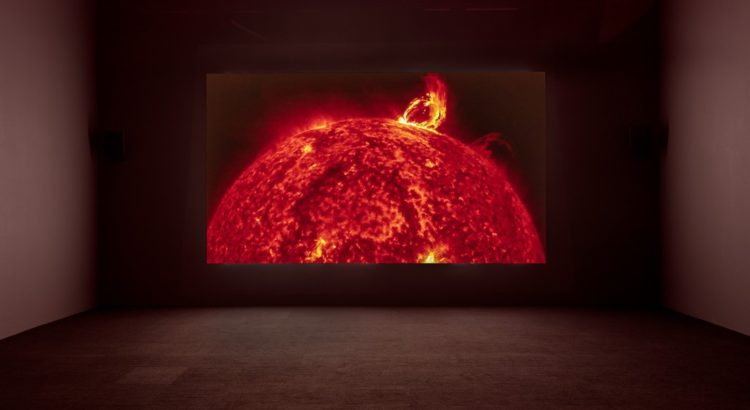
Whilst in Chicago this summer I attended the Museum of Contemporary Art Chicago and stumbled upon a powerful video montage by Arthur Jafa called, “Love is the message, the message is Death”. Set to Kanye West’s “Ultralight Beam”, the video contains found footage displaying contemporary imagery that tries to trace and connect not only American culture but most importantly black culture through time. Jafa examines African American identity through history and focuses on what it means to contribute to the subject of black representation.
I sat through Jafa’s piece twice trying to take in all it’s proclaiming but I struggled to gather it all. The art spoke about a multitude of relationships and interactions which contribute to the complex discussion of its subject(s).
In an interview with the Louisiana Channel, Jafa describes how he has always collected images since he was a kid and how this progressed into his later work. He had no intention of making a portrait of America but just to collect and compile things he was attracted to onto a file. This file then became a strung-out video (with tweaking of course) that Arthur Jafa became highly interested in and shared with others.
“Sometimes I feel like you have to put things together to figure out what you actually are attracted to.” (Jafa, Louisiana Channel)
Jafa explained how when he was a kid there was no documentation of abuse to black people. However, as technology advanced there was a “title wave of documentation” of violence against black people. He explained how the violence was always happening but it was the documentation that was new and revolutionary.
“As I was collecting the files, I wasn’t collecting them to do anything. I was just collecting them in a sense because I noticed things would appear and then no longer be available; disappear. I kept these files mostly so I could look back at them if I wanted to.” (Jafa, Louisiana Channel)
When first looking at “Love is the message, the message is Death” I believed it to be a piece of artwork that came with an elaborate art practice. However, after watching Jafa’s interview with the Louisiana Channel I understood his work is a culmination of imagery that he is attracted to, him figuring out why he is attracted to it and how these images all connect together. He had no intention of creating this monumental piece but instead to figure out what the montage meant to him and others.
Love is the message, the message is Death is an interesting piece to me not only because of its content but also because of how Jafa created it. Jafa explained that he didn’t make these videos important but instead by stringing them all together, he made them important in a different light. Jafa is saying to have people look at things for what they are.
The videos themselves could be argued that they are not art but Arthur Jafa is announcing that they are art.
P.S. here is a link to a definitely illegal version of it on youtube but it is a must watch–> LOVE IS THE MESSAGE, THE MESSAGE IS DEATH
Most likely you’ve heard of the comedian Conan O’Brien, most well known as the host of the late night TV show Conan, where he puts his abrasive yet endearing personality on display in sketches and interviews. Personally, I’ve never enjoyed late night talk shows; I usually find them to be overly political, extremely shallow, or just thinly veiled advertisements of celebrities and other entertainment. Most of the hosts are too dramatic, as if they were trying to entertain children, or they are just clearly bad at conducting interviews. Conan is no exception: a few of his skits force a laugh, his personality is unique and comical, and his interviews are no worse than any other late show, but I have never been able to sit through an entire episode. Whether it be a lack of interest, or a failure in the talk show formula, I’ve never been able to consistently watch any late night show, let alone Conan. However, I was recently told that Conan hosts a small podcast, which is widely praised and quickly gaining popularity. The name of the podcast is Conan O’Brien Needs a Friend, and each week Conan interviews one of his celebrity contacts in a search to find out who is actually his friend and who is just a professional acquaintance.
 I’ve tried podcasts in the past but they never caught on; I couldn’t be bothered with downloading them, finding them, or finding time to listen to them, so I eventually gave up. Recently it’s been different, ever since I started listening to Conan. It’s the one podcast that I can listen to from beginning to end and still wish there was more, that’s how impressive and unique his podcast style is. First, I find the concept of the show interesting, which considers how famous celebrities often struggle to make authentic friends just like the rest of us, humanizing them and painting them as regular people with extraordinary experiences. Second, I think this is the ideal format for Conan; he can rely on entirely verbal comedy, not childish antics as often seen in his TV show sketches, and I think his interview style is much more suited for the intimate setting of a podcast. When he interviews in front of an audience, both him and the guest are putting on a trained persona, crafted to create a positive public opinion and maintain a certain reputation. On the podcast, Conan becomes authentic, and in doing so he is able to draw out the authentic personalities of his guests.
Some of my favorite podcasts so far have been interviews with Ben Stiller and Stephen Colbert, both amazing and inspirational celebrities in their own right, but also fascinating people with complicated histories. It was so strange hearing Ben Stiller give a genuine recount of his childhood and cracking jokes, not promoting some new movie or TV show. I got caught up in how normal and hard-working he was, hearing about how he got into comedy and paved his way in the industry. The interview with Stephen Colbert was very similar, as Colbert talked about his rough childhood and related to Conan about the power of suffering to produce comedy. It was something you would never see on TV, since it would be considered too dark and not entertaining, but I found myself more intrigued than I had ever been watching a TV interview. Overall, I think Conan is in a unique position with his podcast: not only does he have the ability to interview other celebrities, he also has a talent for leading sincere and thoughtful conversations through his personality and comedy. I highly recommend giving it a listen, even if you aren’t one to listen to podcasts; Conan O’Brien needs a friend is the gold standard for the power of podcasts.


Hi everyone! I know it’s been a while, with break and everything, but I’m back again this week to open a discussion about my answer to the question, “what class is your favorite?”
And yes, I am well aware that this is one of those cliche icebreaker questions, but it’s actually also a common question you’ll hear people in studio talking to each other about from time to time, whether it’s asking for peer suggestions on what class to replace with another, or just curiosity. With that said, I’m also well aware that prospective students are probably wondering the same thing and probably worried about the answer I’ll give like, “oh jeez, will I be able to enjoy such a class myself?”
Again, in no way am I representative of the whole body of architecture students here at the University of Michigan, where we all have different values and aspirations, so each one of our answers to this question will likely vary.
***
Over the years, I’ve taken a great mix of courses.
***
Unfortunately I gotta launch back into my assignments again, but I’m so excited to hear your comments and thoughts on this blog! Once again, if you haven’t already, if you want to see more of my photography and what studio works I’ve been up to, give me a follow on instagram: @themichiganarchitect
Ciao 🙂

