
Zaba: A Surreal Concept Album

Zaba is the debut studio album of the band Glass Animals, and was released in 2014. It is also an incredible work of art and a testament to the power of concept albums to create an entire universe inside a single musical space. This album is especially unique in how it pushes the envelope: from the samples used to create the rhythms and flows to the abstract lyricism. The “concept” of this album is fairly loose, and that’s part of what makes it so surreal. It focuses on creating a jungle setting by using rich bass backgrounds and a variety of plucky leads, along with animal samples, such as bird calls, throughout. It accomplishes this effect so well in every single song that it’s almost uncanny: listening to it you almost feel like you’ve entered a parallel dimension, where colors swirl and drums pound from all around you. The drums and pounding rhythms contribute a large part to this feeling, especially on songs such as Wyrd, JDNT, and Psylla. You can’t help but sway to the music; it has an almost hypnotic effect. However, as you’re caught up in the incredible atmosphere of the album, you’ll miss the other unforgettable aspect of it: the surreal lyrics.

Now the lyrics are probably my favorite part, and really sets them apart from other strange bands. Once you start listening, you’ll realize that most of it is well-formatted gibberish. A few sentences of coherent thought, maybe a single linking thread between them, about something vague and shapeless. The magic of this album is getting lost in its universe, and the lyrics are essential to that: they disconnect you from reality; they lull you into different state of mind. Surrealist art often focuses on the subconscious, exploring the dormant world beyond our conscious minds. Often these works use juxtaposition to startle the viewer and contradict their reality, evoking a feeling of uncertainty and creating an atmosphere that simply can’t be described. In much the same way, I think Zaba embraces the surrealist mindset and brings it to the world of music in a startling fashion. The lyrics transcend traditional music and challenge the listener’s reality; the production is hypnotic and unearthly; the singing is soft and seductive; and the jungle atmosphere is so convincing and strange that you’ll get lost and never be able to find your way out. All in all, it’s an incredibly memorable album that has endless replay value, and I highly recommend giving it a listen. It stands alone as a truly atmospheric concept album, and I think it’s a great example of how powerful concept albums are as works of art.

(Image credits: Google Images)

The Calling of the Bees

It has become common knowledge that bees are dying.  I have seen many stickers, read many articles, and heard many people discussing this topic.  If bees go extinct then the way that we live our lives will drastically change. This is a problem that most people do not know what to do about to fix it.  Most people are also scared of bees, and run away when they see one, or they are generally not too happy about interacting with them.

I have spent some time on a Bee farm in Ecuador.  The farm was called Bee Farm Ecuador, and there was one family that kept all of the bees.  The head beekeeper, Gabby, was telling me about what the bees want. She says that a couple of years ago she realized that she could talk to the bees, or at least that she could understand them.  I know that this sounds crazy, but she says that there is a beekeeping community around beekeepers who are able to talk with bees. She says that the best way to save the bees is to invite them into our lives.  Every morning she does yoga with the bees, and she will put healing crystals around the beehives that she has made for them.

Gabby believes in somethings called “the calling of the bees”, this means that bees come to you if they think that you need them for some reason.  She says that the bees come and bring their strong feminine energy and the presence of them will help your life in some way. While I do agree that at first this sounded ridiculous, being around her and the bees I quickly realized that I was not scared of the bees while thinking with the mentality of “the calling of the bees”.  It didn’t matter if I believed that the bees were there to help my life or not, by me telling myself that they were I was not afraid of them when they flew by me and I heard there buzzing all around.

I think that the best way for people to start to help and solving this disappearance of the bees is to first stop being afraid of them.  And having “the calling of the bees” mentality is an easy way to do this.

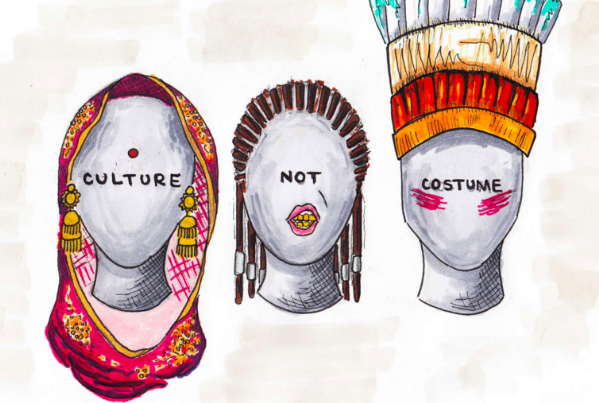
Art may be a part of culture, but my culture is not your art.

Nothing will make me quite as angry as tourism, under the guise of a study abroad program.

I am tired. Tired of seeing one too many pictures of people posing in third world countries pretending to identify with the lifestyle. Do not try to lay claim to a cultural identity that is not your own. You are a visitor and will always be a visitor because your time there is temporary. Spending a few months in Asia does not make you Asian, just like spending a few months in Africa does not make you African. A rice worker’s hat is not your prop. A kimono is not just a fashion statement. A hijab is not a decoration. The culture of other is not a backdrop for your Instagram self-expression. Rather, engage in ethical practices of honoring, appreciating, and supporting the culture of other.

Having deep appreciation for a place is so very different from using a place to create social capital for yourself. By posting appropriated pictures documenting your exotic journey abroad, you reduce another’s culture to a quick snapshot that is able to be scrolled past without a second glance. Think about what you are posting it for. For likes and comments? To cross “travel the world” off you our bucket list? To add “well-traveled” to your personality? We are in an age where everyone wants to “embrace” other cultures by posting these seemingly cute pictures, without actually supporting the people of that culture. This enables people to remain ignorant to the fact that they’re only perpetuating harmful stereotypes.

To make the most of your time away, do your research. When you enter a new space, understand that you are not just bringing yourself. You carry rich histories with you—stories of the people who came before you, of the country you’re from, and of what you’ve lived. Know that your presence transcends the bounds of your body, understand what you are representing, and take responsibility for your role in your own narrative. Especially coming from the United States; it’s of utmost importance to understand your role as an American given the deep rooted and far-extending ideals of colonialism, imperialism, and globalism birthed from our early predecessors and arguably, maintained by present day power structures. Recognize your place and reflect on the assets that allow you to leave your own country.


Definitions for Thought

Cultural appropriation—adoption of elements of one culture by members of another culture; can be controversial when members of a dominant culture appropriate from disadvantaged minority cultures because of the presence of power imbalances that are a byproduct of colonialism and oppression.

Social capital—network of connections with people that allow you to succeed in a social environment; a form of insulation or protection from adversity because of support derived from social status.

Insensitivity—lack of awareness or ability to respond to something; lack of concern for others’ feelings.

Exoticism—the representation of one culture for consumption by another; often involved surrounding foreign cultures with mystique and fantasy, which owed more to European culture than to the exotic cultures themselves; process of glamorization and stereotyping.


(Image credit: Google images)

Lazy Winter Days

Lazy winter days are blank and soft and grey. When spring comes along with its blossoming energy, these days are easy to dismiss and even easier to miss. For, lazy winter days are a comfort that we take advantage of, yet never appreciate fully. On these days, there are always reasons for doing less. It is always just cold enough for us to invent endless excuses to stay inside. It is always just gloomy enough to muddle our brains with imaginations of the summer to come. I can never focus on a lazy winter day. There is nothing to focus on. The hours pass by, unnoticed, each grey cloud replaced by an endless, identical sibling. Daylight grows and fades, a degree at a time, until it the day has become night again. I follow suit, barely shifting a few inches from the seat that has grown accustomed to me too. On these days, I have seemingly endless patience because I barely appreciate the movement of time. When we do work on lazy winter days, they encourage us to work on the things that don’t need doing. There are certainly far more important tasks to be completed, but instead, I find miniscule things to do. Maybe I finally get annoyed by the pile of unfolded laundry laying at the foot of my bed. Maybe I find a new way to rearrange my pencil pouch before it is almost instantly disrupted. But homework, real work, is reserved for another, more energetic time. Instead, I move imperceptibly like a glacier, gradually carving its path into the land.

It seems especially important to reflect on these days as we are about to reach the end of another unhurried February. Everyone will always complain about the bitter winds, the slippery pavements, the pile ever-growing melting slush. But it is also exactly those things that make us slow down. The world moves at a slower rhythm in the winter. Your heart doesn’t need to race the burning heat. Your brain feels content to move at a syrupy pace, at last released from the frenetic pace demanded by the animation of other seasons. Spring is all impulsive growth. Summer a never-ending sunshine-soaked revel. And autumn is transformative, from green to reds and oranges and yellows. But winter, has always been still. We are frozen in ice, awaiting the coming thaw when we must move again. Nothing grows in the winter. We just wait. And in the process of waiting, something is gained. For there is no loss in moving a little bit slower. No sacrifice in catching your breath. We are constant beings, always the same with slight shifts. We don’t believe it though. We try to defy it. Instant transformation is an impossibility that tortures us. It is a hope that is implicit in every New Year’s Resolution, in every career plan stretching for the next five years. And when there is the least bit of stagnation, the sting is sharper than a pounding needle. Winter demands a periodic stagnation. A time to recollect all the broken pieces of our change over the year. And maybe consider the cracked portrait of the past before inevitably moving on.

Fighting the Pain

My junior recital is coming up in about a month.

In this recital I am going to play three solo works for unaccompanied viola and a string quartet with my current chamber group. That’s about an hour and ten minutes of playing in total which is what I can easily do in an orchestra concert, but solo playing is much different than ensemble playing. It takes way more focus because the music is more challenging. It’s a lot more physically challenging because you don’t get any chances to rest. Endurance, physical and mental, is one of the most important parts of being a musician, just like it’s important for an athlete. Both require practice in preparation for a performance. You can’t expect to do your best in the performance if you didn’t prepare yourself well enough. And since adrenaline is only present during a performance and not practice, it takes even more energy to keep the mind’s attention and the body in peak performing condition.

At this point, I definitely don’t have the endurance to play an hour and ten minutes of solo music. I am slowly trying to up my practice time every day, but my body is fighting back. I have dealt with overuse injuries since before my senior year of high school and I know that I am prone to getting injured. Every time I finish a run-through of a piece I have an aching feeling in my right wrist that doesn’t go away, and I can feel that my body is too exhausted to continue.

What am I supposed to do in this situation?

Because of my past experience with instrument-related pain, I know the basics of self-care when it comes to practicing. Warming up the body before playing, icing the muscles after, and doing arm and wrist strengthening exercises should be a part of one’s daily routine. Trips to the physical therapist include KT tape, finger splints, and ultrasounds to break up muscle tension. I know the drill, but after awhile when I start to feel better, I stop doing the exercises because I don’t see them as necessary anymore. I basically just get lazy.

Fresh from a trip to the physical therapist today, I am determined to get through the next month of recital preparation with a clean bill of health. I am going to incorporate exercise into my everyday life as well as practice finger strengthening exercises. I am going to work up my practice time until I am able to do 2 full run-throughs of my recital program in 1 practice session. I am going to ice my arms after I practice and wear KT tape every day. I am going to remind myself that I am an athlete and need to take care of my body as such. 

The Problem with Karl Lagerfeld

Renowned and controversial fashion designer Karl Lagerfeld passed away at the age of 85 this week, leading to a slew of celebrities both praising the iconic designer or bashing him for his problematic statements. As the head of Chanel and Fendi, he broadly expanded fashion through thousands of designs and collaborations with other brands. When someone famous dies, it’s easy to get heated with opinions about the person either way, but it is still important to look at all perspectives. Personally, I believe Lagerfeld’s extremely problematic language and behavior in no way justifies his contributions to the fashion world.

Karl Lagerfeld is a man of paradoxes: brilliant, yet infuriating, one-of-a-kind but discriminatory. For one, in an interview with Numero last year, the prolific fashion director called male models “stupid” and “sordid creatures,” and that he was “fed up” with the #MeToo movement. In the very same interview, Lagerfeld managed to use the word “retarded.” In several instances, he has made fatphobic, sexist statements, famously in regards to Adele and Heidi Klum. He has also been accused in numerous years of being Islamophobic and racist. Those are just a few of the many controversial arguments made against Lagerfeld.

When you look back at someone’s life, it’s easy to ignore certain parts of it. But to remain open-minded and truly take a critical look, you must consider both their successes and faults. No one is perfect, but that doesn’t mean you can’t hold people accountable for their problematic actions.