Romanticizing Chores

(Soiled Counters by Sarah Shu)

After writing this poem, I thought to myself, “Do I really romanticize my experiences when I write them down?”. I kept thinking about that question. For some part, it rings true, because I’ve written about things that may seem rather dull to some people, such as the rainy days when I walk back to my apartment soaked, sad and miserable. Yet I write about those rainy days as if every moment of it begs to be noticed. I write as if every raindrop that soaked me had to be felt, deeply or otherwise. The raindrops have to be reflected upon, whether it be the damp sensation of it or what the dampness may mean in the overall context of my life or in the life of others. I jot down the vivid feelings I was feeling at the time and how it may or may not seemingly fit in the present timeline of my life. My thoughts needed an outlet, oh so badly.

As for this poem, after stress-cleaning the kitchen countertops, I was far from inspired to tackle my bottomless pile of assignments. At this point of the semester, I was in the phase of feverishly writing despite my lurking exams. I needed to make sense of my thoughts through writing while my adrenaline was high. At the end of writing this poem, I wrote down; why am I romanticizing chores? Because I can. 

We Are What We Cook

I was always fascinated by the flickering flame that lit up the stove top. The blue lights gave off a seductive heat that I was warned against. The results were magical too. My grandma conjured up steaming concoctions of Chinese broccoli and sausage, sweet pork ribs, and sticky pork knuckles, glistening with a fine sheen of oil and love. But all my efforts, even under her tutelage, were met with disappointment. “Too much shrimp paste”, my grandma says, after the briefest taste of my limp green beans. “Not enough soy sauce”, she says of my steamed eggs. She teaches me how to wield the cleaver, but its overly large handle keeps slipping from my hand. She shows me how to shake and shiver the wok, but my garlic keeps burning anyway. I end our endeavors at the age of twelve in a petulant fit, disappointed.

It was years later, before I approached the kitchen again. This time, I was hesitant, much readier to leap away from the flame than to embrace it. I changed tactics. Instead of homegrown techniques, I turned to the endlessly tacky. Instead of the intimacy of family, I chose the distance of a stranger. Thus, began my journey into the depths of food television, starting with the most generic channel of all, the Food Network. As I watch Bobby Flay chop onions for his Chicken-Posole Soup or Giada De Laurentiis grate parmesan with a pearly smile, I wonder why I and thousands of others have fallen for their effortful charm. I am not sure that I am really looking to be an excellent chef. For I don’t need to know how to perfectly poach a chicken breast nor do I care how to pulverize a mixture of pine nuts, parsley, and peppercorns into a pesto. It even feels traitorous in some ways, to pursue this life of domesticity, instead of the modern, working woman that I was taught to be. Why do cooking shows, then, continue to entrance me?

But cooking shows were not born in the modern era. The first cooking show was an invention of the late 1940s by a balding British man named Philip Harben. According to current standards, he is not telegenic, but there is a jolly workman look to his crumpled tie and rolled up shirt sleeves. Harben taught people how to cook, not for entertainment, but out of necessity. With Britain still on rations, his cooking show showed how to cook with a nearly bare cupboard. Not so today, when television shows promote only fresh, organic, picked-minutes-ago produce. Perhaps Harben’s show does not seem to be the direct answer to my question. But one can easily see the key characteristics of the modern cooking show already germinating underneath the surface. By 1947, a year after his show first started, the BBC began referring to him as a ‘television chef’. It is more than a simple name change. It is the birth of an entirely new profession, a new genre of television. It turns what was once relegated to an individual kitchen to something broadcasted into a million homes at once.

It is a community that I thrive in. I eagerly look up recipes on the official Food Network website. I buy cookbooks and collect all the recommended gadgets. I have become a dedicated fan, not of cooking itself, but of cooking as an imagined lifestyle. It turns out I didn’t need cooking as a reality; only as a fantasy.

High School Musical’s Alluring Nostalgia

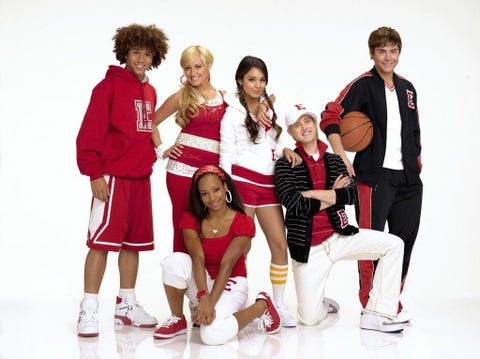
Image result for high school musical

High School Musical: a vestige of 2000’s pop culture. Known to nearly all Americans of Generations Y and Z, for me, the film trilogy has been a staple of my childhood.

I recently re-experienced the nostalgia of quirky musical numbers, spontaneous choreography, and a bright, humorous cast when thinking about Halloween costumes. (Yes, I am going to be Troy Bolton this year). Whether you related to Troy, the jock heartthrob, the “einsteinette” and love interest Gabriella, the popular queen bee Sharpay, or the shy but gifted composer Kelsey, there was always a favorite character for every kid.

For those unacquainted with High School Musical, it comprises a story of a boy struggling to reconcile his love for both singing and basketball, and being with Gabriella while some of his friends become unsupportive. The second movie deals with the friend group’s adventures working at a country club over the summer, and the third deals with the stress of senior year before college. Overall, the films are fun, energetic, and sometimes even show deep emotion. Although some have scorned High School Musical as lacking depth and musical complexity, it is quite literally an adolescent series intended for young fans. With that in mind, I believe the films address topics such as the discrepancies between love, family, friends, and passion.

With a series of three movies spanning from 2006 to 2008, High School Musical was a smash hit among children and tweens alike. Some even likened it to a modern adaptation of Romeo and Juliet. If you want a nice, nostalgia-filled pick-me-up, consider watching High School Musical and immerse yourself in that sweet, sweet childhood.

The secret to knowing what to do with your life

The UMMA presented a documentary about a Disney animator titled “Floyd Norman: An Animated Life.” From the film, the viewers got to know Floyd Norman and his journey with Walt Disney Animation Studios, beginning with his first rejection to being employed to his later rejection. Keep reading to see what I mean.

He seems like a goofy guy, carefree and creative (as reflected by his attire: a black fedora and round glasses), and extremely passionate about his role as a writer, animator, and comic artist. From the documentary, I was hoping to get some insight as to how to find a career that is as fulfilling as animation is for Floyd Norman, but alas, there was no obvious method, no algorithm, no secret that guaranteed this. Norman shared that he applied to the job at Disney and was rejected. Disney said “go get an education.”

First rejection.

So he went to college. Three years into college, he got a call from Disney, and he was asked, “Do you still want a job? If you do then come to the office at 8am on Monday.” And on Monday he went…and since then still works for Disney. I guess what I learned from this is that getting an education is the most important element to pursuing anything. It’s a platform for everything you might want to do…especially at a school like Michigan that allows for extensive opportunities in various fields. Norman went to college to follow the protocol enforced by his dream job. While in college, he could have continued pursuing what was expected in order to achieve that Disney goal. He could have given up the Disney idea. He could have found a path leading to a future he liked better. This is one purpose of education: verification and exploration and verification. You read that correctly. It took his first rejection to verify that he truly wanted to employment with Disney because he committed to the the crooked, unplanned pathway they assigned to him. What are you willing to do to achieve your dream future? While you have an outline to your goal, you can explore along your way. For example, you may take the credentials for a career in medicine and then realize that you want go into fashion. It’s your life. Do whatever you want. So what if you change your mind. See is as: now you’ve harvested a new skill in knowing science. Knowledge, of any domain, is power…in more ways than one. More importantly, you’ll never wonder what if…you’re purpose will be supported not only by interests, but likewise by the disinterests. I think the latter statement is extremely underrated. Knowing what you don’t like is crucial to narrowing down what you do like. Otherwise, you could be missing a world of interests you overlooked. Exploration does not necessarily indicate a change in goal. It coincides with verification. When you explore, you verify that you want to follow the path you’ve chosen or you verify that you want to change it. This self knowledge gives power to your decisions. Knowledge is power…in more ways than one.

The documentary ended and the lights came on. I was going to the UMMA to watch a movie and it was over. Ready to leave, I turned towards the exit when my companion stopped me and gestured to look toward the front of the small auditorium. A man in a black fedora and round glasses walked down the side aisle to the stage under the screen. Floyd Norman, here at Michigan. He stayed for a Q&A session. One point I want to reiterate is his philosophy on growing old. He’s 80 years-old and he says he can’t wait for 90. What an admirable perspective on aging. And the most inspiring part of this UMMA excursion was learning that he was asked to leave work because he was too old.

Second rejection.

He was furious. So Norman found a way to continue “working.” Most people look forward to their retirement starting as early as…well, now. In college. People are thrilled to stop working. Not Floyd Norman. He found a job that never asked him to work a day in his life. How do you do that?

So, I don’t know the secret. Is it rejection? Exploration and verification? Unless you have the secret…

Literary Baby Names

Every year a list of the most popular baby names is published.  Some names are always on the list, or have been for the past twenty years like John and Andrew.  Throughout history names have been chosen from different sources. Some common inspiration for names are nature, religious, historical, and literary.  Art has influenced names throughout history.

Historical names are taken from all different types of historical sources.  The most popular example is a family name. Even though family names generally do not descend from a specific historical figure, a lot of names go back generations and they are historical when considering timelines.  Other historical names are from famous historical figures. Some possible potential historical names for females are: Jane Austen, Susan B. Anthony, Amelia Earhart. Some male historical names are: George Washington, Martin Luther King, and Marlon Brando.  Historical male names could also include all past presidents. While most historical names only use the person’s first name, if a parent wanted there to be a stronger connection then they could use the first and middle name to have a stronger significance.

Literary names have also been prevalent throughout history.  The most common literary names are Biblical names. These names have been prevalent since the Common Era has started.  Some other old literary names come from Greek Mythology. Some very common names are: Achilles, Caesar, Aphrodite, and Artemis.  Similar to historical names there are more male names to choose from than female names. Names from Greek Mythology are not as common now as they used to be.  Greek names are now seen as more formal names and are not common at all in America.

Other literary names are more modern.  One of the most modern examples of this is Harry Potter.  Harry Potter names are slowly becoming more common as people who read the books as a child are having children.  The names Harry, and Hermione are becoming more popular and will only continue to become more popular for the next 10 years or so because of the popularity of the books and the movies.  Other modern literary names come from childhood books that children attached to and remembered. Some examples would be Charlotte from Charlotte’s Web, Ramona from Ramona and Beezus, and Matilda from Matilda.

Literary names have always been common, and they change throughout the generations as new books come out and capture a generation.  Some names have always been popular and will continue to be due to the significance the names have.

Representations of Mental Health

I’m not here to make you watch the entire video. But you can if you want to. (Also: spoiler alert)

I came across this video when my friend Ameera tweeted it and the video mentioned the movie “A Beautiful Mind”, which is based on the real life of John Nash, an Economics Nobel Prize winner. I’ve watched this movie several times. The first time I watched the movie, I didn’t know about schizophrenia. Thus, I believed as John Nash did, that the hallucinations and delusions he believed and saw were real. Only towards in the ending did I realize that they were in fact, not. But it seemed so real. I suppose that was the point.

The second time I watched it was when I was taking Psych 270 (Intro to Psychopathology), which is an intro class devoted to mental health. Since I had a better understanding of the mental health, I appreciated the movie even more. John Nash, despite having schizophrenia, could still function just fine and he managed his symptoms by learning to ignore his hallucinations. Later, he went on to win a Nobel prize. He certainly lived a normal life with schizophrenia. Yet oftentimes, we view people with mental health issues as incapable of living a high-functioning life. While that may be true for some, it certainly isn’t true in all cases. The movie also highlights a key point, that John Nash can live normally and still manage to achieve.

The point here is, that we need to learn to view people with mental health issues as they are, people, and not their mental health issues. My professor in class noted an important point, that we needed to be careful with the labels we give to people struggling with mental health. E.g. ‘person with anxiety’, ‘person with schizophrenia’. These labels matter, because saying ‘he’s schizophrenic’ means reducing him to that narrative. Doing this means that we either view them purely through that lens or worse, that they will internalize the label and succumb to the narrative. However, I’m not saying that we should discount mental health issues entirely. ‘A person with mental health issues’ just means that the mental health issue(s) are only a part of them, never fully defining them.

The video also denotes just how important movies truly are, to explain, to help us understand and to give representation of mental health issues amongst everyday people. So, if you ever felt like binge watching movies, the movies in the video are a great way to learn about mental health issues and enjoy yourselves without feeling too much guilt. #breakthestigma