The Humanity of AI

Recently I read the book The Clockwork Dynasty by Daniel Wilson, which follows a girl named June, a post-grad specialist of ancient machinery, and Peter, the automaton who sweeps her up in his quest to stop another automaton who is bent on consuming all the anima, the spirit that keeps the automatons alive.

Though the book was mediocre, it had some very interesting thematic content, pondering over how we discover our purposes in life and what our life is worth if we don’t know how to pursue that purpose. However, there was a much subtler theme which I found more interesting: are robots who think and act exactly like humans, just as good as humans–and if so, are they better?

If automatons, robots, artificial intelligence, whatever name we give them, gain the same footing as humans in terms of perception, cognition, and whatever else that would make them more “human,”  would that make our two species interchangeable? If they can’t feel physical pain, does that make them better than us? What about emotional responses–if they can feel love and loss, does that make them our equals? If they can’t, are they our inferiors or superiors? Even some humans are incapable of feeling physical pain or experiencing emotions, so are these categories absolutely necessary when comparing humans and artificial intelligence? How do we place a value on things that make us human?

How do we decide what makes us human? When we can artificially craft those characteristics, does that make crafted being a human? If we can make working robotic ears, limbs, brains, where is the distinction between those and fully organic bodies? Can a being be 50% human, 50% robot? 25-75%? 1-99%? Is the 1-99% being still deserving of the dignity and respect we should give to all humans? Or is it a robot about which we need not feel remorse when we throw it out because its iOS is outdated? 

With our rapidly improving technology, we are racing closer toward perfecting AI each day. As our robots become more like us and we them, I wish I could say I had these answers. I wish I could say The Clockwork Dynasty helped me come up with a better solution. All I can do now is ask you these questions, spark discussion, and hope that we become more conscious of our humanity and how we value it as it comes time to be challenged.

James Jean: Making Movie Posters an Art Form

For the past few years, one of my favorite artists has been James Jean.  I discovered him on Instagram (as I do with a lot of creators), and was immediately mesmerized.  I am often attracted to painters that leave me wondering how on earth they have created their work, and Jean definitely left me in that state.  His work often consists of surreal, fantastical beings, landscapes, and creatures that are meticulously detailed and unlike anything I’ve seen before.

This past year Jean has done a lot of movie “posters”.  These are no average movie posters though. Each poster looks like it could stand alone as a piece of fine art.  He created art for Blade Runner: 2020, Mother!, and even best picture winner The Shape of Water.  I enjoyed all three of these movies from a visual standpoint, so it was amazing to see Jean’s take on them.  He incorporates his own style into these works in a way that does not take away from the feel of the movie and still lets his own vision shine through.  I absolutely love his posters for the movie Mother! (even more than the movie, actually).  While I didn’t particularly enjoy the movie itself, theres no denying it had a beautiful look to it, and Jean does a great job of encapsulating that.  They are both extremely interesting in the way they juxtapose beauty and eeriness that ties with the movie so well: Jennifer Lawerence looking angelic but holding her own heart in her hand, and Javier Bardem sitting calmly in a chair while being engulfed by flames.  My favorite of the poster pieces is the Blade Runner one.  With the movie alone being visually stunning, one would wonder how Jean could do anything more.  But, with his piece he does.  I love the way he takes a distinct scene from the movie that one could very easily recognize but does it with a bit of a different set up and color scheme, as a way to make it more “fine art” like.

Jean’s movie posters are extraordinary and something I wish we saw in more advertising material for films.  Posters these days are often trite and cliche. James Jean adds new depth and character to the mundane artwork of movie posters of today.

(Image from vanityfair.com)

Public Figures

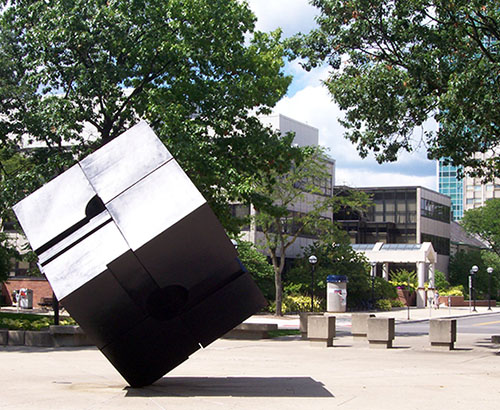
While searching for information on the Cube, I found the website for the President’s Advisory Committee on Public Art. The Committee works to sustain installation and maintenance of public art around campus. Most intriguing, to me, was the assertion that “outdoor sculpture should be an integral part of the educational and research mission of the University”. I have often had both the blessing and the curse of crisscrossing the campus throughout the day, and thus, have probably scurried around these various artistic endeavors more times than I can count. Every time I walk to the Union, whether it is for my daily dose of caffeine or another inefficient study session, I am dwarfed by the Cube or the crossed red beams of the Orion. Less obvious, are the numerous façades on buildings such as Hatcher, Rackham, or the Ruthven Museum. Placed high above, they are brief splotches in our vision as we approach and pass through the brick walls. Then, there are the varied others: the benches, the fountains, the statues.

It is all so easy to take for granted; for I know that come tomorrow, they will still be there, awaiting me. They are patient, unlike the countless that have rushed by them over the years. During the day, they are constantly busy, constants in a bustling Central Campus. But at night, they must become lonely, with only the occasional visitor back from the library or party. Tired eyes don’t see well and cannot offer any admiration in the dark. So they wait, as anxiously as I, for the return of the sun, when they can be glorious once again. The cycle repeats, year after year, decade after decade.

Even if they are oft ignored, public art works have never been useless. In fact, they are all that we lack. They are constantly present, which is more than can be said about people. People pass too quickly. Blink and they disappear. For people, this University is only a temporary place, a jumping off point for bigger and better. Public art, on the other hand, cannot move from their designated place. They must live their eternal lives as they were built. Thus, they can act as an orienting, dependable force in a constantly shifting environment. At the same time, they are constantly adaptable, too. They easily morph to suit each individual desire. I will never see the Cube with the same eyes. Each day it becomes something new. Perhaps tomorrow, I will notice a new feature that had been there all along. Perhaps I will return twenty years later with my hair already graying, and remember exactly how I felt that very first day of orientation, the day I was introduced to the soaring beauty of the campus. Although I will only be at the University of Michigan four years, I know each and every one of those days have been made better, more satisfying by the inclusion of art, even though I may not have had the time to properly appreciate it. But that is alright. Public art is not ostentatious that way. It does not demand anything of us. But it also forms the very heart of the University of Michigan.

Interdisciplinary Arts

The dictionary definition of interdisciplinary is relating to more than one branch of knowledge. As a first year student at Michigan, I have learned to appreciate this integral part of the academic structure as related to my classes.

I knew before I came to Michigan that I wanted to pursue both design and English, and I decided to enroll in the Multiple Dependent Degree Program. I am aiming to get a BA in Art & Design in Stamps as well as a BA in Communication Studies in LSA. I aspire to have a career in creative direction and graphic design, and my interests span technology, media, English literature, and pretty much all things arts-related.

Within my freshman year classes, I have already used the unique opportunity to combine studies. Although I am not enrolled in another interdisciplinary program, I love that my classes give me flexibility to use knowledge and tools from other areas of academia to supplement learning.

For example, I began composing music in my 4D (Audio/Video/Time-based projects) for my videos, which made me appreciate my music background more and inspired me to incorporate composition into my Methods of Inquiry class. I also joined the Campus band, which allows me to keep playing clarinet, since I knew I would not be studying music in college.

Furthermore, the Stamps School of Art & Design is well known for its interdisciplinary approach to art. They encourage students not to dwell on one subject, but to explore other artistic mediums and areas which intersect with society. Foundation year, although overbearing at times, pushes the idea that art and design are interconnected, and that knowledge of cultural, political, social, and economic contexts is essential for learning about and producing creative work. If I had gone to another university, perhaps one not as large as Michigan, I probably would never have thought about touching clay, or writing music for an art class. I could do research, or take business classes, or have an on-campus internship. I truly appreciate the freedom of this education and encourage students to take advantage of all that Michigan has to offer.

Passion to Profession

I asked my Creative Writing professor a question that I think about so often– “How has the act of writing changed for you now that you it as a job?” One of the things I fear most about the future is the translation of my passions into my profession. My professor responded with an honest and real answer: He said reading had changed so that he was constantly scouting for techniques and strengths in the text as assets to replicate in his own… that the act of reading had become, more or less, a refined practice of study, and the act of writing a regimented and structured act upon which the framework of the rest of the day was built. “The awed and raw fascination of it all, of reading a new short story, or gawking at characters for the very first time…” he explains, “I suppose it is not gone, but it is different.”

This terrifies me. I didn’t have to even ask him for this answer– I knew it would be the reality. I cannot imagine looking at the world as a writer through the eyes of a mathematician or a scientist, constantly trying to pin down the variables and processes that will perfect my writing. Joy and passion are the chemicals of the artist, and once that is jaded… what have you? Just work, is all. Just another thing to do. Just another monotonous action to defy time, to defy death, to fill the voids of existence.

As an individualistic society, we are taught to pursue those things which satisfy us internally, but the problem with passion is its flightiness, its restless reincarnation from person to person, until we are halfway through our lives sitting behind a cubicle at some editing firm squeezing in time between coffee breaks for our latest novel, telling ourselves that this is it, this is the one, the same thing we’ve told ourselves for thirty years– or we’re giving another speech in front of a crowd of college students who are rapidly firing questions about our latest best-seller, and repeat the same twenty answers that we’ve given for years now, and head home to fulfill the rest of our day’s writing quota.

Maybe this is all a grossly amateur way of looking at things, but I know one thing for certain– I cannot possibly allow myself to lose that wonder and awe for everything that I love. No matter my success and my relationship to my work, the act of creating has intrinsic value, the strong declaration into the universe that I was here. I existed. And I suppose that it is work– it must be– but so long as I never lose that rose-colored lens, so long as I never look at a work of art as anything less than divine, I suppose it will be okay. And we don’t do it because we get attention or compensation… we do it because, as my professor said, “It is central to our self-concept. It is who we are.”

New York City Ballet

Over spring break, I had the opportunity to watch New York City Ballet perform an evening of George Balanchine’s work set exclusively to Igor Stravinsky’s music. The program featured four works and lasted about two and a half hours.
New York City Ballet is one of the foremost ballet companies in the world. They’re known for their speed and neoclassical style, and the majority of their company members train at the School of American Ballet before joining the company. Being able to watch them perform was breathtaking. With each step they took, they exuded lightness, brightness, and virtuosity.
So often, concert dance proves to be inaccessible to most mainstream audiences. The dance doesn’t always have a narrative or an easily understood meaning or moral. Often times, there are no words, leaving movements up to the interpretation of each audience member. Coming to terms with this kind of ambiguity and lack of a “right” answer can be difficult for new dance audiences. However, I think that New York City Ballet did a great job of bridging the gap between new and old audiences. Their work was both accessible to a first time viewer (my mom) and complex. Their casts featured well established and prominent ballerinas such as Tiler Peck and Megan Fairchild, as well as several corps de ballet members and soloists.
This concert made a big impact on me because it was so heart warming to be sitting in the audience of a sold out Koch Theater in Lincoln Center. It gave me a feeling that no matter the political environment, the arts were still alive. There are still people willing to do the work as well as people who are invested in supporting the arts. There was still a community of people who believed in the arts, in the hope and joy they provided, and that was the best part of the concert. The dancers transcended the outside world-they gave hope and happiness to the audience.