
Passing By

I am walking to class again. It is the middle of November and by now, I know the route well. It is a carefully planned path, borne of the experience of the last two months. Perhaps it is too well planned, because I am craving Starbucks and have set no time aside to stand in line for an overpriced hot chocolate. Instead, I had left the library with exactly ten minutes to spare for my journey across campus. By the time I approach the Diag, my time in the library has already become a blurry memory. Had I accomplished anything? I decide the answer has to be ‘Yes’, if only for my sanity. Of course, I am not the only person walking through the Diag on this wintery day. But I ignore the other people around me. It is the time that matters. I should have five minutes left. Still, I sidestep a pair of blonde girls. Their voices wash over me as I hurry past. They are walking too slowly for my impatient mind. Maybe they are going to the coffee shop to continue their conversation. Maybe they could buy that imaginary hot chocolate. Soon, I can’t even hear their words anymore and their existence seems to fade just as easily. Entire people gone, evaporating into the chilly air behind me. Our worlds intersected for the briefest moment and then separated just as quickly. Perhaps we all exist on the periphery of someone else’s world. Anonymous faces, barely even recognized, quickly forgotten. There are so many people at the University of Michigan and simply not enough time. For some people, we take the time, slow our steps, and talk. But for most, we only make tiny impacts on each other, slightly altering the paths of the people around us. We walk towards each other. We walk behind each other. We pass by.

I wonder if I have passed by these other people before. After all, I have taken this path so many times. They probably have a routine too. This is my path and theirs. Some of them might even be going to the same class, to the same crowded lecture hall. I am approaching my destination now. Someone opens the door for me and the warm air is weighing down on me, squeezing the cold from my bones. I say, ‘Thank you’, without meeting his eyes. I am not sure it is even a ‘him’. All I can see is the classroom and the ninety minutes of eternity awaiting me there. Then, my mind stretches beyond even that, to the evening ahead. I decide that I will make myself some hot chocolate then. And I have already forgotten the walk. Perhaps I will remember again, next week when I take the same path.

Our lives planned ahead. Our steps pre-destined. I only exist in the possible future.  You only exist in my past. The present is forgotten as we walk towards something else. We pass by others as time passes us by.

When Comedy Films Are Scary

I love a good laugh, but I’m a tough critic. As a result, it can be hard for me to find a nice comedy to watch when too many that get heavily promoted are gross or overtly problematic. What has shocked me in my question to find smart comedy is when the comedy doesn’t look like comedy at all.

My first experience with this paradox was in 2003, when I was around four. One afternoon my parents, cultured as they were, mistakenly rented the French animated film “The Triplettes of Belleville” for me and my even younger brothers to watch. They had rented “Finding Nemo” as well. I clearly remember my parents leaving my brothers and I with my grandmother with the request that we try to watch the French film first since we had already seen so many Pixar movies. I eagerly put on “The Triplettes of Belleville”, wanting to not only obey my parents but to watch that little clownfish be found by his dad again.

I was horrified by the French film. The bleak world depicted by animator Sylvain Chomet was depressing, and most of the characters looked evil. The French song featured in the film “Belleville Rendez-vous” was unintelligible to me at the time, but the wailing notes matched with the nightmarish art of the movie was enough to send me over the edge. I stopped the movie within five minutes and made my case that he movie was horrifying to my parents. I watched it all of 14 years later at age 20 and was again scared watching it, not surprised to learn that it is rated PG-13.

The plot is notably minimalist with little if any dialogue: a presumably French cyclist raised by his supportive grandmother has his chance to make his dream of becoming a champion cyclist come true, until he is kidnapped by what looks like the French mafia and held captive in Belleville, a faux New York City filled with stereotypical fat Americans. His grandmother comes to his rescue, accompanied by three aged, former singers known as the titular triplets of Belleville.

What kept my attention throughout the movie was the varied yet scary character designs. They are hellish, from the deformed cyclist’s incredibly muscular legs legs somehow connected to his terribly thin torso, to the closed eyes and hunched shoulders of the witch-like triplets of Belleville. The dark colors and sketchy figures present in this world, from sexualized prostitutes to grim-faced gunmen who kill in cold-blood, added to the fear factor. And yet, to my surprise, the film is labelled a comedy! I concede that the whimsical way the plot is developed in “The Triplets of Belleville” explains its classification.

I believe “The Triplets of Belleville” is an anomaly as far as comedy films go, as other comedy films I have watched that have been questioned for their humor have made me laugh. One is this year’s smash success “Get Out”, which has recently stirred controversy because it was entered as a submission to the comedy category for best picture at the Golden Globes. The plot was so nuanced and developed that it did not feel like it depended on humor to succeed per se, but it did make the film incredibly unique by masterfully intertwining the two genres. And, every joke was uproariously on point. But it is a horror film at heart, and I can understand why the comedy label may feel a bit of a stretch, even though there is no horror category that it can be submitted to.

Chris under a trance in “Get Out”. Source: Bago Games via Flickr.

This made me think of another film that was deemed too dark for a comedy: the 1971 film “Harold and Maude”, a romantic comedy-drama about a 20-year-old man obsessed with death and a 79-year-old woman who loves life (an old manic pixie dream girl, if you will). Roger Ebert panned the film, giving it one and a half stars out of four saying: “Death can be as funny as most things in life, I suppose, but not the way Harold and Maude go about it.” I was horrified by the beginning when our protagonist simulates hanging himself, and would jump when I saw how his subsequent suicide “attempts” become increasingly outlandish as he scares off potential girlfriends arranged by his unfazed mother. And yet the comedy of seeing the varied reactions from the interested girls was captivating, and built up to the climax when (spoiler alert) Harold loses the love of his life to suicide. This was the moment I learned the meaning of black comedy, as I pealed with laughter at the same time I cupped my mouth in horror and sank in my seat out of sadness. I respect Ebert’s opinion informed by his near-encyclopedic knowledge of film, but I do believe more credit is due to a movie that pulls off such a remarkable feat.

Harold and Maude. Source: Craig Duffy via Flickr.

In conclusion, I do not know what to make of these comedy films that struck me as unusual. Their dark styles do not hinder the message of their plots, but still made me uneasy while watching. I believe this is symptomatic of merging different elements of the comedic with the tragic, and I look forward to seeing even more genre-bending comedies as I continue my quest for a good laugh.

The Knights

Middle C: the first note a student learns on the piano. The first note one hears, the first note one learns to identify. Geographically, sonically, visually. Home. It’s an important note, to say the least. It was the first note heard in a concert by The Knights that took place at 4 pm on Sunday in Rackham Auditorium, and the pitch that was sustained through the first piece, “Suite Upon One Note.” The suite was made up of three very different pieces: “Improvisation Upon One Note”, by Kinan Azmeh and Avi Avital, “Fantasia Upon One Note”, by Henry Purcell, and an excerpt from “La Camera Bianca” by Giovanni Sollima Viaggo. Three very different works from three different cultures, time periods, and backgrounds, all connected by a shared note and presented as one.
This idea of unity through a common language was present through the entirety of the concert. Joining the Brooklyn-based ensemble were two virtuoso musicians: Israeli mandolin player Avi Avital and the Syrian clarinetist Kinan Azmeh. Their influence was felt through the concert, as the program blended music from the classical tradition, Middle Eastern cultures, and jazz. On the Knights website, the organization notes that “We are serious about having fun. We thrive on camaraderie and friendship. We cultivate a collaborative environment that honors a multiplicity of voices.”
In today’s political climate, a concert presenting two accomplished, well-known musicians and music from the Middle East inherently feels like a statement. Although it was never addressed by the Knights, the statement that seemed to be made with the concert was that their differences as musicians pulled them together even more. Rarely is Azmeh’s “Suite for Improvisers and Orchestra,” based off of sounds that remind him of his hometown in Syria, heard on the same program as Bach and Schubert. This diversity in work is important: in playing works by Bach and Schubert, the Knights paid tribute to a shared classical musical background. Presenting works by Avital and Azmeh that were partly based in improvisation recognized and celebrated the individuality and virtuosity of the music and character of each other’s backgrounds and cultures.
These ideas are all based in the founding values of the Knights: they say that they are “musicians…who come from a deeply rooted tradition but are eager to look beyond those roots and embrace new means of expression.” Ensembles like the Knights and concerts like Sunday’s are increasingly important today. They encourage this idea of a shared “Middle C” in the audience; a shared sense of home and humanity present in each person. These musicians are not only virtuosic in musical ability, but in creating a community within themselves and the audience that can only be described as warm, inviting, and inclusive: three ideals to strive for in today’s world.

American Idol vs. The Voice

The fall season is about the weather, Halloween, Thanksgiving, and TV shows.  All of the good shows worth watching come back on in the fall: the dramas, comedies, game shows, reality, or a combination of several.  A popular mix between reality and game shows are talent shows; these include things from American Idol to Cake Wars.  It’s a staple genre all throughout the world, not only in the US.  A big chunk of the talent shows have to do with singing.  There is the X-Factor, American Idol, The Voice, about half of the contestants on America’s Got Talent, and Boy Band.  With so many shows for people to choose from the question is: How do you decide which show(s) to watch?


How do all of these shows have an audience?  Is it the same audience watching all of these shows?  Or do different people watch?  If that’s the case then how do people choose which show to watch because they are all virtually the same show (except AGT because you can do more than sing)?  

Do they decide what show to watch based on the judges?  This is likely, because once Paula and then more notably, Simon, left American Idol the show lost viewers and ultimately ended until it will be rebooted next year.  Then The Voice has Adam Levine and Blake Shelton to get viewers who like pop a

nd/or country so they could potentially be reaching more people.  Then The Voice added Miley Cyrus for younger viewers and for people who wanted to see what she is doing now after her wrecking ball phase and they watch to see if she will actually be a good judge.  So Miley brings in more viewers.  The Voice is good at getting people to watch more based on the judges then based on the talent and the a

ctual show.  The X-Factor had Simon as the main judge after American Idol (because he created the show) and the show ended within 5 seasons because it wasn’t producing stars like American Idol had and the judges weren’t good enough to watch on there own compared to the entertainment on The Voice of watching Blake and Adam talk and argue back and forth.

People don’t watch the show because they like the way its set up better than other singing shows.  Each show is essentially set up the same way: auditions, cut offs, then live shows where people can vote from the top 24 contestants.  So there is really no difference in the big picture, each show just changes a little bit in each stage to make it unique.

People could possibly watch for the stars that arise from the show.  If that’

s the case then American Idol should not have stopped because they were the only show that brought any big stars like Kelly Clarkson, Carrie Underwood, and Daughtry (and Daughtry didn’t even win!).  No other show has created a star on any level like the ones that American Idol produced.

Based on these factors and more people decide which talent singing show they want to watch.  For some, they can also be interchangeable based on the judges and contestants each season.

Finding Your Outlet: A Personal Story

Last week, I wrote about the importance of having an outlet and how to find your outlet. This week, I have a story for you readers about my own experience with my outlet:

It’s 3 a.m. I had been in bed at 12, but I lie restless for hours, failing to expel the stressors that keep me awake, stressors that not only trap my mind but taunt my fragile heart. I fear that this heart has been broken, like it’s glass-like composition has now shattered to pieces. These worries start to swell so much that the act of closing my eyes demands effort, so I call my mother (c’mon, who else)…and miraculously, at this terribly inconvenient hour of the night, she picks up. (My mother is a superhero.)

I talk. She talks. We balance sharing and listening. How lucky am I to call my mother to whenever I need, to call my favorite person to talk to. After an hour of conversation, I let her go to sleep. In place of the worry and emptiness I felt before the call, I now feel relief and overwhelming gratitude, but still very much awake from these ideas. My thoughts trail into what I would do if my mother was not here. Then, a good friend Alisa crosses my mind.

Alisa and I met four years ago on my high school’s cross country team when she came to the United States for a year as an exchange student from Germany. After we were separated by an enormous body of water called the Atlantic Ocean, our friendship only grew stronger, staying updated with each other’s lives one way or another. It was November when she mentioned that her mum had been battling liver cancer for the past year, and how her lifestyle was compromised because of it. Meanwhile, she was optimistic about her mom’s recovery and about life in general, telling me about a fleeting desire to be a flight attendant, her pursuit of medical school, and her excitement to send me a Christmas card. On December 15th of that year, her mother passed away.

The day of the funeral, she told me “I don’t know if I can handle this.” How do you handle that?

It’s been almost a year since, and you wouldn’t believe the incredible things Alisa has done. She got a 4.0 in her schooling, started an internship at a hospital, got into medical school, and worked (not as a flight attendant–she realized that was not her dream after all) to make enough money to fly back to the States to visit an old friend from the high school cross country team. At a blue picnic table over two #2 Zingerman’s sandwiches, we talked briefly about her mother, and of course she was sad and she missed her terribly and she was confused as to why it happened. Despite this, she maintained a most positive attitude about the situation and, moreover, about life entirely. She found comfort in that her mother had no pain anymore, that the time they shared is something for which she will always be grateful. At that blue picnic table over two #2 Zingerman’s sandwiches, she told me something her mother told her:

“When making decisions, think with your mind, heart, and eyes.”

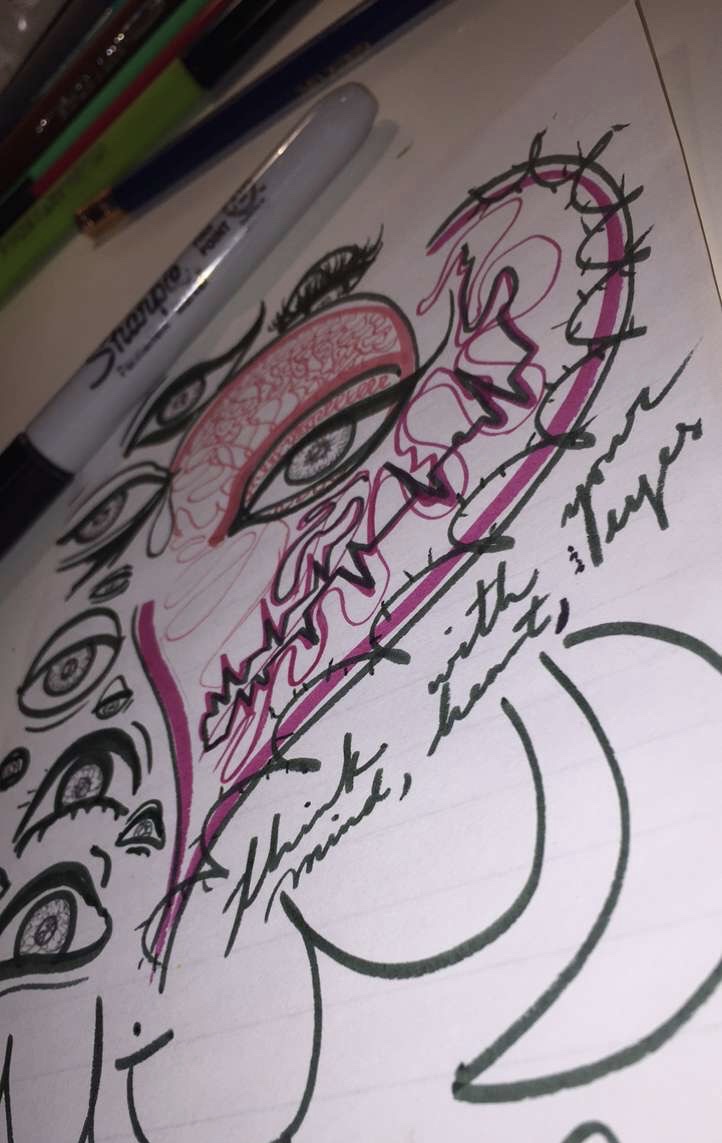
So, with all this in pooling in my head, I pick up a sharpie. begin to let the thoughts flow out of my head through my fingers and onto the paper in black ink.

One side of my heart is protected by barbed wire and the other side is guarded by my own observations. People like my mom and Alisa walk through the gapes that lie between the shielding. What had been troubling is clear now, and having it outlet helps to remove the thoughts from mind and place them in front of me. With drawing is my outlet, worry no longer manifests in my mind because I enable myself to see how it all comes together.

Chatter

Sometimes I wish I could take words back. But no matter how much I try and grab at them, it is a hopeless cause. The words have crystallized, changing from mere thought to reality. Sometimes, I can feel it in the air. The awkwardness that follows wrong words is unmistakable. The sudden silence. The desperation to fill the emptiness with anything else at all. For me, it has always seemed strange that everyone complains about the difficulty of writing essays when speaking is exponentially more difficult. At least, when you are writing, there is a way to erase the offending words from existence. It allows for an infinite amount of time to search for the right phrase, for the perfect way to express one’s true feelings. I am always in a hurry when I am speaking with someone else. I worry that the other person, whether they are sitting across the table or listening on the phone thousands of miles away will lose interest before the sentence can stumble its way out of my mouth. Even then, someone might misunderstand my meaning. So, I speak out of fear.

Maybe that is why there are so many useless words cluttering our ears and minds. Instinctively, we want to communicate, yet surmounting the barrier efficiently is still an unsolved puzzle. Conversations happen every second, but so many are fleeting and forgettable. It is good that there is still a way to record our thoughts so that we may return to them and change them. That is why I continue to write. Not just to create flowery sentences or to impress others, but to clear my mind, to give it a clean start every week. I give my ideas permanence instead of just letting them flow out of my mouth. I pick words carefully so that they may carry my thoughts outside of myself. Speaking and writing are our tools, but we don’t often treat them that way. We replace words with emojis, limit them to 140 characters, skim over words, instead of reading more carefully. We do this to our detriment, for these are the only pathways to understanding that we have. Otherwise, we are doomed to be isolated forever, stuck in the same thoughts that we have always had.

The threat has only grown larger as time has gone on. We can message people at the touch of a button. We order pizza and stay in our respective homes instead of going out to eat. Conversations grow ever shorter and less meaningful. Sometimes, I believe in it too. I wish that I could take all my words back and stay silent. But the words are not the problem. It is how we are using them. We should not be speaking or writing out of fear, but out of necessity. Then, we trust that people are actually listening.