
What kind of spaces do you like to study in? An enclosed, quiet room? Or do you need to have a ton of space and some noise around you, in order to study well?? Studies say the best study areas are neat, sanitary, and have little to no noise distractions. What do you think of this claim? Share your thoughts!
Category: Uncategorized
Geometrical Biology
Why can’t the tentacles of an octopus sprout from the pit of a toad’s stomach? Why can’t crystalline protrusions emerge from the shell on the back of a wolf? Why can’t a raven have two heads? When I see Nicholas Di Genova’s drawings, I see the pieces of biological forms fitted together in oddly natural formations. It is not a deformity but a natural state – acceptable in its entire aesthetic hypothesis. The cellular constructs composed of bubbly units and rectangular bricks; each hair resting not as strands but as singular forms in a bunched up collective; polygonal claws; armor-like appendages; rippling hands; each segment is so uniform and flush with the rest, yet the more you stare the more distinct they become. Is this the geometry of a form? The binding of two shapes rests not in some peculiarity; a moment of chance is not the creator. It is deliberate like the block of creatures that form geometric cohesion – 10,000 vertebrates all locked and neighbors. From afar, blocks of black ink, indistinguishable, like the shapes composing the “Dirt Wolf.” But up close, distinct. The everything of the natural world of a creative mind; the hand reaches into the pit of a frog and pulls from it, a flower.
http://nicholasdigenova.tumblr.com/
The Art of Making It Through a Semester
Making it through a semester is a far more complicated process than assumed up to now. It requires a staunchly capability to endure constant stress, a sufficient mental stability to deal with the question of whether you’re good enough for university or not and the willingness to sacrifice most of your pitiful personal life. There are similarities between every student’s academic experience. These similarities can be divided into five stages.
The five stages of trimestral progression are:
1. Enthusiasm
2. Disillusionment
3. Anxiety
4. Desperation
5. Relief
Every single student will go through these stages during the semester. While the duration of the particular stages may vary, the order will always remain the same. What makes this topic relevant to an art blog? Good question! A German scientist (me) has recently discovered a correlation between the stage of trimestral progression you are in and the art you consume.
Stage 1 – Enthusiasm
At the very beginning of the term you have this feeling that somehow this semester is going to be different, which, trust me, it won’t be. Yet, you get these wild fantasies about actually being able to power through the 3-months obstacle course throwing exams, papers, self-esteem issues and self-loathing at you. This naive “I can really do it”-attitude is characteristic for the enthusiasm-stage and, depending on how optimistic you are, is ousted by the second stage after missing about two to four lectures.

The corresponding art can range from Katy Perry’s ‘California Gurls’ to the critically acclaimed 1988 comedy ‘The Naked Gun’, starring acting genius Leslie Nielsen (may he rest in peace). Anything that is energetic and upbeat, funny and cheerful can be considered Stage 1 art. Growing up with older twin sisters, I have come to appreciate Enrique Iglesias and the Backstreet Boys during this stage.
Stage 2 – Disillusionment
Stage 2 marks the entry of realistic thinking into your mind. You accept that this semester is probably going to end just like the ones before. You have to start weighing the importance of attending lecture with your body’s need for sleep. Deadlines are pushed back, readings are postponed and the work that still needs to be done piles up on your desk just like your self-hatred for not doing it timely.

During this time of the term you will probably work out while listening to an audiobook about how to sell real estate, because procrastination is your nemesis in Stage 2. Hogwash that seems much more important to your future success than university suddenly has top priority. Reading Marx’s ‘Das Kapital’, trying to teach myself how to write music and really getting into photography continuously top my list for unnecessary ventures for when I should actually be studying my soul out in the library.
Stage 3 – Anxiety
Could I drop out of school to become a personal trainer or a travelling bubble tea salesman? Would my parents find out? Would they be disappointed? Oh god, I cannot disappoint my parents. They paid so much for my education. And the rest of my family… What would my third-degree aunt Sally, who I met once at my half-cousin Barry’s wedding, think of me?

Anxiety is a dangerous stage. You start questioning your abilities, forget how far you’ve come and, instead, focus on your weaknesses. Psychosomatic issues like constant fatigue and a racing heartbeat after waking up in the morning are the result. Giving in to your mental instability you read Stephen King’s ‘IT’ or listen to Slipknot’s fast-paced musical depiction of anger and disappointment.
Stage 4 – Desperation
At this point you don’t even care anymore. The unwavering stress has taken its toll on you. You have surrendered and are now dragging yourself the last couple of yards towards the finishing line. Your hair is a mess, you haven’t showered in two weeks, the only person you’ve seen since last Monday is Jimmy John’s delivery guy and your parents are highly concerned because they haven’t heard from you in a while. You would give anything to have this semester end already, but the exams are just coming up…

The lack of spare time in Stage 4 limits the art you consume to pretty much just music. The kind of music you listen to, however, is rather variable. Country, Folk or Deep House… everything is possible. For me it’s usually the 10-hour version of “Sad Music, Cry Music Ultimate Mix 2014” on YouTube, which I can highly recommend; 2014 is, by far, the best and most mellow vintage.
Stage 5 – Relief
Usually the Relief-Stage doesn’t commence until a few days after your last exam. Your body has enjoyed a decent amount of sleep for the first time in months and is now ready for whatever adventure you may embark on during the summer. A woman’s brain releases hormones making her forget negative aspects of the pregnancy after having a child. The same thing happens to students after finishing a semester. They forget about the disillusionment, the anxiety and the desperation, smoothing the way into a new rendition of the same stages after summer break.

Considering the renaissance-like emotional state of students and the beginning of summer, the art consumed in the last stage is all about merriment and light-heartedness. Punk Rock, open-air cinema and street art are most prominent. For me, personally, there is nothing better than listening to a Zebrahead record while driving my car to all the places I couldn’t go to during the other stages. Stage 5 is freedom and happiness.
If you don’t know which stage you might currently be in, just have a look at your Spotify playlist or think about which movie you watched most recently. That should give you a clue. Just try to keep in mind, with exams approaching quicker than the Rohirrim on the fifth day of the battle of Helm’s Deep, that Stage 5 is just around the corner now… We all can get there together!
PS: Remember to be as weird as you can possibly be.
Organized Chaos
At 216 N 4th Avenue, you will find a place called Cafe Verde. When you walk through the door and step inside, there’s a painting on your righthand side.

At first glance, it seems like chaos. As you stare at it, you will see the lines and blots come together in patterns. We may see similar patterns in our lives. Close analysis of a day in the life may look like absolute madness. Seeing how each streak makes up an organized whole gives insight as to why the seemingly insignificant streaks exist.
Artists are perhaps the greatest teachers for seeing things as a whole. While they pay attention to detail, they also demonstrate the ability to tie individual elements seamlessly into a larger whole. Details are not negligible, certainly. Those are what set a piece apart from others. Reading into them can be fun and thought provoking. Stepping back from those details and seeing how they influence the grand scheme of the image may allow you to see a completely different image.
Sometimes, I catch myself getting impatient, wondering why something about this day occurred, how it plays into my future, which strand in all the chaos it represents. While I cannot see the overall masterpiece that my life paints in this very moment, I can trust that all the loose ends will meet in the end. For now, enjoy the puzzling parts of life, don’t linger on that strand long, for there are so many other lines to explore.
Book Review – The Magician King
I definitely liked this a lot, but not quite as much as the first book. So many people seem to prefer the second book, but it was a step down for me.
Maybe it’s because it’s kind of a more straightforward, traditional fantasy book. We’re in Fillory (seemingly) for good now in the main narrative, and there’s a quest along the lines of the Narnia books. By the way, let’s take a moment to recognize just how much this book borrows from The Voyage of the Dawn Treader. There’s the typical similarities to Narnia: talking animals, magic, young Earth visitors becoming kings and queens, etc. But there’s so much more I didn’t even remember until I reread the Voyage synopsis online. In both books, there’s a long journey via ship to explore outer islands, with an apparent end of the world as the final destination. There’s even the same number of MacGuffins—in The Magician King there are seven golden keys, and in Voyage they’re searching for seven lost Lords. Jeez!
I actually don’t have a problem with how liberally The Magician King cribs from The Voyage of the Dawn Treader. The book is different enough in theme and tone that it doesn’t feel like you’re reading the same thing; it’s subversive in a similar way to how the first book subverted our idea of magical schools like Hogwarts. That said, I don’t think The Magician King makes quite as concerted an effort to undermine those fantasy tropes as The Magicians did. It certainly does eventually, at the end (which we’ll get to), but a lot of the book is devoted to the very straightforward idea of hunting down magical MacGuffins to save a magical world.
On the outside, that lends The Magician King a sense of focus that The Magicians didn’t have. So much of The Magicians is focused on Quentin’s general coming of age, without having one distinct, driving purpose beyond Quentin’s abstract search for happiness. Once you reach the end of the sequel, though, you can look back and boil it down to two main arcs.
It seems much more focused on the outside, but I think I preferred the first book’s loose narrative style, especially because its focus on Quentin still made it feel purposeful. It’s kind of like the first book was focused on a character level but loose on a narrative level, and the second book is the opposite. In fact, I’m not even that convinced that this book is a huge leap forward in narrative focus; after all, that early arc I just mentioned doesn’t end up tying together that tightly with the later arc, more just moving around characters and doling out exposition so that everyone is where they need to be for the last stretch.
It seems like I’ve just said a lot of negative stuff about this book, but all that said, there’s a lot to admire here in terms of how Lev Grossman expands the mythology. Even though the first book was loose, it still felt extremely self-contained and brilliantly structured, and that continues here. On the outside, some of the world expansion here feels a little too ambitious. Then again, it was a pretty big jump to introduce the Neitherlands and the multiverse in the first place in the first book, so maybe the next jump Grossman makes isn’t huge. Besides, even if you’re not into the more outsize fantastical elements, there’s still the fascinating inclusion of the concept of safe houses and hedge witches, a part of this world we only heard about in passing in the first book.
I also like the way Grossman utilizes his minor characters—he finds credible ways to bring back characters from the first book for nice cameos, while still managing to expand the world to fit compelling new characters like Bingle, Benedict, Poppy, Asmodeus, etc. Janet is really the only main character underserved by this installment, and I know she’ll be featured in the next book, so I didn’t even mind that.
The main change here is that we have kind of a second protagonist this time around: Julia. To be honest, I don’t like Julia that much—she’s very self-righteous and entitled in similar ways to Quentin in the first book, but it seems like there’s an element of optimism Quentin had that she’s missing. Well, maybe ‘optimism’ is the wrong word, but at least he had a strong sense of humor. There are a few jokes Julia makes, but they’re almost always in the same snotty tone. I think your mileage may vary with this: some people absolutely loathe Quentin, but I really like him.
Anyways, I don’t love Julia, yet I somehow really liked her narrative. It’s always really interesting to see what one character was up to while something else was happening, and given that we know Julia is depressed and practically inhuman in the present day, we have a built-in curiosity about what has happened to her. Sure enough, the ending of her story is heartbreaking, and shocking in its brutality and hopelessness. I also like that the climax of the book is kind of positioned in the flashback narrative instead of the present narrative. It’s neat how Grossman is able to end the present narrative in a slightly anticlimactic way because he can relocate the climax to the past.
In the end, though, I’m mostly here for Quentin’s journey, for his struggle to learn how to be happy. And while this book isn’t as focused at telling that story as the first book, there’s lots of interesting stuff going on. There are multiple hints of growth as Quentin seems to learn to appreciate where he is. But whenever Quentin starts to accept his position and enjoy where he’s at, something else seems to come along and tempt him, and suddenly he’s convinced again that there’s a greater quest out there that will finally give his life meaning.
Some people hate Quentin and will hate watching him struggle to grow, but I find each of his regressions just as fascinating as a new external antagonist. And though the climax of Quentin’s present-day narrative isn’t as impactful as the climax of the first book, the actual final scene of the book is pretty great.
In The Magician King, just like in The Magicians, there are serious consequences for your actions, and serious sacrifices that you must make to be a hero. Quentin thinks he can be the hero of the story and live happily ever after, but that’s not how it works. That’s what makes this series exceptional: it dares to challenge its characters, and to suggest that the magic we all wish we had could come with horrifically painful side effects. There’s no chosen one; everyone is the hero of their own story. If you take up the mantle of ‘hero,’ you better be ready to deal with the sacrifices that come with that.
Commercial Break

It has been two years since the final episode of Mad Men aired on AMC ad I still don’t think that I fully appreciate all the show accomplished in its seven-season run. By turns it was a story about one man, Don Draper, and a larger narrative about the radical changes throughout the 60s. Many times, Don was not even the most interesting character on the screen. That role shifted constantly from Peggy’s dynamic journey, rising from a lowly secretary position, to Joan’s search for balance between work and the traditional notions of womanhood. Unlike many shows, there was no separation between the office and the home, brought together by the men and women who lived and worked there. This resulted in characters that were never caricatures or simply symbols. They often held contradictory beliefs, acted against their own self-interests, or relapsed into old behaviors. Don and his cohorts at the ad agencies may have called themselves, “mad men”, but in the end, they were simply human, with human vices. Thus, the show never needed to resort to depicting anything more dramatic than real life and all its messiness.
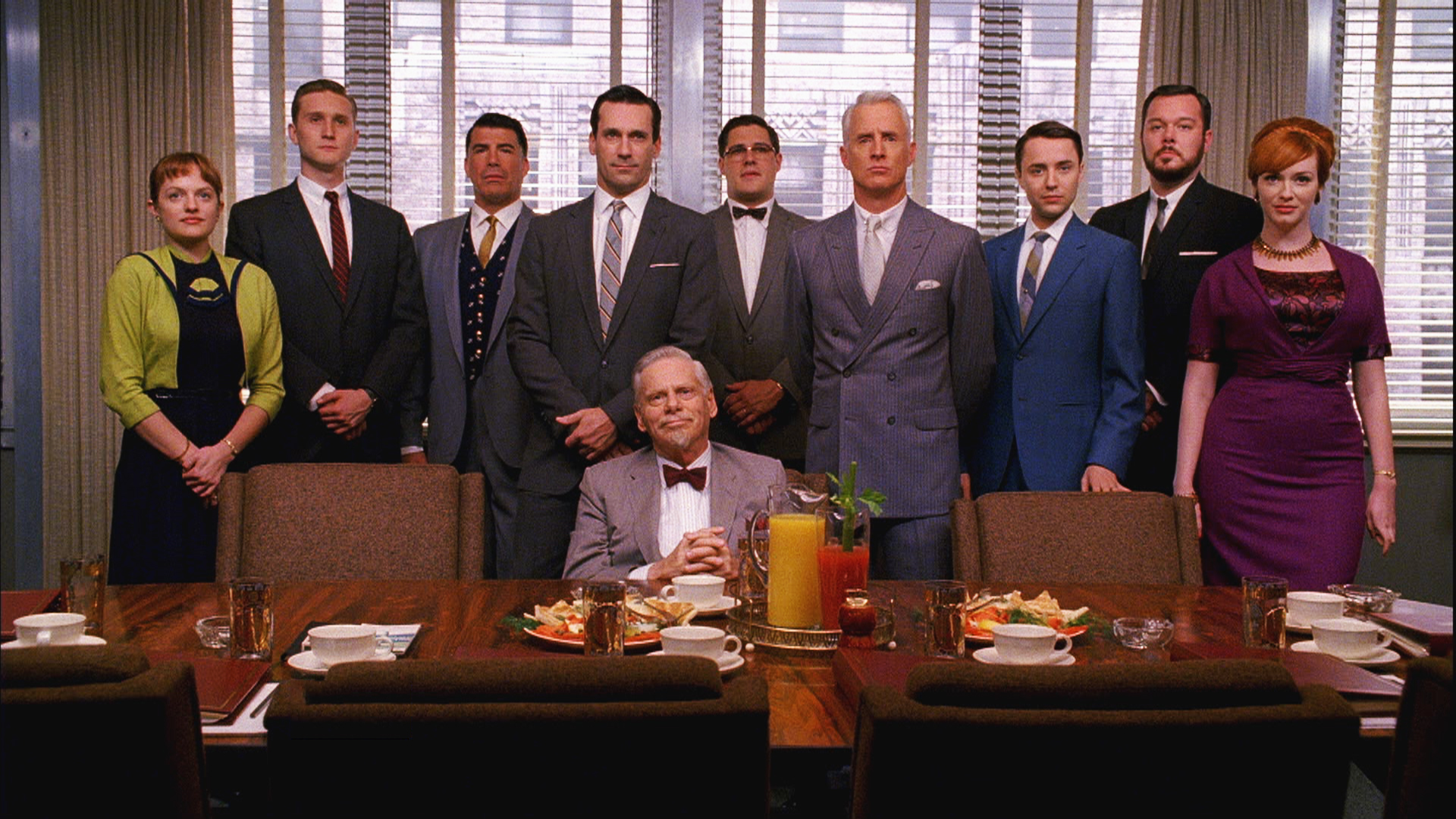
Often glimpses of the past are solely produced to make the present seem more palatable. We smile at their backwards ways and smugly assume that our lives are better, our morals purer. Yet, these productions only serve to peddle the false notion of ceaseless forward progress. Some changes are simply old beliefs returned under the disguise of advancement. Even real change is not always for the better. It would have been so easy for “Mad Men” to fall into one of these traps. It would have been so easy to point at the people of the 60s and laugh at their boozy, sexist, racist views and called them lesser beings. The show, instead, sought to examine the system that produced those men and women, the one that shoved them into tight suits and beautiful dresses, and ask how those roles had come about. The assumptions and unseen regulations of the 60s drove these characters and their reactions to it defined their lives. Don Draper, as first introduced, seems to be an exemplary member of the system. He is wealthy and successful, handsome and with the slick hair and the beautiful wife to prove it. His life inspires envy in those beneath him, such as Pete Campbell, and even his equals, such as Robert Sterling. It is a veneer as shiny and false as the ads that he produces. We do not cheer for the characters to see them to succeed at their jobs, find love, or achieve any of the other traditionally accepted markers of happiness. Instead, we are left hoping that somehow, some way, they will find the self-understanding that seems to elude all of us. Over the seasons, those working at Sterling-Cooper became our companions and our personal mirrors, their struggles reflecting ours. “Mad Men” will continue to be a cultural phenomenon, far past the era it portrayed.
