
Book Review – The Magicians

Based on the first book of the Magicians trilogy alone, it’s unclear as to what exactly the arc of the story will be – is this series about its main character, Quentin, struggling to find happiness? Is it about whether magic can be good or if it’s only an expression of unhappiness?

I think one of the biggest strengths of this first book, though, is that it doesn’t just feel like one small piece of a greater whole; it’s fairly self-contained. All the major bits of foreshadowing pay off by the end, and everything is so perfectly structured. As an example, the story of Emily Greenstreet we hear early on serves three purposes: it gives us important exposition about two major characters’ pasts, it establishes the concept of the niffin, and it directly foreshadows a connection Quentin is able to make near the end of the book. The book is so ruthlessly, efficiently structured, with so many mysteries introduced and resolved, that I’m impressed Grossman was even brave enough to take a stab at writing two more books. But we’ll get to those when we get to those.

It’s beyond redundant to compare these books to the Harry Potter or Narnia books, but it’s also impossible not to, because they’re very aware that those books exist, and they make efforts to both channel the influences and subvert them. There are layers of fantasy to the multiverse of The Magicians – first there’s the ‘real world’ fantasy of Brakebills, which obviously echoes Hogwarts from Harry Potter, and deeper in, there’s the even more fantastical parallel universe of Fillory, which obviously echoes Narnia. This is a series where the protagonist longs to be like the protagonists of those books, children whose mundane lives are miraculously upended by the exciting new worlds they discover. It’s clear from the first chapter that this book is going to comment on that desire, not simply fulfill it and tell another story in the same vein.

Grossman is intent on subverting that sense of whimsy that series like Harry Potter and Narnia provide, which would lead you to think this world isn’t fun at all. But that’s not quite true, either; Grossman pulls off an admirable balancing act where he’s able to conjure just enough wonder and magic that readers are entertained and want to know more about the world, but at the same time undercut that wonder with many suggestions that it’s not quite right. Seeing Quentin drinking and playing Quidditch-esque games with his friends at Brakebills is fun, and you recognize the familiar college-y aspects, but it’s clear that not everything is unambiguously whimsical and carefree. The presence of alcohol alone indicates that this isn’t the same as Harry Potter and Narnia, and eventually you kind of think, Wow, these characters get drunk a lot, don’t they?

And while the Harry Potter books mostly ignore the fact that these teachers are probably violating child endangerment laws with stuff like the Triwizard Tournament, these books are much more upfront about how borderline-abusive the staff is. A trip the students take to Antarctica is mostly depressing. There’s darkness in Harry Potter, of course, but most of the sadness in those books is caused by something concrete and exciting: tragic backstories, filled with lost loves and painful deaths. The characters of The Magicians are certainly mostly unhappy, but aside from Alice’s grief over a painful loss, most of the unhappiness is caused by something else, some nebulous, great ennui. It’s greatest with Quentin, but it’s there with his friends, too. Since I haven’t read the later books yet, I can’t tell exactly where this is going to go – is all this a metaphor for mental illness and depression, or is it simply an expression of the occasional sense of unmotivated sadness we all have, the sense that there has to be something more?

I love that the book actually uses magic to ponder the question of happiness and its attainability. Other books about magic don’t really explore why it exists in the context of the story, and what philosophical and ethical questions it poses. There are tidbits of that in Harry Potter, essentially the same light vs. dark concept as the Force in Star Wars, but The Magicians seems intent on really exploring that philosophical territory. At one point in the story, Dean Fogg raises the fascinating possibility that magic is a necessity to these people because they can’t bear to see the world as it is without it.

This stuff I’ve been writing about is almost entirely abstract, and it’s a testament to Grossman’s writing that he’s able to ground it in a fascinating concrete world. Because aside from all of these questions, there are drunk talking bears, a romantic subplot that kicks off when two 20-year-olds turn into arctic foxes and have sex in fox form, memory spells a la “Obliviate” from Harry Potter, godly rams buried deep underground, evil ferrets getting their throats stomped in, and a creepy monster antagonist in the form of a small British man with a branch perpetually obscuring his face. The co-opting of the fantasy genre for genre subversion and psychological probing is what’s most interesting about this book, but that couldn’t exist without indulging in the fun elements of fantasy itself. Lev Grossman successfully has it both ways, and I can’t wait to see how that continues in the next book.
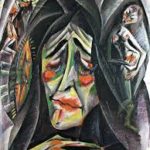
The Nun

German artist Otto Dix expresses themes about religion and sex in his piece “The Nun.” This oil on cardboard is displayed in the MoMa in New York, New York. The viewer’s eyes are drawn to the center of the piece where the focus is a nun, weeping and heavy hearted. On her right is Jesus Christ nailed to the cross with blood streaming down his body. On her left is a naked woman cradling her child in the womb. The nun has devoted her life to her religion for a divine relationship with Jesus Christ and therefore has given up all worldly relationships. Her commitment to the church prohibits any sexual experiences or nakedness. No longer will she be able to bear children of her own or hold them as the naked woman holds her child. She clothes herself in the heavy cloak of her conventual obligations. The black lines resembling flying buttresses on a massive cathedral surrounding her represent the isolation she feels from a life of passion and romance while she remains obedient to the church.

Why Separating Art from the Artist Doesn’t Work at Award Shows

Relatively speaking, this year’s Academy Awards were kind of great. La La Land (which I liked, mind you) didn’t sweep like I feared it would. Arrival got a much-deserved sound editing award, Kenneth Lonergan won Best Original Screenplay, and most importantly, Moonlight won Best Picture (along with a Best Adapted Screenplay win and Mahershala Ali’s Best Supporting Actor win). It was the first year ever that my favorite movie of the year won Best Picture. Even most of the wins I didn’t agree with I could grudgingly accept; I love Emma Stone in general, and I loved Damian Chazelle’s work on Whiplash, so I didn’t mind their wins too much.

But there was one category where I really couldn’t figure out what I wanted to win and how I felt about the outcome: the Best Actor category.

To be fair, I haven’t seen Fences or Hacksaw Ridge. For all I know, if I’d seen those, I’d be rooting for Denzel Washington or Andrew Garfield (probably the former). But when I saw Manchester by the Sea, Casey Affleck blew me away. If we’re awarding the best performance of the year, I’d say he deserves it (though I was personally pulling for Trevante Rhodes, who didn’t even get nominated—he’d probably get classified as a ‘supporting actor’ anyway).

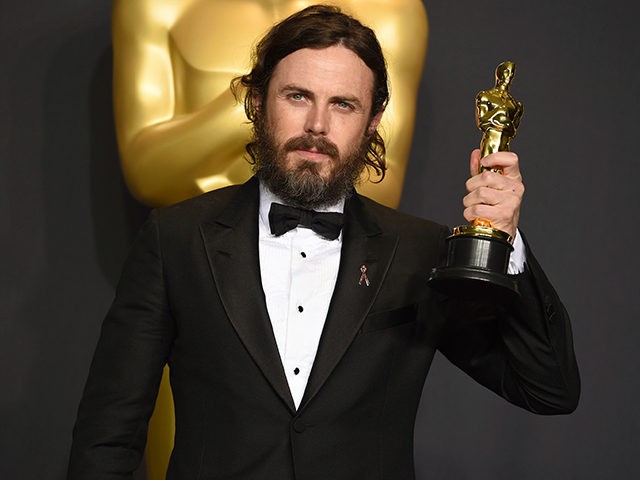
The thing is, the situation is more complicated than that. Controversy has been swirling around Affleck for the past few months due to multiple allegations of sexual harassment.

Normally, separating the art from the artist is fairly simple to me. I’m easily able to enjoy pieces of art I enjoy that were created by terrible people; Orson Scott Card’s views about homosexuality are pretty gross, for example, but Ender’s Game is one of my favorite books. I can love Annie Hall without thinking about Woody Allen sexually abusing his daughter, and I can enjoy Mel Gibson’s performances in Mad Max and Lethal Weapon without fixating on any number of the horrifying things he has said. I understand why people would draw the line with those cases, but I’ve always had no problem overlooking behind-the-scenes happenings to appreciate the art itself.

Of course, that doesn’t mean that I necessarily support these artists continuing to have long, fruitful careers, free of serious consequences. Sure, I can enjoy Annie Hall and Vicky Cristina Barcelona, but I’d have no problem with Woody Allen being blacklisted for the rest of his life (I guess it doesn’t hurt that most of his more recent movies aren’t great). Sure, Johnny Depp in Pirates of the Caribbean is one of my earliest favorite performances, and I continue to enjoy Christian Slater’s work on Mr. Robot, but their repeated acts of domestic violence should prevent them from finding work. And sure, Casey Affleck was amazing in Manchester by the Sea, but he shouldn’t have been offered the role in the first place. Besides, it’s not like there’s any shortage of talented actors in Hollywood. I’m sure Matt Damon and Kenneth Lonergan could’ve found other actors capable of matching Affleck’s talent.

My point is that I can sit back and enjoy these performances and works of art for what they are, but when it comes to the artists’ careers, I support serious consequences. If you asked me to choose between Nate Parker having a long, fruitful career ahead of him and never making a movie again, I’d kill his career. Same goes for Casey Affleck, or Woody Allen, or any of the countless actors with a history of sexual violence. (And, just to clarify, I don’t mean to equate acts of sexual harassment with rape, but they are all lumped into the category of sexual violence—and repeated perpetrators of any kind of sexual violence clearly deserve consequences for that.)

And award shows like the Oscars complicate the whole dilemma. Because even if acting awards should be based only on performance alone, that’s not the case. There are so many other factors that go into who wins, and the outcomes of each competition carry unintended connotations outside the merit of the art.

Because winning Best Actor doesn’t just acknowledge that the performance was good; it acknowledges that the actor himself should be praised, that he should continue to receive more work and high-quality roles. Sure, awards recognition doesn’t always correlate with future success; the pattern of having a lackluster post-award career has been unofficially termed “F. Murray Abraham Syndrome,” after F. Murray Abraham failed to follow up his Best Actor win for Amadeus with many major roles.

But winning an Oscar is generally a pretty big thing for your career. Aside from the obvious prestige that an Academy Award brings, Oscar wins also correlate with higher box office revenue, higher DVD sales, higher paychecks later in your career, and higher visibility (many millions of people watching the award ceremony will do that). Jennifer Lawrence’s insane success the past few years isn’t entirely due to her 2012 Oscar win for Silver Linings Playbook, but that certainly contributed. Lawrence has been the highest-paid actress in the world since 2015, and you don’t get there just from starring in an (admittedly lucrative) young adult science fiction franchise.

So when you win an Academy Award for Best Actor, you’re probably looking at a very successful career ahead of you, especially if you’re relatively young (Casey Affleck, at 41, definitely falls into that category, especially since roles for older men are much more widely available than roles for older women).

What’s more, when a sex offender wins the Best Actor award, it implicitly sends the message to general audiences that you can get away with things like sexual assault and still be rewarded for it. When I see Casey Affleck win Best Actor, and when I see people like Mel Gibson, Woody Allen, and Donald fucking Trump continue to prosper despite the heinous things they’ve said and done, I know that it’s easy to get away with practically anything. If you’re a white man, anyway; if anyone in the film industry was actually hurt by allegations of sexual assault, it was Nate Parker, and race was almost certainly a factor.

Look, I’m all for separating the art from the artist when it comes to evaluating the quality of the art. But it’s different when our decisions actually affect the careers of the artists we’re evaluating. It’s not as simple as separating the art from the artist when rewarding the art actually rewards the artist.

abstract

I’ve always understood the abstract in a superficial yet simple way – something that looks simple. That is a lie. I didn’t always perceive it as such. Initially, I had a more philistine perspective, considering each abstract art piece as something elementary or unable to be understood. This obviously wasn’t true at all, those pieces were understood and that was why they were in a gallery, a magazine, or on whatever medium it graced.
This failure on my part was largely due to my working definition of abstractionism: something immaterial. The dots and color blocks were just things to me. They are still things. But they are different things.
I’m still working through this because I’ve found that, although I haven’t studied abstract art specifically, I’ve gained a greater awareness of it just by living. And it is perhaps my awareness of this development that I find abstractionism so interesting. Perceivably, I will die without ever having understood it at all.
At the moment, I am considering the abstract as a method of extraction: to portray the core essence of something via some other thing. And this loss of detail in the process of extraction, I believe, mirrors the human process of collecting images so accurately. It spits the contours of our visual database back at us – and if done properly – we get it immediately. Perhaps this is why it lends itself to be understood via experience, rather than depending on the learned knowledge of an art critic or professor. As my visual database extends, so to do the contours.

Check your fridge!


I have a lot of stuff in my fridge. Most of what I have in there I don’t recall buying and I certainly don’t plan on consuming it at any time soon. Yet I know I am incredibly lucky to have so much, that I can choose not to consume and still have a balanced diet. Often, I grab the coke instead of the water, the pudding instead of the fruit and the ice-cream instead of the vegetables. Why not, right? If this is what makes me happy then, dammit, I should be able to do it without feeling guilty. I am set in my ways. I know what I like and that’s what I’m sticking with.

I have my bread. I eat bread every day. It gives me what I need: A sufficient foundation for the day. It is reliable, cheap and always there. It gives me a sense of comfort. It seems to adapt to my moods and it definitely has a huge effect on my well-being. Or at least I think so…

My meat is very important to me. It is red, it is juicy and goes along great with the bread. I eat all kinds of meat. that is all the variety I need in my life.

And then, there’s the jelly. Oh yes, the jelly. I can just smear it on anything and it’ll fill in the gaps. It always fills in the gaps. That’s what makes it so convenient.

A pickle I don’t have every day… but on some days, I do, even though I have to eat them at school a lot.

Now, let’s think of the fridge not as a fridge but more as your life in general. The bread is the small arts you consume every day. From your funny Facebook-feed to your tantalizing Twitter tweets. From the childish chalk on the sidewalk to the annoying ads anywhere and everywhere. Think of the meat as the music you listen to… in the shower, on your way to class, during your runs and after hard days of studying. Think of the jelly as videos on YouTube, sitcoms and basically every sort of visual art you consume more attentively, but only in small chunks and between things. The pickle is the brilliant book you read from time to time.

And that is basically it. That is the art we usually consume between classes, studying, homework and maintaining a presentable body shape so your parents won’t be too concerned when you come back for spring break. This routine isn’t too bad, is it? It can even help me to keep my life together, right?

I sometimes think this way. I sometimes think that by consuming the same products, the same services and the same art, I can keep a balance in my life. But most of the time it’s the things that shake this balance, which make living fun and which, paradoxically, balance your life most effectively.

Just like mixing up your diet, mixing up your art consumption isn’t only fun but also healthy. We have so much going on on Campus. Go to the theater and have a laugh, go to a concert and be moved, visit exhibitions and galleries and let the art take you away. Away from the daily stress, away from the sorrows in your life. Maybe just try a new type of meat (that was my metaphor for music, remember?).

Discovering new art is like discovering new worlds, created within and through this, our very own world. It is a lot like having a thorough look into the depth of your fridge. You will find things that you didn’t know were in there and it will take just a little step out of the comfort zone to try them. Who knows… your favorite food might be in there somewhere… you just haven’t found it yet.

Stay up to date about art events: http://artsatmichigan.umich.edu/


PS: Remember to be as weird as you can possibly be.