
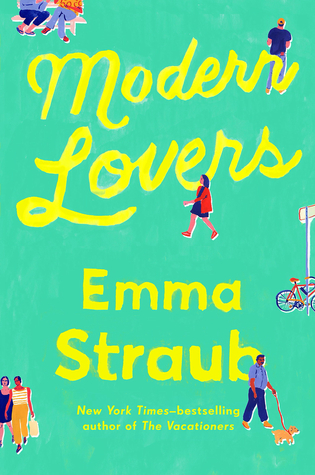
Book Review – Modern Lovers

Modern Lovers is my first Emma Straub book, and I ended up really enjoying it. This semester, I’m trying to really start reading for pleasure again after many semesters when that seemed possible because of all the reading I had to do for class. And this book is pretty perfect for getting you back into that mood to read; it’s light and funny, with short chapters that fly by quickly, but it’s not just empty fluff. It has interesting points to make, and it’s smart.

The first half is a tad slow. The short chapters and fun characters make it enjoyable and breezy, but there’s no one central conflict, which makes the story ultra low-concept; it’s basically a story about two families and their various relationship dynamics, which doesn’t make for a catchy logline, really. You could say it’s about two marriages that are on the brink of failure, one fraught with years of tension and contention and one haunted by a slowly building sense of complacency and buried secrets. You could also say it’s about a teen romance that threatens the stability of the kids’ parents’ friendships. You could also focus on the character of Lydia and the band that she once created with the parents and say that the story is about how it’s difficult to move on from the past, how old events and old tensions can linger years afterward. All of these coexisting stories fit together well in retrospect, but as you’re reading the first half, it’s a bit difficult to see how they’ll build off each other. The first half feels like a time to just hang out with the characters and get to know them a little bit. It’s mostly fun, but occasionally it feels too directionless.

In the second half, the dominoes start to fall, and the conflicts build, and that’s really where the story starts to speed up. Straub is smart about depicting the conflicting ways people view their relationships; Harry views Ruby, for example, as the clear love of his life, but it’s clear to us even without seeing her point of view that she views their relationship differently. Then we get to see her perspective and learn that she really thinks of Harry as a pet project, a fun diversion where she’s able to ‘practice’ saying she loves someone, because all teenage love is performative. It’s sad to see Harry so delusional in his infatuation for Ruby when she looks down a bit at him, but it’s also sweet, and the story sidesteps the big, cliche confrontation scenes where Harry and Ruby might get into a fight about what their relationship means, or have a melodramatic breakup. I like how their story ends, with them agreeing to break up when Ruby arrives at the airport. Their relationship clearly meant something to each of them, and even if those interpretations were different, that doesn’t mean either was wrong. In the end, the story of Harry and Ruby is a hopeful one. Ruby’s flashforward to imagining her and Harry seeing each other at reunions years down the road was one of the most emotionally potent scenes of the book for me.

If I have a complaint with the second half, it’s that the whole thing works out a little too perfectly. To be honest, I was hoping one of the marriages would end, preferably Elizabeth and Andrew’s. I like the idea that the real failing marriage wasn’t the one fraught with disagreement and jealousy (Zoe and Jane), but the one that seemed stable but wasn’t. The other issue, I think, is that I just really disliked Andrew throughout almost the entire book. The EVOLVEment subplot, in which Andrew basically joins a cultish group of hippies who do yoga and drink kombucha, was a bit cringey and annoying for me, even though it’s clear Straub is satirizing the concept and explaining why it holds appeal for Andrew, not endorsing it for everyone. Despite that self-awareness on Straub’s part, though, the EVOLVEment setting took up too much space in the story for me, and I disliked the character of Dave.

In general, Andrew just seemed very selfish and cold to me. Even when he made good points (Elizabeth, of course, shouldn’t have forged his signature to allow the movie studio to use their song), I felt no sympathy for him, because he’d been lying about cheating on Elizabeth with Lydia, because his reasons for turning down the movie deal were selfish. Even when he and Elizabeth got into the fight, Andrew just assumed everything would work out fine for them, and I wished the story punished him more for it. While I’m glad that Zoe and Jane were able to repair their marriage, that, too, seemed a tad too easy; they basically went on one rare date, they had sex, and Jane admitted she was jealous of Elizabeth, and that was it. They were fixed.

There’s also something a bit too perfect about the ending, socioeconomically speaking. Yes, I understand that these people are all well-off, so there are reasonable explanations for how they’re able to overcome their financial issues so easily, but it’s still just…too easy, you know? The fact that Ruby just moved to Mexico and opened up her own pizza place, and Jane and Zoe were able to just open this new pastry shop without any issues…not all couples have the option to spontaneously create a new business together to fix their marriage and start anew. I wanted to see each character find ways to grapple with their issues without throwing money at the problem, and I didn’t really get that.

Still, though I occasionally hoped for a deeper exploration of these characters’ issues and the ways they could fix them, I ultimately really enjoyed Modern Lovers. It’s light, fun, and filled with relatable scenarios and characters. I’ll definitely be checking out more of Emma Straub’s stuff.

Grade: B+

A goddess like woman emerges from the still water…

A goddess like woman emerges from the still water, its calm surface reflecting her face back to her. She has dark brown skin that is highlighted by the vibrant green forest that surrounds her. She looks down at the water, but makes no eye contact as she towers far above the water.

This is IMUA,” one of many water paintings that artist Sean Yoro has created. Using a paddle board and his self taught painting skills he traverses the water looking for interactions between humans and nature that he can use as a canvas. Most of these locations tend to be bridges or walls that separate water from land. Yoro transforms the blank concrete, starting right at the sea level to give the impression that the woman he will paint is rising out of the water. The placement allows the image to be reflected onto the water perfectly.

Yoro isn’t limited to water portraits. He recently worked on project that had him painting on icebergs. Working with North Face he created a film that follows his time spent with the Inuit people while facing the challenges of painting on melting ice. The project highlight the dangers of climate change and combined his love of art and nature to send a powerful message.

Pictures of his murals can be found on his instagram, @the_hula,  as both works in progress and finished products. Yoro shares information about his creative process, upcoming projects, and highlights some of his favorite pieces from his past work. Each photo is more mesmerizing than the last, and the creation of the murals is both impressive and intriguing.

From Hawaii to Florida to the Arctic, Sean Yoro has left his mark as the_hula. In addition to being beautiful, his art is sending a powerful message about preserving the climate and valuing nature. Hopefully one day I’ll be riding by on a paddle board in the Hawaiian sun and see one of his creations. Right now, in the middle of February in Michigan, it’s a really nice thought.

Starry Nights

http://img01.deviantart.net/470a/i/2004/163/c/2/night_ann_arbor.png

Most days, my classes end as night begins. I walk out to softly, glowing oranges and dusky blues. The dimming environment becomes a comforting blanket after the stresses of the day. It is usually a brief respite though. There are club meetings and the omnipresent threat of work still to be done. But as night advances, your sense of time elongates. I am usually absorbed by the computer screen, its glow lighting up the darkness. It is so easy to lose hours as there is no deadline for a long time yet. The consequences of staying up are also quite far away. By 2:00 in the morning, everything falls silent and still and its only me left typing at my laptop.

The night is intoxicating to me. I drink it in because it is my time. During the day, I am forever a slave to my schedule, shivering from one classroom to the next. Reflection in between is rare. There is always something to be done. So even as my head begins ache dully, I realize that I achieve greater clarity in the silent hours of the night. I can slow down and give voice to my thoughts. I perch on the edge of my seat, floating in a bubble of light. It is loneliness, but not an uncomfortable one. There is no longer any pressure to do anything other than sit and work. But it’s also a false hope. As the hours pass, the urgency of day begins again clashing with my idling brain. I am practically asleep, but I want to cling on to consciousness. Occasionally, my eyes drift toward the darkened window and wonder about the parties, the drinkers, the vivid adventures lived out only when the sun has gone. But I can’t worry about that too much. There is statistics homework to do.

Two hours pass and I’m already imagining the next day. It will drift, my mind obscured by the fog of the night’s non-excursions. I can see it, hear it too loudly. And suddenly, I am. I’m not in my bedroom, I’m sitting in a crowded lecture hall. My bleary eyes search out the rest of the students sitting around me. How many of them are fighting through confusing weariness? Frankly, I’m too tired to care.

The college experience is as much about what happens at night as what occurs during the day, although they are never represented equally. The bright and glossy brochures arrive in the mail, hinting at nothing. There are classes to go to, but the real work happens afterwards. Even clubs usually meet under the cover of darkness. It is what truly differentiates life at the University of Michigan and all the years before. There are no more parents sleeping upstairs or younger siblings in their prying eyes. The only curfew is the sunrise creeping closer as the hours pass. Only fear prevents you from wandering through the quiet streets. The liberty of becoming an adult, coming to college, is only truly realized at night. Sleepless nights. Peaceful nights. Nights lit with the neon glow of a club’s sign. Nights are without boundaries and without routine, without even the obstruction of time. Outside, the glint of the rounded street lamps is omnipresent. Here and there are sparks of blue. Up above, the stars.

The Infinity in Originality

When you think about something deemed “original,” what do you think about? Perhaps you speculated something along the lines of “something unprecedented?” In all, it is simply a question I ask out of curiosity. Across several disciplines, the question of originality is a widely debated topic, and each of these disciplines defines originality differently. In the sciences, originality typically refers to substances pure of any hybridity or human influence, or the first generation. But what about the arts? Some artists define originality as a product being “one-of-a-kind.” Others say originality is the uniqueness of each person’s interpretations and conclusions drawn from a precedent. Perhaps there has not been a concrete definition of originality in the arts because the objects of judgement are so personal- “personal” in the sense that it is a natural tendency for artists to be emotionally attached to their creations. To students of other disciplines, that statement sounds like a sort of joke. However, as an architecture student, it is reality. We spend hours toiling on our creation assignments, so it is natural for us to be inspired by our personal experiences and incorporate those feelings into our studio work. Then, when a classmate tweaks our idea to make it their own, we feel cheated. This is a common nightmare of any arts student. However, if you never take any risks in sharing your work, you have less exposure to feedback, which means less personal growth. After all, what is the point of bringing something into this world, if you are not willing to share it, or have it built upon?

Anyhow, I agree with both definitions of originality provided by artists. I agree that something can be called “original” if there is something unlike it. I also agree that something can be still be called “original” if a new idea or purpose is applied to what that thing first was. An example of this is a hallway. Despite how ridiculous it sounds, a hallway was actually an innovation from the past, since it was a major step-up from caveman days and the one-room buildings. When the concept of a typical hallway was first introduced, a hallway was considered an original creation. However, as time passed, hallways have come to be incorporated in people’s basic idea of a building, and the originality of the hallway itself has long been forgotten or overlooked. But does this mean that the idea of the hallway no longer deserves to be called original? Or is its originality considered part of the originality of the building itself? Or does originality related to time? Or is this a question that cannot be resolved? I think that the hallway was original when it first became a thing. But I also think that the hallway can still be deemed “original” even when it became a part of newer buildings because there were original ideas behind the logic of its shape, design, and location within that building. In addition to that, another building with a similar hallway can still be considered original if they took the bits they liked about that hallway and incorporated it with other ideas that they liked. This process goes on forever in the arts discipline, and originality is infinitely discussed. In the end, I would say the overarching truth about originality is that it is the product from making something our own, whether it is a precedent for innovations to come, or if it followed a precedent. What would you say originality is? And do you think it is ethically acceptable to only call precedents “original?”

a rat

Along the polyurethane track encircling the park, I saw a rat slightly bigger than my hand running in the shadow of the curb holding back the dirt. It was running alongside a young woman who was exercising in the middle of the night. In the heat of a South Korean summer, it was fairly customary that the busy professionals of the urban hub of Seoul would exercise once the day cooled off. I could not take my eyes off of that grey rodent nor could I tell the runner in front of me of her uninvited workout partner. It was one of those moments, that was not particularly astonishing, exciting, or at all warranting of a blog post, but it was certainly memorable, sitting right on the edge of banality and extraordinary.

I cannot even describe the rat to you in full detail. In fact, it may have been a mouse for all I know. However this mysterious rodent was special to me in that it validated the existence of a critter my mother abhors (not suggesting that I felt like rats were a fairytale before). There is this dated fear my mother has: you cannot, or you must not, sit on the grass in any old park in Seoul, for the diseased rats could have, or most likely did, scurried over every inch of the sea of green blades. Silly. And a part of me could not accept that my free will, to step on, sit on, or I don’t know, chew on grass, was somehow halted by a rodent that I had never seen before in the wild urban landscape of the far east. Fuck the rat that tells me what to do.

But seeing the rat run alongside that woman, made me consider Veronica the name of an all too important rat in the sewers of Manhattan (ironically my mother’s baptismal name). Father Linus Fairing, the mad priest who preached to rats, had one special one that just kept on returning for that good old sermon. I never much cared for religion either. Feasibly, what keeps the rat running at night is not so different from the runner in the night – a sense of security beneath the moon and the dim street lamps; a feeling that the great heat of the day has sailed on by, leaving the grassy realm free for their tiny palms, dirtied by the dirt treaded on by countless others. It is but a part of a fiction we are all a part of.

Of course I see reason to hate the rat. I see reason to love the rat as well. It never told me what to do of course. That was simply my mother (who had every reason to be suspicious of grass). But the rat is running not because it needs to lose weight, but because it has things to do, rats to see, food to eat, and places to be, just like the runner in the night. When the unseen becomes seen, it is quite dazzling. It is amazing how a little critter just minding its business, can be the producer of so much abhorrence.

Words – A Limit?

Before I get carried away with by my train of thought, I must first say that Manchester by the Sea was brilliant, and Casey Affleck does a phenomenal job as Lee. I saw this movie knowing nothing about it other than its title, so I will leave the same opportunity to my readers who have not seen it yet by keeping details out.

When the credits began to roll, the audience remained still as if they had been petrified to stone and the theater filled with silence. Moments later, the stillness was finally interrupted with the onset of surrounding lights and soft footsteps that signaled it was time to go.  Throughout the movie, director Kenneth Lonergan blankets each scene with the perfect sound, whether it was a classical number by Handel, Poulenc, Albinoni, or Massenet, elements of an original score by Lesley Barber, or a piercing silence. Sometimes the music would overpower a conversation in the film because the conversation itself didn’t matter; the feeling associated was far more powerful than the words.

Words are limiting because they form a framework for thoughts whereas silence does not give any direction. We can use words and sounds to communicate with each other so we can follow and understand each other’s direction. Without these, we are left stranded. Perhaps this is why Lee is surrounded by silence during his story. When he feels the most pain, it becomes so overpowering to the point of numbness. The silence embodies the numbness. However, the absence of noise does not have to be a bad thing. It can be almost…liberating. Like a fresh start.

So I refrained from spilling details about Manchester by the Sea because my words might have influence your own perception of what you would expect to see going into the movie. They might steer you in a direction that you would not want to follow. For some movies, I think it’s important to have a sense of background and public opinion, but for this one, I highly recommend viewing without any expectations.  Instead, watch it for what it is in each moment.