Because of P’ansori: Thoughts from Places

So because I don’t really know how to introduce this blog post, I’m just going to launch into my story..

If you’re like me, you didn’t even know p’ansori existed until last semester, and you definitely couldn’t say what it was if someone asked you. But because I saw it in a movie a couple of months ago, I kind of knew what p’ansori is. It’s a traditional folk music style originating in Korea, and it’s definitely performance art – the performance is everything in p’ansori. Typically, there’s one drummer with his drum, and one performer, either a man or a woman, singing a song that tells a story. Easily the most famous p’ansori song is the story of Chunhyang, and there is an excellent film made by Im Kwon Taek based on this p’ansori, available to watch for free on YouTube if you’re interested.

But until this semester, when I signed up for P’ansori: Text and Performance, I don’t think I really knew what p’ansori really is. I definitely didn’t know what I was in for, thinking that the class would cover the historical and cultural background of p’ansori and that we’d watch a couple of movies and filmed versions of performances. No, I knew I was wrong when on the first day of class Professor Park pulled out her own drum and started teaching us the first sori (song), Era Mansu.

But right now I’m sitting in a hotel bed in Columbus, Ohio, and I can tell you that I would have never guessed I’d be sitting here writing a blog post about a class I took to finish my Asian Studies minor. And I can tell you that I love p’ansori.

Or maybe it isn’t the p’ansori that I love. True, I didn’t love it at first, when I watched Im Kwon Taek’s other movie, Seopyeonje. I thought it sounded scratchy and harsh, not at all like I expected it to be. But taking this class has made me realize how much I enjoy and appreciate Korean culture. All of it. Not just the food, not just the K-pop idols, not just the nice people I meet. I love everything about it. And I love the people I met because of it.

So the reason why I’m in a hotel room in Columbus, Ohio is because our class, typically taught at Ohio State by Professor Park and taken in Michigan via webcam, was able to travel to OSU in order to participate in the 2016 Wind & Stream performance, a combination of a few different types of traditional Korean arts.

Yes, yes, I know – we crossed over into enemy territory. And I was hesitant at first. Sure, it was nice to get a day off of classes and work to go somewhere new, but there was three of us (four including our procter/friend Megan), and a lot more of them. And they were Ohio State. Surely they would hate us, or maybe just ignore us.

That wasn’t the case at all. Not only were all the students and faculty and special guests friendly, they went out of their way to make sure we were welcome. More than once one of the students would tell us that they were so happy that we were able to come, that they couldn’t believe we drove all the way there just for the performance. Over and over they told us “good job” or something like that, during rehearsals and after they show. They gave us the most amazing food for free, and even the other faculty, the seongsaengnim that came to support their students, encouraged us too and even told us to come get even more amazing food after the show (they provided kimbap and tteok, the most delicious thing you will ever eat).

So maybe it wasn’t necessarily the p’ansori that I loved so much. Maybe it was the fact that when I told my professor I’m trying even harder to learn Korean, she just smiled and said “of course you’ll learn it, just like that!” Or when I asked for a picture with one of the guest artists, Kim Eun Su, she took the hand at my side and held it close, like we were friends. Or when leaving the performance area we’d been cooped up in for seven hours straight, I wasn’t happy. Or maybe the fact that I feel like I just made 10 new friends and I already have to leave them.

No, maybe it wasn’t the p’ansori, but it was because of p’ansori that we were able to come together and make an amazing performance, and a precious memory that will last me a lifetime.

Things You Can Do With Girl Scout Cookies

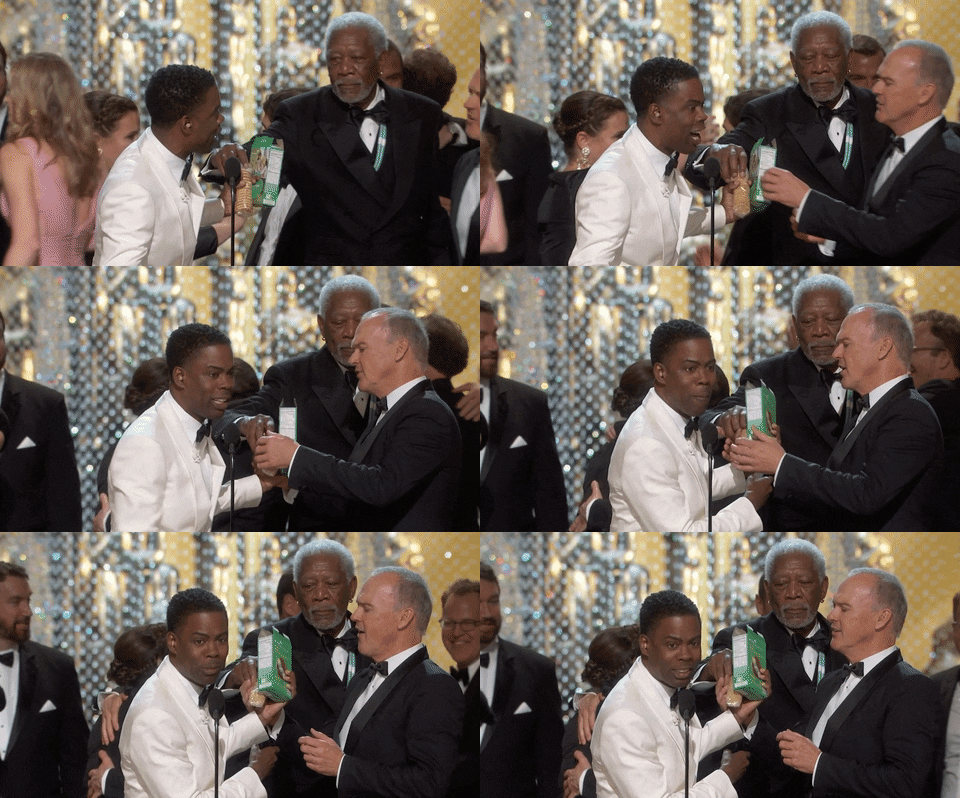
Morgan Freeman takes some Girl Scout cookies at the 2016 Oscars.

You’ve seen them in your grocery stores and at your parks. You’ve turned your head to avoid eye contact, but everywhere you look, there they are. They’re sweeping across the nation to take your money and there’s nothing you can do about it. Who are these fiends? Little girls in vests and sashes. That’s right. Girl Scouts.

This spring break, we all thought we’d be returning to massive piles of cold, wet snow, but we were wrong. Instead of being greeted by the abominable snowman, springtime greeted us. And there’s only one thing that can add to the happiness of springtime: Girl Scout cookie season.

Sure, you’ve waited for them. You’ve talked about them. You’ve bought them. You may have even watched John Mulaney beg the troops to share these delicious snacks all year round and nodded in emphatic agreement. You’ve eaten them and savored every bite. But, did you know all of the creative things you can do with Girl Scout cookies besides stuffing them in your mouth?

You can…

  1. Lick them and stick them on your face as a fun mask
  2. Freeze them before you eat them (Best for Thin Mints)
  3. Build a shrine to them and worship them
  4. Give them to your mother, father, or other family member
  5. Give them to your crush or your significant other. They’ll love you forever.
  6. Cry over them and let your salty tears help to wash them down
  7. Put them on your forehead and try to get them in your mouth without using your hands
  8. Make a castle or a tower out of them
  9. Do some creative art projects with them
  10. Make ice cream flurries and milkshakes with them
  11. Throw them at people
  12. Use them as chasers (If you’re 21 and over only! Suggestion: Bailey’s Cream and Thin Mints)
  13. Hide them from your friends
  14. Buy so many you risk your roommates seeing you as a hoarder
  15. Use them to bribe people to do your chores for you
  16. Bake with them (Suggestion: Girl Scout cookie pies and brownies)
  17. Give them to people as birthday presents
  18. Create a picture frame with them and put a picture of you smiling with a box of Samoas inside the frame
  19. Use them to make a fun necklace that doubles as a snack for later
  20. Decorate your house with them
  21. Put them in your bunker for the end of the world
  22. Time yourself to see how fast you can eat an entire box of them
  23. See how high you can stack them
  24. Play Jenga with them
  25. Build a fort out of them
  26. Make a friendship bracelet out of them
  27. Carve pictures into them
  28. Determine which cookie you identify with best. Example: Do you like your cookies covered in chocolate? Did you know chocolate is peanut butter’s best friend? Do you like to tag along on adventures? You might just be a Tag Along!
  29. Tile a floor or wall with them
  30. Make ice cream sandwiches out of them
  31. Make a sculpture with them
  32. Build a home with them
  33. Play catch with them
  34. Write a message with them so the rescue team can find you when you’re stuck on that desert island
  35. See how many you can balance on your head and then eat that many

Oh, and one last thing! Grab them and eat them before someone else does!

Watching Zootopia

I don’t remember when I last saw a Disney animation at the theater. Maybe it was Treasure Planet? Maybe. Possibly The Incredibles? But for the most part, my Disney filmic experience consisted of me sitting in front of an old tube TV and watching: The Fox and The Hound, Dumbo, or Hercules once again. However, over the break, I finally decided it was time to see a Disney film on the big screen for the first time in a long time.

Zootopia sounded interesting to me, because, animals are nice…ya? I can’t say I’m a sucker for anthropomorphized animals (which may seem odd given two of my favorite Disney movies contain talking animals). However, seeing as there were no princesses involved in this film, I thought, “Fuck it, why not?” Now I know it sounds as if I’m not the biggest fan of Disney animated films. And you would be right in assuming so. A part of the reason is because I’ve been rather disappointed with the Oscars giving Disney the best animated film award year after year, despite there being wonderful films produced overseas. At first, I figured, “It’s the Oscars, why do you care so much? I mean your favorite actor is Joaquin Phoenix, and you know what he said about the Oscars…” But yet, I end up caring, and I hate myself for it. So I’ll just say this, somebody has to take ole Oscar home; I mean it can’t stay there at the ceremony. Right?

On the subject of the Oscars however, it was interesting to watch Zootopia after a ceremony that was so heavily swamped in the whole #whiteoscars bonanza. The film, to my surprise, was heavily about stereotypes and crept into other mature themes like drugs and the mafia. The film was quick to touch on how the optimistic girl (bunny) from the farm found out quickly how much different species don’t get along in a city where such perfect inter-species relationships hypothetically exist. We get other racial jabs like, “Only bunnies can call other bunnies cute, and when another animal does it…” Which is funny. Haha, Racism but it’s a bunny. And we move on. However, the overarching conflict occurs to be between predators and prey however, which is odd because all the sudden, we are now reduced to just two groups.

Now let me sidestep around this for a second and say, I thought the last season of South Park was perfect as they tackled the subject of PC.

At the Oscars, Chris Rock made a joke about Asians. Correction, he made two jokes. Was I offended? Not really, because the joke pertains to the Chinese more than the Koreans. And lets be honest, we only truly get offended when it pertains to a very specific group we belong to. However, did I think it was offensive? Yes. I found the lack of diversity in a quest for diversity very interesting. Even Zootopia lacks this diversity. Although it may show various animals, we cannot fully explore each species and their relationships with other species because there is a limited run-time. If people want to see films, that pertain to every race equally, we are going to be sitting in the theater for like eight-hour films. Chris Rock mentioned in the Oscars, how he finds it hilarious that black people are mad at the Oscars in this day and age. To which he concludes – black people had more important things to be angry about in the past.

I don’t need to verify this; we all know it’s true. And of all the fucking things, the Oscars? Really? This is an institution that gave best film to Forrest Gump the year Pulp Fiction came out. They gave it to a film that portrays a mentally disabled white man who bumbles his way through history, magically taking credit for many major African-American achievements. The Oscars never fucking mattered or were an authority on anything. Ever! All I ever used the Oscars for was as a way for me to vent some anger – to be mad at all the obvious yet annoying picks they make, every year. And then be pleasantly surprised when they acknowledge how great Mad Max: Fury Road is.

The Oscars shouldn’t be a standard for anything because it’s shit. The average viewer doesn’t even end up watching the films that won after the ceremony. The show dictates so little it is laughable. So why try to change it? It’s like getting mad at a rock that wasn’t in your way in the first place. Just forget about it and move on, knowing, that people will watch what they want to watch and love the films they fall in love with. Just because Big Hero 6 won last year doesn’t meant I suddenly love it more than The Tale of the Princess Kaguya. Not one bit. You know why? Because, say it with me, THE OSCARS ARE SHIT.

Double Feature: “Breakfast at Tiffany’s” and “Citizen Ruth”

This weekend, I watched two comedies, both great for different reasons: “Breakfast at Tiffany’s” and “Citizen Ruth.”

At this point, I’m not sure I could write anything about “Breakfast at Tiffany’s” that hasn’t been said, but I wanted to briefly share my thoughts because I actually liked the movie so much more than I expected. In fact, setting aside Mickey Rooney’s racist caricature of a Japanese man, of course, I really loved it.

The most obvious place to start is Audrey Hepburn, who is just a magnetic presence throughout the whole movie. Of course, part of that is her undeniable beauty, but it’s more than that. Whenever Holly Golightly was onscreen, I was just enraptured. There’s something offbeat, weird, and deeply intriguing about her. She’s like the flighty, unstable weirdo that Natalie Portman played in “Garden State,” but so much less grating and two-dimensional. While Sam from “Garden State” represented the purest form of the subtly sexist Manic Pixie Dream Girl trope, Holly has a rich backstory and layered psychology that explains her behavior.

When Buddy Ebsen came along as Doc Golightly, the movie briefly lost me; as interesting as Holly’s past life should be, I was more engaged by her present flirtation and evolving relationship with Paul Varjak (George Peppard, a funny, likable straight man). The subplot with Doc is kind of a weird digression stuck into the middle of the movie, considering he never even shows up again once he takes the bus home. That said, I recognize that it serves an important role in the movie. It’s just not what I was most interested in.

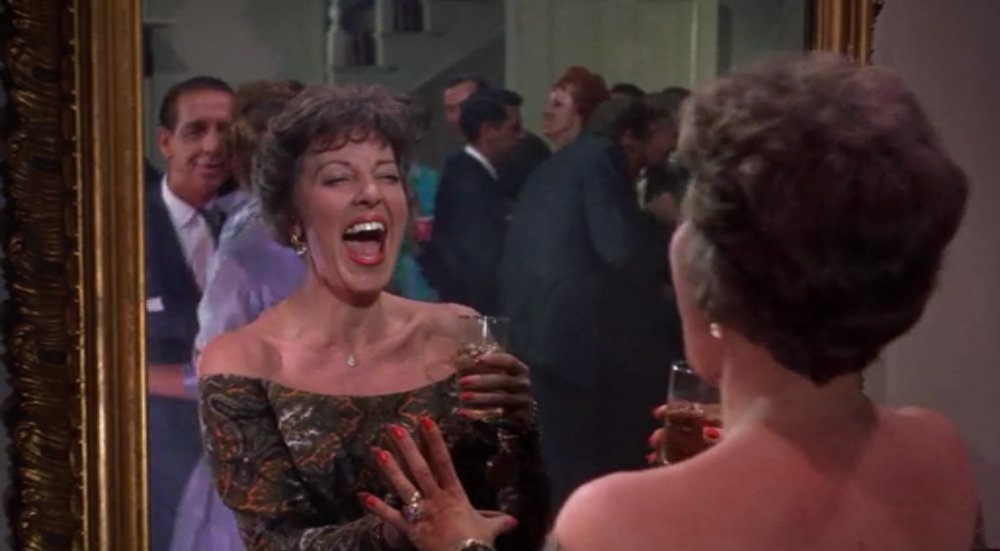
Pretty much everything else is golden. The party scene is just so great, and as odd as it sounds, I felt like I could relate a little bit to it, having seen some weird and random stuff at college parties. There are so many little moments in that scene that I love: the quick speed of Martin Balsam’s talking, the way Paul self-identifies as “Paul baby” when O.J. calls him “Fred baby,” the moment when Paul tosses a girl off Jose’s back and onto the back of another random attendee, and the comedic highpoint of the movie: the shot of one woman laughing hysterically at her reflection in a mirror, followed by the shot of the same woman sobbing at her reflection. Really, there are a lot of those small moments that I love throughout the movie. In some old movies, antiquated dialogue can create a bit of a distance between me and the movie, but here, it was funny and appealing. I love “the mean reds” and the way Holly calls all men “rats” or “super-rats.”
The way the romance between Holly and Paul proceeds seems like the standard romance formula, in some ways. Girl meets boy, girl gets boy, girl loses boy, girl gets boy back. (I put ‘girl’ as the subject because Holly is the one who has the real character arc here, but the other way around would work, too.) There’s a really cute date scene, lots of funny banter, numerous other love interests as obstacles (most notably Jose), a final confrontation, and a kiss in the rain. But there’s something so deep and unique about the conflict that drives Paul and Holly apart; it’s not as simple as Holly loving another man. The conflict is more internal—it’s a character flaw. It’s Holly’s love of materialism, her stubborn insistence that these temporary distractions will fill the hole in her heart.

This is best represented by the heartbreaking moment when she opens the cab door and shoos the nameless cat away. Pretty much any scene in any movie when a character gets rid of a cat will inevitably hit me hard since I love cats, but this one was especially potent because it was such a powerful metaphor for how Holly feels. Towards the end of the movie, I was so frustrated with her—I seriously wanted her to stop pretending she didn’t have any genuine love for Paul, or her cat, or her house, or her life in New York. And that final moment, as she jumps out of the cab, searches for the cat, finds it, and embraces Paul, is so cathartic.

Skipping forward 35 years, “Citizen Ruth” is most notable for being the debut film of Alexander Payne. I’ve always had mixed feelings about Payne; while I like “About Schmidt” and “The Descendants” well enough, I have to admit I found “Nebraska” pretty dull the first time I saw it. I was ready, for a while, to write Payne off as a filmmaker who simply didn’t fit my tastes, regardless of how beloved he may be. Then I watched “Election,” and I almost groaned, because I could no longer dismiss Alexander Payne. I absolutely loved “Election,” and “Citizen Ruth” represents another boost in my regard for Payne (I still haven’t seen “Sideways”).

Oddly enough, the first thing “Citizen Ruth” reminded me of was “Mockingjay,” the third book in the Hunger Games trilogy. In “Mockingjay,” Katniss defeats President Snow and the primary villains of the series with the help of ostensible good guys President Coin and her best friend, Gale. Eventually, though, you realize that the good guys have some dark secrets of their own. One of the fascinating twists of “Mockingjay” is that though President Coin might be trying to accomplish an admirable goal—defeating Snow and bringing justice to Panem—she’s ultimately just as manipulative, vindictive, and hateful as the presumed bad guys. Gale, too, though well-meaning, is implicated in some of Coin’s most heinous acts.

In this analogy, the pro-lifers that try to convince Ruth to keep her baby in “Citizen Ruth” are like President Snow and the corrupt citizens of the Capitol. They’re the most obvious choice for the antagonists; they’re religious zealots who seek to manipulate Ruth and use her to accomplish their own political agenda. Honestly, to me, abortion is the kind of issue that doesn’t need for both sides to be treated equally, just like a movie about gay people fighting for same-sex marriage to be legal doesn’t need an equally valid point of view showing that maybe gay marriage should be illegal. I would’ve been fine with an unequivocally pro-choice movie, just like I’d be fine with a pro-gay marriage or anti-racism movie.

And yet “Citizen Ruth” manages to humanize both sides. On the pro-choice side, the characters can be likable because they’re generally more accepting of Ruth and her lifestyle and her choices. On the pro-life side, the characters can be likable because Norm (Kurtwood Smith) and Gail (Mary Kay Place) are such kind people to Ruth, feeding her and clothing her and paying her bail and putting up with her shit. Us liberals tend to dismiss radical conservatives and pro-lifers, but Norm and Gail, despite being cartoonish, were genuinely caring people. It’s important to remember people’s humanity, even when their beliefs are damaging.

Yet the other striking thing about “Citizen Ruth” is that really, none of the characters are likable. They’re all mostly caricatures, the pro-choice side being stereotypical hippie liberals and the pro-life side being stereotypical Jesus freaks. To a degree, both sides are kind or respectful to Ruth, but a lot of that is pure manipulation. Ruth is treated like Katniss is in “Mockingjay”; she’s used as a symbol for a political agenda, and even if that agenda is arguably the correct one, it’s taking advantage of Ruth and using her, not treating her like a human with desires that should be respected.

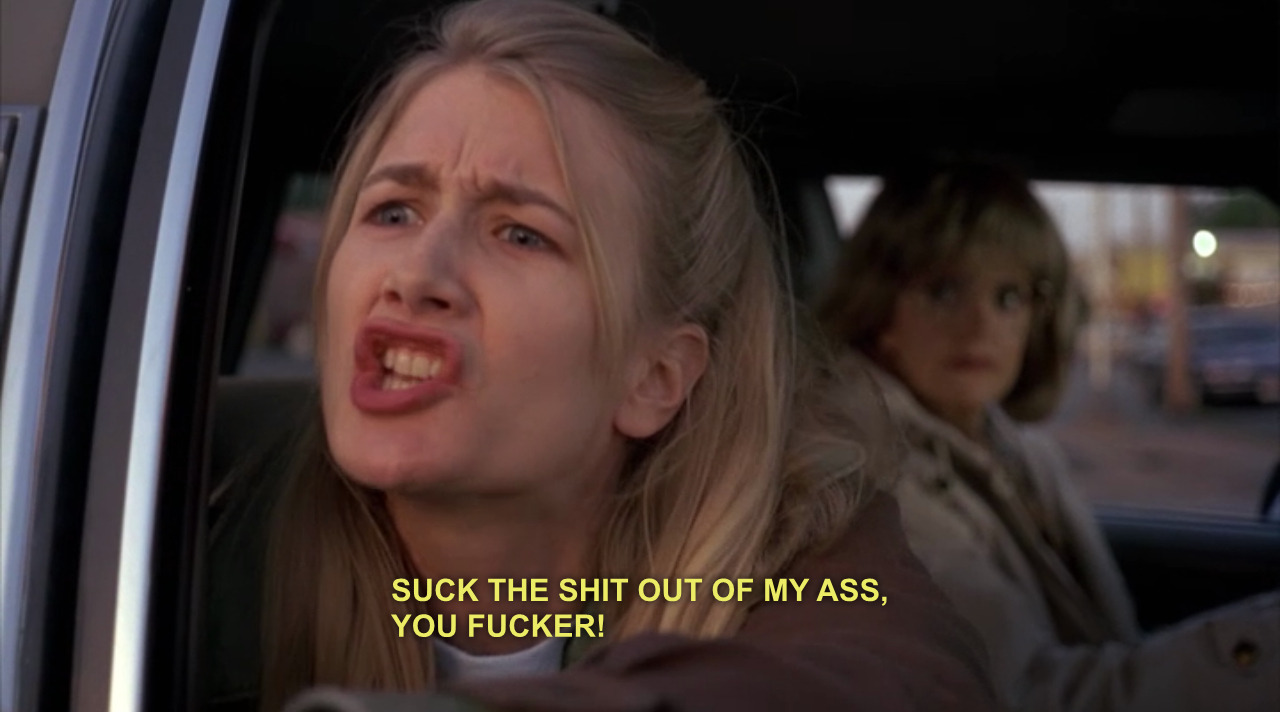
It’s worth noting that Ruth is also a terrible person. She’s an addict, so not all of her actions are entirely her fault, but it still gets painful and exasperating to see her repeatedly huffing paint and glue and patio sealant when she knows it’s terrible for her. And she definitely acts entirely selfishly and ignorantly, regardless of any physiological drive. She acts entirely in her own self-interest, with no specifically pro-life or pro-choice stance of her own. She drops a toilet tank cover on a guard’s head and knocks him out. She ruthlessly uses profanity, including such hilarious gems as “suck the shit out of my ass, you fucker!” and a casual “oh yeah, well you’re a cunt.” When her pro-life mother begs her not to abort her baby and asks, “What if I’d aborted you?,” Ruth screams back over a megaphone, “Well, at least I wouldn’t have had to suck your boyfriend’s cock!” Laura Dern sinks her teeth into this role with a brilliant, hilarious gusto, and you have to admire her for how shamelessly abhorrent she makes Ruth.
[Spoilers for the ending in this paragraph.] And yet, despite Ruth’s despicability, you know that she deserves a happy ending just as much as any of these manipulative people trying to control her body. So when the movie ends with Ruth escaping with $15,000, you feel happy for her. Sure, there’s a good chance she’ll squander it all in a couple days on booze and drugs. Maybe she’ll end up back in jail by the end of the day. Maybe she’ll never turn her life around or see any of her kids again. Maybe she’ll die early after living an unhappy life with no support from family or friends, only drugs and the streets.

But whatever happens to Ruth after the credits roll, at least it’s her choice. And that, more than any explicit pro-abortion moral, is the most progressive message “Citizen Ruth” has.

Me, Myself, and I

Image via gyphy.com

Sure, we all learned the types of point of view in, like, third grade. But I was told something the other day during my Creative Writing Tutorial that crumbled everything that I thought I knew.

I’m a fan of the first person. Yes, there may be some editors and publishers out there who are cringing right now, but let me explain myself. To me, the first person point of view allows a kind of depth that is unachievable by any other viewpoint. You get to know intimately the tone and voice of your character. Sarcasm can come much more freely in the first person because the voice and emotion that sarcasm depends upon is omnipresent. Third person requires quotation marks and dialogue in order to make use of sarcasm.

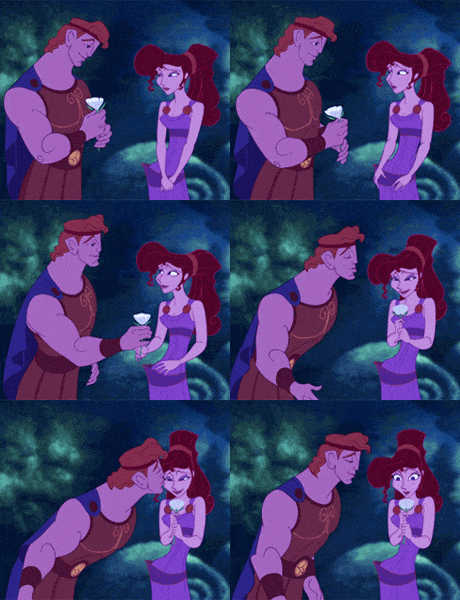
We as humans were born to tell stories. It’s what you probably did two minutes ago to your roommate. It’s what you are texting to your mom right now. It’s what our ancestors did every night for fun. The myths they told, of course, almost always were in the third person. For example, Hercules did this great thing. Then, he beat up a lion. Then, he fell in love with the mysterious Meg… and so on.

Image via gyphy.com

But, these people that historically were spoken of in third person were mostly gods or heroic figures of history or people who seemed larger than life. They are beings that we may aspire to resemble, but will never actually become them. In contrast, we always tell anecdotes of ourselves in the first person. This allows for a subjective perspective rather than objectively factual (remember Hercules did this, then he did that). As the words come out of our mouth, we have the ability to embellish the “I” as fancifully or plainly or victoriously or victimized-ly as we want. This unreliability of first person is what draws me to the viewpoint the most. I’m fascinated by the psychology behind human credibility. Can we really trust what we see? Or do feelings get in the way and we end up seeing what we want to see? What motivation does a character have of lying to his/her reader? Then again, what motivation do we humans have when we omit parts of the truth from the stories we tell? This doubt and uncertainty is what makes our characters the most human. This is what readers bond to when they read a first-person story – the humanness of the character. Essentially, this tenuous relationship between truth and story is what makes them read on and perhaps read a bit more closely.

Now to the mind-blowing. Turning in my ninth draft of a first person narrated story I’ve been writing, my professor says, “You can cut down on wordiness by letting the narrator do the talking and just have your character experience the events happening around her.” My eyebrows pinched together in confusion. “But aren’t my narrator and the main character actually the same person?”

“No,” she responded. *poof* went my brain and the lie I’ve been living.

Image via gyphy.com

I asked my professor to give me an example. She explained: Your character, sitting in an airport, could say, “I saw the janitor drop his cell phone in shock.” But, if you get rid of the words “I saw,” what do you have left? The janitor dropped his cell phone in shock.

So, what do you achieve by omitting the words “I saw?” Well, a few things actually. First, you move the sentence and the action along, so your reader doesn’t get caught up in extraneous words. (This is along the same lines as why we are told to omit the words “I think” and “I believe” in academic papers). But, the crazy thing is that it leaves the sentence up to interpretation. Did the main  character see this happen or not? A writer can use this scene description to showcase other activities going on around the main character to heighten drama OR to draw attention away from the character for whatever reason OR to emphasize that something is happening simultaneously to the main character’s actions that the character may or may not have seen! This “showing” rather than “self-reporting” narrator gives the reader a VIP pass inside the scene, in the same vein as dramatic irony. It allows us to know more about the story and fictional world than the main character herself.

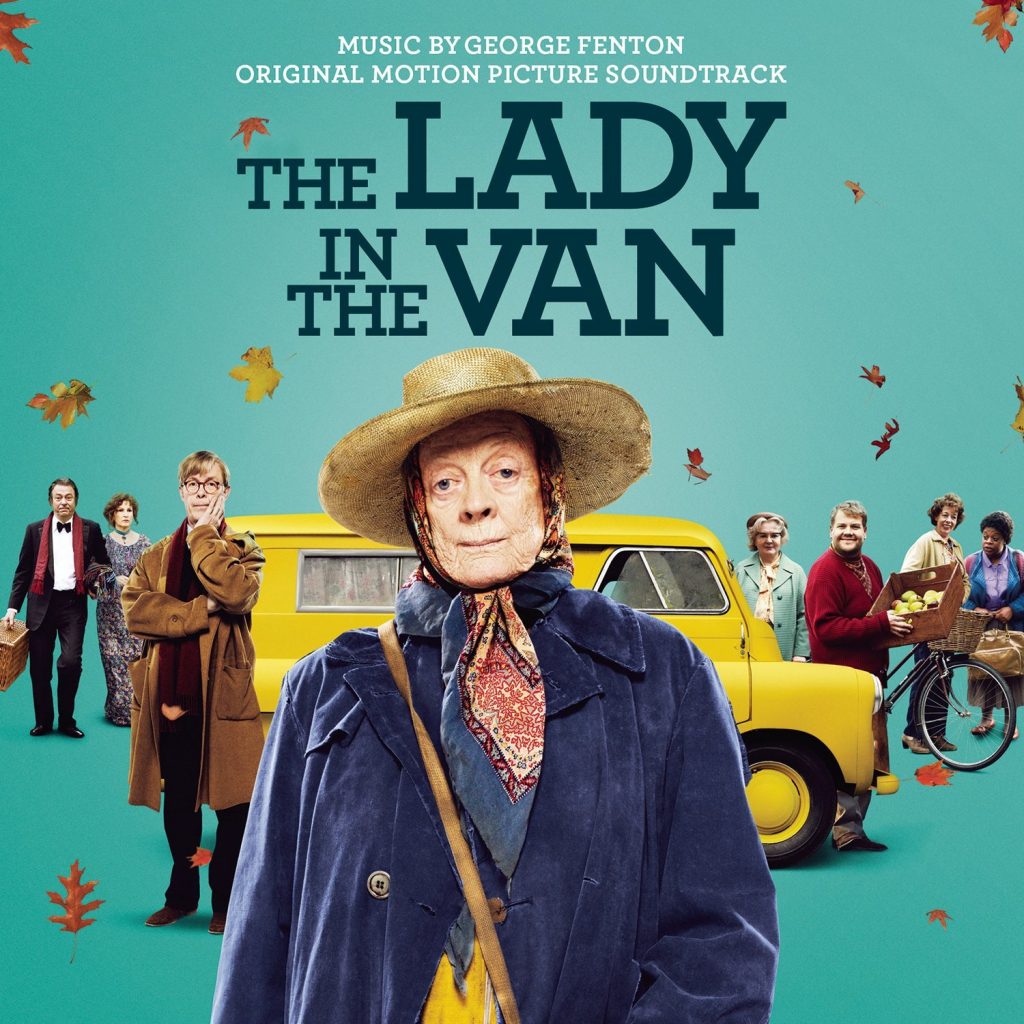
This discovery was especially timely because there is a sense of this narrative split in the movie “The Lady in the Van.”

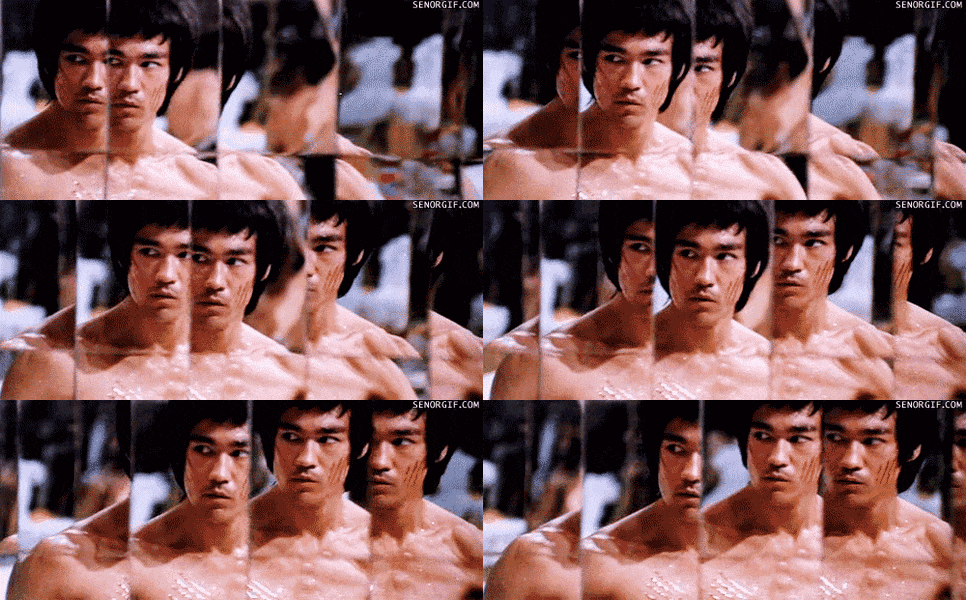
In the (mostly true) film, the main character Alan Bennett (Alex Jennings) is a writer who allows a homeless woman (Maggie Smith)  to park and live inside her van in his driveway for 15 years. Although the plot itself has its own bizarre and unique qualities, I was struck by the choice to double Alan Bennett, much like Lindsay Lohan in the Parent Trap. Indeed, throughout the film, we see identical images of Alan Bennett next to each other, talking to each other, mostly arguing with each other. The two representations symbolize the split personalities between “the writer” and “the one who lives”, or the narrator and the experiencer. I’ve never seen this portrayed in a film before but it made me begin to understand what my professor was trying to tell me in class. And perhaps it begins to explain my own psychology as a writer. There indeed is always one hand on reality and one hand writing the next sentence.


Pushing Daisies S01 E09: Corpsicle

This is the season finale. Yes, the season only got nine episodes, but it’s because it got cut short due to low ratings. Actually the season was only nine episodes because it was in production right before the Writer’s Guild Strike. At this point, only nine episodes were written, so Bryan Fuller made changes to the last episode so that it could serve as a season finale. I personally believe that this is what really caused the series lose ratings in the following season, creating a dark cloud that hung over the production.

Summary:

Another flashback to start the show, but rather than focusing on Ned, we are instead focusing on Chuck. We get to the see the starting scenes of the series from her perspective. We see how she confronts her fathers death as a child and what her home life becomes like. Her aunt Vivian is immediately comforting, even though she normally has trouble touching people. On the other hand, Lily can bring herself to comfort Chuck and is only able to do so after Ned loses his mother. We then jump forward to when Ned is being taken away to the boarding school. Chuck sees him leaving and begins to chase the car, but can’t catch up.

We’re then transported to the present and find Ned looking for Chuck after she left due to a fight caused by Ned’s revelation from the last episode. After scouring the streets of the city, he then heads to the aunts’ house, but is unable to find them there. He then checks at Olive’s apartment and while Olive insists she isn’t there, we learn that Olive is letting Chuck hide from Ned there.

After Ned gets turned away, Olive asks Chuck about faking her death. Chuck actually reveals the truth, but Olive doesn’t believe her, convinced that Chuck just doesn’t want to talk about it. Since Chuck doesn’t want to see Ned, she asks Olive to bake her aunts the pies. She gives her the antidepressants, but tells her it is vanilla extract. Olive makes the pies, but adds way too much of the medicine, believing the vanilla flavor to be too weak.

Down at the Pie Hole, Emerson tells Ned to stop looking for Chuck and Olive agrees. After she leaves, Emerson reveals the case of the week: Victor Narramore, a life insurance adjuster, was scooped up by a snow plow. They head to the morgue and wake him up. The body was frozen solid, but he is able to tell them that they couldn’t see the killer, but was killed by a bat that had the word “kindness” carved in it. They ask if he has any enemies, and of course he does. His job is to quantify life and if patients should be given life saving operations.

We then cut to the roof where Chuck is sitting by herself. Her alone time is interrupted though by Oscar Vibenius. He wants to know the truth about Chuck’s mysterious death scent. He reveals that he stole some hair from Digby and is also able to smell the scent off of him. He asks for a lock of her hair so that he can study the scent more, but she refuses.

Back at the Pie Hole again, Olive returns behind Ned in the kitchen, but Ned is unwilling to engage in conversation. He believes that Olive knows where Chuck is and gets her to admit to Chuck’s location off-screen. Emerson wants Ned to come with him to investigate the only living person who was denied by Victor, but he instead goes to Olive’s apartment to confront Chuck. Chuck reveals that she wants to talk to someone other than Ned about the truth, but can’t. She also insists that she needs to be away from Ned in order to deal with the secret from the last episode. From this conversation, she decides to leave a note for Oscar.

From this scene, we move to one where Emerson is visiting Abner Newsome, a teenager who was denied a heart transplant by Victor. It’s clear that Abner is much too sick to kill the adjuster, but mother is incredibly rude and possibly a new suspect for the murder. However, once Emerson leaves, he finds a snowman, with a dead body inside. This convinces Emerson that the mother isn’t the killer as she doesn’t seems stupid enough to place a victim in her front yard.

Ned wakes the body and they find that he is another adjuster. He also didn’t see the killer, but tells them to ask Kevin, his carpool buddy. They head to the company and learn that both the dead man and Kevin also denied Abner. Kevin has also been missing since the same night.

Meanwhile, Oscar comes to visit Chuck in the kitchen of the Pie Hole. Oscar believes Chuck and Digby came back to life, but Chuck tells him it’s ridiculous. Chuck gives Oscar a hair sample, hoping that she can finally reveal her secret to someone else without having to tell them.

We then switch back to Ned and Emerson, who are visiting Abner at the same time as a Wish-a-Wish agent (a fictional counterpart to Make-a-Wish) who is trying to improve Abner’s mood with a monkey. Ned and Emerson tell the family that they will be doing a stake-out in front of the house, hoping to catch the killer when they potentially put the new body on the front lawn again.

During the stake-out, Ned gets Emerson to talk about his relationship. Emerson reveals that close relationships are not easily mended and that he has also lost ties with someone close to him, his daughter. Emerson refuses to talk further and in the background, we find a shadow sticking a potato in the tailpipe of the car. Ned wakes up from passing out and saves the two from carbon monoxide poisoning. They leave the car and find another body in a snowman. Unfortunately, the body becomes too damaged for Ned to awaken him.

Back at the Pie Hole, Oscar comes back to visit Chuck. He wants to give Chuck her hair back as a sign of trust and reveals that he didn’t smell the hair. He would rather let her tell him in person. Chuck realizes that she was fine with only keeping the secret with Chuck and tells Oscar that he should’ve smelled her hair when he had the chance.

Emerson and Ned then learn that another agent has denied Abner and that the Wish-a-Wish lady asked to go visit him. Emerson and Ned rush over to try and stop her before she is able to kill another person. They get there just in time, but she has a gun and stops them in their track. Luckily, her monkey from earlier plays with her car’s gear shift and runs her over, killing her. This leaves her heart open to Abner for his surgery.

In the end, Ned finds Chuck at her father’s grave. She wants to wake him up, but Ned refuses. He doesn’t want to bring him back to life just to kill him again in front of her. Also, at the aunts’ house, Lily reveals that she is actually Chuck’s mother.

Pros:

-The absolute best part of this episode is Emerson’s reveal. It’s a highly emotional reveal and gives much needed depth to the character. We get to see a new side to Emerson that we’ve never seen before.

-The mystery is good. Not stellar, but is still a good one.

-The emotional journey of all the characters in this episode is spectacular. For the first time, Chuck and Ned’s relationship is truly on the rocks. This adds actual weight to their past arguments, which seemed slightly shallow as you could tell that the issues were never going to break them up.

Cons:

-The new characters introduced in this episode aren’t that interesting. They’re pretty one note.

-Outside of Chuck’s and Emerson’s storylines, not much is too great about this episode. Clearly this was not meant to be the finale as it is not a very strong episode overall.

Overall:

This episode is not that remarkable, which is really a shame for the season finale. However, as stated before Emerson and Chuck’s emotional journeys in the episode are bright spots. We never get to see Emerson get emotional and while Chuck has had emotional problems in the past, we never see her flirting with disaster like she does this episode. It is clear that she is really distraught if she was thinking about telling her secret or getting Ned to wake her father.

On the other hand, this episode made me realize one of the reasons why I enjoy this series so much. It is very much shot like a stage production (which should be obvious given the notable Broadway alums). The episode focus on only 3-4 main set pieces and body language/character placement are hugely important to scene composition.

The sets are highly decorated, which is unnatural for smaller productions, but can be very important for larger ones. Especially if the art style of the set helps to create the atmosphere of the production, much like it does for Pushing Daisies. The set is highly stylized and serves to reinforce the emotion and plot of the episode.

The character placement is important to creating the scenes atmosphere. They placed just so and it is highly visible in this episode. Height of characters or depth within the scene can give characters power over others. This important to various scenes, like where Oscar confronts Chuck on the roof or Ned confronts Olive in the kitchen.

Rating:

7/10 Daisies