Menstrala

Menstrala: menstrual art. Creating art from period blood. Yes, this is weird and strange and out of the norm but I also find it fascinating and I imagine to be liberating. I can just imagine your grotesque faces, twisted with horror but admit it: you feel fascination as well. And you can see how it can be liberating. Something so shrouded with stigma (God forbid we talk about periods in public or girls walk to bathrooms without veiling their tampons/pads with a folder and their shame) just being brought into light. Just like that. Revolted by period blood? Oh, here it is, in a painting. Beat that with a stick, motherfucker.

Anyways, where was I? Here’s a work by Vanessa Tiegs, who has extensive menstrala work.

However revolted you are by the fact that the red strokes you see were made by a female body’s excrement, you have to admit that there’s nothing but talent here. Using such an intimate source of pigment is almost like exposing your soul… Isn’t it? Or is that just me at 5 AM when sleep is kicking in?

I find this incredibly beautiful, think what you want of me.

Here’s South African artist Zanele Muholi’s work, a commentary on rape being used as a “cure” for lesbianism in some regions of Africa.

Ummeli, Zanele Muholi

What she has to say about it: To read more about, click here.

Isilumo siyaluma is a Zulu expression that can be loosely translated as “period pains/ periods pain”. Additionally, there is an added meaning in the translation that there is something secretive in and about this blood/“period in time.”
At one level, my project deals with my own menstrual blood, with that secretive, feminine time of the month that has been reduced within Western patriarchal culture as dirty.

On a deeper level then, my menstrual blood is used as a vehicle and medium to begin to express and bridge the pain and loss I feel as I hear and become witness to the pain of ‘curative rapes’ that many of the girls and women in my black lesbian community bleed from their vaginas and their minds.

To read more about, click here.

Another artist who combats the stigma of periods being dirty and unclean is May Ling Su. One of her videos is of her going to the beach naked and smearing herself with her period blood, breaking the whole can’t-go-to-the-beach-while-on-your-period “rule.” Here’s an image:

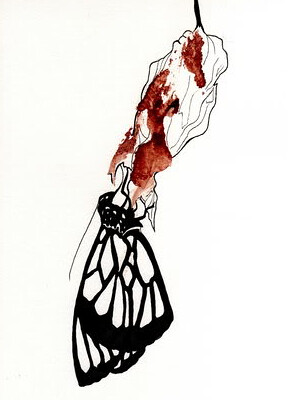
There are entire communities and forums dedicated to menstrala. Here’s a fragile and delicate piece from Blood Art-Menstrala Live Journal community:
Well.

That’s it.

See you all next week, same time, same place.

Let’s talk: Race, etc.

Flashbacks lead to something that never was. Or is. You seem to feel like the walls crumble and the chairs melt away, the harsh lighting of the projector intensifies to stage lights, the draft becomes the auditorium breathing, and the warm body next to yours familiarizes itself like it used to in between longs summer days.

The projector flashes off and faces fill the void. Familiar voices waft up in the air. Gone.

Like 8 months passed, at least the t-shirts look the same “ETC”. I watch those I spent 3 days with and those I interviewed and those I befriended and those that befriended me all perform. My two worlds collide–interest with social, or academic and event, or myself and others. AKA the UM Educational Theatre Company did a show on race and I had all the feelings.

Race is something that I talk about everyday. It is something that I would like to only talk about, even. Something that I feel like should always be talked about and something that should never stopped being talked about.

So it was both terrifying and wonderful to see this show. Terrifying in that certain scenes and bits of dialogue come from real life–real lived experience. Terrifying that in most of life I’m in a space where racial oppression and racism aren’t spoken of right away. Terrifying in that most people I interact with don’t think about race, in that most people on campus are white and that because of this, like the pervasiveness of whiteness, race becomes a topic often not talked about and it is made invisible and immaterial.

Terrifying in that there are many topics that need to be debriefed more: biracial and multiracial identity, the politics of passing, and the different impact racism has on different racial identities. So I flee into fuzzy phone calls, torn book pages, and cups and cups of coffee.

What is at once infuriating becomes also reassuring. Wonderful in that race actively confronts each and every audience member by a removal of one. Wonderful in that this space is dedicated to talk about a topic that is so embedded in culture that the entire modern world is founded on it (the middle passage and slavery) without even acknowledging it. Wonderful in that it gives the time needed to hear certain stories and gives a voice to certain experiences and allows for a place for them to be heard.

Wonderful in that IGR is here to help to facilitate two dialogues about race and the show–only moments after the performance. But these dialogues, however basic they are, are so nice to be a part of in that it helps to refocus my world view and show me how much shit is truly everywhere and how much we don’t actively talk about it. The fact that only certain experiences can be shared in a facilitated dialogue–where the scene is set, rules established, and safety made certain–make me want to vomit everything I have ever eaten and then some. This realization is wonderful.

But I only can say half of this (read: all of this) because of my white privilege. I get the privilege of how and when I talk about race because my race (white) reads as neutral, normal, socially accepted. I won’t get my white racial identity brought up by the public, I won’t get my hair pulled, I won’t have my skin complimented, I won’t be asked where I’m from and no one will ask me if my mitten isn’t michigan but something else, somewhere even “exotic.”

I have the privilege of being able to talk about race and then walk away from it and into a safe space, which by safe I mean the entire world–all of society.

Events like these, like UMETC, especially UMETC, get me thinking. They get me uncomfortable, angry, passionate, loving, and disturbed. Good theatre does that. In all of my expert opinion, I wouldn’t go to theatre if I agreed with all of it or if I left feeling comfortable. And it is here, at U of M, where racial climate can be completely terrifying but at least we have these moments where we can briefly,

ever so briefly,

talk about it.

Before it crumbles away and we’re faced

with new memories.

The one, the only, the original.

Authorship is a complicated business. Ideas and images are used and reused, and oftentimes, even new work can but follow known and established forms. There will ever be things that serve as references and sources— content is often more meaningful because it draws upon things that already exist, things that already in themselves hold a concept or association. And imitation is how people learn in the first place, learn how to create work in their chosen medium, learn its parameters, learn how to produce work that transcends those boundaries.

But at what point do allusion and imitation and reference, especially after filtered through artistic license, become plagiarism? Is a fictitious account of a non-fiction source original? Credible? Is a painting of a photograph a legitimate work of art in itself? (There have been massive outcries over this.) Is the recreation of a piece in a different medium its own autonomous entity? Even when accusations of plagiarism can be mitigated by attribution and sourcing, things deemed the first or the original are also deemed the most genuine, the most valuable, the most worthy of reverence.

Photography, in particular, often finds itself in a morass of undefined attribution. Technology has rendered the ability to take images mundane, trite. The sheer volume of pictures produced every day, hour, minute, of anything and everything, has changed the nature of photography and its perceived value. It has, moreover, given new weight to the question “what is art”: are images of other people’s art art?

Some of the answer depends on subject, of course. Natural subjects, photographs taken for journalistic and documentary purposes— these are not so much contested. But if someone else has set up the installation or erected the building or made and laid out the food, or what have you— which part, the physical piece or the carefully oddslot composed image of it, is more important? Photography requires translating a more ephemeral or greater-dimensioned, multi-sensory experience into something that cannot merely allow itself to be reduced, but needs to create for itself a greater, meaningful something that might not have been visible in the original form.

Purpose and context are what everything comes down to, in the end. While copyright laws regulate the commercial aspect of intellectual property, they do not regulate its creation, it social meaning, its cultural significance.

Ethics in the Art Market

Today in one of my art history classes, we discussed the greatly heated debate of whether or not the art market is ethical and if so, is it less ethical than the stock market. At first, I was somewhat taken aback. Comparing the art market to the stock market seemed quite a longshot. The art market deals with fine works of art, excellent pieces composed by masters, those that have changed the face of what art is and how art affects society. The stock market, so far as I know, is nothing more than intangible dealing with numbers – figures so far removed from the everyday life that it is nearly impossible for me to correlate the two.

However, once we began to delve into the topic, it became apparent that the differences between the stock and art market are not nearly as great as they initially seemed to be. Rather, there are quite a few similarities. The thing that struck me most, however, was that the legal regulations that are implemented on the stock market are nowhere to be found in the art market. For instance, in the art market, the auction house can be a bidder at the auction, invariably raising the price and the base price of works of art without any restriction or regulation. But is that, in any way, fair? Should the auction houses, rather than the buyers, be the ones setting the market? And if it is the auction houses, how are they determining the value?

Rooks, Knights, and Bishops, Oh My!

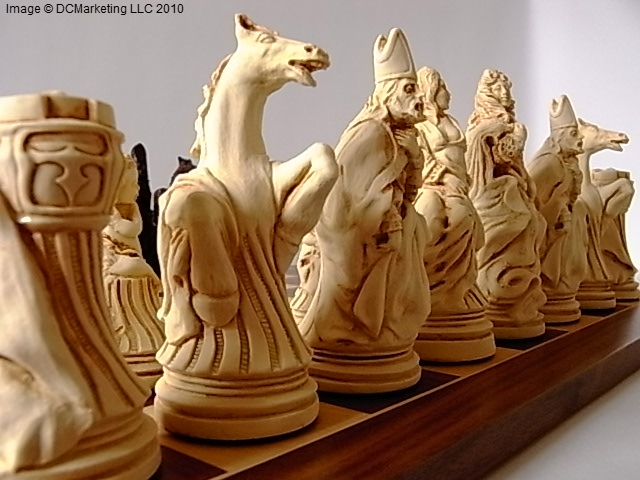
The greatest game of all time garners its beauty not only from the intricacy of its elegant design but from its variety of tastefully styled constructions. Chess derives from several ancient games intended to simulate war across the globe, and each contributes to the miraculous game that we all know and love. Specifically, chess draws its origins from the Indian chaturaṅga—a game containing pieces with similar movements to modern rooks, knights, bishops, and pawns, but called chariotry, cavalry, elephants, and infantry—and the Muslim shatranj—which has many similarities to both modern Western chess and the Japanese variant shogi. After chess was adopted into European culture, it fully became the standard F.I.D.E. (World Chess Federation) version we know today. While the game is an abstraction of war tactics and strategy, the design of its pieces gives it a classic and elegant feel that mirrors the brilliance of thought required to succeed in the game. In this regard, there are quite literally hundreds of variants in existence, which attempt to embody and exploit different aspects of the game and explore its further intricacies, whether that be increasing the number of players, the movements of pieces, or the shape and size of the board. Many of these deviations from standard F.I.D.E. chess are wonderfully amusing, and I strongly suggest exploring them at the Chess Variant Pages.

With so many varieties in existence, it is easy to see the impact chess has on the people subject to its addictive allure. Years are dedicating to exploring and mastering this game, and, as a result, it has become a quintessence of the human condition. At its heart, chess subsists of pure logic and rational thought. In this regard, it tends to employ the left-brain, which is often favored by society for the progression of accomplishment, in war, business, or development. However, while the game is mastered in understanding and applying this rational thought, the display of chess and the environment it operates in allows for creativity to play its part. Ergo, chess sets are some of the most brilliant pieces of art.

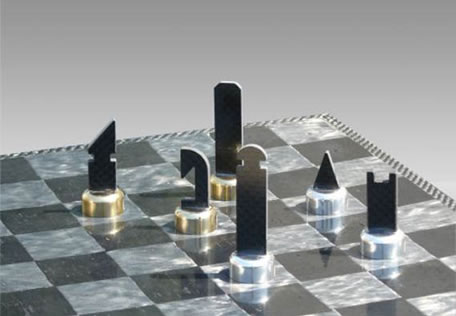
Many sets are traditionally beautiful, with hand-carved pieces or glass boards, many of which can be placed on display in homes for the sake of class and esteem. Some sets change the display of pieces, deviating from the traditional Staunton chess set which has been adopted by F.I.D.E. as the standard since 1924. These deviations can sometimes become more concrete, such as using figurines, which are designed as people or animals. Other times, they can become more abstract, such as finding a singular shape to stand for a known piece.

Not only are the pieces greatly altered, but the boards themselves can take on dynamic changes, whether that is scale or direction. There are several “life-sized” chess sets around that involve two to three foot pieces on a large ten-by-ten foot board. Also, the boards can have a variety of different colored pieces, separating from the standard black-and-white checkers. The most original design I have found incorporates a vertical board, where the game is played on a wall-hanging by moving pieces up and down a picture-framed surface.

Many variations of chess exist, from the concept of the game to the design of the pieces and board, but they all mirror the brilliance of the elegant game.

Manifesto on the Rain Part II: Non-Artifice

Art is fake. It is people and objects pretending to have a significance that they don’t actually have. Paint means nothing and a painting means nothing. This is the place where I start as an artist, the endpoint, the place where nothing has significance anymore. Of course, this means everything has significance. But such is post-modernism.

If nothing is significant, we must make something that actually contains meaning to make the truest and most honest art. That, I think, is my goal in art-making. I want to honestly show someone something that is true. And for now, all I know to be true is that of my own experiences and my own self.

When I was young I loved having friends spend the night. We’d stay up late playing video games and finally decide that we were too tired to continue and retire to sleeping bags. But at this point, a curious thing happened. We stayed up. And we began to talk. And at these points, I was the most vulnerable and the most honest. And so were my friends. We were sharing things together – things about our oddslot lives and our psyche and our experiences. It was affecting. It was beautiful. But, of course, I know this to be not a unique experience, it’s a near universal scenario. We’ve all been in situations where honesty takes over and the pure humanity of existence comes into focus. I want to create art in that moment. The moment where the young boy tells his friend his nightmares, something he would never share in the light. The moment where everything is broken and only ourselves remain.

Theatre is lying. Acting is lying. It is pretending and being as convincing as possible but still not true. There is no honesty in art. The work I make is also lying, but I’m trying to push it to something further. To a place of honesty and realness and non-artifice. I want to make work in those moments.

Part 1