Angels Versus Amsterdam

The City of Angels has wings. It’s bright and clear rays create new marks on my skin; my face scratched by the salt of the sea.  As the sun wakes the earth and unveils cliffs and valleys naturally spotted with magenta, lime, and lemon, a new world is revealed.  Yes, changes by man are inconspicuous, and neighborhoods exhibit the expected heeled, bleached, glamorous reality of television.  But those who inhabit it show a way of life unbeknown to the deciduous breed that I’ve only known. Striving artists of multiple types show rigor and passion for their craft in bountiful numbers, only to hopefully become the cream.  Tension is slowly erased from my mind and instead is filled with sunlight. Strides turn to strolls and stress to smiles.  The Hills rise up and up and above your head and are polka dotted with residents burrowed in between them.  The lights at night shine like stars in a clear sky, creating constellations new even to the Greeks.

The City of Angels has wings, yes, but New Amsterdam breeds an unmatched animal. Its hills are paved with concrete and glass, its parks artificial, and its people never stationary.  The once pure waves that still exist in The City of Angels are littered here with bottles, over population, and sweat. Buildings block sunlight and fill the air with intensity.  With few areas of solace and escape, intensity reigns this world. It will thicken your skin, and make you feel overwhelmed and alone all at the same time. But it’s the destruction that makes you stronger.  Passion is in never lacking in a place that has transformed from The Gangs to The City.   Constantly pushed out of comfort and into the wild, you know it’s for the better.  Strife and stride keep you going, donned in black and ready for anything.

It’s Angels versus Amsterdam, the eternal battle.  There are no winners, just wanderers and explorers, trying to find their way home.  To which do you belong?
The Rise and Fall of Picture Books

If a picture is worth a thousand words, then why don’t books have more of them?

Books that aren’t intended for fourth graders, I mean.  Seriously, in the early dating/infatuation phase of books and humanity, the uppercrust was obsessed with pictures books, which scholars refer to as “illuminated books”.

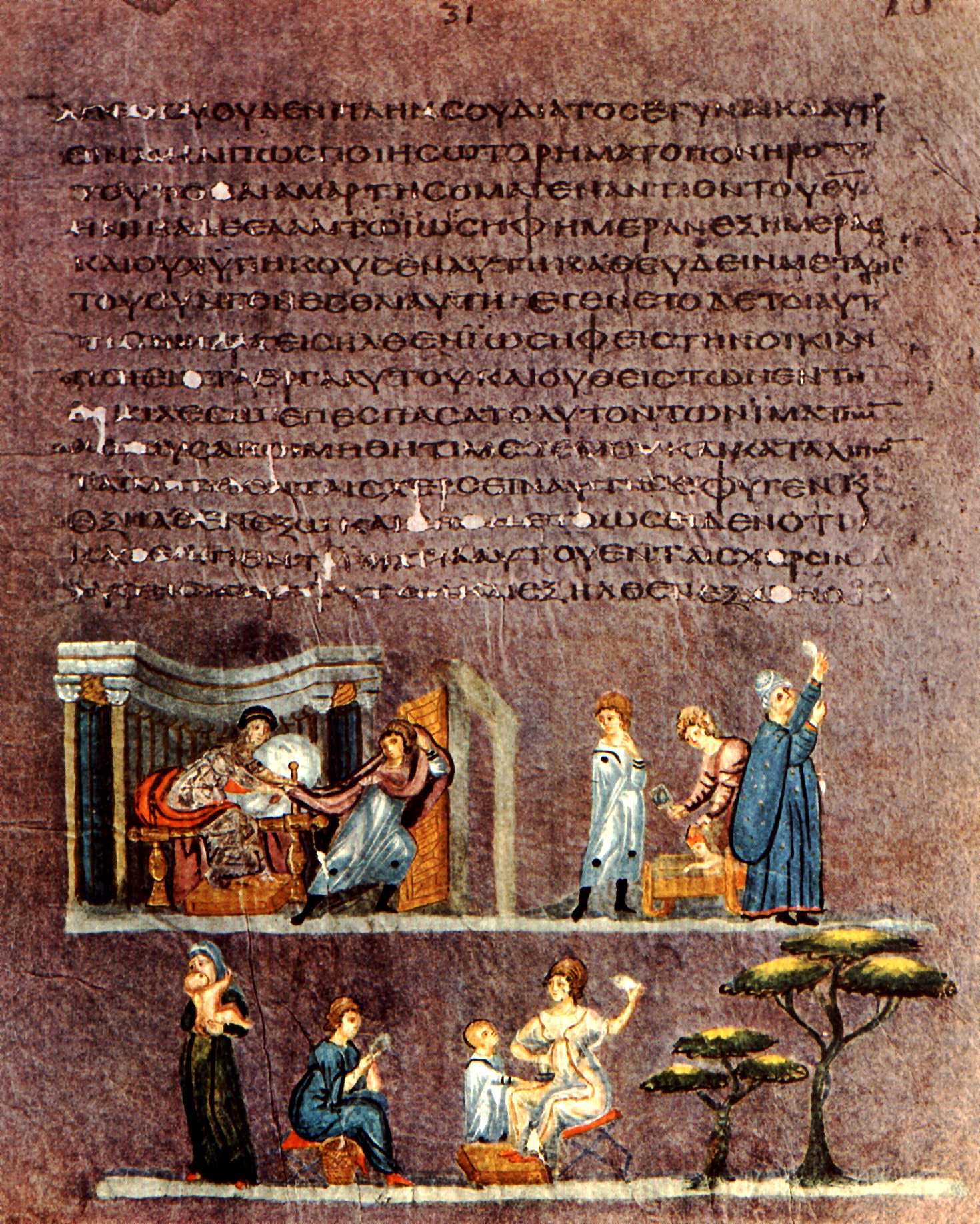
Just take a gander at some of these beauties from the early history of books, when they were codexes, barely out of their puberty papyrus phase….

This page is from the ‘Vienna Genesis’, which scholars date to mid-sixth century Syria.  It is a gorgeous  PURPLE dyed codex with silver writing.  It demonstrates how sixth century books were not merely illustrated, they were also color coded!   Purple meant that you were rich and brown meant that you had spilled beer on your book during the last round of Byzantine festivals.  This page shows the temptation of Joseph with that slut Potiphar’s wife, which landed him in prison :/  And then landed him in the position as Pharaoh’s go-to Grain Guy, which eventually led him to place a silver cup in one of his brother’s sacks (which is less weird than it sounds…).  If you don’t know the story, you should read it!  In terms of biblical narratives, it takes up thirteen chapters in the book of Genesis and sets up the conditions of the Israelites in Egypt which forms the kickass sequel to Genesis….the book of Exodus!!

But moving on in our history of awesome picture books….

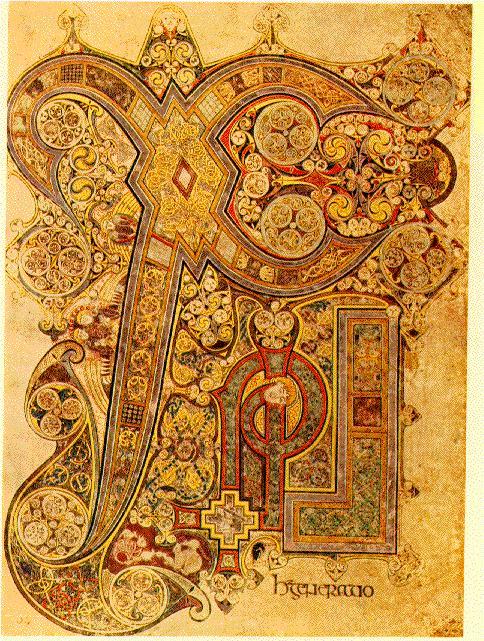
Chi Rho Page from The Book of Kells
Chi Rho Page from 'The Book of Kells'

This is the ‘Chi Rho’ page (the two Greek letters that spell the nomina sacra for ‘Christ’) of the Book of Kells which dates to roughly 800 AD (or possibly earlier).  In addition to beautiful Chi Rho pages such as this, the entire work contains other similarly adorned pages full of animorphic figures and colorful Celtic interlace designs.

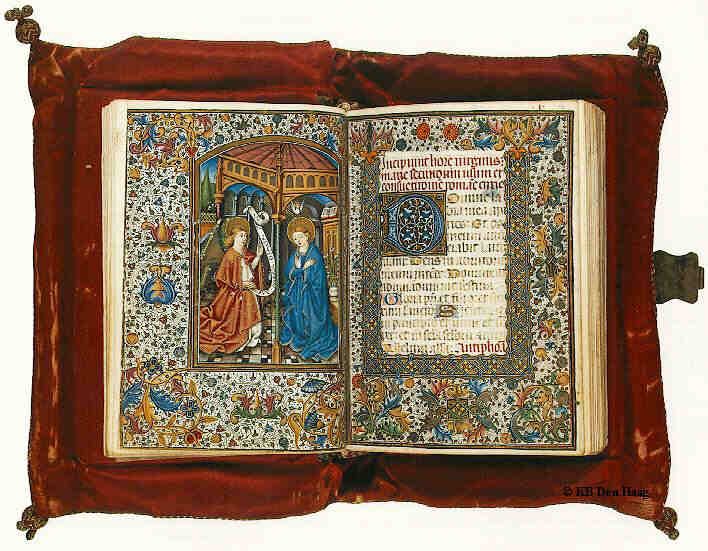
Jumping ahead six-hundred years, we stop upon a book of hours, which was a type of devotional book used by medieval Christians.  This one is from Valencia, but was most likely produced in a French workshop in the fifteenth century.

I have GOT to get me one of these!
"I have GOT to get me one of these!"

Jumping ahead three hundred years, we come upon the watercolor poetic works of William Blake, who was not merely a stellar poet and storyteller, but was also an excellent watercolor artist as well.

Poem and accompanying illustration for The Lamb from Blakes Songs of Innocence
Poem and accompanying illustration for 'The Lamb' from Blake's 'Songs of Innocence'

Yet another instance where illustration meshes with text in a beautiful way.

There are countless other instances of illustrated works throughout the history of manuscripts, print, and literature.  My charge to you (if you think you are currently creating the next great piece of literature) is to take the pictorial plunge and add illustrations!  We live in a visual culture.  And who knows?  Maybe now that we’re out of the prime age of watercolor and illuminated manuscripts, perhaps it’s time we started using vectors and programs like Photoshop to make our literature both intellectually and visually appealing again.

It’s a long way to Michigan and back.

A guitar. A ukulele. A strap on harmonica. And a piano with sticky note reminders.

Sunday night couldn’t have been planned better with 50 people sitting around a stage, a stage all to ourselves to laugh and cry and joke and sing and make mistakes.

Humans are crazy. I critique and analyze them and their thoughts for my job. But the music let me step back and listen to someone for an hour and half with no judgment.

Antje Duvekot was the happiest person to be around. In jeans she made herself and a guitar she “exploded” her wallet over I was impressed with how much she loved what she does. Sure she has the company of a GPS and knows only crowds of strangers, but sometimes that’s all you need to make a moment special. Her voice was sweet and intentioned, every note seemed emotional and every broken note reminded me of how human she was. I forget that music is meant to be imperfection.

Imperfect because the world is terrible.

What better way to cope than to make beautiful, folky music? She whispered and belted about Kerouac, hippies, commies, peyote, and her friend–a.k.a. the dreams I have of my future as I find myself (because we all have to do it) out on the road. She sang about scenes she drove by, feelings she had about war, and her unwanted agnosticism.

I’ll be honest, at first I thought about writing this column about social identities and privilege and how they project on our view of the world. That would have been a crime. For all she did was to bear her soul and her memories for me. 15 dollars is worth learning about a human in a way that I doubt I know some of my friends.

And the crazy part was that it wasn’t just me learning about her. The old man, two rows beside, me was there too. There was even a child across the stage from me! Students. Adults. Teachers. Friends. Spouses. Couples. Friends. Granted I think we all hailed from very similar situations and our whiteness could’ve been compared to the Crayola crayon labeled “milk,” but it was so refreshing to be surrounded not just by 20-somethings.

The show ended and the encore came and went. I packed up my belongings and my friend and I headed the wrong way out the door. SHE WALKED BY US. Smiled and thanked us for being there, she walked to greet the rest of the crowd and waved goodbye as we left her life to return to our own.

The Ark is a great place to get some perspective. When I fret about an impossible midterm about boring English empiricist philosophy and over a paper on gender and distance and work and waking up early and going to bed late and running out of coffee and money and food and friends and breath and forgetting pesky commas and pondering on Toni Morrison I will know that last Sunday I got to feel again. “Oh, that’s what it’s like to be a human.”

And even if I’m pushed back on the Merry Go Round, I’ll have more balance now.

http://www.youtube.com/watch?v=1dWTG6MkvUY

The Repository of Forgotten Things

In recent years, the function of the library has shifted from a repository of information to a designated workspace. Where once people conducted their research primarily by sitting down in a library and poring over books and microfilms, they now bring their work to libraries for the building and the environment and the quiet. We still utilize traditional resources from time to time, of course, but increasingly we value libraries for their updated café area or their cushy wood-paneled (and vault-ceilinged) rooms, or even just a nice table tucked away in a corner.

Part of the appeal of the library environment lies in its very identity. What makes us choose a library over the local coffee-shop, for instance? It still has a grave sort of dignity to it, however great or humble. When we say “resources” we don’t just mean the technology and the services it boasts, though those too are important. We mean the hundreds of thousands, the millions of files and tomes and volumes, organized, catalogued, searchable. Knowledge! Data! It’s not quite at one’s fingertips, but it’s all so very accessible, and, moreover, aggregated and collected. It’s an institution, an institution for the people.

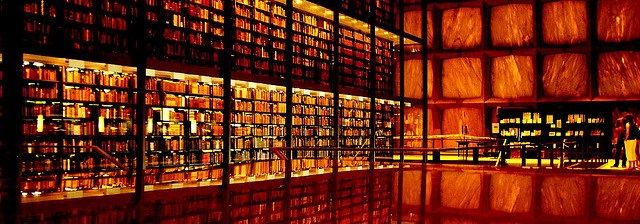
Library stacks, though, are always something different. In a significantly large library, at a significantly late hour, you can be the only one in among the stacks. Shelves and shelves and row upon endless row of books, footsteps muffled and deadened by paper and oddslot fabric and webbed binding material. When was the last time someone touched this book? Opened it, read it? How old is it? Who wrote it, and were they well-received? Are they? What do they say? What are and were the lives of these books, their authors, their subjects? I don’t tend to enjoy studying in libraries, but sometimes I like to prowl Hatcher’s stacks, looking, brushing cracked spines, wondering if that one will fall open with a gentle puff of dust, like in films.

The space created by the presence of so many books exhales a sense of possibility. It’s a museum of art and history and science, but tangible, there for the purpose of letting you smell and handle and read it. It’s yours.

A Call for Virtuous Video Games

I am not a fan of video games.

Mindlessly falling away into a realm of flashing lights and sounds of illusion is often a means to mental decay. Modern video games have become more concrete and closely parallel to society. People blast away at the avatars of others with artificial guns, peppering virtual bodies with imaginary bullets. The sights and sounds are brought to life before our eyes and the lack of abstraction takes us to a place we can perceive, without much thought, as reality. While this is often the basis for arguments against violent video games, I am not trying to debate against the content of these games, simply the premise and existence for them. At their core, they lack ingenuity. They are largely based off of war, sports, or racing, and while we typically may not  have access to the full extent of these activities in real life, the fact that these games are simply reflections of this reality does not aide in the mental development of players.

Video games need to be more intuitive, leaving more to the imagination and less to graphics. While technology becomes increasingly easier to use and manipulate, a higher creativity is required for furthering greater development. With fresh and innovative ideas, we can form technology as not only as a wondrous tool to eliminate grueling and grinding work (such as mindless data entry, etc) but a refreshing toy that teaches us how to think and learn.

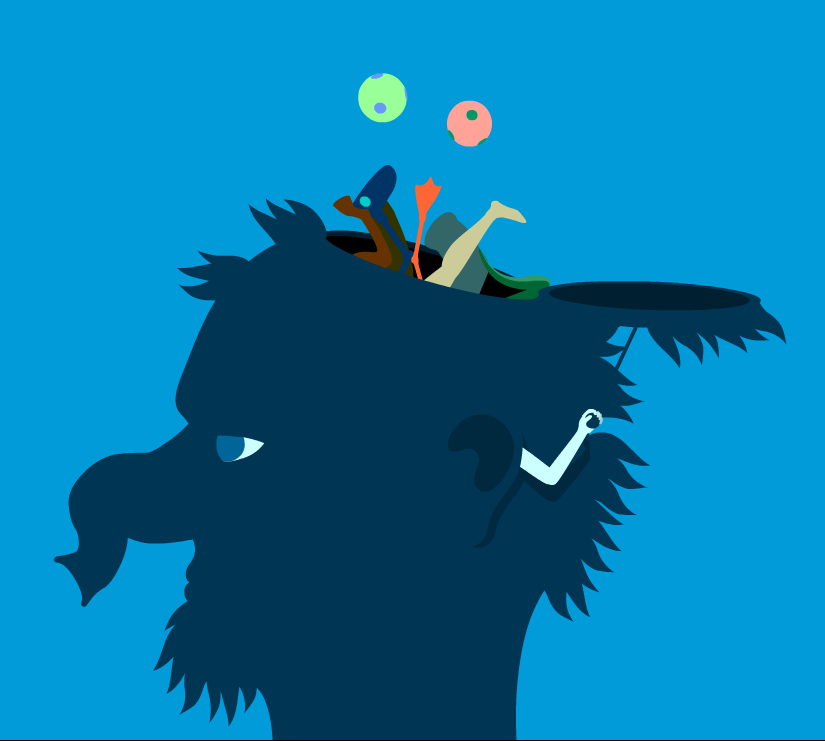
We need technology to better our minds, not help them. VectorPark.com is a beautiful example of what improved technology can create. It breaks the mold for what video games have popularly become. It defines something new and strange, something that makes us think and learn, like children, developing a greater plasticity in which we can continue to learn and figure out the unknown. There is a small niche of these games in existence and they revolve around a philosophy of thought and intuition, rather than a dexterity of control. It challenges the mind by pushing the player into a flow state. If we, as a society, can learn to embrace the unique, the strange, and the challenging, we could develop a whole new line of video games and draw in a more intellectual audience that benefits society, rather than detract from it.

So start by playing Feed The Head, both for your intellectual and visual enjoyment. This game, like any form of art, holds the potential to inspire you.