
The Goddess

I’ve always found it interesting and amazing that the portraits of the (debatably most) important Hindu goddess, Durga, differed region to region. Before you roll your eyes, frown from incomprehension, or click at some other link, let me explain myself.

India is a wee bit complicated. The country itself doesn’t have one unified identity; there are many regions that have their own languages, ways of dressing, cuisines, ideologies, and traditions. To bring that into perspective, imagine going to Indiana, right downstairs, and everyone speaks a radically different language, the art and architecture look completely different from Michigan’s, the men and women wear togas rather than jeans, and you can’t recognize anything that they’re eating.

Yep.

So, in a sense, the word “Indian” doesn’t really mean anything in terms of summarizing a culture because… well, an “Indian” culture doesn’t exist.

Which makes the art throughout the country so interesting. Like so many other cultures around the world, art and religion are inextricably linked. Hinduism especially relies on art because it places such high importance in the visual aspect of religion. Stories of famous mythologies are painted on the streets and temples and images of gods and goddesses are omnipresent. I mean everywhere. Bumper stickers, posters on restaurant doors, statues at business entrances and every empty crook and cranny on the streets, walls in houses. Literally everywhere.

My dad’s job had us traveling throughout India so I couldn’t help but notice how radically different the images around me were, despite depicting the same figures. Durga is particularly interesting. She’s an Indian goddess in some sense because many Muslims and tribal people also worship some form of her, not just Hindus. She is hailed as the Supreme Goddess and the origin of all energy and life in the universe, a timeless maternal spirit that pervades everything, transcends time and religion, and ensures that the world remains in balance. Think Eywa, from the movie ‘Avatar.’

Here’s a statue of Durga from my home province, Andhra Pradesh.

A Priestess in Tirupati, next to a Painting of Durga
A Priestess in Tirupati, Next to a Painting of Durga

Note how colorful and vivid it is. Also, note what the Goddess is wearing. A fairly simple sari. The people of Andhra are traditionally farmers, very rural people. Though we’re known for having a beautiful and poetic language, we’re simple people who toiled away in the lush lands of southern India. Hence, the folksy, bright colors and fairly simply draped sari. Juxtapose this with the sophisticated refinery that is the North.

The Goddess Durga, Kicking Ass

Northern India has seen far more attacks and conquests, from the Muslim Mughals to the Christian British, and has been more directly placed under their rule than southern India. Thus, the depictions of the Goddess tend to be more anglicized and highly influenced by what is considered beautiful by that region of the country. Her body is generally made of white marble to reflect the more appealing (to them) aesthetic of having lighter skin. Her garlands are made of roses, as opposed to native flowers such as the hibiscus or the marigold flowers. Her jewelry is also more intricate and contains many gemstones and pearls whereas in southern depictions, She wears extremely ornately designed gold due to relative abundance of gold and lack of gemstones in the south.

The Bengali Durga
The Bengali Durga

Depictions of Durga from the state of Bengal are radically different from all other regions, especially in terms of Her distinct facial structure. Also, while northern India generally depicts Durga as marble white and southern India depicts Her with a more flesh-colored tone, Bengalis depict Her with yellow skin. I mean the yellowest yellow of all the yellows you’ve ever seen. Her bindi (the marking on her forehead) is also more intricate than the standard red dot and her jewelry is out of this world.

The Yellowness of Durga

Durga is the Bengal’s most loved deity and Her festivals are celebrated with more pomp than any other.

A depiction of Durga from Tamil Nadu, the southernmost state of India:

Tamil Durga, Also Kicking Ass
Tamil Durga on a Random Street in Tamil Nadu, Also Kicking Ass

Her skin color is a lot darker. It is also common to find Durga statues made of black marble in these parts of India because they more accurately depict the darker pigmentation of southern Indians. Also, Her bindi is completely different (three horizontal lines and a red dot in the middle) to reflect a more popular strand of Hinduism in Tamil Nadu. The usage of animals more prevalent in this region, such as buffalo, is common in imagery associated with Her.

The following depiction is from Rajasthan, a state in the north that perhaps had the greatest association with the Muslim Mughals. She has on a blouse and a long skirt and drapes Her sari over her shoulders rather than tying it around her body, like the women of Rajasthan. The way She’s painted, with Her head facing the side but Her body facing the viewer, is a direct influence of the Mughals, who also painted their figures this way.
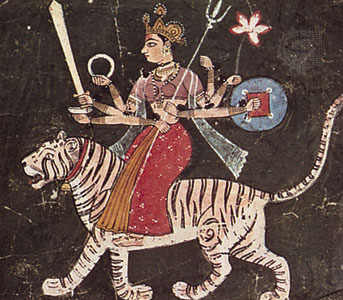
A Rajasthani Painting of Durga

In the coastal Orissa, where peacocks are especially used as a sign of beauty and majesty, silver is abundant, and jewelry is designed after the beautiful conches and seashells found along the beaches.

Durga from Orissa
Durga from Orissa

In Assam and Tripura:

Common Depictions in Assam and Tripura

Depictions of the Goddess are endless. There are paintings and statues of Her naked, clothed, blue, green, black, orange, with bindis of all shapes and sizes, with Oriental features, with blue eyes, etc, etc, etc. But this post is getting way too long and I’ve realized now that none of these pictures do justice to Her or to the beautiful statues and paintings they’re portraying.
“all oppression is connected, you dick!”

She screams at my face and my heart beats faster, my hands get sweaty, I can’t breathe, I can’t think, all I want to do is cry and cheer and love and “kill mother-fuckers who stay stupid shit to me.”
She says everything I have ever felt. The way she growls her pronounced “r’s” and “ow’s” and kills with her “c’s” and “k’s” hit me like capitalism hits me every day. Like homophobia hits me like the garbage from car windows. This time, however, it isn’t trash or consumerism or money but it is solidarity. Her fist is up in the air and her words light the flames to everything I have ever wanted to burn: society and the faux-leftist agenda of assimilation to create people as people as humans and not as queer or black or working-class or woman or undocumented or disabled or. . . the idea that our humanity brings us together rather than our different lived experiences.

“the new fangled fallacies / of sexual and racial freedom for all / these under-informed / self-congratulating / pseudo-intellectual utterances / reflect how apolitical the left has become”

6pm. I step into the room as a role call of identity rings out and my ears begin to bleed. I hear calls for [marriage] equality and my ring finger shrivels away to fall off by my aching feet. I feel awkward yet alive in a space that I worked to build 2 years ago, but today it is another’s. I inch closer to the man in all leather and rubber and platform boots and red hair, soaking in the past quicker than the room realizes that MBLGTACC 2013 is here. Right now.

We sit together in the Lansing Center amidst our intersex, transgender, lesbian, bisexual, gay, gender-non-conforming [etc.] identities. This chance comes once a year and it is in this moment when I realize that I better pay attention. Pay attention to what is said what I agree with what I actively hate what I love. Pay attention to the space and the community and the environment because come 48 hours from now I will be in a different society. Breath it all in till my lungs fail.

“the time to act is now! / Now! while there are still ways we can fight / Now! because the rights we have are still so very few / Now! because it is the right thing to do / Now! before you open the door to find / they have finally come / for you”

The ending to her poem scares me. My thoughts are radical, my thoughts aren’t normal, my thoughts will get me into trouble. Future tense. I want to run out of the room and fight for everything I believe in, but I stay seated. I want to protest and burn and educate and learn and be checked, but I hang out with friends and dance at a club. I want to scream at the top of my lungs–so instead I’ll write at the top of my lungs.

Good poetry is aesthetic–sure. Good poetry performs well–not always. Good poetry gets you out of your seat, makes you throw a book or strip naked, and makes you come alive–yes.

Good poetry is truth.

Staceyann Chin is my poet of choice. She comes on stage from flying with her baby and lays it all out. She acts along with her poetry, she performs her emotions, and she screams as if she is dying. Never in my life have I been so affectively affected.

http://www.youtube.com/watch?v=1ofsVwH4O_k

The Making of Meaning

For most of us, museums are givens. They house great works of art, artifacts from all periods of history, things that are somehow important, culturally significant. Yet they embody in them a sort of unquestioned authority, something that manages to shape our perceptions of the things they display without our ever really being aware of its even happening.

When objects are removed from their original contexts, they are uprooted, unanchored, available for meaning and significance and narratives to be redefined, recast. Every setting has the power to describe its object. A scattering of pots on the floor is not accorded the same importance as a single pot sitting by itself on a plinth. Are things displayed in a corner, along the wall, in the center of the room? Are they lit (or not lit) in any particular fashion? If all the displays are spaced very far apart, each individual item gains a sort of weight. It’s like those dishes in high-end establishments where you get a thumb-sized filet of something (albeit an aesthetically pleasing something) that covers ten percent of the plate’s surface area. We assume it’s nice because it’s been marked out as something unique, important.

These are all rather ambiguous frames, but they do just the same work as the literal picture frame, which tells us what to pay attention to and what to pass over. Even if the wall has designs on it, even if the painting is about as interesting as the wall, you look at the painting, not the wall. Placards and other accompanying text oddslot function similarly. The Plexiglas box is a utilitarian object (a bench), not part of the exhibit (some sort of rumination on the human condition) because it has not been marked. It does not say, look at me, contemplate me. We refrain from treating it poorly out of consideration for other people’s property, not because it has gained some sacred status.

And the text itself, naturally, has an entirely different power in its ability to shape how we contemplate things in museums. Even the fact that an object is in a museum, as opposed to someone’s private collection (a Bronze Age artifact), or on the street (any sort of art— what even is or isn’t art?), says something about the worth it is given. We, the general public, on the whole have little specialized knowledge, little background on the things museums display. We look to museums to be authorities on their subjects. Indeed, the great majority of the time, they certainly are. But this relationship, the one between the things and the museums and us, is often invisible. We don’t see it, and we certainly don’t think about it.

Valentine’s Prank

So, I’m sure by now almost everyone on campus has heard about the student roaming through Angell Hall in fatigues, a gas mask and empty ammunition pack. Alarmed by this student, the police were called in, and although any evidence of foul play was dismissed, the student claiming to be playing a joke, I can’t help but feel a terrible sense of disarm at what occurred. The student may have claimed ot be playing a joke, but the implications of his action were monumentally more significant than he was aware of, clearly. Did he intend for the police to be involved, for the entire campus to shudder in fear? Maybe, maybe not.

The student claims that his joke stems from a desire to play against Valentine’s Day, the hallmark holiday that invariably leaves singles feeling all the more alone and those in relationships an excuse to buy presents and lavish in one another’s presence. Either way, the holiday has developed into an one filled with anxiety, whether one is in a relationship or not. But so much so that a student felt the need to act out in this fashion? I’m honestly shocked. With the degree of violence happening around the nation in the last decade, a joke like this is inarguably not funny.

All this makes me wonder, however, whether the real culprit in this prank is Valentine’s Day itself. Does the holiday put such pressure on all that these types of actions are merely par for the course? It’s truly hard for me to believe, but if such is the case, does that mean we, as Americans, need to rethink the emphasis placed on the holiday? Invariably, people without significant others are going to feel lonely today, and feel that they are alone in being alone (if that makes any sense?) The amount of oddslot drinking or depression induced acts on this day must be higher than on average day (as today’s incident seems to show). So, what’s the answer? Take away the holiday or possibly revise and reframe the way Americans view the holiday and the emphasis placed on it?

For more info: http://www.michigandaily.com/news/police-enter-angell-hall-after-reports-suspicious-behavior

Hand Socks & String Monkeys

As children, most of us were given toys which we were encouraged to manipulate through our imaginations. Whether we played with dolls or action figures, we took on the role of orchestrating their actions and encounters with one another. We projected voices and personalities, body language, thoughts, and relationships upon these inanimate objects, which instilled life into them. As time progressed and we matured, we often abandoned that sense of imagination through the cycle of socialization, as we were influenced by society to believe that a hold in reality is more important than a life absorbed in illusory fantasy. However, as civilized members of society, we are advocates for storytelling and the spread of life experiences. As time and technology progresses, those mediums of storytelling often change and transform, but the essence remains. While it began orally, storytelling has many of its roots in theatre and performance art. While as a civilization we prefer stories to be rooted in a realm of realism, the conventions by which we share these stories requires an effort of the imagination. A culmination of ideas and thoughts must be projected through concrete objects–products of reality–to display a more abstract concept of the world via fantastical insights. These imagined thoughts can best be displayed through a medium similar to our childhood toys–via object manipulation. As opposed to simply using objects as tools to do concrete activities, we can throw emotions and human qualities upon these objects to make them relatable to us. It brings them to life.

An example of this is best demonstrated through puppets and marionettes. Like oversized and more intricate action figures, these creations can be manipulated to tell stories of us, as humans. Similar to theatrical performances with actors and props, the art of puppetry relies on the imagination of the viewer and the exact manipulation of the performer. While the digital medium of film can incorporate more precise details of both acting and effects–to inspire the consumer of the media in a more prescribed fashion–live action performance captures a new state of magic. This real world effect inspires more fantastical thought as the performers must be adaptive and clever on their feet, making a more personalized performance, as no iteration of an act will be exactly the same. The same goes for manipulated objects, marionettes and puppets. Marionettes are controlled from above, with strings, while puppets are manipulated from within, by the hands. Taking this into consideration, a puppet often interacts directly with the performer, be it sitting in his lap and conversing or acting on a stage, with the manipulator hidden below. Conversely, marionettes are indirectly influenced by the manipulator, as the strings controlling the movements are tugged from above by an unseen person. Not only does the skill of controlling puppets involve adept motor skills and ventriloquism, but it encompasses the creation of compelling stories and the ability to create inspirational and well-constructed manipulatable objects that reflect us, as humans.

Although it may not be the most popular form of artistic expression, the world of hand socks and string monkeys is a beautiful medium of sharing stories and should never be forgotten. One effort to support this niche medium is celebrated here, in Ann Arbor. Be pro-puppet and attend FestiFools this summer.

Manifesto on the Rain: Part I Impermanence

I’m articulating these things because I don’t know if they are entirely clear to me, yet. I hope my personal exploration will be, at the very least, interesting, and at the very best, encouraging. I gladly invite anyone to disagree with me, call me out on poor ideas (or writing), or stare confused.

A while ago, I found some graffiti in a bathroom stall that read “Art is Nothing Permanent.” A few weeks later, the graffiti had reproduced and included such gems as “Art is Permanent Nothing,” “Nothing is Permanent Art,” “Is Art Nothing Permanent?” “Nothing is Permanent Art” and, in a dangerous act of defiance and self-righteousness, “Get your heads out of your asses and add something beautiful to the world!” There is a lot to say about this, it was rather a remarkable find. And in a beautifully cosmic moment, all of that conversation has now been painted over, with only my fond memories and a few pictures I took on my cell phone as proof of it’s existence.

But first I think I’ll address that last bit of writing on the wall – a call to add beauty to the world. While I can’t really argue with the sentiment of that gentle bathroom-goer, I am going to defend the courageous philosophers willing to engaging in a discourse of dangerous thoughts – the thoughts about why art is the way it is and what is permanent about it.

While I do think it’s good to add beautiful things to the world, I’d hate for anyone to do it without thinking first. (Beauty is not why I make art, but if beauty is why you make art, make sure you are thinking about what you are doing.) Art is dangerous and you need to have some understanding of it and your relation to it before you go off and create something as remarkable and potentially destructive as beauty.

But the nonsensical conversation on permanence in art really did get me thinking. It poses an interesting solution to a question I’ve asked myself for a long time – why am I making work that is made for performance? (Originally this was explicitly musical performance, but as of late has expanded to include theatre, performance art and all its variances).

Recorded media makes a lot more sense to create than performance, when you think about it. It can be played back and replicated infinitely – every listen is another authentic and exact experience of the art. Recorded music, at least, has become so ubiquitous that live shows are praised for sounding “just like the record.” (Which is an interesting predicament, because the record was intended to sound like live performance?) Recorded media is the medium by which our generation engages with music, recorded media is the way our generation engages with theatricality, recorded media is portable and hip and new and personal and ever-expanding and something that should appeal to me a lot more than what it does.

So why doesn’t it appeal to me? I think the bathroom graffiti gets close to an answer. The experience of “live” art (whether this means a live performance or the experience of standing in front of a “live” painting) is inherently an impermanent one – an experience that will end. And that makes the moment all the more special. In time based-mediums (like music, performance, theatre, etc…) the element of impermanence is compounded by the reality that time is passing and the moment that existed 3 seconds ago will never be again. It is a constant race of mortality and the passing of time that makes the experience unique and uniquely engaging (no two performance will ever be the same to any of the performers and no two performances will ever be the same to the audience members, even if the material is the same. There are variances in personal, emotional, and temporal states that create literally infinite possibilities for experiencing art). You can stretch this into an idea about mortality – that the impermanence of art reminds us of our own impermanence and thus creates a human connection with something that is not human – but I don’t know how comfortable I am making that bold of a leap. But that truth of impermanence is brutal and fascinating, that truth that art doesn’t exist anymore once we stop engaging with it.

I think this is why digital and recorded mediums don’t interest me as much. They exist in duplicate, they exist in ones and zeros and magnetic forms that I can’t see and I can’t see deteriorate in front of me. This is why (I think) the live art experience (whether it be music, visual art, poetry, etc) is much more engaging. I might change my mind in the future. I have a great love of pop music (a medium which exists very strongly in a recorded form) and want to produce a pop album someday.

This all being said, I must note that recorded media is, in fact, just as impermanent as live performance. The difference is perhaps decay rate. Live experience evaporates before your eyes and recorded media takes much longer before it is consumed by the ether.

But I think that right now my heart lies with performance, with impermanent objects and the constant reminder that the event you are experiencing is entirely unique and undefinable. I think that this is an element of my work that is vital: awareness of its own impermanence.

Which then leads me back to the graffiti on the bathroom stall. Is nothing permanent art? Is the idea of nothing permanent art? Is permanent nothing? Is art simply the awareness of impermanence?

More questions.