Food Art

I love cooking. And baking. And food.

You may scoff and say “Who doesn’t?” but you don’t understand. I LOVE, LOVE, LOVE food. My father always says that other people eat to live but I live to eat.

The roughest part of living in dorms was always the food aspect. I missed cooking like I would miss a limb and I missed having delicious food. In high school, as soon as I came home from class, I spent a good three hours designing a four-  to five-course meal and then making it and then the glorious part: eating it.

While I have adapted to eating godawful shit dining hall food, I still miss food. Real food. That I made with my own hands. While listening to Edith Piaf. It’s especially rough after breaks, where I go home for the few days off class and cook again. I went home MLK weekend and haven’t fully adjusted back to dorm life. And the pictures and taste of the chocolate raspberry tart I made still haunt and taunt me.

Thus, in my despair and separation from sweet treats and savory wonders, I have turned to porn. Food porn, that is. And found a whole new world of art.

Food art is especially emphasized in Japanese culture, where it is commonly believed that people eat with their eyes first. Thus, food has an extremely visual aspect and a chef must not only train to prepare delicious food but also learn how to present it in an extremely aesthetically pleasing way. Beautiful geometry, symmetry, and variation in color are especially utilized.

Sushi and vegetables
Sushi and various meats and vegetables

And everyone who wastes their days away on Reddit and Tumblr knows bento art aka lunch box art. Bento boxes, Japanese lunch boxes, are known for having different compartments and are the inspiration for some crazy art.

Artistic fruit bowls are also becoming an extremely popular way to add pop to a party due to their relative affordability and DIY potential.

For the hardcore:
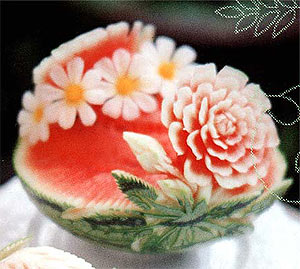
How I want to learn how to do that one day… Instead of having an ice sculpture at my dream classy cocktail party, I’ll just carve a bunch of fruits and display that.

Edible Arrangements have nothing on this.

Yes, the following is a real thing, not Photoshopped.
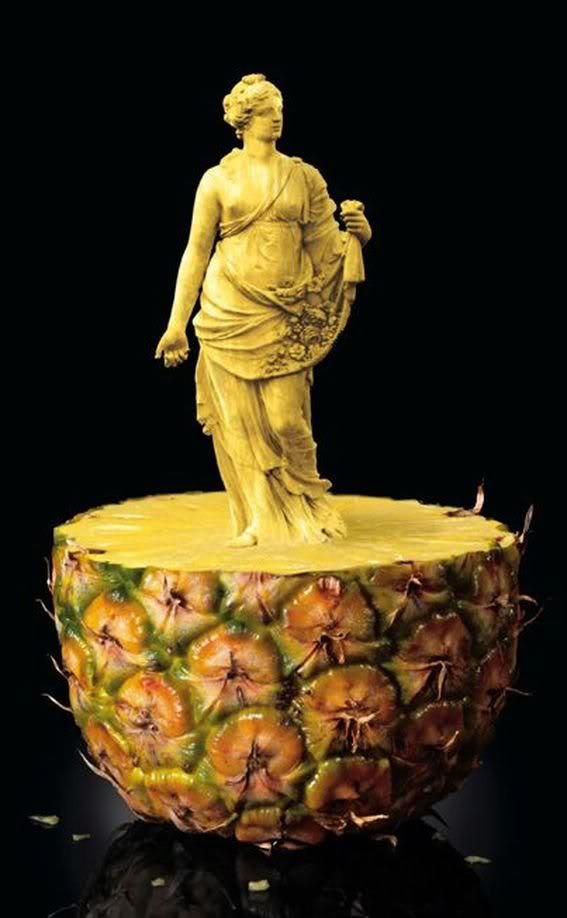
Microsculpting is also a thing.

Hungry yet?

Fruits, vegetables, nuts and other gifts of Mother Nature are already ridiculously beautiful but this is just a whole another level.

Sorry for the lazy post. I just wanted an excuse to search for more food.
Endless Rodin

This past weekend I visited a friend at Stanford University and had the pleasure of going to the Cantor Arts Center, the University’s museum. The museum has an enormous collection of Rodin sculptures, and although I have seen many Rodin in passing throughout my life, I have never had the opportunity to view endless (as their collection felt) Rodins in the span of merely an hour. The museum had over three rooms of Rodin as well as an outside sculpture garden of his sculptures. Of all the works, however, what was the most stunning and awe inducing was The Thinker of 1881, the enormous 182 x 77 x 142 cm bronze sculpture of a man sitting, his head in his hands, ruminating over his thoughts. Rodin’s rendering of the human body, I believe, is unique in for his capability of capturing the human form, movement and ambiance is utterly and entirely reminisce of the actual human being.

Amazed as I was by Stanford’s Rodin collection, I decided that, upon arriving back in Ann Arbor, my first stop would be to spend some time in UMMA. Somehow, in all my countless ventures at our University’s museum, I missed what I believe to be a true highlight of our entire museum’s collection – the sequential statues by Rodin titled “Dance Movement”. Although these Rodin sculptures are far smaller in size than the massive sculptures featured at Stanford, being in the presence of Rodin in Ann Arbor was yet another reminder of how often I find myself taking for granted the incredible works of art that are present at UMMA. The museum’s truly exhaustive collection is one that should be both highlighted and cherished.

Degenerate Frame: a performance review.

Date: 2 February

Time: 18:82 (for those uncultured [re: non-”pretentious”] Americans–4:22pm)

Place: Diag

The bells oddly tolled a few minutes late, marking the time the artist arrived to when he started as a waiting period. He stood with brush in hand, close enough to the canvas to look like he was touching it (but there is always room for Jesus), and stood completely still. Dead still.

The frame was 3×3 and white—white like the frail, thin hands of the woman who stood a distance aways, flaming red hair. 3×3 like her mouth as it made a “C” to read the first word, “Lily…” She started from the top of the steps of the grad library and descended at a rate of one step per 3 minutes. After she had reached and tapped the bottom step, she repeated her motion backwards up to the top steps and topped the topmost step, and then she repeated her motion forwards down the steps and tipped the bottom step…

The man was too aware of her movement and each time a tap, top, or tip rang through his ear he jolted the brush in a circular fashion that obscured the staircase from being a staircase. In the end it resembled a face, a foetus, a flower, but really the staircase turned inwards. It was filled with color: light green, dark green, medium green. He was dressed in black and smoked a dark-chocolate brown cigar (rebel) that was shaped all to phallically for the passersby dressed in head-to-toe white.

Her hands quivered. The snow was falling over the scene and gently smudged the green into green into green. He w(h)ip(p)ed the mistakes out of the canvas and the wooden frame began to morph. But he couldn’t go too crazy. He stepped back and stared through it as if it were a window looking out onto the scene. As if he were paces behind the woman’s frame, safely inside the stacks of white pages, staring as if the blanket was coming down all too fast against his feet, and before long his eyes would begin to close over the white landscape of his eyes.

But they hadn’t any time and the chimes struck again. Her mouth folded into a “C” as she whispered–this time, “She was fast asleep.”

He quickly moved from the center of the “M” and grabbed, from behind a garbage can full of rats, gray paint. A gray that would paint the London sky on a rainy afternoon, a grey that would splash the sidewalks and sewers, the grey of cityscapes, and the gray of a fog that won’t quite lift. He took the gallon and dumped it onto the art. No canvas, no frame stood in its way and once the entire gallon had dissolved onto the canvas he got a spray bottle full of vodka. He sprayed and shot and shot and sprayed and now that the two were just buzzed enough he picked up the frame and brought it near to her. It was her 13th time on the 1st step. She picked up her foot and sent it crashing through the grey/gray/green stair-fa-foet-case.

“His own identity” as the artist “was fading out into a grey” canvas and all he knew to do was to rip the frame from itself. He could not have done it soon enough because as she read aloud the last word, the whole scene became “dead.”

These events I find most odd, peculiar. I can’t help but laugh and ask for forgiveness when something like this happens close to me. Guilty by association. I felt that it was…different…and some would even say…but I’m not them and I’m not to say. It is on these afternoons at 19:41 where I can only think that this was a “portrait” told by an artist, full of sound and fury, signifying nothing.

The bell chimed.

Beasts of the Southern Wild OST

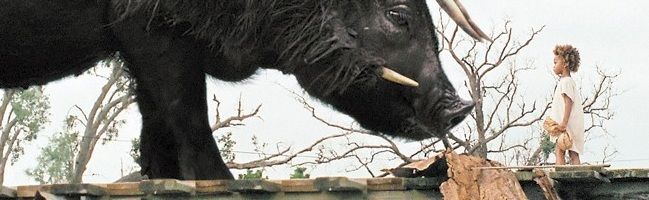
Beasts of the Southern Wild (2012) boasts a colorful and poignant soundtrack written by composer Dan Romer and the film’s director Benh Zeitlin. Its score is rooted firmly in a sense of place and a sense of indefatigable spirit, its identity very much dependent on the identities of the setting and of the characters themselves. We hear the tension and the determination and the release as the young heroine fights to save her bayou community in the face of impending disaster.

The sounds are wonderful— folk elements have been blended with more traditional orchestral ones. We hear banjo and accordion, sober piano and the bright notes of brass instruments and perhaps a glockenspiel, and under all that what seems like a full oddslot string section supporting the entire thing. “We wanted the score to have an indigenous texture, but also have kick-you-in-the-face energy that modern pop music is so good at,” said Zeitlin. “To the rest of the world, it’s just a Cajun band, but in her [the protagonist’s] head it’s reharmonized and orchestrated.”

And that’s just it, isn’t it? Even as the film takes on the world through the perspective of the impossibly young protagonist, so does the music. “‘She sees herself living these glorious moments,’” said the composer, moments that a child scores for his or her own world, to accompany a life in which one is always the lead character.

The music is inexplicably satisfying, full-bodied in some places, simple and straightforward in others. But running all through the score is a forward-moving energy, lungfuls in and out, clear and wholesome, a sort of jubilance at life, go, go go.

Until Flash embedding functionality is restored, listen here.

Because I’m Purple //Alt-Lit Examined LOL

America is a left brained society. It focuses on routine and structure and analytical/logical thought processes. It involves order and consistency and is most efficient for achieving preset goals. As a result, our education system suffers this disease. We draw at a perpetual sixth grade level because we were no longer encouraged to be expressive once we ‘matured.’ Reading level and math skills take priority because they’re what’s important IRL. That’s kinda stupid. Just like all those stupid kids that write poetry and draw pictures and do theater and make movies. Those kids aren’t smart because they can’t spell hippopottamos (hippopotamus) right or understand derivatives. They get scores in the 20s on the ACT because they can’t fill in the right ovals. Gosh.

I think Alt-Lit is sort of a backlash at left-brained upbringing. Poetry, at its core, doesn’t ‘make sense’ to left-brainers because it isn’t required to have form or structure and may not follow grammatical norms. Like abstract paintings, poetry can be a mystery to its readers. Poetry is flexible and adaptable to the visions of the artist, which is the true nature of art, and since so much of the world has fallen into the realm of the internet, a new breed of poetry arises. It’s loosely called Alt-Lit, with a lot of emphasis being placed on internet interactions. A reputable–if you will–blog about Alt-Lit, Internet Poetry, describes this thing as…

posts “screenshots of poetry being distributed with guerilla tactics on the internet”: poetry as Wikipedia vandalism, tweets, blog comments, etc (read the original doctrine).

Internet Poetry now publishes with a broader idea of what “internet poetry” can be, and is open to the many forms poetry can take online and community it can build.

Among this new genre of poetry, a specific artist has inspired me in a very peculiar fashion to document my life, even at its most mundane. Because I’m Purple is a collection of works that spans random ideas, longings, common daily occurrences, and anything else the creator finds particularly worthy. The inclusion of texts, emails, instant messages, and various other basic but somehow deeper thoughts, are reflected through the art. What captures one’s life in 1st world society more closely than this?

While we munch away at mass-produced synthetic substances we call food, we synthetically interact with our friends and the world via the Internet. Today is a time of disassociation and plastic interaction. Our lives become separated by this invisible digital wall that we can throw our emotions, unguarded, into and cause all sort of repercussions without ever seeing them.

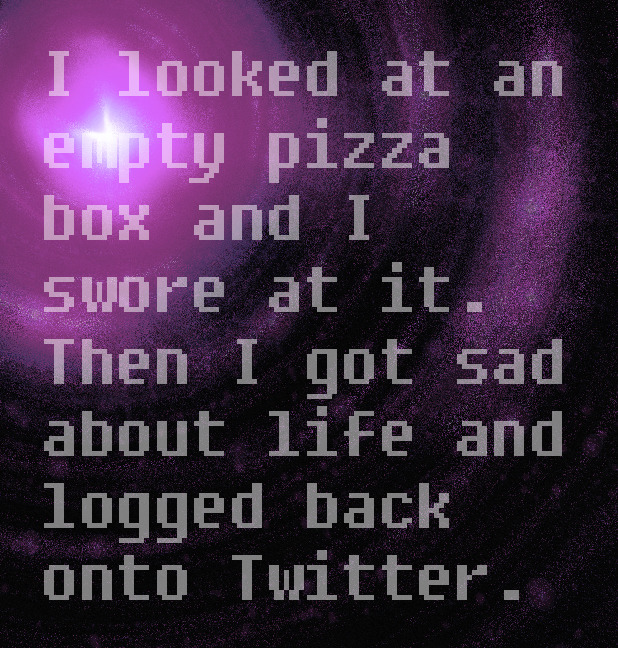
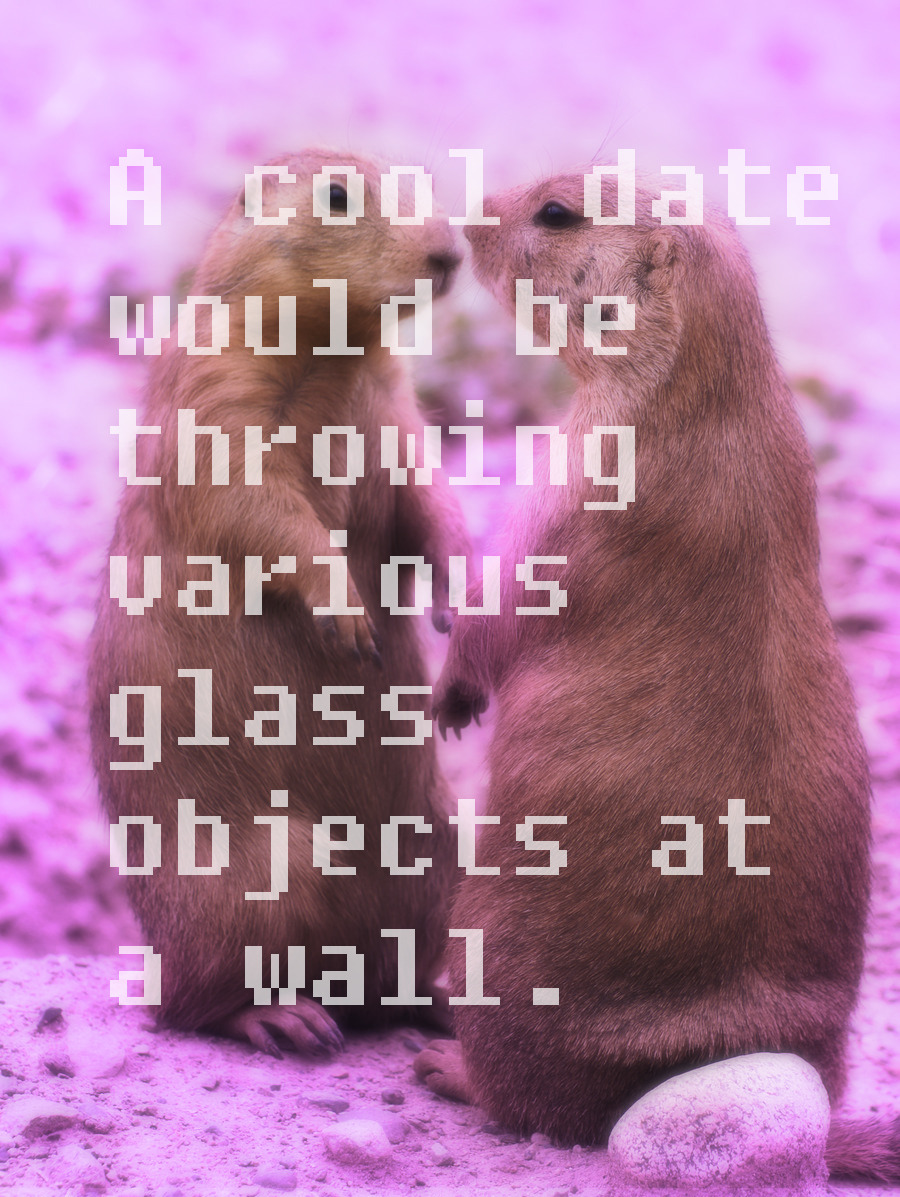
Texting conversations can kill relationships as the blunt unspoken words instantly traded back-and-forth can escalate emotions in false directions of intentions. Love can exist via a phone and this is strangely alienating. Because I’m Purple does a spectacular job of revealing this. By mockingly prodding at the false romanticism created via instant-messaging, a sense of disbanded heartache gets conveyed to the readers of the poem. Image-macros of prairie dogs take on the background for a perverse thought or desire, making that thought both a byproduct and machination of the interaction we have with the Internet. It is almost a strange love-affair where we are mental addicts to an illustrious drug. One piece that is particularly interesting pokes at this strange love-affair by inserting a new medium of transaction.
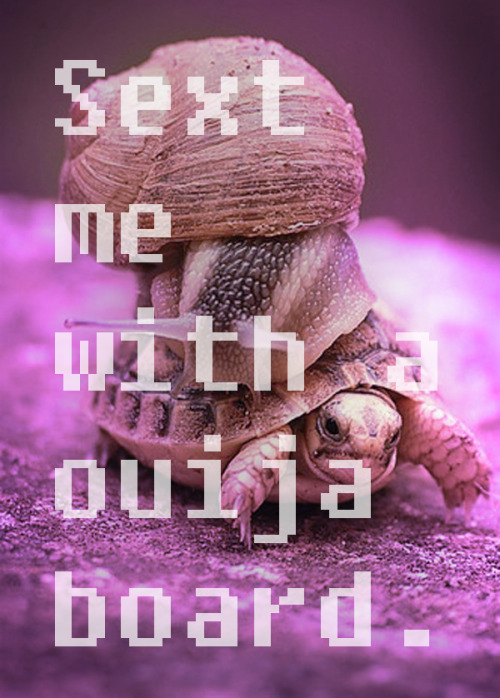
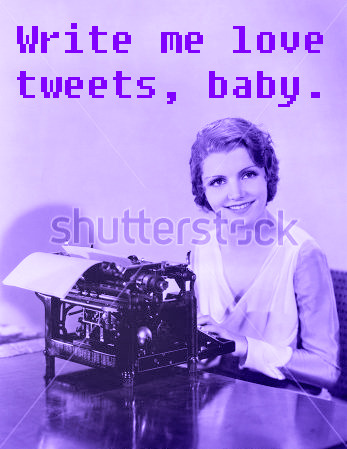
Like the purple hues taken on by most of these image poems, the melancholy state of these pieces reflect not only a longing for more classic and human connection, but a mocking tone of hopelessness toward society. Rather than become intimate in physicality, they poke at a state of lost romance/aesthetic appeal. Unlike most Alt-Lit, however, Because I’m Purple does a surprisingly good job of making Internet graffiti and uncoordinated image-mash-ups beautiful. They fully embrace the right brain and document our current state as a human race. Trying to understand Alt-Lit and making sense out of its purposeful confusion is against its very nature. It is something that rubs society against the natural grain, sometimes purposefully unappealing. To examine it as ‘art’ is almost ridiculous. As any Alt-Lit fan/creator would say after an attempt of examining Alt-Lit…LOL. Rather than embrace society and try to right its wrongs, Alt-Lit decides to laugh at the burning world.

Alt-Lit is probably the most reputable documentation of modern times.

All images are shared from BecauseImPurple.Tumblr.com

In response to the obituary published on January 22nd, 2013 12:06pm

I do believe that we have stumbled upon a corpse.

Poetry is dead.

We are the damned now.

What is there left to say? But

poetry has been dead since the first words were written. We’ve been defiling the poor broken body ever since.

As artists, I think it’s important for us to believe in a microcosm. We need to believe that it is not one bang that makes the world end, but instead merely a whisper. An avalanche being born of straw and camels. That is, we are poets merely because we believe that our medium is loud, but not just loud-louder, louder than ever could be imagined. We believe that all power is derived from the written word and that power is the microcosm of individual lives. That the power of the word is derived from use between disparate individuals and communication between them. What a wonder that anyone ever understands anything anyone says in the first place.

I went to see Angela Davis speak on MLK day. Afterward I was speaking to my best-buddy and awesome creative person, Nola, and her breath told me how antsy she was. How can I go back to doing laundry now that we have heard this woman speak, she told me, how can we keep going having realized how wrong the world is and how much work needs to be done. It’s an impossible question, but it stares like the face of clock across the room and clicks every second. It’s a question that I have to face and we all have to face. Is the art that Nola and I make actually changing anything? Are we screaming in the forest with no one to hear us? Do we actually make sounds?

It’s a terrible predicament. A socially conscious person turns to art as a way of making change but doubts the ability of art to be socially conscious. Or, at the very least, socially relevant. Which brings us to our recently deceased poetry. Alexandra Petri says that “it used to be that if you were young and you wanted to Change Things with your Words, you darted off and wrote poetry somewhere. You got together with friends at cafes and you wrote verses and talked revolution. Now that is the last thing you do.”

I beg her to look closer at those cafes:

I believe that our laundry needs to be done. Our laundry needs to be done because the poems need to be written. And the poems need to be written because they are poems and to hell if they are read or not. Poetry is dead. But we are not. And I can’t think of any better life to live than one that screams violently and perversely loud and does it through any means necessary. There needs to be someone screaming in the world. And that might as well be me. And it might as well be through poetry because it screams loud enough for me in the microcosm.

I believe in the microcosm. I think that that’s enough. If I’m lucky, someone else might scream along with me. Maybe we scream at the same isolated corner of the forest. But maybe someone oddslot else hears and they can do the laundry for someone else and suddenly we are a lot closer to there being no more laundry to do for anyone in the world. Prisons will be converted into mass laundry facilities and we will all bring our clothes to be washed there and we will all scream. Or some of us will. I don’t care if poetry is dead. Let it rot in its grave. I’m much more concerned with the fate of the living.