You’ve Just Been Validated

Have you ever felt unwanted or like the action of smiling would take every ounce of energy out of you? I think everyone has.

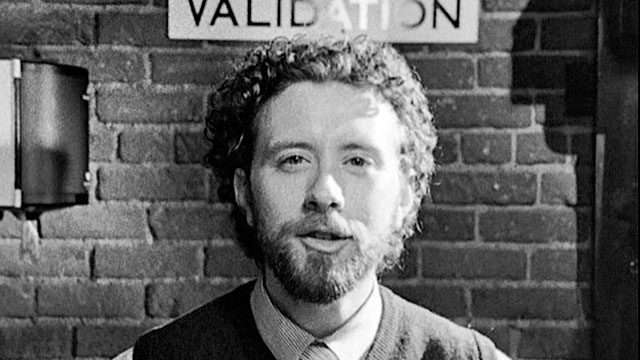
One thing many people don’t know about me is my growing obsession with short films. I’ve fallen in love after watching two Italian strangers fall in love at a restaurant in the span of 3 minutes, and I’ve felt empowered after watching a teenage girl fight off the forces of her disgusting boss. Yet one of my favorite short films would have to be Kurt Kuenne’s Validation.

Validation uses comedy to capture the plot line of a society of people that need the validation that they are good enough, that they are smart enough, and that they are worthy enough to smile. Hugh Newman, played by Bones’ TJ Thyne, is the scruffy validator to give these people what they need (and free parking). Within the span of 16 minutes, Validation takes on the battle of falling in love and finding reason enough to smile.

The artistic structure of Validation is also unlike any short film of its time. When other films are focused on the HD picture, beautiful actors and actresses, or the most luxurious backdrops, Validation uses a black and white color scheme and incorporates normal people with normal problems in order to project the message of wanting to feel more, well wanted. The film uses humor with great social issues of the time while simultaneously showing the importance of  feeling good about yourself through the act of giving kind words.

Personally I feel like as a society we don’t spread kindness enough, to strangers or to the people we know. It’s one of the easiest and most free forms of giving known to man, but it just isn’t utilized enough. Why is that, do you think? I’m not saying that I’m the next Hugh Newman when I’m around people, but as a result I do view how people interact or don’t interact with others differently.

I could go on and on about the amazing-ness of this short film, as I said it is one of my favorites, but it’s just something you have to experience for yourself.
Validation

Art as a Gift?

I’ve been thinking about presents a lot lately. Many friends have had their birthdays fly  by recently and mine is coming up and I might be seeing people I haven’t seen in a long time for Thanksgiving and Christmas is almost upon us and blah blah blah and my bank account is fucking empty and I will have the pleasure of giving. I just don’t know.

A friend whose birthday is a few short days after mine is one of the classiest people I know so that thought of presenting him with a favorite book of mine or a nice painting has crossed my mind various times but I’m hesitant. I’ve always thought the idea of giving art was slightly pretentious. Setting aside the stereotype of being an activity reserved for the wealthy, it seems to imply that art is an object and can have an owner who will then hang it up the way museums do.

As much as I love museums and art exhibits, I always feel slightly uncomfortable while attending events. All the people who come in, look at the art, try to “figure it out,” and move on to the next piece of art don’t seem to be swept away by it. This process, to me, seems extremely artificial and mechanical. Of course, that could be because I’m listening to Animal by Neon Trees right now but still. The idea of art being owned is silly. It’s not. I watched a documentary about street art recently in which much of the street art was being auctioned off. Blasphemy. Street art is the most liberated form of art. The anonymity it grants results in some of the boldest and most audacious works in history; street art is almost synonymous with liberation and absolute freedom. So, what the hell is a rich old guy going to do with it hung up in his basement? Does spending hundreds of thousands of dollars on acquiring and “owning” something that defies ownership a perverted form of exhilaration? How can something that was meant to please the masses not feel trapped and suffocated in the emptiness of a house, where, at most, a handful of people passively walk by every day?

Did I digress? I think so. Okay, bye.

Art of Perspective

It all started with a party. Two people celebrating two books and two lives that shot them towards this very moment.

Linda Gregerson’s voice melted my soul. Her consonants were held to a length unmatched as her vowels seemed to punctuate every word. Her rhythm was English but accent was American, her sound had no home but I felt as if I was there while in this space.

I sat, in the front of the Kelsey Museum, literally surrounded by ancient artifacts and stories that needed a home inside my mind. But I was also surrounded by life. Lives that kept living to share all that this world had to offer.

Today it offered me head congestion and foggy, red eyes. My throat felt like the dirt that found its way into my foot’s blister. My head seemed to spin with every pause she made, trying to find something to grasp on to but only finding more air, more space. My hands shakily grasped my jasmine green tea. My crossed legs seem to beckon my torso to fall towards them; before long I had turned into something more severely collapsed than the Thinker’s and I think Rodin would only scoff at my body’s positioning.

Before I could pour another sip David Halperin took the podium. His book defined my second week of August while it helped define his last ten years. I found myself in two main locations while he found himself in one, and I thought how interesting it would be to have a thought turn to book all while inhabiting only one place. Where must one’s mind go to in order to have such thoughts? Surely one would have to free their mind because I find mine to be trapped all too often by walls and colors and block m’s here.

He read. His presentation was less precise, he is not a poet, but his content was much more present and it seemed to ground the whole experience.  He talked about faucets and boyfriends and subjectivity—all which regularly don’t bring me to tears. But at this moment, the perfect draft from the window hit my weakened eyes, and a façade of emotion fell from my ducts where it was really the sickness springing forth. Others were laughing at the prose and I sat wiping my fake tears as they splashed onto the scarf I had just placed on my lap.

After the applause had ended we were herded into an adjacent room where friends told me their new definitions of poetry and of the mad and all I could do was stare at the food. The appetizers sat in the most perfect arrangement only ruined by myself. Unknowing if they were vegetarian or not, I shoved them into my mouth, grabbed at the vegetables, and started my decent into what would become a quarantined apartment.

I found myself holding myself as my feet quickened their pace and as the birds flew chaotically overhead. Aren’t they supposed to always assume a formation? Or fly to Florida or Mexico? Aren’t they like butterflies? I didn’t know and I didn’t care but the streetlights flickered into different colors. Having no headphones only exacerbated the atmosphere and I just assumed this was going to mark my downfall.

These omens are never right but they were not proven wrong that day.

I must have been infected by art, I tell myself, because no virus has touched me like this. It can’t be “treated” and only a poem would necessitate chewing on garlic. Only passages on Queer Theory would demand hours gargling with salt water and baking soda. Only academics and their speech would require my body to writhe in pain at four in the morning. The human body cannot ingest art. From my perspective, if it attempts to, one has to spend days purging art from their system.

I’ll stick to listening, watching, and touching; leave feeling for those whose immunity has been built up for longer than mine.

How to Get Writing

We are always in search of the perfect writing environment, for that one place that will let us finally get down to writing that novel. But it’s elusive, that place. You have the right lighting, your own nook in that little coffeeshop, new pens and a leatherbound journal, pristine pages waiting for inspiration to strike. Yet it never quite comes. There’s always something else happening. Commitments, distractions, other things that can be, ought to be, need to be done. So how? How does the great American novel begin?

There is no universal answer, of course. Getting the words down on paper is the most important part, and often the most difficult. Resist the urge to edit on the spot. No-one needs to hear all these trite bits of advice again, though. What we want to know is how? Where? Is there a better way to get started, to make progress?

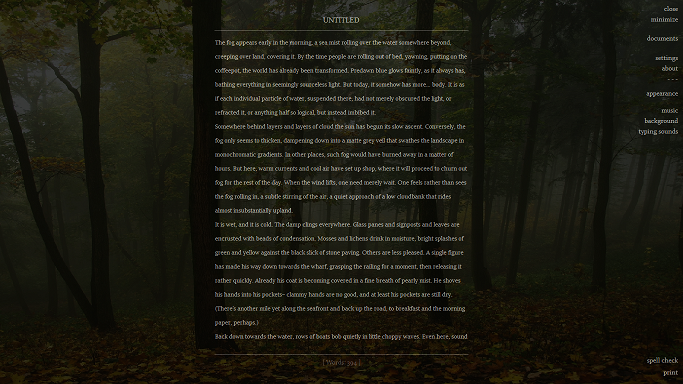
Zenwriter, for starters, is a free program that comes as close to replicating ideal writing conditions as I’ve ever seen. It’s simple, text on a pleasantly faded or dimmed background. The unobstrusive text-only menu fades when not in use. There are options for typing sounds (typewriter) and background music (ambient). It autosaves. (But please back up your work anyway.) The great thing about this is that it football predictions site ever fills up the entire screen- there is no start menu, no desktop unless you minimize, a greatly reduced temptation to draw up other windows and multitask. Its aesthetically pleasing minimalist design is not just task-oriented and distraction-reducing, but attention-retaining; it may not suit each and every single one of us, but it does certainly live up to its name.

To complement, there is Rainy Mood, which, for those who find the sound of rain and the occasional distant rumble of thunder soothing, will provide a textured, low-key white noise (that can be layered under sad music, for that extra kick). And if you’re writing a novel or some sort of story, there are resources everywhere. Like here. And here.

National Novel Writing Month (which, by the way, will also help provide that driving impetus to get on that writing) is halfway done. Sit down and get to work.

UMMA’s Greatest Treasure

It goes without saying that there is nothing more underrated here than the University’s Museum of Art. Among the masterpieces on view are Pablo Picasso’s Two Girls Reading (Deux Enfants Lisant) from 1934. The piece is emblematic of Picasso – the sharp lines, the geometric shapes, the rendering of the two females embracing one another. The combination of colors is enthralling – the smaller child’s face partly lavender, partly white. The larger female who is embracing the smaller is entirely sage green, her hand clutching the other figure’s shoulder. The two females are looking down, solemn in both their stares and the curvature of their eyes. Pasted behind them is mustard background. On the table with which they are perched is a book sprawled open.

The meaning behind this work is dual, undoubtedly. There is the loving embrace between the two female figures, but there is also the educational and literature element to the work – the fact that although the two figures are embracing, they are embracing through the shared love for reading.

The work strikes me in its classical Picasso movements – the sweeping strokes that create the figures in a combination of geometric shapes, the pointed noses, the curvature of the eyes, the geometric fingers that feel entirely non-human. The color is  Picasso, too.  The brusque orange and mustard yellow, contrasting the sage green and melodic lavender. The contrasting of the colors, the sharp black lines pointed – creating figures in themselves. But for me, more than anything, this work resonates the feeling I, as an English major, love all too much. I could spend hours, days even, snuggled up with a book – getting lost in its nuances, the plot and the characters becoming so familiar that I feel as though they are my kin. This painting, moreover, could be appreciated and have a familiarity with most, if not all, U of M students. We all, just in the inherent nature of being a student, spend hours with our books – losing ourselves in our studies, in the words written on the page.

So, I urge all students to take a stroll through UMMA. To find themselves face-to-face with the world’s greatest master, Picasso. Lose yourself in his colors – his lines. But moreover, lose yourself in the meaning behind the work, the ability it could have to strik you in a more personal, a more unforgettable, way.

The Great Cat Massacre

Throughout my studying of French history, I have read about some of the highest pinnacles that our species has reached; Déclaration des Droits de l’Homme et du Citoyen, where men of different backgrounds, ideologies, and classes joined together to oppose tyranny and forge a more equal world, the works of the Enlightenment, which prevailed reason over superstition, the impassioned painting of David amidst the chaos of revolution, and the countless scientific advances that ensured a safer world for future generations.  But yet, for every action there is an equal and opposite reaction meant to knock humanity down a peg and I am pretty sure that the Great Cat Massacre of the late 1730’s cancels out the development of insulin.

Though the exact causes of this event are, as they should be with something so strange, uncertain, we do know some of the specifics.  In the 1730’s the printing business largely encompassed the professions of those on the rue Saint-Séverin, and incidentally it was all the rage for printers to own multitudes of cats, with one of the more wealthy printmakers apparently having had portraits painted of his twenty-five felines.  One night disgruntled workers decided that enough was enough and rounded up the cats, massacring dozens with lead pipes and subsequently, deciding that hammering cats wasn’t theatrical enough, put on a mock trial for the kittens.  Amongst the mob, a hangman, confessor, guards, and judge were named.  A miniature gallows was erected, which must have been adorable, and the cats were hanged for witchcraft.  Such is the darkness that lies in men’s hearts.

Historian Robert Darnton attempted to make sense of this cat-astrophe in his book “The Great Cat Massacre and Other Episodes in French Cultural History,” observing how modern commentators on the subject tend to be stymied by the fact that this cat massacre was done for amusement and was a source of hilarity amongst the workers for some time to come.  Nicolas Contat, an apprentice who took part in the kitty killings and the Michael Vick of the Ancien Régime, wrote “The printers delight in the disorder; they are beside themselves with joy.  What a splendid subject for their laughter, for a belle copie! They will amuse themselves with it for a long time.”  Though bludgeoning and hanging cats has never really been my thing (yet), I can be sympathetic to the extent that this act symbolically reversed the class hierarchy for a night.  When a wife of one of the printmakers saw what was done to her cat, she reportedly exclaimed “These wicked men can’t kill the masters, so they have killed my pussy!”  The Carnivalesque appeal must have been poignant to the workers, underfed and overworked by their masters who instead gave their best meat to their beloved cats.  Thus, the eighteenth century’s greatest social commentary comes not from Rousseau, not from Voltaire, but from the Great Cat Massacre.