Round 2

Hello again, Arts, ink readers! I hope your summers were a fresh bite of relaxation and that your Falls have galvanized the start to another year. My name is Alex Winnick, I’m a sophomore in LSA studying English and Community Action/Social Change. Clubs with which I am involved and subsequent people who inspire me include: rEDesign, (an organization that aims to involve college students in K-12 public education) the Prison Creative Arts Project, TedxUofM and 826Michigan. I enjoy drinking cold water from my washed out Tomato Sauce jar and riding my bike with gloves on. I found at an early age that music has a tremendous influence over my life, and am delighted that I get the opportunity to share its energy with you.

I return to this blog with a renewed drive for updating you all on new (or perhaps old) music that I have been listening to recently. Last year I focused my attention mostly on additions to my Hip Hop universe; this year I not only want to continue that effort but also bring in new releases to a multitude of other genres. I try my best to stay relevant in the music world by following a few different blogs, including Hypem, Sunset in the Rearview, Pigeons and Planes, Earmilk, and by using Spotify. I highly recommend using Spotify if you don’t already; it is an application that streams practically every album ever created for free. Legally. You pay nothing and the artist still makes money. It is the absolutel best way to listen to music.

As Fall is always, in my opinion, the most prime season for cutting-edge music, a number of terrific albums have already come out in the last month or so. Kanye West’s label Good Music released its compilation album Cruel Summer to mixed reviews. While I concur that it is nothing special, and absolutely nowhere on the level of My Beautiful Dark Twisted Fantasy, there are a number of stellar tracks including The Morning, To the World and Clique. An unfortunate trend in the Hip Hop world lately, Kanye’s decision to reveal basically half the album before the release date left little anticipation for the real thing. Lupe Fiasco’s Food and Liquor 2 also arrived in a cloud of disappointment. While I think we can all agree that it was marginally better than his last effort, it is almost insulting to attach the “Food and Liquor” label to it, as it doesn’t even slightly compare to his debut release. Mumford and Son’s second studio album Babel is just as cohesive and impressive as their first; they managed to maintain their specific style while also varying their lyrics and tempos enough to keep the entire album interesting. Finally, one of the best albums to appear in the last few months dropped almost two weeks ago. The debut record from Macklemore and Ryan Lewis has swept across the country in a wave of party jams and emotional videos. (See below picture) Until next week when I go into more depth, download Spotify and listen to The Heist on repeat. It will soon become the soundtrack to your Fall.

The Irrelevance of the Artist

The last time my parents visited Ann Arbor, we took a walk in the chilly weather to the Ross building. Though I’ve lived in Ann Arbor for a while, my parents had never really visited until then and I was eager to show them the interesting and beautiful architecture around campus, especially the school I studied in.

As we were approaching the building, I pointed out the bronze sculpture next to Lorch Hall that vaguely resembled bones. I asked my dad what he thought it was and he immediately walked up to the corresponding plaque to read the provided information. He was surprised that it only contained the author’s name, not his intentions or his core message.

I asked him why the author’s intentions mattered. And I pose the same question to you.

The artist is the creator of a provocation. A piece that represents, challenges, or illustrates something he or she has observed. It is a direct interaction with society. But it has nothing to do with you.

Art is not meant to be a definite, a concrete the way we prefer things to be, a constant that is reliable, or a fact we can memorize. It is fluid and abstract and that is the most terrifying and breathtaking thing about it. It can mean everything, anything, and nothing, all at the same time. It is not the physical piece itself but the emotion and thought the viewer or participant feels and thinks upon experiencing it.

My room, without a doubt, at any time, on any day, is covered with newspaper, tubes of paint, charcoal, and baubles I use to express myself. When I make something, I do it almost intuitively – my hands know what colors I want to use, where I want the lips to go, which buttons to use to form human hair – and when I am done, I am done. I no longer have a part in it and neither does any artist. They are transformed from being a creator to an observer of their art and their opinion of what it means and what it represents are as important or as arbitrary as anyone else’s.

We have the innate desire to look at something and understand everything about it. We look to figures of authority to do so, people with experience and knowledge. In art, we turn to the artist. But this would imply that there is something about art that is a fact. Something that remains constant no matter who stands in front it. This is wrong. As much as the concept of universal human emotions is touted as some unquestionable truth, it is not. While something beautiful like a smile can invoke the same warmth in my heart as it can in the heart of someone from a completely different background, it has different implications, different effects, and is the manifestation of different thoughts.

An artist stating what their art means is an artist telling you what you should think and feel when you experience their art, which defies the inherent purpose and essential quality of art. The interaction between the physical piece and the participant that is art is tremendously intimate and cannot be explained.


The plaque did not lack information. In fact, it had more than what was necessary.

The Art of Blank Space

First, I’d like to introduce myself to the wonderful machine of information that is the Internet. My name is Taylor Portela, I’m a junior studying English and Philosophy, and I work at the Spectrum Center. I love cheese, I read everything I possibly can, I dance and sing on the way to class, and I’m attached to the elliptical most days. But for this brief time, every Friday, I will discipline myself to keep my fingers typing, words a-spewing, and thoughts forming into a web so dense that it might, just maybe, make sense.

Living in Ann Arbor has many great advantages: the food, the trees, the people, the free things. However, one thing that is lacking in most places is blank space: the one wall that extends forever in a rhythm constant and defined by one color. Or no color. Or the sky that has no clouds in it that looks as if you are looking at the bluest blue. Or the ground without grass, without dirt, but only a foundation to stand on.

October 19th is stressful and hectic for me, shoot, this whole “mid-semester” business is. When I try to escape to the library, I’m bombarded by signs on the wall, when I flee to the café, I’m surrounded by people, and when I go home, I’m encased in vegetables. There is no finding blankness in life, so I crave blankness in art.

Now I am no stranger to the critiques of so-called contemporary art: the loosely defined squares, the canvas with nothing on it, the lone light-bulb hanging from the ceiling. But it is no critique of mine. Now I will withhold, for the present, a lengthy theory-ridden discussion of why it not only is art, how they could be deconstructed further, what meaning is even there, or what that upside-down-urinal says about your unconscious, instead I will say that what they all have are  instances of blankness.

Why blankness? Why is the absence of color, of shape, of obvious meaning, of everything so important to living? (Yes, bold claim, but just wait….I’ll get bolder.) Because we get no space that is just pure space. Even outer space isn’t space, dammit. There are comets and planets and dark matter and aliens and before long there is more out there than in here and then there is nothing else to do besides light a candle drink some tea and cry as you listen to Tchaikovsky. Once that gets old though, and believe me it does, I’ve looked for the supposed instances of “empty.”

The third floor of Angell Hall, near the English Professors offices, and the large room on the second floor of UMMA in the travelling exhibit space have some of the blankest, emptiest spaces I have stared at.

“What are you doing? Are you ok?”

“Oh yes, I’m just staring into the blank, into the void, no worries.”

So, I admit that I’m crazy. If you see someone staring at nothing, surprise! It’s me. But there is something so exhilarating and so calming to look at nothing. The nothing acts as the medicine I need for modern day society. If I have to continually look at naked people trying to sell me plastic bags or animals trying sell me cars that don’t guzzle gas like I guzzle coffee, I’ll let the world on fire! So to tame the beast that is my troubled soul, I stare at nothingness.

Blankness allows you to project your own images on them. It allows you to slow your breathing and calm down. It lets you take a pause from the day. It acts as an extreme form of meditation in that I’m not in my mind, or outside of my body, there is no me involved but I’m embedded in the act of gazing at surface. It is the ultimate transcendence rooted in pure aesthetics of the other.

Or it really is just blank space.

Ampersand

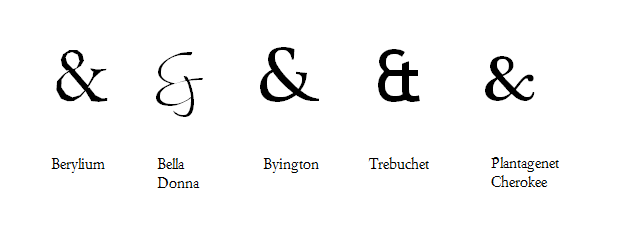
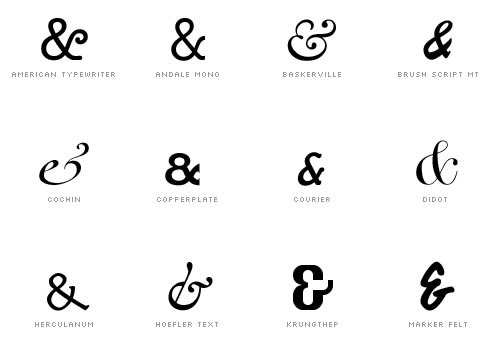
The ampersand is one of the most flexible symbols in our alphabet, allowing an impressive range of interpretation and aesthetic freedom. But how can the appearance of this swirly bit of confectionery be related to its function but in an arbitrary way?  What’s to stop someone from drawing an elephant, for instance, and declaring it to mean “and”? There is, as it turns out, a surprisingly logical history. Concisely put, the ampersand is literally the physical representation of the Latin et (et cetera, et al.)— “and.” In some typefaces, this is still visible.

In the second and fourth examples, the letters e and t are distinguishable. The other fonts are, essentially, variations upon variations of the same basic design. What appears to be a single symbol is in fact a ligature, which is something consisted of two joined graphemes— basic written units (letters, in the case of English). In turn, the ampersand as a whole is categorized a logograph, a symbol that represents an entire word.

And the word itself, “ampersand,” comes from “and per se and,” from when “it was common practice to add at the end of the alphabet the “&” sign as if it were the 27th letter” [wikipedia]. After z would come “and” by itself, or per se and— hence, “and per se and.”

Using the ampersand in writing is usually an informal and dashed affair, such as one might do when taking notes in shorthand. A quick little e with a line cross it, perhaps. In formal writing it is little used, except in titles and names. Yet this symbol can be a oddslot template that allows a great deal of artistic license. The construction of the ampersand, like any other letter of the Latin alphabet, must be recognizable, but outside of that, can manifest itself in any fashion. It might have fewer constraints than any of the twenty-six letters, even, because its appearance does not have to be legible, immediately recognizable, able to be processed in conjunction with other symbols. And in the end, really, the ampersand is easily one of the characters with the most creative potential.

New Blogger!

Hi! I’m Victoria and I could not be more thrilled to be one of your new arts, ink. bloggers. I’m a senior studying English and Art History, with hopes of one day becoming a museum curator. When not in class or staking out in the Ugli, you can find me running, doing yoga, being a student docent at UMMA, editing the Hillel newsletter, and trying to soak up every last minute of my tenure in Ann Arbor!

I am an art enthusiast and museum groupie, I can spend hours (and hours) in a museum without tiring (and go back the next day to do it all over again). To describe my love for art as an obsession is an understatement. De Kooning, Matisse, Koons, Warhol, Picasso and Rosenquist are among my favorites, although I could spend hours pouring over a Gauguin or a Whistler (my artist crushes are seemingly endless!)

I hope to take you along my exploration and discovery of art at Michigan, from exhibitions at UMMA to student work, as I learn about the incredible artistry that this campus has to offer.

Our Noble Steeds of Steel

Street Signs of Bike Cognizance
Adaptations for bicycles

Like most college towns and urban areas filled with high pedestrian traffic, bicycle lanes and parking structures encourage the inhabitants of an area to bypass automobiles. As a result, the bike has become a pivotal tool used by the residents of Ann Arbor. Like any well-used tool, a relationship comes to form between the user and the object. Not like some Golem-esque petty obsession where the owner screeches ‘my precious’ upon interacting with an object, but a meaningful mutual relationship. By providing the object with respect and TLC, the object can provide proper working condition to its user.

If only this was the case for these poor specimens of abuse…

*WARNING*

The following images are graphic and may be disturbing to some viewers.

When we become drones of day-to-day living, ants marching about our mundane existence, we tend to overlook the violent disregard of our environment. We are desensitized to the mangled machines and twisted tools we have so carelessly disregarded and left to waste. What were once stallions to carry us through our daily routines, we let our bicycles take a downward spiral and succumb to rust and decay until they are no longer usable, like great horses put out to pasture in a desert.

As I walked outside Mason Hall yesterday afternoon, I could not help but notice the rusted bicycle chained to a pole beside one of the common walking paths. Ever since my first day at the University of Michigan, over a year ago, this bicycle had been tethered here. The tires were deflated to noting. The rims were speckled in blobs of orange rust. The chain had deteriorated off the bent gears. Forlorn, the bike remained bonded to its pole beside the cement path. Hundreds of students passed by it every day, but none held the key to its lock. Nobody cut it free. Just like nobody had come to grease its chain or fill its tire. It filled me with sadness.

I wanted to tear it free from the pole, give it a new chain and scrub the rust from its rims. I would slip on a new tire and polish up its finish. I could install a new seat or replace the handlebars. Refurbish this decaying beast and transform it into my noble steed of steel (if that’s what bikes are made of). Cruising beneath the late-afternoon sun, I would go about my life and draw attention to my stallion. My journeys to class or work would become a daily display of art.  It would instill a sense of pride in my life, in something as simple as a bicycle.

As it turned out, I would not be the first to perform this rejuvenating act. As I continued on my walk, my feelings heightened with this fantasy of restoration. I became even more inspired by the wonderfully original bicycles in motion. Many of these were minimalistic in design; single speed, thin tires, no brakes, no stickers on the frame or unnecessary accessories. Standard hipster bikes. Some adopted more vintage features, with unique paint-jobs and varying seat styles. Some had baskets or uniquely-shaped handlebars. They were each beautiful in their own way. Each a piece of art.

While they are simply tools, vehicles to aide in the day-to-day transport of our lives, these bicycles embody something more. They are a part of us. Let us treat them appropriately. And make them into something beautiful. Something we can call art.