From Audio File to Spotify

A question I got a while back was how someone would take a piece they’ve been working on and actually go through the process of putting it up on Spotify/iTunes/etc. I’d like to take this post to share how I’ve personally gone about doing this!

The song I am releasing is not up on streaming platforms yet–it’s currently under review to make sure it abides by all copyright laws, etc.–but the process for getting to this point was actually a lot easier than you might think it would be! So here we go: my step-by-step guide to putting something on Spotify:

  1. The first thing you’re going to need to do is figure out what third-party website you want to use in order to manage your release. There are a lot of good options including songtradr, TuneCore, etc. but these all require you to pay a subscription fee. I personally recommend using a website called Routenote (https://www.routenote.com/) Routenote has the option to use a free version or a paid version of their service. The free version allows you to keep 85% of your royalties, while the paid version allows you to keep 100%. If you don’t really care about the monetization of your work, then the free version of Routenote is a great plan for you.
  2. Creating a Routenote account was the second step for me. It lets you log in through Soundcloud, Twitter, Facebook, Google, or by manually signing up, so there are tons of options! I’ve found for some reason if you use an incognito window there are fewer glitches while signing up/logging in.
  3. Once you’ve created your Routenote account, you’ll be able to create a new release. You’ll give your release a name–this is the name of the album. My song is just a single, so the album was the title of the song, but if you’re releasing a multi-track EP or full-length album, you’ll have to come up with a title!
  4. After you’ve submitted your title, Routenote will send you to a page where you’ll have to edit four different things: Album Details, Add Audio, Add Artwork, and Manage Stores.
    1. In Album Details you’ll provide artist details, titles, any copyright info, etc.
    2. Add Audio is where you submit the actual audio files for your release. These have to be uploaded in a very specific format. The website only accepts MP3 or FLAC files–though this is easy to convert in Apple Music if you’re using a Mac like me!
      1. In Apple Music, go to “Music in the upper lefthand side of your screen.” Click preferences, and then “files.” You should see ‘import settings.
      2. Once you’re in import settings, under the settings menu, click “custom.”
      3. Set your stereo bit rate to 320 kbps and your sample rate to 44.100 kHz.
      4. Click okay.
      5. Now go back to your music library, click on the song you want to convert, go to “File,” “convert,” and “create mp3 version”
      6. Music will create an MP3 version of your song, which you can then drag and drop to your desktop, and upload directly to Routenote.
    3. Add Artwork is where you can upload the artwork you want to show up as your album cover. This must be at least 3,000 by 3,000 pixels, so make sure your image is big enough!
    4. Manage Stores is where you choose what platforms you want your release to be available on. I am personally only releasing to Spotify, iTunes/Apple Music, and TikTok, but there are dozens of other options available!
  5. Once all of this information is filled in and correct, you are able to confirm your release. The website will put it under review, and once this is complete, it will be sent to streaming platforms within 14 days!


That’s really it! Not too hard at all. I hope this helped, and if anyone ends up releasing some of your own work, I’d love to give it a listen!

Round green shapes of varying sizes glow against the black background. The text reads, "Immersive."

Immersive #9: Loving Vincent

Oftentimes, adaptations of pre-existing work are translated into new mediums in order to expand upon the impact and outreach that the original work holds. However, given that every medium has its own advantages and disadvantages, these adaptations run the risk of losing the insightful themes and emotional responses that the original creator sought to invoke within their work. Nevertheless, when adaptations do manage to stay true to the original message, the end result can truly add onto the original contributions of the creator’s work in a meaningful manner.

One such adaptation that takes this approach of having a deep rooted understanding of the original work while transforming it into something revolutionary is through the 2017 feature film Loving Vincent directed by Dorota Kobiela and Hugh Welchman: from its conceptualization to implementation, Loving Vincent sought to put a new spin onto the life of Vincent van Gogh and the circumstances surrounding his death by having its animation consist entirely of hand-drawn paintings, becoming the world’s first ever fully painted film.

In having every frame of the film be painted in the style of Vincent van Gogh, Kobiela sought to build upon the words van Gogh stated in his last letter: “We cannot speak other than by our paintings.” And since such an ambitious feat had never been pulled off before, the creators had to spend 4 years developing the technique that would allow them to accurately capture the fluidity of film within frame by frame oil paintings. But after they managed to hone their technique, it took the team of over 125 painters another 2 years to finish the film, which consisted of over 65,000 frames painted over 1,000 canvases. The end result would be a nostalgic yet vivid world that truly allowed for its viewers to experience what it would be like to live within the contemplative and nuanced world of van Gogh.

Adeline Ravoux Folding Napkins

Overall, Loving Vincent embodies its name within all aspects of its production, retaining the expressive style and intentions of van Gogh while inspiring new life into his works through animation: it is truly a product of love for what van Gogh stood for and what he means for other creatives and admirers who gaze upon his work for inspiration. The film also serves as an indicator on how traditional mediums can be transformed into something new and innovative that adds onto the original work without subtracting from it. It is also a reminder that love for a project can go a long way in ensuring that all elements of the production work with intention and in harmony with one another, which is a mindset that I hope we are all able to embody within our own personal pursuits and creative endeavors.

Witness Loving Vincent: HERE

+KHAOS+ EP.21: A BEAUTIFUL CATASTROPHE

+KHAOS+ EP.21: A BEAUTIFUL CATASTROPHE

+KHAOS+ EP.21: A BEAUTIFUL CATASTROPHE

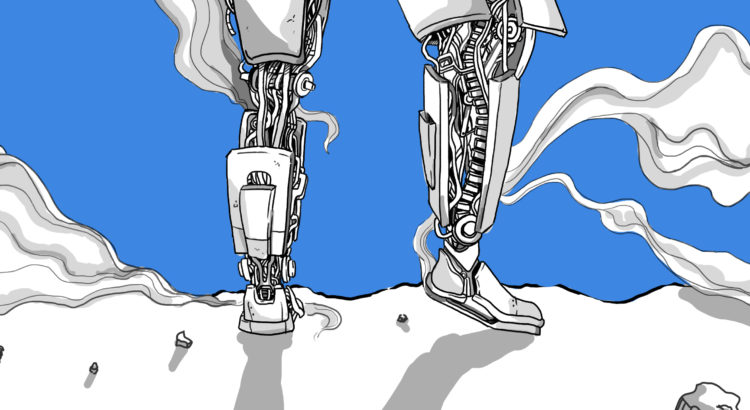
While Milo and Ed hurry back to their spaceship, they watch the breathtaking sight of disintegrated parts of Ellea heading towards earth, causing irrevocable mass destruction.

+Author’s Comment+

Hope you enjoy this one. I’d do anything to go to space someday.
Feel free to follow my Instagram art account: @kats.art.folder

Album Review: G_d’s Pee at State’s End! – Godspeed You! Black Emperor

G_d’s Pee at State’s End!

Constellation (2021)

Note: Godspeed You! Black Emperor does not make music fit for formulating opinions quickly. I expect to listen to this record several more times before I feel comfortable with my thoughts on it, and as such, my review will primarily be my immediate reactions to it. This isn’t because I think their music is just that deep; they just make really long, densely arranged music. Also, I thought I would mention that because the song titles are quite long, I’ll be referring to them by their specific movements as done on streaming services. But, anyway, on to the review. 

The Canadian music collective Godspeed You! Black Emperor has been making some of the most essential music in the experimental scene for nearly three decades, with multiple classic records under their belt, most famously their 1997 debut F♯ A♯ ∞, and 2000 follow-up Lift Your Skinny Fists Like Antennas To Heaven. Although they took a break from 2003 to 2010, their more recent output has been quality as well; while I haven’t heard each of the four records they’ve released since returning, their Polaris Music Prize-winning comeback album Allelujah! Don’t Bend! Ascend!, is arguably my personal favorite release of theirs. G_d’s Pee at State’s End!, their seventh album, continues their tradition of making sprawling, deeply political music (they announced it with a list of demands, including to empty the prisons, end imperialism, and tax the rich). In a similar format to Allelujah, the album is made up of two longer tracks sequenced around two short ones, though on streaming services the longer tracks are split into four and two songs, respectively. 

“Military Alphabet (five eyes all blind) [4521.0kHz 6730.0kHz 4109.09kHz]” is, like most Godspeed album openers, slow and unassuming, building tension with droning sounds and recordings of radio transmissions. After a surprisingly simple, catchy guitar line, it transitions into the next movement, “Job’s Lament”. While not the most interesting piece on the album, mainly due to the ascending melody and static chord progression becoming somewhat stale, the chugging guitar riffs and 3/4 time signature make for an admirable performance, like watching the group jam on a single idea for eight minutes. “First of the Last Glaciers” is much more enjoyable in my mind. With its swaying, hypnotic rhythm and powerful drums, it’s one of the most cinematic parts of the record. And to close out the first song, “where we break how we shine (ROCKETS FOR MARY)” is a short recording simply of birds chirping and what I’m assuming are rockets going off. It’s a bit strange, but I’d expect nothing less.

The first interlude, “Fire at Static Valley”, is a droning track primarily made up of chiming, delay-heavy guitars, eerie strings, and a steady kick drum. It’s a nice moment of calm, giving the listener a moment to breathe before the second longform piece, starting with “”GOVERNMENT CAME” (9980.0kHz 3617.1kHz 4521.0 kHz)”. On first listen, I was pretty surprised by this one. The first few minutes following the vocal snippets are some of the heaviest I’ve heard on a Godspeed album, full of distorted bass and sharp guitars. It sounds sort of gothic, or even metal-inspired. From then on, the track adds strings and some real tight drumming in a lumbering crescendo ending in layers of instrumentation getting tangled with each other. It’s chaotic, and quite impressive. Following this, “Cliffs Gaze / cliffs’ gaze at empty waters’ rise / Ashes to Sea or Nearer to Thee” is a decent movement to close out the piece. The buzzing drone that takes up the first half of the song isn’t bad, but the end is far more engaging. The driving rhythm section and triumphant lead melodies are straightforward and genuinely uplifting, a sound that reminds me of one of the best songs from the group, “We Drift Like Worried Fire”.

The record closes with “OUR SIDE HAS TO WIN (For D.H.)”, a six-minute string piece that completely blew me away. It is my favorite song on the record, and one of my favorites by the group in general. I don’t know how to describe it other than that it is absolutely stunning. The “D.H.” the song is dedicated to is Dirk Hugsam, a tour agent and friend of many Constellation Records artists, who died in late 2018. I think it’s a testament to just how communal and personally involved Godspeed are as a collective that they could have written such a devastating, singular piece to honor someone important in their lives.

Overall, this is a great record. It’s not an entirely unique project for the group at this point in their career, but it’s great simply by virtue of coming from them. The pieces are arranged, produced, and performed well, as with all of their work. If anything, it’s different for their outlook. While they’re not exactly making happy music, it seems as if there’s something bright in the songs amongst all the darkness. Even if they know things are pretty hopeless, it’s comforting to hear them sound so hopeful. As they said in their record announcement, “this record is about all of us waiting for the end… this record is about all of us waiting for the beginning”. This record showed me the nature of Godspeed You! Black Emperor as a collective of people, rather than just a band. It’s more than just the music, it’s what the music represents: human connection, basic rights, an end to capitalism’s destruction of society and the earth. While it might not be their best release, at the very least it affirms there’s something worth sticking around for, despite all the shit going on: each other.

– – –

The group addresses the political and personal sentiments behind the record in a statement accompanying its announcement, which you can read here. I highly recommend checking it out, as it’s actually quite beautifully written.