Mile-Long Mixtapes: Ep. #6

“Mile-Long Mixtapes”: Ep. #6

Catharsis

by Kellie M. Beck


Aristotle’s Poetics defines the term “tragic catharsis” as a type of purgation. The idea behind tragic catharsis is that when we see something deeply tragic, we experience a purification process of a sort. Described as a “tragic pleasure”, we experience a certain satisfaction in witnessing difficult emotions in the media we consume. 


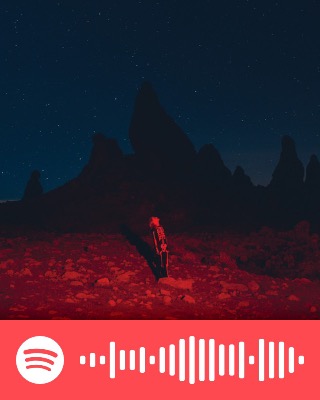
Phoebe Bridgers’ sophomore album is full of opportunities for catharsis– even the title, Punisher, alludes to it to a certain extent. But it’s the album’s second single, Kyoto, about Bridger’s estranged father, as well as the ending track (really quite a finale), I Know The End, are the ones that ring the truest when it comes to my own personal catharsis. 


When I was in high school, I had a boyfriend, who, to make a long story short, was emotionally dependent on me, two years younger than him initially, at fifteen. While our actual relationship was short-lived, he haunted my life for three and half years afterward– he would show up out of the blue at my theatre productions, or send me a text late at night, asking how I’d been. It’d be fair to say I should’ve blocked him, ignored him, been firmer in telling him to leave me alone. But he knew all too well what to say to get my attention. 


Listening to Bridgers’ Kyoto for the first time, I burst into tears– not the gross, sobbing kind, but rather that kind of emotional response you’re not sure where it comes from. Bridgers’ lyrics are blunt– they cut to the chase. 


I don’t forgive you

But please don’t hold me to it

Born under Scorpio skies

I wanted to see the world

Through your eyes until it happened

Then I changed my mind


Even though Bridgers is referencing her father, one of her major skills is writing her personal stories to be universal. The most interesting thing about Punisher, to me, is its use of both themes of masochism, as well as tragic catharsis, that makes me wonder if Bridgers herself finds tragic catharsis in her own pain. A better question might be, can we process our traumas and hurt through art so that we ourselves might find catharsis in them? But perhaps that is why creating art is so seductive– to play a character outside yourself, to write a story from another’s point of view, to write your story down through lyrics– isn’t that what most artists pursue?


The boyfriend moved to Frankenmuth, of all places. He asked me to visit for a day– god knows why, but I said yes. We had a fine day. In fact, it almost felt normal. After that day, we never saw or spoke to each other again. 


Catharsis is a kind of relief. 
Study Hal: Week 37 – False Spring

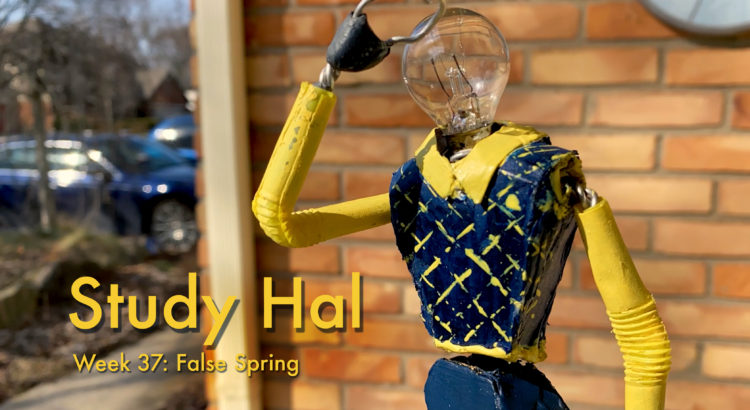
Okay, this week we planned on making a joke this week that it’s still too cold to go outside. But when Hal went to check, he discovered it was a balmy 57 ºF. At that point, the goof was dead. Who cares if there’s snow on the ground and only a couple plants are growing? If it’s warm enough for the snowdrops to bloom, it’s warm enough for Hal to sit in his favorite chair.

Hal has been so excited for spring. It’s his favorite season, and with all his classes online, having time outside is a real mental health boost. Michigan weather has a way of lulling you into a false sense of security, though. I have a feeling there are still several 40º days ahead, but I don’t have the heart to mention that to Hal…

If you’re new here, welcome in! Hal is a senior studying remotely from his hometown in Michigan. He’s back every Tuesday, but if you want more you can always check out the Study Hal tag!

unscrambled #25 – “euchre.cpp”

Background: EECS 280’s famous “Euchre” was project was due yesterday, which meant a lot of inspiration was taken from the long nights, countless errors, and furious debugging. I wrote this as a sort of satire, because to be honest, it wasn’t as dramatized of a storytelling as I’ve made it out to be, but still a pretty difficult coding project nonetheless. I also can appreciate all the different concepts we had to incorporate into the project, so [disclaimer] I do understand why it had to be a relatively obscure card game mostly known in the Midwest. Regardless, I can confirm: I did think “why couldn’t we have coded Go Fish or Uno instead” multiple times.

The Poetry Corner – 9 March 2021

[To read an introduction to this column, please see the first paragraph of the previous post here]


This week I would like to share a poem I found recently from the Nigerian poet Gbenga Adesina. The following poem I discovered in the Fall 2020 issue of Narrative magazine. It is titled “Across the Sea: A Sequence”:


                        Across the Sea: A Sequence                       

                        Gbenga Adesina            


1.
Across the Sea


The bottom of the sea is cruel. — Hart Crane.


i
On the sea, your prayer is not to the whorl scarf
of waves. Your prayer is to the fitful sleep of the dead.
Look at them, their bodies curve darkly without intention
and arrow down into the water. What do you call a body
of water made of death and silence? The sea murmurs
on the pages of this book. There are bones buried in the water
under these lines. Do you hear them, do you smell them?


ii
In the panic of drowning, there are hands lifting babies
up in the air, out of the water, for breath. A chorus
of still pictures brought this news to me, to us. Because we do
not see the bodies sinking, because we do not see their mouths
already touching water, the hands lifting up the babies look almost
ordinary. Like the Greeks lifting their newborns unto the sky.
What is the failure of dead? That they sink?
Or that they sink with what is in their hands?


The children of God are upon frightened waters,
And God being hunger, God being the secret grief of salt
moves among his people and does not spare them.
The children of God are upon frightened waters.


iii
There is a child whose protest is of eyes.
She has crossed the water with her mother,
they are shivering, waiting for her father, two days now, they are
waiting,
shivering for a father the mother knows would never arrive.
The mother holds the child, she says to her, gently:
“It’s a brief death. Your father has gone on a brief death.
He’ll soon be back.”


v
A man is bent on his knees, wailing at the waters.
He slaps his hand on the wet sand and rough-cut stones
the way one might fight a brother.
He grabs the shirt of the sand as though they are in a tussle.
The stones here carry the island’s low cry inside them.
A landlocked grief. They say the man was a newlywed.
Now his vows are inside the water.
He claws at the sand. He wails: “Ocean,
you owe me a body. Ocean, give me back my lover.”


vi
Think of the boats. The timber comes from Egypt.
They are cut into diagonals and made pretty. They
are polished by hands. Their saplings are watered by the Nile.
The White Nile flows through Khartoum
before it puts its teeth into the Mediterranean.
The waters and the trees eat bodies.


The children of God are upon frightened waters,
And God being hunger, God being the secret grief of salt
moves among his people and does not spare them.
The children of God are upon frightened waters.


2.
Coma

The silence is a prairie country. The silence
is the silence of hospital sheets.
The silence is of IV tubes, veins, quiet siren of ghosts.
The silence is the silence of what
is dappled invisibly by a body
that is no longer human but not yet a ghost. The silence in your
body has lodged in my throat.
Silence, can you hear me? The silence is of lime,
and kraal stones. The silence is not shadow
but the light of a body buried under a mound of rough stones.
The silence is the silence
of hands. Hands, wire-vine hands, can you hear me?
The silence is the silence of broken ribs.
The silence is the silence of the head,
shorn and shaven. The silence is silence of a bandage wrapped
tight around what is sunken, what is fallen in the gait of the head.
Head,
can you hear me?

The silence is silence of blood,
seething through filament of bandage.
Blood, can you hear me?
Father, blood, Father can you hear me?


I have read this poem multiple times and every time I discover something new about it. Each section is a separate scene, but they are all connected by themes of water, death, and the struggle for connection and survival. The language, images, rhythm, line breaks, and everything is so striking to me, by the end I’m left speechless. What do you see in it? I would love to read your thoughts in the comments below!

A New Project

I thought I would share the lyrics to the song I wrote about a month ago which I am trying to polish enough to put on Spotify. I’m currently looking for someone to collab with who will sing the guy’s part I wrote over the bridge, so the progress has been stalled for the present moment, but here it is!

The title is under construction, but I’m currently calling it “i used 2 sleep with my phone”


(I thought I saw you last night)

I’m setting a reminder in my phone for early May (across the bar, yeah you caught my eye)
saying if I’m still talking to you it’s time to go our separate ways (I went home with another guy)
yeah it’s harsh, kinda cold (you were never mine)
but I best do what I’m told (you were never mine)
cause now you’ve got her to hold, hold you (you were never mine)

thinking back on everything that’s happened; I’m feeling kinda down
all those late nights that I stayed up hoping you would come around
I would sleep with my phone
ringer on, all alone
wondering if you took her home again

you’re not mine to lose
but if I could choose
the place that you’d have is by my side
I know that it’s wrong
to feel so in love
with someone who’ll never change his mind
but I can’t excuse my feelings for you tonight

we had a good long while of talking every day
and I’d hang up with a smile; you made colors out of gray
but pack it up, signing off
won’t wait around for your love
now you’ve got her and that’s enough for you

you’re not mine to lose
but if I could choose
the place that you’d have is by my side
I know that it’s wrong
to feel so in love
with someone who’ll never change his mind
but I can’t excuse my feelings for you tonight

wake up faster (I thought I saw you last night)
make it better (across the bar with some other guy)
move in closer (true you were never mine, but when he held you tight)
remember (I said “I’m fine;” I lied)
all those evenings (tell me girl, did I hurt you?)
I spent feeling (I know I did, but what did I do?)
things I thought you (and when you took him home, I called a girl I know)
were also feeling (couldn’t be alone, would’ve lost control)

but it’s okay (now I’m with her instead)
I know you better now (but you’re still in my head)
I won’t wait (I bite my tongue and try to say, anything except you’re name)
not gonna wait around (would you ever wait for me?)

you’re not mine to lose (all those evenings) (I thought I saw you last night)
but if I could choose (I spent feeling) (Cross the bar with some other guy)
the place that you’d have is by my side (things I thought you were also feeling) (true you were never mine, but when he held you tight, I said “I’m fine;” I lied, can’t you see I’m crying?)
I know that it’s wrong (but it’s okay) (tell me girl did I hurt you?)
to feel so in love (I know you better now) (I know I did but what did I do?)
with someone who’ll never change his mind (I won’t wait) (when you took him home, I called a girl I know, couldn’t be alone, would’ve lost control)
but I can’t excuse my feelings for you (I’m so confused; I know I used you)
no I can’t excuse these feelings for you (I never knew that I would lose you)
no I can’t excuse my feelings for you tonight (how can I prove I’ll always choose you?)

(can we go back to last night?)

Round green shapes of varying sizes glow against the black background. The text reads, "Immersive."

Immersive #4: AI Dungeon

The ability to transport oneself into another world is an alluring prospect as it allows for people to explore choices and lifestyles that they typically wouldn’t be able to experience in the real world. As a result, people have found solace in immersing themselves in pre-existing worlds written by famous authors or in new worlds that revolve around decisions made within role-playing games. But, in order to have this imaginative experience, the work of worldbuilding must be done by someone else in the first place before others are allowed to enjoy it.

In order to bypass this requirement of human-touch, creators have begun to explore the applications of artificial intelligence (AI) within their works, creating unique AI-generated works that closely resemble those that have been made by a human hand. Therefore, it is to no surprise that programmer Nick Walton leveraged the power of AI and the appeal of interactive storytelling to develop AI Dungeon, a choose-your-own-adventure-type simulation.

Within AI Dungeon, players are able to select from a variety of different genres to establish the setting that they want their adventure to take place in, ranging from cyberpunk to apocalyptic, as well as the type of role they want to undertake in the setting. From here, AI Dungeon gives players a customized scenario from the options that they have chosen, and the story continues onwards in response to the inputs that the player provides afterwards.

An example of an AI Dungeon story
A Custom AI Dungeon Experience

Already writers have begun to take advantage of the unique story generation, creating their own works from AI Dungeon’s generated plot like Lady Emilia Stormbringer by Emily Bellavia. And as of now all rights of ownership of a specific AI Dungeon-created story belongs to the player who first produced the work in the program, enabling the creation of new published material and eliciting the joy of its players in experiencing a new adventure.

Ultimately, AI Dungeon presents a modern twist to choose-your-own-adventure stories with its constantly evolving prompt-based narrative that ensures that no two stories will ever be the same. But, for transparency purposes, it must be stated that prolonged-usage of AI Dungeon requires creating an account and perhaps even spending money if one chooses to use the “premium” version of the generator, a result of the immense memory usage that is required to host such an ambitious piece of software. Nevertheless, while the usage of AI still presents barriers in terms of accessibility, I believe that the application of AI to reinvigorate traditional methods of storytelling is an area that will continue to grow and will soon have wide-spread implications on how we perceive and define art and original content.

Experience AI Dungeon: HERE