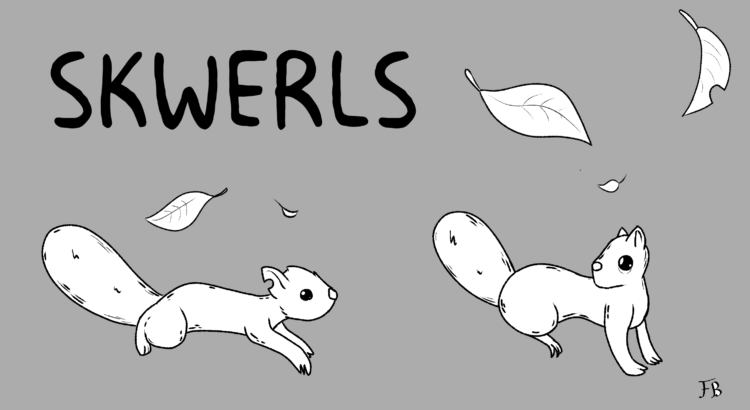
And so it begins. This series will be focused on the life and misadventures of two Diag squirrels, Jun and Buck. In this page, we see the pair’s reaction as students return to campus for Fall semester (not very timely, I know).
Last week I wrote about pumpkin carving, and this week I’m discussing baking. You might wonder, what is this girl even talking about? How do these things relate to art? As a reminder, my blog series seeks to bring the arts from my home to yours. This school year presents unique challenges for how we create and experience different art forms, and I hope to document my process navigating these changes. For example, this week, I attempted to make banana bread for the very first time. I learned that small differences in ingredients and recipes can have a big impact on the flavor, aroma, and appearance of baked goods. Besides granting me a delicious finished product, my experiences inspired me to consider the similarities between baking and art.
What is art? Art conveys human creativity and imagination. As art includes a diverse range of types and activities, baking could be considered a form of art through the imaginative and technical skill required of its baker. Both artists and bakers learn how to use their chosen medium in various ways. In baking, ingredients are measured, altered, and mixed to create something new. Like other forms of art, becoming good at the craft takes practices, dependent upon the ongoing process of trial and error and the available materials.
A sculptor can shape a basic piece of clay into something wonderful, while an instrumentalist can use the same instrument to play different sets of notes and sounds. Similarly, a baker can use the basic structure of their mediums–utensils, ingredients, recipes–to create an original product. As an artist, they combine chemistry with whimsy ingenuity to create familiar yet unique goods. No two baked goods are exactly alike. Much like the art of performers, painters, and other artists, the products that bakers make can provoke emotion and reflect creativity. As such, bakers use flavors, aesthetics, and textures to create edible art pieces, applying their unique ideas and skills to create breads, cakes, and more from scratch.
The finished product: chocolate chip banana bread!
I know it’s been a stressful week for many of us, between election results and many people moving back home during the stay-at-home order. I hope that you are all able to find a way to relax this weekend and perform some rituals of self-care. Do a face mask, drink some tea, go on a run, or make a nice dinner for yourself. You deserve it. Beyond that, I hope that this article can provide a space for you to think about something else for a few minutes, easing your stress even just a little bit. So, without further ado, let’s get into this week’s conversation.
Courtesy of the Design Lab website
I had the pleasure of speaking with Erica Ervin, Technology & Media Production Specialist at the Shapiro Design Lab. What is the Design Lab, you might ask? Erica describes it as “an engaged learning community focused on interdisciplinary collaboration and peer to peer learning and teaching that offers a variety of spaces and tools for everyone on campus.” It’s located on the first floor of the Shapiro Undergraduate Library (or the UGLi, as you may know it better) and houses a variety of tools like 3D printers, a letterpress, and equipment for recording and graphic or video editing. There is even a repurposed vending machine that distributes current student works, like poetry, small 3D prints, stickers, and more!
Courtesy of the Design Lab website
As someone who has used the Design Lab myself, I want to stress that the value of this resource is not just in the physical tools they provide, but in the incredibly knowledgeable and energetic staff as well. If you have a creative idea but you’re not sure where to start to make it a reality, chances are the Design Lab staff can help you. They can provide consultations for students, staff, faculty, and the community on projects ranging from community citizen science projects to converting physical media to be digitally accessible to storytelling, including podcasts.
Courtesy of the Design Lab website
Given the changing nature of creativity and collaboration on campus, the staff at the Design Lab have been trying to gauge the needs of campus right now and how they can best provide assistance. Although their main workshop and PIE spaces (standing for prototype, invent, explore) are closed right now, they offer virtual consultations for many types of projects and can help direct you to where physical tools may be accessible right now. Additionally, their media production rooms are currently available to reserve for individual use, with the recording microphones being quarantined between users. The staff can also help you make the most of your own recording equipment, including best practices for conducting and recording interviews via video call.
Erica also left me with a beautiful reminder when I asked her how her own experience with the arts on campus has changed this semester, saying,
“It’s a little bit trickier for me to consume the art that’s being created on campus. But I don’t think that means that art has stopped. I think that the current situation has brought even more creativity to the way that people are not only making art or making things in general, but also in the way that they’re putting it out to the world, putting it out for others to see. They’re finding these new solutions to get things out and that’s really exciting.”
And I think that is so true. Although we may not be able to view and share art together like we are used to, it’s important to remember that it has not disappeared. It is still here, pulsing through campus as powerfully – or even, maybe, more so – than ever before.
If you want to get involved with the Shapiro Design Lab or use their resources, be sure to check out their website hereor email them at shapirodesignlab@umich.edu. And if you’re interested in using their media production rooms, here is the Canvas training you’ll need to go through before you can reserve a time.
That’s all for now! Come back next week to hear about Creatives of Color and how they are adjusting to this semester on campus.
Stay safe,
Lucy
*Please note, quotes have been edited minimally for clarity and reading purposes, with the intention to maintain all of the meaning and voice of the author*
This week, I (virtually) sat down with Stamps BFA senior Claire Smith. As a fellow fan of branding and Aaron Draplin, I asked Claire about her inspirations and motivations.
Q: So I really like your graphic design work. First, can you tell me about what inspires you to make work?
Claire: Ooh, that’s a tough question. A lot of times it’s like things that other people need.I think that’s where I find the most satisfaction in my work is when I’m making things actually for other people. I’m a fairly practical person, so it’s helpful to know that it’s actually like being useful in the world. I also enjoy helping other people reach their goals, so I guess that’s a main reason behind why I make things.
In terms of how I find inspiration for different styles, I just always look at other artists and see what they’re doing. I have a Pinterest board full of different inspiration styles that I really like, I like talking to like other students and other graphic designers that I know to see what they’re up to.
Q: That’s great. Do you have any specific designers or artists that you look up to?
Claire: Yeah, well my all-time favorite graphic designer is Aaron Draplin, you know, classic. I just enjoy how he doesn’t take design too seriously. A lot of times when I look at my Dribbble or something, like people are really like, everything needs to be perfect and super classy or whatever. And [Aaron] just is very unapologetic about just throwing colors and shapes together and just like having fun with it. And I love Field Notes.
Also, one of my favorite artists is Sam Larson. He’s more of an Instagram artist I would say. But he does a lot of American Southwest inspired art, like lots of animals and plants and things like that. But I like the way he experiments with a lot of different styles. He has like a very set way of doing things, but he is also constantly experimenting. I like the way that he isn’t afraid to try things, even if people don’t end up liking it.
Q: So going off of your interest in graphic design and making things that help other people, do you know what career path you want to go on?
Claire: I would love to go into branding and visual identity design–I think just that’s the most fun, because I think you can be the most creative with it, like starting from scratch and making something new. Then it can help someone who’s like trying to start a business. Honestly I just love design so much. I’d be happy doing anything that just involves design, whether that’s in house somewhere or not.
I interned with Michigan Athletics last year and I haven’t ever done athletics or sports-related design at all, but that was honestly really fun. I also did that Stamps alumni mixer. One of the people I talked to, she works for the LA Dodgers now and I was like, “Oh wait, that’s kind of cool!” I always figured that that’s a possibility. So I want to say it would be fun to work in the sports industry, but I think mainly branding and visual identity. I think the goal is to eventually be able to freelance, but that might be a while.
Q: Nice. Do you know where you want to be?
Claire: I’ve been thinking a lot more about Detroit lately for a few reasons, cause it’s closer to home. Then also I’ve been working this semester with the Detroit Neighborhood Entrepreneurs Project and doing some design work for them. I really enjoyed learning a lot about small businesses in Detroit and how there’s whole neighborhoods, of entrepreneurs and that’s a huge area of growth. It would be fun to continue trying to help them out. There’s also one of my favorite design studios called Skidmore Studio and they’re in Detroit, and it would be really cool to end up working for them.
But I think ideally if I could go anywhere, I really love the West Coast. So Oregon or Seattle, or Colorado, but probably Oregon.
Q: Can you talk about your favorite project or the most challenging project you’ve done?
Claire: One of my favorites is the one that I did while studying abroad. It was pretty fun obviously, cause I was in Denmark–the Copenhagen Jazz Festival project. You did everything yourself. You researched the festival and then we did a ton of ideating projects, like random drawing whatever comes to mind when you listen to music. And then it was kind of interesting to see how concrete ideas could come out of that, even when it felt sort of random. And then it was branding, so I really liked making a logo and then a whole identity and an entire project. That was a lot of fun.
I think the most challenging one, at least the one on my website right now, is Molar Bear, that was tough. ‘m not very experienced with UI UX design. So that was a whole new thing to try to learn Figma, but it was really fun. There was so much research that went into it. I think with both of those projects, I learned a lot about research being important, because I think sometimes I get impatient and want to just jump into the designing, but it’s all about research.
Q: I feel the same way. So in your studies at Michigan so far is there a favorite class that you’ve taken?
Claire: I took Typography with Beth Hay and that was really good. I think something about Stamps is I feel like they always tell us to do these projects but don’t teach us actual, foundational design techniques, like “here’s how you lay things out.” So I feel like in that class, I actually did learn about the grid and learn about hierarchy and stuff like that. I definitely still use skills that I learned from that class. And I really liked the final project.
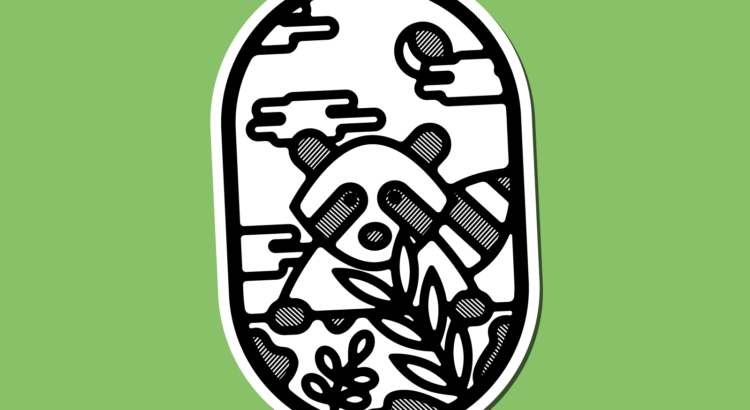
Q: I have one last question for you. So I’m looking at your website. What’s the deal with raccoons?
Claire: I just think they’re really cute. I have this one friend who doesn’t like them at all and I keep trying to tell him that they’re actually cute and it’s more just like a spite thing at this point. I feel like I also just really love animals in general. Maybe they’re just kind of representative of that. I just love little creatures. I love feeding the squirrels on the Diag.
I went to Korea last summer and there was this meerkat cafe where you can go and pet a bunch of animals and there was a raccoon there. It was really fun. It’s not very deep. I think they’re cute and I like animals.
This was the first election that I have been apart of, and the first election night where I lost sleep over it. For most of my life, I didn’t really care about voting or politics in general. As a child they seemed distant, and as a young adult they seemed trivial. Even the 2016 election had little effect on me, before or after the results.
However, this year was different. I can’t tell you why, but for the first time I felt so unbelievably nervous about anything and everything surrounding it. I was checking the polls every two minutes, barely getting any work done at all. I talked to my friends about what we wanted and what needed to happen to get it. I was talking about electoral votes and deciphering which candidate needed what states to win and all the different outcomes. It was, to put it simply, exhausting.
This poem is meant to capture a lot of the different feelings that I felt on Tuesday night. My anxiety and how thinking about certain scenarios made me cringe inside, the rollercoaster of either excitement or despair depending on which way the states were swinging, and even guilty at how others will be much more affected than I am with the results. But I think the idea I wanted to convey the most was how tired I was of it. It is very clearly important and I believe that whole-heartedly, but I would be lying if I didn’t miss those days when I was a kid and I wasn’t sympathizing with all the adults who had to worry about the news headline the next morning. It was nice and didn’t raise my blood pressure at all. My young self had that privilege, and I do not. I voted, and like a normal person, I was concerned for my country’s future. And that’s how I held onto my sanity, and how I still am.