Art Biz with Liz: The Christine Wonch Creative Writing Program

When I was in elementary school, the children at my school participated in the Christine Wonch Creative Writing Program. The program was a local contest formed in honor of a young girl who was killed in a car-pedestrian accident. For twenty years, it provided an opportunity for students to submit their creative writing to be evaluated and critiqued. Serving as both a tribute and an outreach program, the annual contest left a lasting impact on many in Charlotte, Michigan, including myself.

My stories featured what you might expect to see from a young child. In kindergarten, I wrote a story about a princess and a dragon. Throughout the following years, magic, talking animals, and my pet goldfish (R.I.P., Lucky) dominated the scene. In addition to writing practice, the program gave students insight into the publication process. My story and drawing of Lucky, for example, were immortalized in a book that was housed in the Charlotte Community Library. I’m not sure whether the archives of all the past winners are still there, but it was a great experience to go through the writing process and reach the publication stage at a young age (even if just for a local competition).

During those years, I looked forward to the end-of-the-year assembly, where we were reminded of the stories that we had written months before. The Christine Wonch awards were handed to us in a manila folder amidst other certificates and documents. Some years, I earned purple ribbons with gold stars and “young author winner” embossed in gold print. Other years, I received participation ribbons in a rainbow of bright colors. Either way, the message to young Elizabeth was clear: my work was recognized. Our work was recognized. My peers’ creative stories, poems, and essays had been read and appreciated. Someone even cared enough to judge and critique them.

Like most things, writing well takes practice, which is why opportunities to do so are extremely important. While it is a difficult skill to master, writing is an important part of our daily lives. The Christine Wonch Creative Writing Program encouraged children to get a head start in developing writing skills with simple activities, incentives, and outreach efforts. It allowed them to begin exploring the craft, laying a foundation for learning in later years. The program was not just for writing, either; it encouraged growth and self-confidence in young students.

I’m not sure what prompted my memories of the Christine Wonch Creative Writing Program, but I’m glad to reflect on them. The program blossomed a love of writing among students like me, nurturing our interests in the art form. Its legacy illustrates the positive impact of creative writing on children. From broadening the thought process to encouraging self-expression, there are numerous benefits to practicing creative writing early on. I owe some of my first attempts at creative writing to the Christine Wonch Creative Writing Program, and I’m forever thankful to the organization and its volunteer efforts for encouraging me to stretch my imagination.


For more information on the Christine Wonch Creative Writing Program, click here to find a local newspaper and an article on page 2 regarding the program’s legacy.

Artist Spotlight: Photographer & Designer Natalie Guisinger

Natalie Guisinger is a senior pursing a BFA in the Stamps School of Art and Design. An avid photographer and designer, she is also Editor in Chief of SHEI Magazine. I sat down with Natalie to discuss her inspirations and aspirations in the creative world.

To Natalie, art has become an integral part of her life since high school. She took just one formal art class in high school but fell in love with photojournalism through yearbook. She also explored different ways of making outside of school, by knitting, sketching, and even building her own boomerang and longboard. Natalie applied to one art school, Michigan. “It sounds cliche, but art becomes embedded in your life.”

Human resilience and raw being are the main themes of Natalie’s photography–“I like to use art to portray human life in its most authentic form. My passion is storytelling through photography and I love getting to know people by observing their actions and interviewing them.” Being a part of SHEI has emboldened this passion, as it allows her to work collaboratively with a variety of talented students. “We all support each other. School has taught me that there are so many interesting people out there; we can communicate and exchange ideas to make awesome creative projects.”

On where she aspires to work, Natalie hopes to continue helping people, specifically sharing stories of underrepresented people: her plans include applying to news publications or joining the Peace Corps. After traveling to places such as Tanzania and Copenhagen in the past two years, she’s not sure if she wants to go abroad or stay within the United States for a while. She says, “I enjoy working with people on an immediate and intimate level. I know it sounds vague, but I want to make sure I do what I love.”


SHEI Magazine Nightlife Street Style – Winter 2020


Stroll with Bernie Sanders – March 2020


Pan-African Pulp: A Night at the UMMA


Day in the Life of Lee – January 2020


Day in the Life of Tess – Fall 2019


Tanzania – August 2019


Copenhagen – Spring 2019


Principles of Design – Poster Design Project 2020

The Catty Critic: Reflecting on Rupi Kaur & Artistic Merit

I wrote an article titled “Here’s Why Rupi Kaur’s Poetry Sucks” over a year ago which gained an overwhelming readership (you can find the old post here). There were verbal battles breaking out in the comments, people purposefully downvoting others’ votes a couple hundred times, and someone even posted the link in the reddit thread in which someone commented, “First thing I read of Fareah Fysudeen” (I really wish it weren’t the first thing). Frankly, I’m quite embarrassed by this attention, because I hardly agree with my past self. I can’t be proud of an article whose contents I no longer uphold. I can still see myself writing it: slouched in a study cubby typing away between classes, buried in the Hatcher stacks of the University of Michigan, in my sophomore year of undergrad, believing that I finally had access to the great, profound knowledge of the world. I’m here to reflect on that past article and what it means to me now, over a year later, a soon-to-be graduate, and hopefully a more introspective and worldly individual. 

In most ways, my opinion about Rupi Kaur’s poetry itself hasn’t changed. I still think she is the crowned champion of “fake deep” poetry that finds its home in niches on Tumblr and Instagram. I still think her clever use of enjambment and thematic seriousness adds to the illusion of depth to her poems. But in the article, I draw a much more dangerous parallel argument in order to prove (with apparent exacting mania) that the reason Rupi Kaur’s poetry is bad is because it doesn’t fit the criteria of “good poetry.” I say it doesn’t fit into a “larger poetic narrative.” I say that there is a definite dichotomy between good and bad poetry, and that this dichotomy exists as an objective reality. My exact words, if you will: “If all literature was subjective, then, there would be no point to literary criticism and an entire discipline dedicated to the study of good literature. Poetry is not subjective. There is good literature and there is bad literature. Your experience of either can be subjective— as in, you can like bad literature and hate good literature, but your preferences don’t change the fact that it’s bad or good.”

In many ways, re-reading this series of sentences was especially painful to me, because not only do I no longer hold that opinion of art and literature, but because it consigns to a standard of artistic excellence determined by the English literary canon. The literary canon doesn’t exist to be the sole arbiter of artistic value (whether it should exist at all is also worth considering). This isn’t so much a question of whether or not Rupi Kaur’s poetry is good, per se. This is a question about how we interpret poetry, what baggage and preconceptions of art we are bringing to the table. It’s a question about what system of rationality we adopt. And the more we adopt systems of rationality that have historically and continue to marginalize the voices of women and non-white people, the more we perpetuate whiteness— or any other arbitrary marker of artistic merit— as the standard of good art. 

I’m reflecting on why it was so important to me that I uphold the canon in that article. Why was it so crucial to me that I maintain proximity to this historically stuffy and pretentious group of authors and titles that aided in constructing the Western empire? The thing is, I think I wanted the stability of being able to determine whether something was good or not, because without that system of rationality, I feared that there would be a lack of real power or worth to my opinions, as a non-white person. Can you see the problem? The dominant culture is so hegemonizing that I feared its absence means I am stupid. Instead of repudiating a system that made me feel stupid in the first place, I tried to wholeheartedly accept it in order to be part of that dominant cultural frame of reference. In some way, I was playing that historical role of siding with the bully in order to gain agency for myself… What I didn’t know is that there is so much more power in letting go of what does not serve you. 

I don’t like Rupi Kaur’s poetry. But the reason I don’t like it has changed. Whoever finds power, love, creativity, inspiration, vitality in her poetry— who am I to tell them that it’s not there? Find the art that moves you, and let it move you. There is no greater power than constructing the world for yourself.

Hidden Gems: Doom (2016)

It’s officially October and the beginning of spooky season! Whether it’s pumpkin patches, apple cider, warm sweaters, Halloween, or the general atmosphere of spookiness, October has it all. In celebration of my favorite month I’ll be posting strictly spooky hidden gems, ranging from classic horror literature to blood-curling albums and everything in-between. The first entry in this series is the video game Doom from 2016, one of the many games released over the years in the Doom series. Although Doom is recognized in popular culture and has heavily influenced the development of video games, it has been overlooked by a majority of people: most people have never played a game in the series, seen gameplay, or know the plot. Doom 2016 is the best example of everything that the series does right and is already a classic in the gaming community.
I feel like I’ve always known about Doom: that it was taboo, violent, and graphic. I had always been told to stay away from games like that, but as I got older and more into video games, I couldn’t help but be drawn towards the legendary status of the Doom series. I had heard especially profuse praise for the latest entry in the series at the time, Doom 2016; that it was intense, addictive, extremely fun, and incredibly immersive. Needless to say, I felt like it was a game I had to play, and I’m so glad that I did. Doom 2016 has perfected the concept of an addictive, arcade style game that also cares about its art and aesthetic. It’s extremely approachable, regardless of skill level, and immediately fun. Anybody can pick up a controller, start playing, and suddenly realize that they just spent 3 hours slaying demons in order to save the world from a demon invasion, and then keep playing for another 3 hours, it’s that addictive. It’s no accident either; the entire style of the game is a perfect mix between intense fighting, cartoonish enemies, and a good sense of humor. It never takes itself too seriously, which I think is the perfect way to approach a game that features demons and monsters. One of the key reasons that the series has been popular for so long is because it’s the only series that has been able to fill the niche of a fun horror game, and Doom 2016 is the best example of that quality. So although Doom 2016 hasn’t been played by a large majority of people, it is absolutely loved by those who have played it. As one of those people, I can say without a doubt that Doom 2016 a hidden gem.

Study Hal: Week 21 – Home Alone

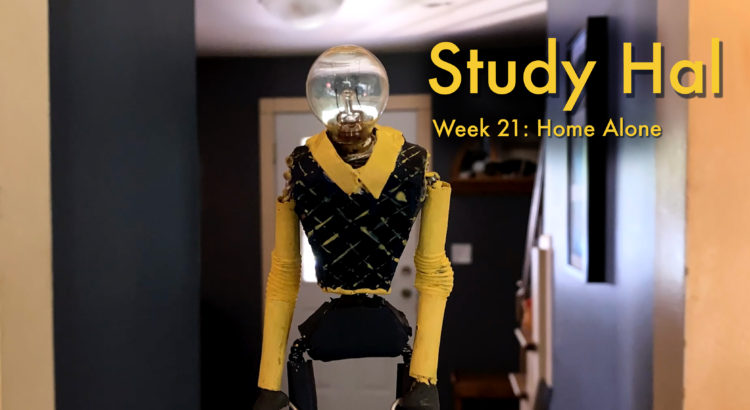
Hal’s been staying in his childhood home since March, but today was the first day in months that he’s been there all by himself. Though he gets kind of annoyed when other folks distract him from his work, he found himself wandering aimlessly through the house in search of company. He was relieved when someone finally got home with the groceries!

Hal keeps telling me that he’s learning about himself from this pandemic. For instance, he used to think he’d rather live alone than with roommates, but now he thinks now he’d rather have people around more often. What do you think? Have you learned something unexpected from this time at home? Do you want roommates more or less than when this whole thing started?

If you missed it, Hal is a student here at U-Mich. He’s studying remotely this semester from his home in Michigan. If you’d like to see more of his exploits, check back in next Tuesday, or check out the Study Hal tag!