An Autumn in University

in a flurry,

before anyone notices,

the leaves begin to fall 

crunch under the boots

perfect jumps to get them right under the sole,

for that satisfying crunch

sweaters in the morning that transform

 into tees by mid-day

silent classrooms of students taking exams

papers flipping, pencil scratches being made,

teachers walking down the aisles,

the tension could be cut with a knife

waiting for the time to finish, and also to keep on going,

for that one problem that seems unsolvable

but is on the brink of the mind,

almost teetering on the exit 

perhaps it will drip into the paper

perhaps not, either way

exams are forgotten as soon as they are handed in

can’t even remember a question a friend is asking about

 in the midst of 

going home and 

apple cider and 

donuts and 

hayrides,

nothing matters when you’re happy and the 

feeling of autumn

envelopes you in its embrace.

The Poetry Snapshot: strength is undefinable

Alpental, Washington

I’ve been told to stay strong.
not cry
be the rock
pull it together
and I’ve succeeded.
I’ve successfully built a wall around me,
locked up my emotions, and lost the key.

All this time I thought someone else
would have a spare,
so I’ve been looking for myself in others.
But when has a locked door
stopped a prisoner from escaping.
Perhaps, I need to bring down these walls
with the same strength that built them.
Because there is nothing weak about
vulnerability.


This poem was inspired by a recent opportunity that allowed me to let my guard down and share a personal story to the public. After years of thinking that my strength came from internalizing my story, I realized that sharing it and allowing it to be a beacon of hope for others was my real display of strength. Strength is not limited to the constraints set by the media that showcases our lives filtered and perfected, and a culture of always putting on a happy face. Breaking through those constraints and embracing the authenticity of being vulnerable, accepting mistakes, and needing help is also a display of strength.  

Anaphora about Joe R.

Meet Joe.

Joe is a tall, lanky dude.

Joe wears graphic T-shirts with depictions that don’t make sense.

Joe’s pin-straight blonde sweeps just over his eyeballs.

Joe’s sharp facial features are softened by clear round spectacles that aren’t worn to be in style.

Joe wears them because he likes them.

Joe sings in the shower with a door closed haphazardly.

Joe maintains old-school idioms like yelling jinx when you say a word at the same time.

Though, Joe never yells.

Joe is calm and cool.

Joe asks a colleague to randomly pierce his ear using a lighter and a safety pin in the middle of the woods because Joe feels like it.

Joe’s humor could break the ice in the Arctic Circle.

Joe is a subtly brilliant English major at U of M.

Joe quits his job as a busboy an hour before his shift to “exercise his free will.”

Joe and my friendship begins with shared music…or was it Calvin and Hobbes?

Over time, I got to know Joe.

Joe brightens my day every time I see Joe.

I once learned in a creative writing class (ENGLISH 223 with Lillian Li) that we can best describe someone we know in the second degree, meaning someone who you see regularly without a profound emotional relationship attached to them.

First degree: YOUR sibling, significant other, parent, best friend.

Second degree: the sibling, significant other, parent, best friend OF YOUR sibling, significant other, parent, best friend.

I know Joe to the second degree. I am inspired by Joe and how he is unapologetically himself. This entry expresses the character of Joe, using a tone that is honest and carefree just like Joe himself. I am grateful to know Joe and to have Joe as my friend. Whether you’re a freshman or a graduate student, keep your heart open to making new friends. Ann Arbor is filled with remarkable people.

Architecture and its Inspirations: from the Eyes of an Architecture Student

Hi Everyone!

I’m back again this week’s topic: Design Inspirations!

So, I’m curious, what things or what places would you guess we as aspiring designers get our ideas (please don’t say “your mind” or anything of the like)?

Take a moment, think THINK, give a guess?

Well, I’m going to give an educated guess about your guess, and say that you most likely said something along the lines of something on this known universe!! Like, famous precedents of the past, or perhaps a current proposal from a starchitect? Or even mundane, everyday objects? Experiences from our own memories? Or maybe even something that happened to us, almost as though in parallel to Newton being hit in the head by an apple?

So, this is gonna sound lame, but I’d consider all of the above as listed, as a partially right answer. I mean, we’re still humans, and we draw our ideas from live experiences from our human minds, so yes, all of the above could serve as points of inspiration, since they are all valid sources of Earthly experiences that can feed into our designs.

But, I say partially, because, all of those things are just the factors that serve more like kick-offs to further ideas into our designs. In other words, they’re like the lighter to firecrackers- they serve their single purpose to ignite the flame, and the rest of the party happens a few moments later, after having had time to absorb and chemically react to the ignition.

***

As a design student, we are often given a relatively detailed yet open-ended prompt to give us some context and general guidelines for the proposal that we are to make. Usually, I read it over a few times and look into any words I find confusingly used or I’m unfamiliar with, then try to interpret the prompt as concisely as I can in my own way, as I often find this to be the best way for me to understand what is expected of me and narrows down my scope of research for inspiration for my proposal!

In my current studio, we are doing a partnered project and our prompt is to make a facility to allow for the storage and display of artwork/artifacts primarily, but we are free to add any additional programs as we see fit.

My partner and I came to a compromise and agreed that our proposal is to make a facility that primarily functions as storage for artwork and artifacts of any medium and size (with just the limit that it must be able to fit within our site, and estimated square footage), and it would be able to accommodate for pop-up exhibitions through proactively interactive elements from the infrastructure of our facility.

From this, our first assignment (under this overarching project) is to (as best) clarify and demonstrate our first-pass ideas to actually build such a facility. We call this phase another research process, where we gather what other information we need, and create concept drawings (usually quick sketches) to communicate our thoughts in how we imagine as “answering” this “question” of how to make a storage facility that can also have interactive elements that change the building’s function from storage to pop-up exhibition. And these concept drawings then lead to concept models, also known as sketch models, which are usually pretty ratchet, and serve as a first attempt for us to literally get our hands on our ideas, and it shows us what does or doesn’t work, and usually also functions as yet another source of inspiration for more of ideas, which then lead to an ongoing cycle of creating other concept drawings and concept models.

Usually, what happens after this is, we present our ideas through talking with our studio professor about the idea, showing him our concept sketches along with that, showing him our concept model(s) and then explaining what elements of our ideas worked/didn’t work from those first-pass models. The professor would then usually reword the purpose of your proposal, to verify that we are on the same page of what ideas we are trying to portray. Then, he will critique what you’ve just showed to him, and when things can be done differently to be more effective, he will suggest his own ideas and even insight on how to make such amendments to our initial ideas. Sometimes, this can be pretty frustrating and end up in tears and torn up models and drawings, and you end up pursuing a whole new idea. Other times, we get the “okay” and continue to build upon it, revising drawings to make them ultra-clear to read, and building further models if necessary to clarify or experiment on a specific topic from those previous models.

***

So, my partner and I each decided to make our own study models over this weekend (since we agreed that we may each come up with interesting elements that we can then combine to create a perfectly partnered proposal afterwards).

I chose to tackle our proposal by brainstorming three potential methods for the storage infrastructure to become pop-up exhibitions. I asked myself, how can I create something that can assume both identities as storage and interactive exhibition spaces? Naturally, I went on Pinterest, and got hooked on images of origami til parametric architecture; essentially the idea of folding elements to create a new object and or space- I was envisioning elements that could be folded to save space, but also add elements of surprise to the space, especially if they could be reconfigured, or we play with different colors, textures, or  materials.

And I came up with these three ideas, initially concept drawings, where I attempted to sketch what I was imagining, and then going back, scrutinizing that chicken scratch of a sketch, and writing down possible logistics on what would help it to function, and what would keep it from functioning well. In the image below, you can see I attempted to give each idea a sort of summary title (which helps to keep me focused on what the sketch should be and what purpose and elements it should have).

Then, I proceeded to look upon my leftover materials, and made decisions on how the heck I would construct a rough model to display these ideas best.

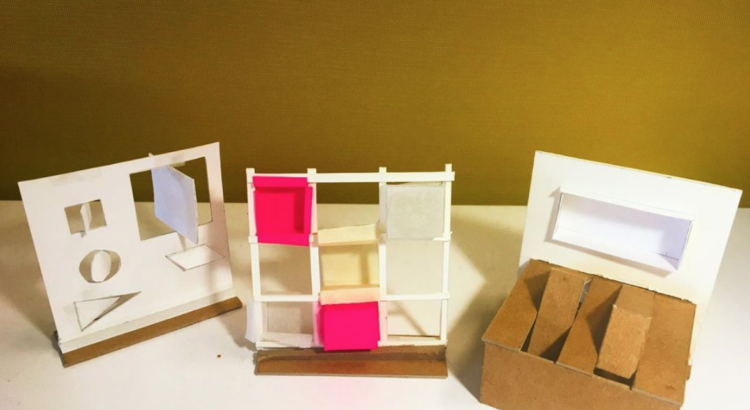
This is my first model (see below), which corresponds to idea #3 from my sketchbook, and I chose to just use Bristol- kind of like a fancier cardstock. I chose this because I like the clean look of white paper, but also it is a relatively easy-to-cut material that’s cheap, and that was really all I needed because I was just looking for a way to convey my ideas in the most affordable and decent-looking way possible! It’s a bit gnarly, but it serves its purpose (and ironically, it’s sometimes the ugliest of models that inspire the critics most haha).

The second model (see image below), which is meant to display concept sketch idea #2, I decided to construct from a mix of thinly sliced4-ply museum board, a hot-pink post note I found chilling around my desk, masking tape, regular tape, some white sewing thread, and scraps of trace paper. I was shooting for different materials that could suggest different materialities, and it was also just me trying to get a handle on how to best create these forms while attempting to maintain overall stability of the standing model.

Lastly, the third model (see below), corresponds to idea #1 of my sketches, and I decided to use a mix of scrap pieces of 3-ply cardboard, 4-ply museum board, and some bristol scraps. I was simply aiming for stable materials that wouldn’t be too much of a pain to cut and scour for folds, and they would be able to stand alone when re-positioned or refolded during demonstrations.

As you may have noticed, I took as best photos as I could of these ratchet models, not just for my own enjoyment as a photographer, but also since they serve as documentation for future mentions in portfolios,  and I’ve learned the hard way that anything (drawings, sketches, mental mindset, etc) you bring to a critique can be drawn over or torn up for the interests of pursuing another idea off of your initial ideas!

***

I’m a little nervous and excited to present these to my partner, classmates, and professor in class tomorrow, but I’ve sort of gotten used to this feeling, as these kinds of assignments happen all the time for class.

But thanks again, to all of you, who took the time to read all the way to this exact line!! I hope you enjoyed my insights! If you have any questions or comments, feel free to respond to this post, and I’ll be so excited to read it! And if you’re interested in seeing more of my work, in and out of the studio, give me a follow on instagram: @themichiganarchitect!

Ciao 🙂
Three A.M.

It is 3 am and my eyes are drooping as readily as my spirits. It is 3 am and most of my fellow students have been dreaming for hours. Maybe I have been dreaming, too. That would certainly explain how the mild ceiling lights flash like lightning with every blink. Maybe it is only in my delirious mind, soaked in a concentrated solution of caffeine, stress, and over-read notes. This night it is the latest economics problem set that has rendered my brain a useless instrument. I keep puffing, but the same tune keeps playing. Wrong answer. Wrong answer. There is no one to ask for help now. After all, it is 3 am.

The night is too quiet for my brain to keep up this frantic urgency. Everyone else is moving at a lethargic pace now, their dreams changing with the consistency of maple syrup. I want to be drowning with them. Theirs is a slow-developing paradise, mine is a never-ending purgatory. The sun will not raise his cheery, golden head for another few hours yet. With the lightening skies, comes a renewed confidence, one borne of a culminating desperation. One does not grow hopeful without dancing on the edge of the abyss. But even that dangerous hope is still far away; for now, the night remains stubbornly irresolute. Detail become lost and everything becomes shaded within indefinite lines. Even the music that pounds in my ears becomes a fuzz. What are they saying? It doesn’t matter anymore; all that matters is what I’m trying to say. Wrong answer. Wrong answer. Wrong answer.

I don’t know why I keep trying. Futile efforts wasting passing minutes until I must acknowledge that I haven’t been moving, probably haven’t shifted since at least 1 am. But this is the penance I pay for my incompetence earlier in the day. Avoiding responsibilities is easiest when you can see them. Why had I spent those precious hours browsing the web? In the depths of the night, these questions lack meaning. I can erase all the consequences of my careless distraction if only I can find the right answer. Right answer. Even that has begun to lack meaning. It is 3 am and there seems to be no journey and no end. No significance and no insignificance. Every action may have some unknown, weighted meaning. If only I could get some sleep, I might be able to divine it. But right now, I may as well grasp at the lengthening shadows.

It is 4 am and I am slipping into bed. Already, unconsciousness is sinking its soft claws into my consciousness. I will have to wake up soon, blinking away sleep in the blinding light. And then I will yearn for the grey quiet of 3 am once again.

Having Too Many Opinions Isn’t That Great

I’ve been thinking a lot more deeply about how I think about art, and a sad realization I’ve come to is that I categorize the works I love by whether they are good or bad. At some basic level, this doesn’t seem too bad, but it’s throwing me back to a time in my elementary school journal where I would make T-diagrams for all the binaries in my life, splitting things into good and bad categories: friends, school subjects, books, TV shows. It helped me crystallize my thoughts and make a definitive opinion about a wide range of things in my life. 

I think I carried this habit into my high school years, determinately debating why I fiercely loved some books and hated others in Enlglish class, my beliefs settled in their ways. I wanted to have an opinion about everything, and in order to do that, you either have to truly know a lot about a lot of things, or simply scam your way through arguments and loopholes and binaries in order to appear to know things. I’ve seen this happen in many classes at Michigan (specifically political science classes, though you didn’t hear it from me) where people label themselves in a way which shuts many doors to other possibilities of thought. Students label themselves “communists” or “marxists” or “democratic socialists” (which I think… I might be–); they say they only listen to Indie music, that pop songs are trash, some Kpop music is okay; we “cancel” each other, call each other out, try to stay “woke” about anything and everything, interjecting ourselves in conversations about climate change and intersectional feminism and genocides and the perils of capitalism and sustainable fashion with our Twitter-fed knowledge. We have watered down the meaning of knowledge in order to appear informed. In so many college spaces, I’ve seen the performance of global understanding. In reality, most students have a superficial understanding of the world’s problems, though a robust set of unshakable opinions. 

The more I learn, the less I realize I know. This has grounded in me a deep humility, and also a sense of inadequacy. I am not good enough, I don’t know enough, I don’t deserve to be here– and yet, we all keep faking it. Why? Why can’t we accept the fact that the search for knowledge is a continual journey, one that never settles, and that is constantly reaching for the higher ideal? I want to have good opinions, well-informed opinions, that can be subject to change– not opinions that I will debate until I’ve won over those that disagree with me. That undermines the entire process of acquiring knowledge, of developing ideas. 

More specifically to art: I’ve realized I’ve been doing this same thing with TV shows, books, movies, poetry. I often cannot recall moments that touched me in particular and I sometimes forget the feeling the narrative left me with– but I remember, for some absurd reason, whether it is “bad” or “good” and I materialize an opinion for it. I am tired of my own lazy systems of developing opinions to rack up my intelligence points. I want to stop looking at the world as good or bad, and simply look.