
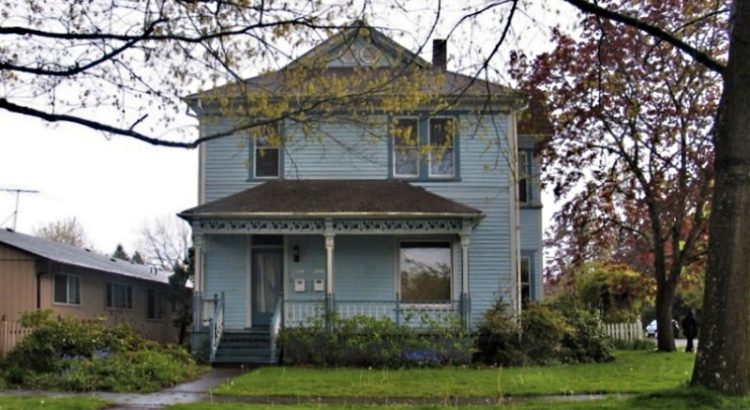
To Grandmother’s House We Go

I remember baby blue stairs. It was a color that was simultaneously garish and soft. Garish because it clashed horribly with the moderate browns and conservative whites of my grandmother’s quiet neighborhood. Soft because it reminded me of the ascending sky on a summer’s day. I remember accompanying my parents to the store, their hands enveloping mine, hypnotized by paint swatches. I got lost in the swimming colors and possibilities while my mom and dad made their choice. I got lost in the swirling paint as they repeatedly dipped their paintbrushes. Stroke and stroke and stroke and dip. What was once natural became artificial as the wood was covered by coat after coat of blue. I remember stretching out under the shade as my parents labored under the hot sun to paint, not an artistic masterpiece, but to protect a set of stairs. Over the years, the various forces of nature would chip away at their hard work. The blue was marred and scraped and gashed, at the mercy of the driving rain or an equally temperamental set of children, my sister and me. Then, one day, I no longer lived in my grandmother’s house. The car pulled away from the pavement where my grandma stood waving and the stairs glowed under the moon’s light. The family who lived there next, impermanent renters, painted the stairs a dark maroon red, a supposedly stylish color that reminded me of blood. But I still remember the baby blue. Blue like a never-ending childhood.

My bed was not mine. Shared between my sister and I, she got the convenience of the bottom bunk while I got the light of the only window in the room. I woke up with the streaming sun across my blankets.  I woke up before everyone else except my grandmother. I saw her from my perch, quietly eating her bread and drinking her milk at the kitchen sink. Her hair was fine, white, and thin. Like feathers, they seemed to float in the light. Like a beacon, it drew my eye to her. She stood in the small enclave with her back toward me. I was never sure if she heard the rustle of the comforter as I shifted back and forth. We existed in the morning semi-silence together and alone. We never spoke, too afraid to wake the others. I hope she wasn’t lonely. I never was. I watched her careful movements and was lulled back, back into sleep.

The garage was a steady walk from the house. There, the ghosts of past endeavors lay on abandoned shelves. My dad’s fishing pole and plastic tackle box now rested far from the beach shores. My mother’s high school textbooks gathered dust in the shadow of a red gasoline container. She explained to me, as we cleared the boxes, that she had hoped to use those books again. She had photocopied every page. But my sister and I were in college now and she was a computer engineer, readying for retirement. So, the books joined the growing pile of recycling. I am not even sure what happened to the fishing pole. The garage was the last place to be emptied in what used to be my grandmother’s house. The bunk bed had already been disassembled. The sink had been cleaned and scrubbed. Only the stairs remained, as we backed out of the driveway, one last time.
Why I Write

Power.

The undeniable assurance that I am a woman who has riches building in my veins, elements of the cosmos running through my blood, the pressure of the universes accumulating like the process of impure carbon turning to gleaming diamonds, the diamonds of words, of expression, of articulation. There is nothing in this world more powerful than a person who can speak and who has something worthwhile to say. There is nothing more powerful than an articulate woman. There is nothing more powerful than putting one word in front of the other, one sentence after another, building mosques and schools and homes and worlds with nothing but the faculties of my mind, the untarnished tools I was given at birth combined with centuries of human development. There is nothing more powerful than words.

Expression.

Where there is power, surely, it must come from something, and here is the secret of writing: that it takes the sticky, messy, confusing parts of human life– the conflicting emotions, the mundane routines, the war of evil and good– and gives it back in eloquence. It aims to understand, not merely as a means to an end, but just for the sake of the thing itself; writing aims to know, to untangle, to explore, to marvel at the gloriousness of life and living. To express what is in the heart, mind, soul, body can’t be an easy task, but when it is done and done well, it hits with the force of change. When it is done well, I’m sure the humanness of writing becomes utterly divine. Besides, in all different cultures of the world, hadn’t god spoken to his messengers? Speech is divine because it is an invention of man. The most powerful invention.

Beauty.

I know there are people that disagree with me, but beauty is the double-edged purpose of writing. There is more to words than mere aesthetics– there is argument. The beauty of words comes from their ability to cause real change in the world. I want to make a massacre of beauty and re-gift it as power– I want to burn the aesthete and use his ashes as fodder for the philosopher. I want to seize language by the reigns and shout at the mute: “Look at you, caged by your pragmatism, daily routines, your boorish practicality– how, if only you could speak, you would have been free.”

Native American Indian Heritage Month

As the month of November winds down, I have only recently heard of Native American Heritage Month. I wondered why I haven’t heard of this before–yet I realized that socially and historically, Native Americans have been left out of the story.

First started as a day of recognition, the movement has evolved into a month designated to celebrate significant contributions Native Americans have made to the growth of the United States. In 1990, President George H.W. Bush approved a joint resolution making November National Native American Heritage Month.

The month presents a time to learn about and celebrate diverse cultures, traditions, and histories of Native people, who were the first Americans. The month also serves to raise awareness about issues Native people have faced and continue to face, such as victimization and prominent rates of mental illness. In the United States, there are 566 federally recognized Native American tribes who speak more than 200 indigenous languages.

Since before the founding of the United States, Native people have faced being executed, forced eviction, and slavery. It’s concerning that many history textbooks glaze over the fact that Native Americans provided the basis of colonialism. It is dangerous to present a revisionist history in which people ignore certain details. Thus, as members of American society, we should work to educate ourselves and work to preserve Native culture, which is fading.

Recently, in my communications class, I learned that statistically, there is barely any representation of Native Americans on television–less than .5% of characters are Native American. Besides African Americans, only a small percentage of television and film characters are people of color. This was alarming to me, as I hadn’t noticed this factor before. In the hegemonic narrative of society, white is dominant and the norm. Was I also complicit in ignoring the history and contributions of Native Americans?

So, this month, I decided to brush up on my history and try to gan a better understanding of Native American cultures. Native people have always been important and should be represented in different media, outside of offensive stereotypes. Here are some things you can do to celebrate Native American Heritage Month:

  1. Read a book about Native American/American Indian History
  2. Watch a documentary
  3. Learn the real story of Thanksgiving
  4. Attend a lecture about Native American history/traditions
  5. Learn about local tribal communities in your area


When the West is on Fire

The fires in California have me thinking about my own dry, woody state and a wildfire that happened in my valley in July. The mountains and wildlife in my hometown are a piece of art in their own right, and the reality that they could burn away during my lifetime is terrifying.

I grew up in Colorado where we had 300 days of sunshine a year, but when the snow fell, it would stick all winter. Every couple of weeks another blizzard would come through to replenish the supply and we would celebrate another few inches on the mountain with our skis. Winter always went late into the year, and we even experienced occasional May snowstorms. This was no problem for our little town: it was the off-season so local ski-bums could skin up to the top of the most precipitated-on mountain (by this time the ski lifts would not be in service) and make their way down the mountain through an amalgamation of sticky snow, rocks, grass, and dirt. “Spring skiing” is what they called it. Eventually the temperature heats up and the only snow which remains is on the mountains’ peaks, and the flora turns green and vibrant: the grass is silky and from it sprouts smooth, velvet flowers, the forests are thick with the woody smell of pine. During the summer I am always stunned by the presence of life in these plants– I almost overwhelmed by a feeling that they are truly sentient, basking in the energy of the forest and intensity of the Colorado sun just I am. In the fall, our mountains were a gradient of hot colored Aspen trees, so bright that the leaves practically reflected off of our cheeks. Within a month or two comes the first snow fall, light at first, like the tiniest sprinkle of powdered sugar over red and yellow trees.

When I was a child learning about global warming, I did not expect to see the effects of it in my hometown. The snow had been there my entire life, in abundance. The mountains outside my door were my only sense of home, of landscape, Earth, etc. and the snow always came when the trees were still red and it always reluctantly left at the end of May to reveal a lush, wet summer brimming with life. But last year when I came home for winter break, there I was in the middle of December, staring out of my windows at bleak, brown, snow-less mountains. Longtime locals said that there had not been a winter so brown since the 1970s. I worried for my town. While a large percentage of the Aspen population has nothing to lose due to a dry ski season, there is another group of ski company employees and business owners that suffer from the lack of tourism. Beyond economic loss, less snow leads to dry summers. My whole county was placed under a fire-ban this summer: no campfires, no fireworks on the 4th of July, and no cigarette butt left unattended. One month into our third hottest summer in recorded history, two people decided they would fire outlawed tracer bullets at the local shooting range, about 20 miles from my home. A spark from the bullets led to a full on forest fire, incinerating 12,588 acres of land, burning three houses down, and displacing thousands of wildlife animals from their habitat. Next to Highway 82, a road I drove on for my whole life, I saw an entire mountain twinkling with embers and flames. The environment that was my Home and my first understanding of the Earth has disappeared into char and dust because of the carelessness of two people.

I know I don’t have control over what happens to my home. I try to stay present when I’m outside and  feel the vitality of my environment because I know it’s not going to be there one day. If I have seen things change this much in just 20 years of my life, I’m afraid to see what happens next. But the earth is resilient. The earth will fight defend herself how she sees fit and give right back to us what she receives. Maybe we’ll be compelled to take action, or maybe we’ll sit back in fear.


“The Assassin” and Pacing in Action Movies

Despite being about an actual assassin, “The Assassin” nearly put me to sleep. The film is based on a classical Chinese text from the 9th century titled “Nie Yianning”, a notable entry of Chinese fiction’s famed ancient martial artists, and is rendered beautifully with stunning cinematography and gripping premise. Yet its pace leaves a lot to be desired.

The film stars Shu Qi (“Journey to the West”) as the titular assassin Nie Yinniang, who has been trained for years and has become a superb killer sent to murder corrupt government officials. Qi is badass and kind of terrifying in her unwavering resolve as the assassin, appearing just enough in action to illustrate her skills without getting too attached to believe she is a sympathetic character. Yinniang reaches her limit, however, when the next target she is sent to kill is the nun who raised her. She does not complete the task, and as punishment is sent to kill the governor of the far Weibo province, Tian Ji’an (Chang Chen, “Crouching Tiger, Hidden Dragon”). The plot development of the movie, while slow, still manages to establish the premise within the first 30 minutes, which kept my expectations high at the start. The catch? Tian Ji’an is her cousin who she had been arranged to marry. Drama of the stickiest order ensues as Nie Yinniang takes up her next mission.

I can’t stress enough what a feast for the eyes “The Assassin” is. The cinematography of the Chinese landscapes are absolutely beautiful and breathtaking. The lighting is exquisite as well, making the gold of the rich main characters shine in a way that adds to the luxurious sets and costumes. The shots of the uninhabited mountains transports the viewer back in time, another stunning element paid careful attention to in order to bring to life this historical drama. Some of the visuals foreshadow the plot as well, like when a blood-red sky at sunset is reflected in a lake, contributing to the mise-en-scène as well.

Unfortunately, the editing does not allow the screenplay to breath, making you feel every minute that passes by while watching this movie. There is far too much exposition, especially at the beginning where the assassin is given her orders to kill, only to then attempt to kill the following shot. Instead of feeling like a detailed chronicle of the assassin’s life, it often feels terribly redundant. Additionally, the shots themselves are way too long. Despite being a martial arts movie, the movie seems more preoccupied with the mundane aspects of daily life than the fighting itself. You literally watch people sit, eat and sleep while stuck with the same forlorn expression for the entire time, making you wait for any plot development (of which there is too little). This adds gravity to the characters, but in an unoriginal way as if they were all in a Western playing mysterious sheriffs who blew into town to restore law and order. To be sure, the editing wasn’t all bad. There was an effective switching from black and white to color in order differentiate the past in flashbacks from the present. But this does nothing to quicken the pace, making important developments feel understated and inconsequential, like when Governor Tian’s interesting origin story is delivered through a boring monologue.

Overall, “The Assassin” is a solid piece of film that feels more like a recorded play than a movie. There is a limited number of sets that the camera stays stationary on the majority of the time as monologues and exposition are dished out like nobody’s business. If you love historical pieces, this will surely delight. But damn, is it boring.

How To Write

Some of my friends have always asked me how I came around to writing. Most of them didn’t know I started out 4 years ago, back in high school. Embarrassing poems were penned down in small notebooks, in between my worksheets and elsewhere. I wasn’t much of a good writer then. Nonetheless, I’ll have to credit my high school friend for prodding me to begin my writing journey:

  1. Get a notebook. Yes, I’m all for the old fashioned way. Nonetheless, you can always type down in your phone notes whenever you feel the writing fever coming on to you.
  2. Write about what inspires you, your thoughts, your observations. In light of my great-grandmother’s death, I wrote a short piece about her, which what I eventually used as my admissions essay.
  3. Read, a lot. Thats a really great way to explore what writing styles, phrases you’d like to incorporate in your pieces.
  4. Decide what kind of writer you want to be. I decided early on that I wanted to be a writer who can relate to people who don’t write, and to not use super fancy words to references that weren’t ultimately relevant.
  5. Write down any quotes, excerpts that you find particularly interesting. You can use these quotes to inspire you further.
  6. If you can’t find anything to write, write about your surroundings. A lot of my pieces revolve around the weather, the rain, how the cars seem to blind me as I cross the roads, how the cold bites my hands as the wind blows. And sunsets.