
Taking Advantage of Ann Arbor’s Music Scene

Like many other students on the U of M campus, I sometimes struggle with boredom. To be bored is a privilege of course, but the feeling is there, and it is palpable nonetheless. By the time the weekend comes and I’m ready to let myself forget about the stress of the past week, I’m always itching to do something fun, go somewhere cool, and eat something good. Usually I can’t do all three of those things, but I compromise with at least one. A lot of times I just go out to parties with my friends, but it’s honestly never actually fun. I have no idea why I still go out every weekend when I’m truly quite introverted and an early sleeper. For some reason I always think, “This time will be different!” even though it never is. I know I’m not the only person who holds this sentiment. 

Recently I realized that I really underappreciate Ann Arbor’s music scene. This town is a top tour destination for a lot of famous artists. Also, the local musicians here are incredible. Have you ever visited the Detroit Street Filling Station when they have live music? I highly recommend it. We are so lucky to have such a rich culture of music on our campus, and the fact that it’s so easily accessible for students makes it even better.


You can never go wrong with a University Musical Society concert, especially when student tickets start at just $12. (Seriously, UMS is an invaluable resource on this campus. Never again in your life will you be able to see world-class performances for such an incredible price!) Another opportunity for entertainment on campus is seeing theatre by various student production companies, like MUSKET, whose production of Cabaret will be opening soon. But recently I discovered a new venue on campus that is super cool and very underrated: The Ark.


The Ark is located on Main Street near Conor O’Neill’s and Pretzel Bell. It’s currently under construction, but you can find it by the line of people going out the door every night. The acts are usually Americana/roots music artists, but the genres are loosely defined so there’s a lot of variation in what you can hear. Last Friday I heard former U-M music student Jeremy Kittel perform with his band Kittel & Co., and I was pleasantly surprised by the casual yet intimate atmosphere. Tickets can be anywhere from $11-$50, but I did some extra research online and it seems rare that any acts exceed the price of $20. That’s what I like to see, very student friendly!


Inside The Ark, there’s a cafe/bar where you can buy popcorn, candies, and drinks to accompany the concert. There is ample seating on three sides of the stage, but the middle of the seating area is reserved for members. You can also sit in tables closer to the stage if you’re into that dinner-theatre vibe. I just think it’s a great place to go that’s low-stakes and unintimidating if you want to enjoy some music. This week they’re actually starting Pre-Sale student tickets for their 42nd Annual Folk Festival on January 25th and 26th, 2019. You can grab those tickets in person at the Michigan Union Ticket Office until November 10th.

Photo courtesy of CBS Detroit.

Malaa at the Russell Industrial Center

Every time I drive to Detroit, I see this enormous mural but I never knew what was inside. On Friday night, I learned. I bought tickets to see Zendlo, Golf Clap & Malaa perform and the venue listed “Russell Industrial Center at 1600 Clay Street, Detroit Michigan.” I googled the location and honestly I was a little skeptical. I have been to many concerts, but never a concert at this place.

So my companion and I drive into a regulated parking system and find ourselves into the closed in center lot between the towering structures of the Russell. It is dark and unfamiliar. There is a water tower stacked on the very top of the building. We peer through the windows and see giant empty spaces. We follow the sound of the music to a door illuminated by red and white lights to be greeted by enthusiastic staff and reassuring security. I learn that this place a gathering site that can suit anything from art studios, music studios, galleries, exhibitions, concerts, weddings, motion pictures, and really any creative event. It’s wicked cool how many people also knew to come to this seemingly dilapidated, vacant, broken-glassed industrial building off of Chrysler Freeway for a hub of a variety of arts. By 1am, the cold space had filled with bassheads and house music that made the night feel timeless. And man what a night! You might be able to see the outside, but you can’t judge a place until you know what’s inside.


Only an hour drive from Ann Arbor and what a different world. Check it out: https://russellindustrialcenter.com

midterms during midterms

Despite not being an eligible voter here, I realized that there is a stark irony happening to American students in Umich right now,  midterms during midterm elections. I joked about it with my friend Ammar, who is minoring in Political Science, about it and he laughed at the irony.

I feel rather grateful towards my advisor back at home, who suggested that I take American Government in prep college. I didn’t know much about the American political system and taking American Government had helped me by giving me a small gleam into how voting, check and balances and etc works. I entered Umich just as America faced the 2016 presidential election and was able to understand whenever the word ‘electoral college’ was thrown around in overheard conversations or in between pages of the Michigan Daily. I remembered some of my White classmates telling me, “I’ll vote for your safety”, reassuring me that things will be okay. I was deeply touched by the gesture of affirmation.

The day after elections spelled a dark contrast to the burning hope of “as long as its not him” that many on campus desired. The weather itself matched the campus mood, somber, sad, gray and drab. My manager at East Quad spat out some swear words. My co-worker turned to me and said, “Sarah, when I last saw you the world was very different”. The diag seemed different, with heads down, students dragging their feet to classes they most definitely did not feel like going. My Israel-Palestine lecturer gave a short speech before beginning lecture. It was clear he was deeply upset. I sensed the gray mood, as if it was soaking me slowly. I myself did not know what to feel, or if I had a right to feel. After all, I wasn’t American.

Here we are again, same battle(s), different people. I am still wondering, “Will America disappoint me, a foreigner?”. Whatever it is, I have a choice, to leave this space, to isolate myself from the slow poison coming from Washington. I can return home, my safety net, all that resembles me, my safe space. But my co-workers cannot. My Muslim American friends cannot. My Jewish American friends cannot. My White American friends cannot. What will be of them? This is home.

In the end, we all want the same things, security for ourselves, for our family. We all want to be healthy, to feed our families and to have the freedom to choose what we want in our lives. We can disagree as much as we want but see ; we still have to live together in this shared bit of Earth. We have to make things work. We cannot afford to not talk to each other.

As everyone is scrambling to vote, I hope you remember us, the forgotten resident ‘aliens’ who also exist on campus. We’ve been watching, absorbing everything about this country in our journey to graduate. Our version of America is what we tell to our families back home. I hope America leaves a mostly positive imprint on me once I graduate. I really do.

https://www.indianembassy.org/adminpart/album_images/S_8642.jpg

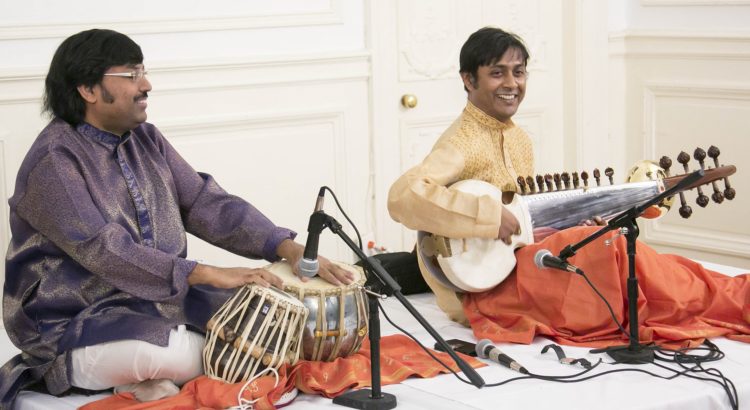
Strings of India

Hindustani classical music is developed through two interwoven elements: Raga and Tala. Raga is a melodic element and is crafted by improvisation on fixed patterns of ascent and descent. Tala is the rhythmic structure on which the melody is laid.” So to my understanding, Tala is the template to which Raga molds in the artist’s own creative original way.

The Strings of India concert this past Friday in Ann Arbor expressed this style of music using the Sarod,  a 25 string fretless ethnic instrument, and the Tabla, a membranophone percussion instrument that plays by unique configurations of the palms and fingers and requires constant retuning. Two artists dressed in traditional Indian attire sat poised at the front of the orange and yellow accented Hussey Room, one with the Sarod and the other with the Tabla. This genre of music was new to me. To be candid, I felt pretty naive hearing this performance. I had no gauge of what was considered good Indian music; I had never listened to it. Basic questions filed through my head. What are these instruments? Well, I could deduce that a 25 string instrument must be difficult to master. Playing my 6 string is hard in itself, and I have frets to measure where the notes are…so imagine more than 4 times the strings on a guitar minus the indications of the notes given by frets and that roughly equates the complexity of the Sarod. The Tabla looks like a simple goatskin circle that generates different sounds depending on where you strike it…so knowing where to strike it to produce the desired output must be quite a feat. How good are these guys on stage? Turns out, the two gentlemen before me were globally recognized as prestigious musicians, and I had hardly understood the magnitude of their talent until this Friday. Apratim Majumdar, the Sarod player, and Amit Kumar Chatterjee, the Tabla player, have very strong, extensive music backgrounds and are prominent in the music world. They have celebrity status in India (I confirmed this with a coworker from India), and after listening to them gain momentum in their performance, their remarkable talent becomes obvious.

It’s amazing how different the lives of these musicians are from mine. Their practice focuses on intimate time with just themselves and their instrument. Mine is based in the Ugli, study collaborations, and standardized tests. I wonder how they chose to dedicate their lives to mastering an instrument. I wonder if their interest ever tires after hours and hours of rehearsing. I wonder if there such thing as being the best _______ in the world. Best Sarod player. Best Tabla player. Best surgeon. Best chef. Best employee. Best friend. Is being the best based on statistics…or what? In that case, how can you test music in a statistical way? Maybe by the accuracy of notes…no! Hindustani classical music is improvisation. Thus, there is not a standard correct way to play because there is no script for them to follow. Surgery faces complications in the case of emergency so the surgeon must improvise. If every chef followed the same recipe, all food would taste the same. Chefs improvise. Employees don’t deal with the same exact case every day so they improvise. Every friend is different and so are his or her experiences, so friendship adapts to these changing circumstances by improvising. So how can we grade each other based on a standard when life is improvisation?????

I’m thankful to be at a school that fosters my interest to explore the world through art and music in the closeness of the city I call a home, Ann Arbor.

Special thanks to SPICMACAY, the Society for Promotion of Indian Classical Music and Culture Amongst Youth. I and crowds of people are able to see performances at the University of Michigan by Indian artists from across the globe for free because of this group’s efforts. Through events like Strings of India, the organization promotes an understanding of the richness and depth of Indian culture and has expanded immensely since its establishment in 1972. Groups like this help make a big world feel small.

Here’s a video of one of Apratim Majumdar and Amit Kumar Chatterjee’s performances.


Wish Fulfillment

“What would you wish for?” It is a question that I have asked of others and of myself countless times. Sometimes, it is all finished within a laugh. We blurt out fantastical inventions with barely a thought spent. Sometimes, we treat the question as if a fast-talking genie was awaiting our orders. It is a game that is endlessly fascinating because the answers tend to change every time we ask the question. It is also an endlessly useless game because the things that we wish for are seemingly unattainable. After all, if we believed that we could achieve this wish through hard work, we would have chosen something different. The game doesn’t just reveal what we desire; it reveals what we believe is impossible. So, we wish for piles of cash to rain down upon us or for carefree voyages around the world.

Aladdin, for the most well-known example, wishes to become a prince so he may gain Princess Jasmin’s hand. But even as a child, I knew that Aladdin simply had to present himself as he was to gain the acceptance he desired so desperately. Aladdin knows what he wants. He simply doesn’t know how to gain it. Perhaps he should have wished instead to have infinite knowledge. Yet, the movie posits this, too, as the wrong approach. Infinite cosmic power, after all, comes with an itty-bitty living space. The movie ends with Aladdin relinquishing this power to face the future on his own. I think this speaks to our desire to be challenged even as we want things to be easy. We want to triumph, but only after we feel like we deserve it.

It seems so often, though, that no one gets what they deserve. I look at the world around me and see injustices everywhere. I look at the world around me and want to wish it away. But when I close my eyes to imagine this as a better place, I realize that I would be a cruel and unjust god. For my wishes are arbitrary, subjective, and worst of all, vague. I recognize, like Aladdin, that I am not omniscient, and thus, my wishes will likely cause many unintended consequences. But perhaps, this is the inherent value of wishes. I can pretend at omnipotence, if only for a moment. A wish is not simply an expression of desire. A wish is something deeper, a dream of infinite possibilities that we can use flippantly.

Yet for all my endless speculations and formulations, I have not answered the most important question of all. “What would YOU wish for, Corrina?”. I could wish for world peace. But peace can be achieved easily under a dictatorship. I could wish for personal happiness. But one happiness can come at the cost of many others. Perhaps I will wish for something simpler: a beautiful, turbulent life and some good people to enjoy it with.

A Travesty Against Intellect

“Philosophy is the childhood of the intellect, and a culture that tries to skip it will never grow up.”

–Thomas Nagel


Perhaps this quote does not lend itself to the interpretation that I will now transpose upon it, but it is the invocation upon which these musings are built, so I will include it nonetheless. Being in college as and English and Philosophy major is such a strange thing. It is freeing and exhilarating to be immersed in subjects which I was told, or at least systematically conditioned to believe, were useless. But somehow studying them more has not made them more “useful” to me. I do not think they would even be “useful” if I were to go on and become the world’s greatest contemporary philosopher or the next bestselling author or the most sought-out keynote speaker. The thing with these subjects is that they are by their very nature inconclusive and therefore hold no real “usefulness”. Useful things have an end goal, they have a purpose which can be perfectly traced like the mechanical parts in an IKEA instruction manual. But english and philosophy will only allow you to bask in the glorious and magnificent enquiry of human existence. That is practically useless.

They both seem to be two wildly selfish disciplines. They aim to satisfy insatiable and snowballing curiosity. To want to understand the world for yourself holds no innate goodness unless you intend to act upon that knowledge. There is no moral worth in knowledge unless it is applied. And so philosophy and english, for me, as Nagel said, are both the “childhood of my intellect”. They are my selfish vices to inconclusive understandings and problems I will always flirt with but never love.

But Mr. Nagel, you are wrong about one thing– if we want to “grow up”, we cannot altogether rid ourselves of the childhoods of our philosophy. We must live both as adults and as children, as vice and virtue, in order to be complete. To be either only adult or only child is a travesty against intellect.