
Public Figures

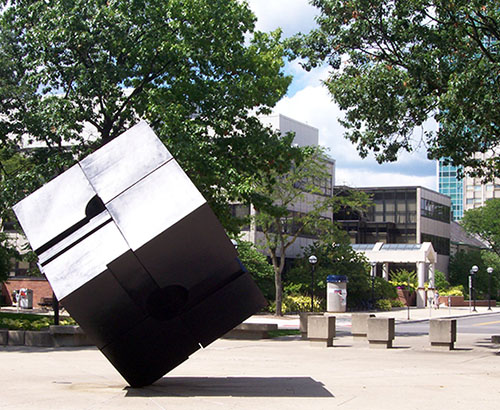
While searching for information on the Cube, I found the website for the President’s Advisory Committee on Public Art. The Committee works to sustain installation and maintenance of public art around campus. Most intriguing, to me, was the assertion that “outdoor sculpture should be an integral part of the educational and research mission of the University”. I have often had both the blessing and the curse of crisscrossing the campus throughout the day, and thus, have probably scurried around these various artistic endeavors more times than I can count. Every time I walk to the Union, whether it is for my daily dose of caffeine or another inefficient study session, I am dwarfed by the Cube or the crossed red beams of the Orion. Less obvious, are the numerous façades on buildings such as Hatcher, Rackham, or the Ruthven Museum. Placed high above, they are brief splotches in our vision as we approach and pass through the brick walls. Then, there are the varied others: the benches, the fountains, the statues.

It is all so easy to take for granted; for I know that come tomorrow, they will still be there, awaiting me. They are patient, unlike the countless that have rushed by them over the years. During the day, they are constantly busy, constants in a bustling Central Campus. But at night, they must become lonely, with only the occasional visitor back from the library or party. Tired eyes don’t see well and cannot offer any admiration in the dark. So they wait, as anxiously as I, for the return of the sun, when they can be glorious once again. The cycle repeats, year after year, decade after decade.

Even if they are oft ignored, public art works have never been useless. In fact, they are all that we lack. They are constantly present, which is more than can be said about people. People pass too quickly. Blink and they disappear. For people, this University is only a temporary place, a jumping off point for bigger and better. Public art, on the other hand, cannot move from their designated place. They must live their eternal lives as they were built. Thus, they can act as an orienting, dependable force in a constantly shifting environment. At the same time, they are constantly adaptable, too. They easily morph to suit each individual desire. I will never see the Cube with the same eyes. Each day it becomes something new. Perhaps tomorrow, I will notice a new feature that had been there all along. Perhaps I will return twenty years later with my hair already graying, and remember exactly how I felt that very first day of orientation, the day I was introduced to the soaring beauty of the campus. Although I will only be at the University of Michigan four years, I know each and every one of those days have been made better, more satisfying by the inclusion of art, even though I may not have had the time to properly appreciate it. But that is alright. Public art is not ostentatious that way. It does not demand anything of us. But it also forms the very heart of the University of Michigan.

Interdisciplinary Arts

The dictionary definition of interdisciplinary is relating to more than one branch of knowledge. As a first year student at Michigan, I have learned to appreciate this integral part of the academic structure as related to my classes.

I knew before I came to Michigan that I wanted to pursue both design and English, and I decided to enroll in the Multiple Dependent Degree Program. I am aiming to get a BA in Art & Design in Stamps as well as a BA in Communication Studies in LSA. I aspire to have a career in creative direction and graphic design, and my interests span technology, media, English literature, and pretty much all things arts-related.

Within my freshman year classes, I have already used the unique opportunity to combine studies. Although I am not enrolled in another interdisciplinary program, I love that my classes give me flexibility to use knowledge and tools from other areas of academia to supplement learning.

For example, I began composing music in my 4D (Audio/Video/Time-based projects) for my videos, which made me appreciate my music background more and inspired me to incorporate composition into my Methods of Inquiry class. I also joined the Campus band, which allows me to keep playing clarinet, since I knew I would not be studying music in college.

Furthermore, the Stamps School of Art & Design is well known for its interdisciplinary approach to art. They encourage students not to dwell on one subject, but to explore other artistic mediums and areas which intersect with society. Foundation year, although overbearing at times, pushes the idea that art and design are interconnected, and that knowledge of cultural, political, social, and economic contexts is essential for learning about and producing creative work. If I had gone to another university, perhaps one not as large as Michigan, I probably would never have thought about touching clay, or writing music for an art class. I could do research, or take business classes, or have an on-campus internship. I truly appreciate the freedom of this education and encourage students to take advantage of all that Michigan has to offer.

Passion to Profession

I asked my Creative Writing professor a question that I think about so often– “How has the act of writing changed for you now that you it as a job?” One of the things I fear most about the future is the translation of my passions into my profession. My professor responded with an honest and real answer: He said reading had changed so that he was constantly scouting for techniques and strengths in the text as assets to replicate in his own… that the act of reading had become, more or less, a refined practice of study, and the act of writing a regimented and structured act upon which the framework of the rest of the day was built. “The awed and raw fascination of it all, of reading a new short story, or gawking at characters for the very first time…” he explains, “I suppose it is not gone, but it is different.”

This terrifies me. I didn’t have to even ask him for this answer– I knew it would be the reality. I cannot imagine looking at the world as a writer through the eyes of a mathematician or a scientist, constantly trying to pin down the variables and processes that will perfect my writing. Joy and passion are the chemicals of the artist, and once that is jaded… what have you? Just work, is all. Just another thing to do. Just another monotonous action to defy time, to defy death, to fill the voids of existence.

As an individualistic society, we are taught to pursue those things which satisfy us internally, but the problem with passion is its flightiness, its restless reincarnation from person to person, until we are halfway through our lives sitting behind a cubicle at some editing firm squeezing in time between coffee breaks for our latest novel, telling ourselves that this is it, this is the one, the same thing we’ve told ourselves for thirty years– or we’re giving another speech in front of a crowd of college students who are rapidly firing questions about our latest best-seller, and repeat the same twenty answers that we’ve given for years now, and head home to fulfill the rest of our day’s writing quota.

Maybe this is all a grossly amateur way of looking at things, but I know one thing for certain– I cannot possibly allow myself to lose that wonder and awe for everything that I love. No matter my success and my relationship to my work, the act of creating has intrinsic value, the strong declaration into the universe that I was here. I existed. And I suppose that it is work– it must be– but so long as I never lose that rose-colored lens, so long as I never look at a work of art as anything less than divine, I suppose it will be okay. And we don’t do it because we get attention or compensation… we do it because, as my professor said, “It is central to our self-concept. It is who we are.”

New York City Ballet

Over spring break, I had the opportunity to watch New York City Ballet perform an evening of George Balanchine’s work set exclusively to Igor Stravinsky’s music. The program featured four works and lasted about two and a half hours.
New York City Ballet is one of the foremost ballet companies in the world. They’re known for their speed and neoclassical style, and the majority of their company members train at the School of American Ballet before joining the company. Being able to watch them perform was breathtaking. With each step they took, they exuded lightness, brightness, and virtuosity.
So often, concert dance proves to be inaccessible to most mainstream audiences. The dance doesn’t always have a narrative or an easily understood meaning or moral. Often times, there are no words, leaving movements up to the interpretation of each audience member. Coming to terms with this kind of ambiguity and lack of a “right” answer can be difficult for new dance audiences. However, I think that New York City Ballet did a great job of bridging the gap between new and old audiences. Their work was both accessible to a first time viewer (my mom) and complex. Their casts featured well established and prominent ballerinas such as Tiler Peck and Megan Fairchild, as well as several corps de ballet members and soloists.
This concert made a big impact on me because it was so heart warming to be sitting in the audience of a sold out Koch Theater in Lincoln Center. It gave me a feeling that no matter the political environment, the arts were still alive. There are still people willing to do the work as well as people who are invested in supporting the arts. There was still a community of people who believed in the arts, in the hope and joy they provided, and that was the best part of the concert. The dancers transcended the outside world-they gave hope and happiness to the audience.

Technology in Entertainment

New technology can change an entire industry.  In the entertainment industry, the invention of the camera, and then the video camera changed the way that people consume there entertainment.  The most popular form of visual entertainment used to be plays, until the video camera came along and people became fascinated by movies. Technology has changed the way that people consume media throughout time.

For a long time the most popular form of live entertainment was plays, and operas.  People would go to a theater to have a day of entertainment of long plays by Shakespeare or other famous playwrights.  Once the video camera was introduced, plays and operas declined. The general public was fascinated with the new medium of entertainment that the video camera brought.  Plays and operas eventually found their niche audience, and have stayed in the spotlight. The niche group that plays and operas found was an elite group of people. Plays were for the highest class of people and not very accessible the general public.  This stigma is still attached to plays and operas, but it is smaller than it once was. Now plays will travel around the world so that everyone has an opportunity to enjoy their work.

Video cameras were a huge development in the entertainment industry.  Movies became very popular for the entire public, not just one demographic.  Movies popularity grew with the number of movie theaters that were added around the world.  Movies were much more accessible than plays were because people only had to travel to their local movie theater and not the nearest performance theater.  Movies were also much less expensive than plays so all types of people had the opportunity to enjoy them. With the innovations of video cameras also kept movies in the limelight.  From silent films to speaking films, then from black and white to color, and then the video quality continually improving, and finally with the introduction of the 3D movie. These innovations kept the movies new and exciting for everyone.  The theater didn’t have as much innovations as movies, which could contribute to why its popularity did not grow like the popularity of movies did.

Playlist Poetry

Like many people, I take a lot of pride in my playlists.  It’s a great feeling when you find songs that sound delightful together, despite them being pretty different.  It’s like finding two puzzle pieces from different puzzles that somehow match up perfectly.  While I’m a total believer in listening to albums in their entirety, I also think there’s a beauty in strolling home from class listening to a combination of different sounds that you curated, kind of like your own personal life soundtrack.  So, naturally, when I was trying to think of what to write about today, I turned to my new playlist.  Its a very short, 5 song playlist, but I thought I would walk you through it, and share some new and old songs that I have completely fallen in love with.

TRACK 1

To start off, I have a song that has been in my favorites since this summer called “Dog Years” by Maggie Rogers.  Ok, I admit, the only reason I initially listened to this song was because she has the same first name as me.  Sorry, I guess I’m vain!  But, she has become one of my new favorite artists.  Her songs blend electronic and folky sounds, two things that would not seem to fit, but somehow in her music it makes perfect sense.  I fell in love with this song initially by watching the music video.  Anyone who has spent time Up North in Michigan will totally connect with this video as she walks by lakes and through forests.  This song achieves the paradigm of being peaceful yet so incredibly free spirited at the same time.

TRACK 2

Next, we go to a full on folk song (my jam to say the least).  I was so excited when I found this song, because I feel like I’ve spent my whole life looking for a modern Joni Mitchell type.  She’s my absolute favorite, and it seems there are very few like her today.  But the song “30” by the Weather Station perfectly encapsulated that style.  The lead singer, Tamara Lindeman, has a high and soft tone that Mitchell is so famous for, as well as her amazing ability to pack what seems like a million poetic words into a song and still not have it sound rushed or too jammed.  They are not identical to Mitchell though, they do they’re own spin on the style, and definitely differ from her with the amount of electric guitar they use.

TRACK 3 

Of course, we always need an oldie in a playlist.  I chose Simon and Garfunkel’s “A Most Peculiar Man”, the 1967 live from New York version.  I chose the live version because I lover hearing Paul Simon talk about it in the beginning; I’ve listened to it so many times that I know the words he speaks before hand as if they were lyrics in the song.  This song is just perfectly sweet and melancholy. There’s beautiful guitars and harmonies, and Simon’s lyrics are completely enticing, as always.  Enough said!

TRACK 4

José González has been a favorite of mine for a long time, and when I realized he had a new EP out this year, I was ecstatic.  The song “Afterglow (with the Brite Lites)” is my favorite of his new songs.  All of his music, especially on this new EP, is incredibly rich and layered, with many guitar and singing tracks that create beautifully haunting harmonies.  Its hard to describe why I love his music so much, but I just feel like it has a heavenly aura that I absolutely love.

TRACK 5

I always like to finish it off with an instrumental.  So lastly, we have “Sunflower River Blues” by John Fahey.  I really have no idea how I came across this song, but it is perfection.  I just love the simplicity of a person and their guitar, and how just that can make a complex song.

If you would like to listen to this playlist click the link below and enjoy.  Or, take a good 30 minutes to make your own playlist that is the musical definition of you.