Winter 2018 Olympics: Bobsledding

The Winter Olympics are getting closer and people are beginning to pay more attention to the sports that will be featured in them.  Most of these winter sports are only highly publicized every four years during the Olympics.  An example of this is the sport of bobsledding.  Bobsledding is a sport that most people have heard of and know the general concept of what it is without knowing many details about the athletes or logistics and scoring of the sport.  The sport gets minimal media attention, even throughout the Olympics because it is overshadowed by figure skating and snowboarding.

There has only been one movie made about bobsledding, “Cool Runnings”.  It is about the first Jamaican bobsled team and how they were formed, practiced, and eventually made it to the Olympics.  The movie shows the basics equipment, requirements, and skills needed to compete in the sport.  It also states the basic rules and possible qualifying times to make it into the Olympics around 1993.  It is more of a fun team building and friendship movie than an informative bobsled movie but it did help to expose more people to the sport.

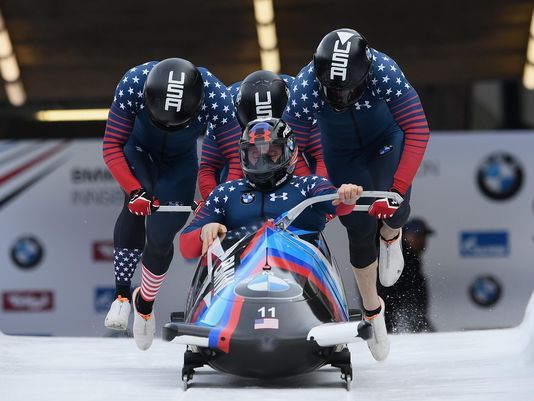
In all bobsleigh events there is one driver and at least one other person in the sled to help with the momentum of the sled as it travels through the course.  The driver has to turn the corners and lean the sled at the perfect angle for the sled to not lose momentum during the race, and the other members in the sled have to lean along with it to make the sled steady.  The driver of the team has to memorize each course and the angles of every turn to be prepared before he/she even gets to the event.

There are three different bobsleigh events: four man, two man, and two women.  The four men race can be man and/or women.  The four man bobsleigh event has been a part of the Winter Olympics since the first one took place in 1924.  The two man bobsleigh was added in 1932 at the third Winter Olympics, and the two women bobsleigh was added in 2002 at the nineteenth Winter Olympic Games.

For the 2018 Games the center that the race takes place is also the venue of the luge and skeleton races.  All three sports use the same track with the course length being adjusted per sport.  All of the bobsleigh events use a course length of 1,376.38m, or 0.86 miles.  The average slope of the track is 9.48%.

Bobsledding is only one of the many sports that are only in the spotlight during the Winter Olympics.  Even during the Olympics they are still overlooked and out shined by other sports like snowboarding.  But throughout the years the viewership has risen thanks to the movie “Cool Runnings”, and with time it will hopefully become more popular.
Beyond the Marquee

I grew up watching movies everywhere. At first, I consumed them mostly at home, begging my Dad until he popped in the VHS tape of The Sound of Music or Babe in the City.  As I slowly learned the ways of the DVD and then, the Blu-ray player, I spent even more time watching my favorite flicks repeatedly. Outside of the home, our family weekend trips consisted of traveling to the IMAX theatre to watch the latest nature documentary on a screen that was twenty times the size of our television’s. But I didn’t care about the increased visual or sound quality. I just wanted more. I’ve watched movies on computers, on iPads, on phones. I’ve watched them on planes, on trains, and automobiles. Trips to the theatre became special occasions for certain types of movies, such as the latest superhero extravaganza or Star Wars film. For one, the explosions of red fire and blue lasers always looked impressively large on the screen. It also became a race to avoid being spoiled by overzealous pop culture sites and YouTube channels, all who obsessively covered these blockbuster films and little else. For a student with limited means, $14 movie tickets had to be carefully rationed throughout the year. Any other films were added to my growing list on Netflix.

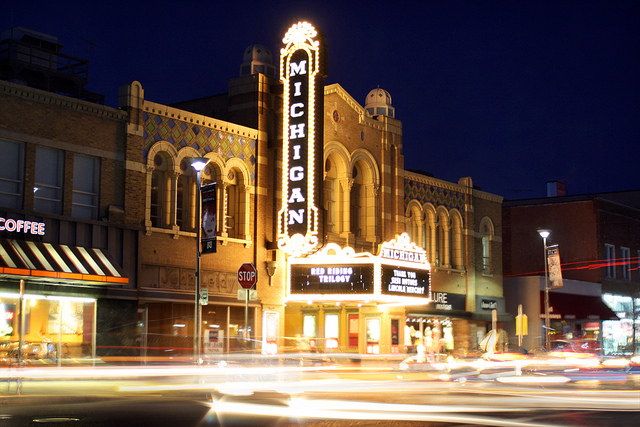
Recently though, I have questioned my assumption that some movies were destined to be watched on the small screen. It may come with a thousand little annoyances, but there is something irreplaceable about the theatre experience. When the lights dim, I allow myself to sink away from reality. I let my grip on my own ego slip away and become a puppet of the movie and its director. The darkness is crucial. It allows me to feel without reservation, cry and laugh without worrying about the judgmental glare of the light. My connection with the outside world is severed in other ways also. With my phone stashed away in a pocket and with a safe distance established between myself and my homework, I can stop thinking about such mundane worries as school or text messages. This is sadly lacking when I watch movies from home. Tempted by the sudden vibration of my phone, I will pause and start a movie like an overworked engine. I will stop for a snack break or a stretch, actions unimaginable in the darkened atmosphere of a theatre. I write this piece because 2017 had the lowest ticket sales since 1992. I write it because I hear my classmates talk excitedly about the newest season of Black Mirror or Stranger Things 2, but not even mention Lady Bird or The Shape of Water. The latter two aren’t available outside of theatres, the former ones are readily accessible to anyone with Wifi and a Netflix account. It worries me that in a town with two theatres and student discounted tickets, that most haven’t found their way past the brightly lit marquees. Most of all, I worry that the bubbling anticipation in my heart as I settle into a theatre seat, will be left lost and unshared.

A New Year’s Resolution

Recently, as I was sitting on the bus on the way to my next class, I overheard two students talking. They had just come out of an introductory level non-majors dance class, and were speculating about what a day in the life of a dance major might look like.

“I bet they never have homework.”

“Yeah, and I bet they start at, like, noon.”

“I wonder if they even need that many credits to graduate.”

“What do you think they even do after college? Will they just, like, not make money?”

I was taken aback. I will admit that as a dance major, the majority of my friends are other artists within the School of Music, Theater, and Dance, and, as a by-product, I am surrounded by their ideas of art all the time. However, this conversation caught me by surprise. While the role of art and artists in society are generally misconstrued and misunderstood, there is no question: being an artist is a job. A real, legitimate, challenging job, just as being a banker, or a doctor, or a teacher is a real, legitimate, and challenging job. Similarly, being a student in art school is just as challenging, sleep-depriving, and difficult as being a student studying liberal arts or science.

Many of us are pursuing second degrees or minors. Many of us juggle full credit-loads on top of rehearsals, performances, and crew hours. Many, if not the majority of us, have stayed up into the early mornings to finish papers, lab reports, and readings.

I could talk for a long time about the legitimacy and difficulty of completing a dance major. I could talk about the fourteen hour days and the weekend rehearsals; the running across campus to make it to class and the dance clothes that I wear underneath my clothes at all times. However, the larger issue at hand is this: artist are people too. The arts is a viable career field. What we do is not easy, and what we do deserves the same respect as any other job.

I do not say these things as a criticism of the two intro students; I am sure they were legitimately curious and unknowing. However, the importance of continuing to educate the general public as a means to change how society views the arts is incredible. This is 2018. The year that the arts start to be recognized for what they are: essential.

AC Slater to Start the New Year

Even when it’s 3 degrees out, Detroit cranks up the AC. On New Years Eve, the Magic Stick hosted one heck of a 2018 welcoming party, featuring Sonya Alvarez, Golf Clap, and AC Slater. At 9pm, the wooks begin flooding through the doors of the club, dressed in their pashminas and their grunge tees, greeted by the intoxicating juggles of the young Sonya Alvarez. She has zoned into her own space of mind on stage, totally cool and comfortable. Accompanying her and her opening music is the early signs of an evolving electro concert: a women distributing glow bands, a smoke break on the deck, and a slow head bob. It starts with a slow bob from the crowd. Soon after the ring of new year, AC Slater meanders on stage as if he is not the main act when in fact he is, but rather another guest of the party. With the groups of VIPs on stage, he makes conversation with smiles and suave while Sonya closes out with her last track. Then, the AC steps in front of the booth.

So, it starts with the slow head bob when the beat of the music syncs with the beat of your heart. Then slowly, your entire system accelerates at the rate of the noise seeping from the speakers until the sound of imminent explosion has you on edge so much that you must contain the urge to break out in crazy motion…

and then,

the tempo rises more and more when

the bass drops.

I look around, and what was once just a dark empty room has become an illuminated oasis for music lovers. Everyone is engaged. Everyone is dancing. Every single person. Even at the doors and behind the bar, the bouncers and bartenders have the head bob. That’s the thing about this genre: everyone is there for the music. Maybe at a pop concert, people go to the venue for a social experience (not always the case, but from observation), but here, it’s about the bass. It charges the crowd with unmatched electricity. Amongst these people, anything goes. When Golf Clap comes on at 1 in the morning, he is another one of us, just plunges right into the break. He too intoxicated by the beat. At one point, I jumped on stage and danced next to AC Slater and Golf Clap’s booth without any insecurity of how I may look. There is no such thing as not fitting in because there is no mold for whom can attend or what you should wear or how you should dance. It’s about the bass.

Winter 2018 Olympics: Figure Skating

The winter Olympics are in February, and the big sport to watch is always figure skating.  There are so many variations (women, men, couples) that figure skating will be on for the entire two weeks of the Olympics.  A big change has been made to the figure skating rules that the audience will surely notice.  The skaters are now allowed to have words in their music for their routines.  This will create a new dynamic to the figure skating competitions.

Popular figure skating music in the past has been to popular music that is easy to recognize without the words.  This includes popular movie soundtracks like “Pirates of the Caribbean”, or popular songs from musicals like “The Sound of Music” or “Fiddler on the Roof”, or even popular hit songs like “If I Were a Rich Man”.  Classical music is also a popular choice for figure skaters.  These songs appealed to the crowd because they could enjoy the figure skating routine and the music.

The International Skating Union allowed for words to now be incorporated in their music to try and innovate the sport.  Figure Skating was losing viewers and made this move to try and attract some new fans.  Now the skaters can skate to new and popular music that more people can recognize. Some skaters, like Jimmy Ma, are embracing the change and skating to very modern music.  Ma has performed to an Eminem medley and to “Turn Down For What” in the past two years.  He has said that his choices of music is to bring in more fans and to show that figure skating is a cool and modern sport.  His goal is to turn some heads and get people to pay more attention to ice skating.  Others music choices aren’t so bold, they still have lyrics in their routine but nothing too modern or different for the figure skating world.

Though many are embracing this new rule, it is not a requirement.  Skaters can still skate to instrumental music, it depends on each skaters preference.

Unsaid

I have been thinking recently about all the words that we leave unsaid. All the thoughts that we don’t dare give voice to because they are too strange, too embarrassing, too true. We say other things instead that are less burdened by meaning. We say things that may only half-convey all that we are feeling, especially to those we feel the most about. Perhaps I have always assumed that those who love me, who know me don’t need the affirmation of mere words. My parents must know that I love them. My sister must know that I miss her. So, I don’t say these things as I leave them standing behind those flimsy elastic barriers at the airport. But I remember that moment later, when I’m on the plane, on the bus to Ann Arbor. Of course, I will have the chance to tell my parents that I miss them, that I love them, that I will return in a few months. I am lucky because I have technologies within arm’s reach that would be impossible to imagine even fifty years ago.

There are so many moments to come. But I am so afraid that I will ever be able to express what they mean to me. I haven’t told them about that one grey morning last semester, when I woke up aching for the aura of security and comfort that I feel when they are nearby. I haven’t told them about all the late nights, when I have wished myself back home. This was my decision, after all. To come to college more than two thousand miles away. To plant myself in a new land and prove that I could grow independent and strong. But there must be some weakness within me, for I cannot find the words to say.

My parents don’t know how to find this blog. Yet more words that will be left unheard. I imagine their silent, inky forms floating all around us. Their weight pulling down elevators of reticent passengers. Their shapes clogging the air between two strangers sitting side by side, for hours without paying the barest attention to the other. And other times, words come all too easily. They turn the air red with their anger. Those are to be regretted too, in time. Either said or unsaid, words haunt me with their subtle power, their dangerous potential. And they urge me to speak.