Three Billboards Outside Ebbing Missouri – Quick Reflection

I went to the Michigan theater at 4 this afternoon to see Loving Vincent which had sold out moments before I arrived, so I stood alone looking at a list of other showings. I turned around to see a good friend of mine also standing alone looking at a list of showings.

Turns out, my other friend likes to see movies by himself, too. He intended to see the Vincent Van Gogh movie today, but faced the same fate as I did. Both wanting to make use of our time at the beloved theater unfortunately without Vincent today, we bought two tickets to Three Billboards Outside Ebbing Missouri.

And the two of us went to the movies alone together.

Three Billboards Outside Ebbing Missouri is dark comedy crime film written, produced and directed by Martin McDonagh. After months go by without investigation of her daughter’s rape and murder, Mildred Hayes (Frances McDormand) purchases three billboards, each painted with a bold messages that challenge the Ebbing police department in hopes of capturing their attention to find the culprit of the crime. Not only do the police notice the billboards, but news casts turn their attention to the billboards. Soon, everyone hears about the Mildred Hayes billboards.

https://www.rogerebert.com/reviews/three-billboards-outside-ebbing-missouri-2017

Without spoiling the ending, I will say that this provoked real emotions. There isn’t a perfect character or predictable plot line. There isn’t a happy ending. In fact, there is no evident conclusion at all. In a story like this, however, the conclusion is irrelevant. Too often I think we focus on the actual outcome of an obstacle that we forget the process that is involved to reach that ending. You hear it all the time: “it’s about the journey not the destination”. In the midst of frustration, it can be difficult to remember this, especially something as disturbing as the Angela Hayes case. The only thing on the mind is to solve the crime. Life does not provide instant solutions to these issues. This film teaches viewers that without the battling and boldness, vulnerability and doubts, the story would never develop how it does. Without subjecting herself to hatred from some people, Mildred Hayes would have not made progress in her daughter’s case. Despite the seemingly endless setbacks, she stays determined. This is perhaps the loudest message to be taken from the film. To relate this to a more common instance we may face, let’s say you are having a debate with someone. Initially, you may state your opinion, but it is unlikely that they will immediately adapt to your way of thinking. Everyone has their own feelings and opinions, and to permeate through these feelings is not an easy feat. Before entering the discussion with the other person, have a purpose for your words. Why do you want them to see from your perspective? Why is it important to you? Why is it important to them? You must follow reasonable points along the way to guide them to understanding your end goal. Likewise, Mildred Hayes has a purpose to find the culprit, but she does not directly to the police for the answer because, clearly, that had not worked in the past. Instead, she follows a process to engage them. Now, I don’t know if the other person will ultimately see from your vantage point. However, if this is conversation, you may have learned a thing or two from his or her vantage point. Though you may not see complete results right away, odds are you have made progress. Keep going.

 

Personalize Your Holiday Gift Giving

When people hear the word “art” they think of paintings, photographs, sculptures, music, or maybe movies.  But not paper.  People commonly think of paper as a mode to transport art, or a medium that art is displayed through, but they don’t think of the paper itself as art.  Cards a common form of a present to loved ones, whether they are store bought or handmade.  This holiday season make cards extra special by creating the whole thing by hand,  even the paper.

The kerrytown bookfest in Ann Arbor teaches people that paper itself is creative and can be a form of art.  There were stands that were dedicated to making paper.  The paper that these stands were selling looked vintage, like the paper you would see a medieval letter written on.  Each piece was different and they all varied in colors, size, and even texture.  The texture, thickness, and color of the paper depends on what it is made out of.  Paper can be made out of different materials; the easiest material to make paper out of is other paper.  But it can also be made out of leaves, grass, flowers, or even a wasps nest.  Keep this in mind while making a card, and use the materials and colors that the recipient will love.  This uniqueness will translate well into a nice holiday card for a loved one, because they will see all of the effort and love put into it and appreciate it even more.

The people who worked at the Kerrytown bookfest were so passionate about there craft of making paper, they wanted to show and teach every person that worked by how to do what they did so that they could share in their happiness with this overlooked artform.  These people were more enthusiastic about their craft than most other professionals are about there job, and that is because they make paper because they loved it, and it is something they are truly passionate about.  It is no longer a necessity to make paper from scratch, it is much easier and less time consuming to go to the store and buy whatever size and color paper you want than to make it yourself.  But the paper we all buy at the store lacks the uniqueness of the paper that the people at the kerrytown bookfest put into their paper.  This passion and compassion will come through a handmade Christmas card, the loved one it’s made for will love the gift made with love.

Link to learn how to make paper:   https://www.wikihow.com/Make-Paper

The Perfect Thanksgiving Story

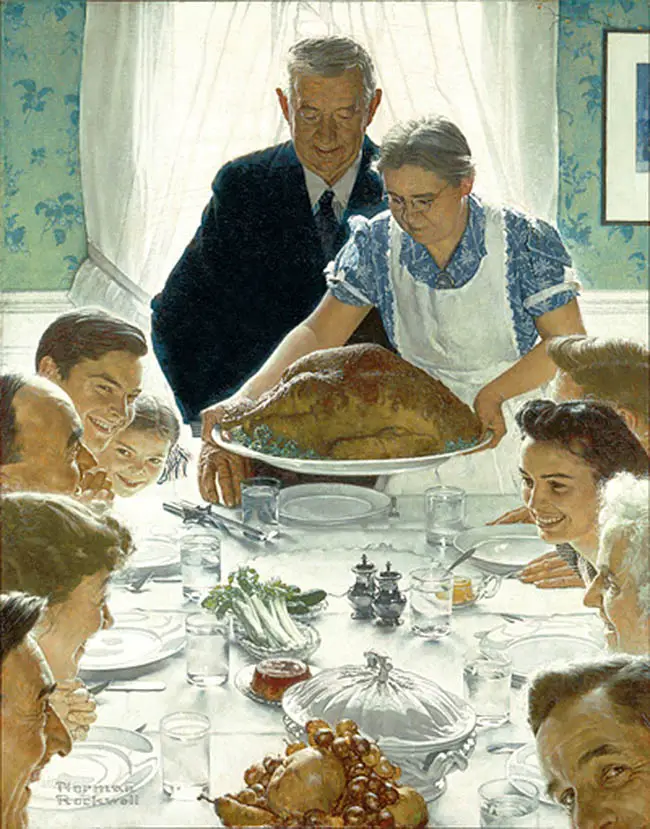
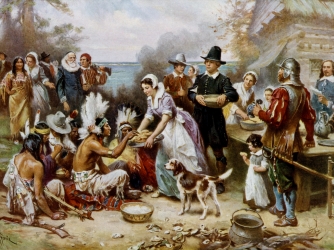
Thanksgiving has always been a holiday with a dubious history. You start at the foundation: the simple and heart-warming story of two cultures coming together to celebrate and give thanks. I remember cartoons of Pilgrims and their buckled hats and shoes sitting next to Wampanoag Indians in feathered headdresses. Then, layers of complexity. I learned that the hats did not have buckles and that the Wampanoag did not traditionally wear headdresses. I learned that Thanksgiving was an isolated moment suspended in a long history of violence that ended with one culture almost destroyed by the other. From there, the spirit of Thanksgiving has been appropriated for various causes from briefly uniting a nation divided by a Civil War to boosting holiday sales during the Great Depression. Thanksgiving has never been as all white, small town American idyllic as a Norman Rockwell painting would suggest. It is shades of grey and blood with a splash of commercialism.

Perhaps then the perfect Thanksgiving story is not the first one of Pilgrims and Native Americans sitting around a table. It is not even the story of today, the one of parades and football games and giant, over-fed turkeys. The perfect Thanksgiving story is one set in the distant future. Written by George Saunders, The Semplica- Girl Diaries tells the story of one American family struggling to keep up appearances. Like any father, the main character wants the best for his two daughters. He wants them to believe anything is possible. He wants them to live without the financial limitations that comes with his middle-class job. But at the same time, he exhorts the teachings of Thanksgiving, to be grateful for what you already have. Saunders presents two sides of America that are constantly at odds. Yet, both are quintessential to our history, inevitably tied together. The myth of Thanksgiving cannot be separated from the pursuit of constant expansion and Manifest Destiny. They are part of the same hazy American dream, one that we seem to be constantly pursuing without even realizing what it means. The protagonist of The Semplica-Girl Diaries, at first, doesn’t seem to realize the depths of his indoctrination. Perhaps that is the scariest thing. The way that we are told stories as children about the way life works, and how that story persists no matter what we are taught afterwards. That is why the Thanksgiving story remains so powerful. It reminds us of simpler times where differences could be resolved, at least for a day, with a few plates of mussels and some mashed-up corn. It allows us to ignore the war that came afterwards, the messiness of conflict. It gives us some semblance of redemption for past sins and perhaps forgiveness for future ones. We give thanks for what we have on one day, and return to our old pursuit of bigger and better on the very next day. It is no accident that Black Friday evolved as a secondary Thanksgiving tradition. As much as we would like to believe that we are grateful for what we have, there is also an instinctual urge for more. Like the father in the story, I am not sure that I can let go of that horizon that always seems to promise more. I was steeped in the belief that I could do more if I just reached a little further. That seems to be a hunger that not even endless platefuls of turkey and mashed potatoes could satisfy.

“Doki Doki Literature Club”: a weeaboo nightmare

After showing several warnings that this game is not advised for children and those with depression or anxiety, the 2017 video game “Doki Doki Literature Club” begins by almost boring you to tears with a typical story for a dating sim. You are a remarkably unremarkable male high school student in Japan with a love of manga. Your neighbor and closest friend, a cute and ditzy girl named Sayori, drags you to her literature club after school out of a shared concern for your lack of social skills. There you meet her equally cute friends who you are obviously smitten with as they fit anime tropes: president and queen bee Monika, tsundere Natsuki and mysterious Yuri. You are forced to play the game straight, meaning repeatedly playing an almost dull mini-game where you form a poem by strategically picking words from lists in order to win over the girl of your dreams.

In the droning rhythm of the game, little hints that something is off are something you shrug off. But they’re not quite subtle enough. There is clearly something wrong with the girls that they keep hinting at. And yet you must continue forward with the story, as you are rarely given the opportunity to engage the girls on a more personal level. The game starts acting wonky as well, and makes you start questioning your sanity. Does the cheerful music keep getting distorted? (Yes.) Are there supposed to be “errors” in coding that makes the normally sweet girls’ dialogue shockingly dark? (Yes.) Do the glitches when the girls appear scrambled or out of place happen intentionally? (Yes.) And yet you still feel secure as you continue this mindless journey schmoozing the anime girls as you discuss writing poetry, because nothing this pastel can get under your skin like it claims. Right?

Wrong. Spoiler alert: the horror in “Doki Doki Literature Club” is revealed slowly by undoing what you know about the story, and then goes a terrifying level further by undoing what you know on a technical level about the game itself.

The cute girls of the literature club all kill themselves and in a way that implicates you in their death. It is shockingly dark in and of itself to find out that each of them is hiding dark secrets. Sayori has been struggling with depression for years. Natsuki is neglected and physically abused by her father. Yuri cuts herself. The way these sweet two-dimensional girls are dealing with all-too real issues is shocking and unnerving.

Yet what is weird is that the errors in the computer game makes them reveal this to you. Sayori screams in pain when you share your interest in the other girls before she reveals she likes you. And then she hangs herself as the music distorts, restarting the game! Natsuki’s eyes change animation style as they pop and bleed after you give her a poem tailored with a different girl in mind. And then she snaps her own neck before her figure is pushed to the front of the screen, restarting the game! Yuri has blood running from cuts all down her arm after she gets excited and dashes out of class to be left alone. And then she clunkily stabs her otherwise static body after she confesses her feelings to you! No matter what you do, the game’s glitching pushes the horror from the imagery of the characters committing suicide to a profound moral guilt as you are made complicit in the demise of these girls who have no other choice but to love you. But it gets worse still. Why did this happen?

Because Monika knows you’re out there, and she wants you all to herself. Yes, you, behind the screen, even though she knows you may not be a boy and that the name your computer is registered under is not the one you used in the game for immersion. She did all of that to her so-called friends. For you. And so she proceeds to destroy all the sets and characters in the game until she is in a timeless void in space with unending time to spend. With you.

The unnerving obsession that is made grotesque in this game speaks to the excessive romanticizing of dating in general. Thankfully, I put the game to rest by deleting Monika’s character file on my computer, effectively killing her. This was a small feat, as the game hints at this time after time. But I could not kill the sleep-stealing fear she instilled in my heart.

Accompanying Movement

The role of an accompanist in a dance class can often seem to be a confusing one. Music is an integral part of almost any form of dance, and so the person or people creating that music must also be of importance. However, many accompanists are tucked away into a corner of the room, hidden behind a piano or drums. It can become easy to realize that they are as much a part of a dance class as the dancers themselves—they just aren’t dancing.

I began playing piano before I started dancing and grew up taking lessons at the University of Hartford, and decided last year to start training to become an accompanist myself. My time spent learning how to accompany dance classes has given me a whole new perspective on an art form that I spend every day immersed in.

As a dance major, I take dance technique classes daily, each with a live accompanist. Forming a relationship with the real, living, breathing person playing music for class is often passed over. Dancers take music and, oftentimes, the musicians that create that music, for granted. Recognizing the wealth of knowledge that each accompanist has about his or her art form as well as my own has opened my eyes to many new ideas. Often times, accompanists need to have a deep understanding of dance in order to play for it—they are a constant student, collaborator, and teacher in the dance classroom. Imagine having to learn how to understand playing an instrument just by sitting and watching day after day. That’s how an accompanist learns about dance.

My experience as an accompanist has been challenging, albeit exciting. I had to learn how to improvise to fit each exercise as the teacher gives it. Picking up movement and details quickly is a necessary skill for any dancer, and having to translate those details into a sound score appropriate for each combination has greatly helped my ability to pick up details in rhythm and musical phrasing. It has also helped me become very comfortable thinking of and trusting my artistic instincts and ideas. Having to constantly confront my improvisational habits has also pushed me to expand my musical and movement vocabularies.
Most importantly, my experience in accompanying dance classes has taught me how to not fear failure. In an environment in which you’re required to think on your feet, play something that fills the room, and set the mood of the exercise, there’s not a lot of room for second guessing. Sometimes, oftentimes for me at least, musical ideas don’t pan out the way you thought they would. Learning to accompany classes has allowed me to fail—and to pick myself up, start again, and succeed.

FreeForm 25 Days of Christmas

Thanksgiving is now over, meaning that it is officially the holiday season.  Stores are decorated, the radio is playing festive music, people are now buying gifts for the upcoming festivities, and TV channels are playing their holiday movies and TV episodes.  A staple TV holiday movie schedule is ABC Family, now FreeForm, 25 Days of Christmas movie schedule.  This is a month long event that people look forward to starting in October.  FreeForm posts the movie schedule in November for their viewers to get excited and mark their calendars and DVRs for when their favorite movies are playing.

The 2017 schedule is out and it is starting in 3 days, so it’s time to look at it now and prepare for a month of nonstop holiday movies and entertainment.  Starting on December 1st everyday from 7:00am to 1:00am there will be nonstop holiday movies.  There are hundreds of holiday movies to choose from for FreeForm to put on the schedule, but they mainly stick to the same 50 or so movi

Buddy the elf showing his holiday spirit

es each year.  The classics like Home Alone, Polar Express, and A Christmas Carol are always played several times throughout the month so that everyone can get a chance to watch the show.  The most popular holiday movie in recent years is Elf.  Elf is playing 20 out of the 25 days, so don’t worry about missing it because there are plenty of opportunities.

With FreeForm being owned by Disney, there are also a lot of Mickey Mouse appearances throughout the month.  Disney takes classic stories like A Christmas Carol and replace the characters with the familiar faces of Mickey and his friends.  Movies like these will be played several times throughout the month along with non-Disney versions as well so people can watch it both ways or just pick their favorite version and watch that.

The movies throughout FreeForms 25 Days of Christmas range from animated to live action, child to adult movies, and old to new.  Claymation movies are sprinkled in throughout the new animation remakes.  The classic Rudolph The Rednose Reindeer claymation is generally played at least once during the month.  This year The Little Drummer Boy will be played 5 times throughout the month for all those who enjoy classic claymation movies.  These claymation movies are generally more for adults who grew up watching them, children now enjoy the animation in the Polar Express and A Christmas Carol more than the claymation animation style.

FreeForms 25 Days of Christmas is a nonstop holiday party for the entire month of December.  Whenever people are feeling festive they can put it on and know that it will deliver.  It shows movies for every age to enjoy and for families to watch together.  Check the schedule now to make sure that you don’t miss your must watch holiday movie.

https://freeform.go.com/25-days-of-christmas/news/25-days-of-christmas-2017-schedule-full-list-of-movies