Have You Seen This New Sculpture?


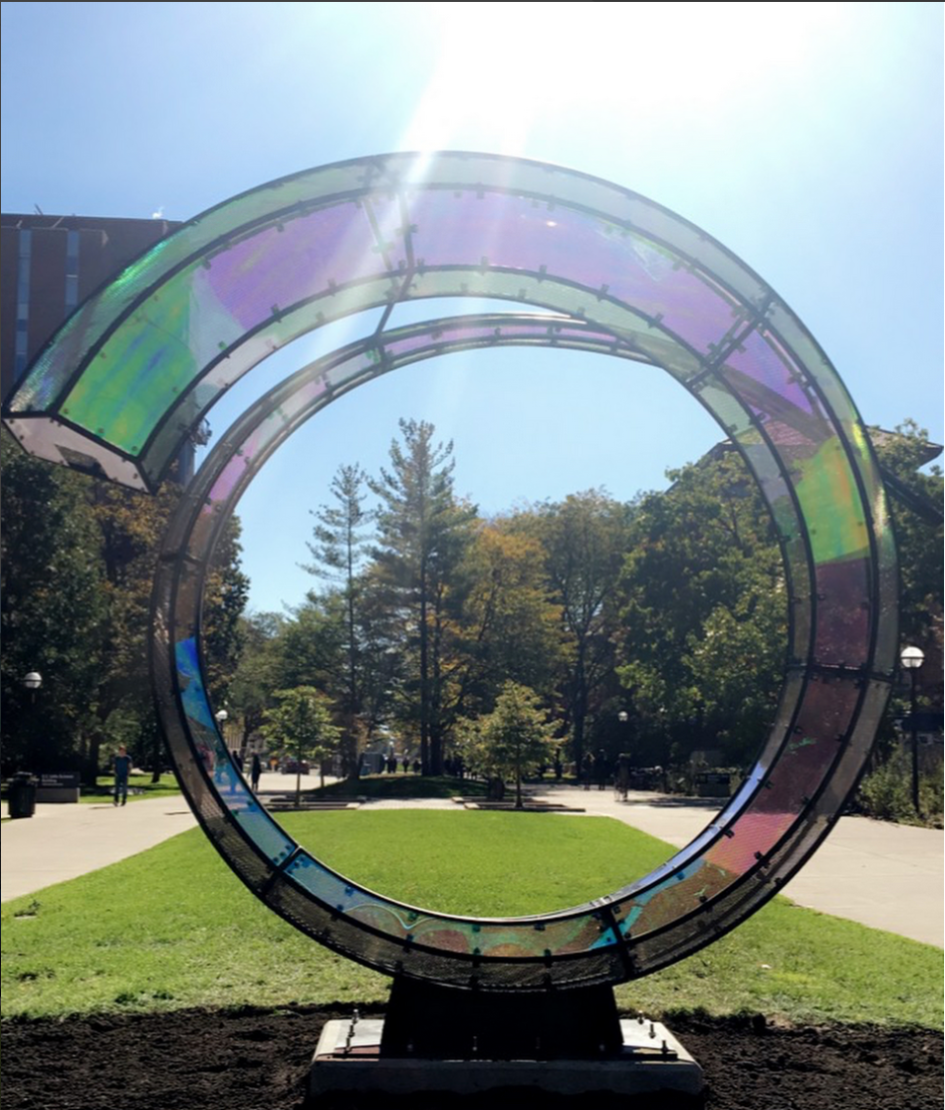
Has anyone seen this beautiful stain-glassed sculpture that was just recently put up by the Central Campus Transit Center??
As an architect, I am very intrigued by this structure. I have so many questions to ask about it!! But I guess that is the fun in creating and experiencing art in general… I’ll write my questions and attempt to give my own answer, so feel free to comment your thoughts, and ask more questions if you have any!! Also, give my instagram (@connecticuto8) a follow if you want to see more interesting views of our Michigan Campus!

Question #1: What’s with the shape?
Answer: Perhaps providing an interesting framed circular view (as depicted on the right), but not wanting to just use a basic circular frame for that view.

Question #2: Why all the colors?
Answer: Maybe a fun sort of way to symbolize the beauty of the ethnic diversity (like the diverse choice in colors in this sculpture) on our campus? And maybe experiment with lighting, in terms of how the different colored glass interacts with the sunlight to affect our perception of the framed view (shown on the right).

Question #3: Why glass, instead of other building materials?
Answer: If this project’s mission was to experiment with lighting, then this glassy material would definitely allow for that sort of interaction, since there would be light reflecting off of the metal framework of the sculpture, and glass would allow for the sunlight being absorbed by the glass to be refracted, thereby affecting the change in tints of the colors we perceive on the glass.

Question #4: Why this specific location?
Answer: Maybe administration finally found that grassy island across from the chemistry building as boring, so they decided to install this piecework there to add more character to central campus, after all, central campus is like the livelihood of Michigan’s campus, and it is in an almost introductory location (for anyone who just got off the bus from North Campus and was just now seeing Central Campus for the first time), so it would put a pleasant view to facilitate pleasant experiences on our campus.

Escapist Entertainment

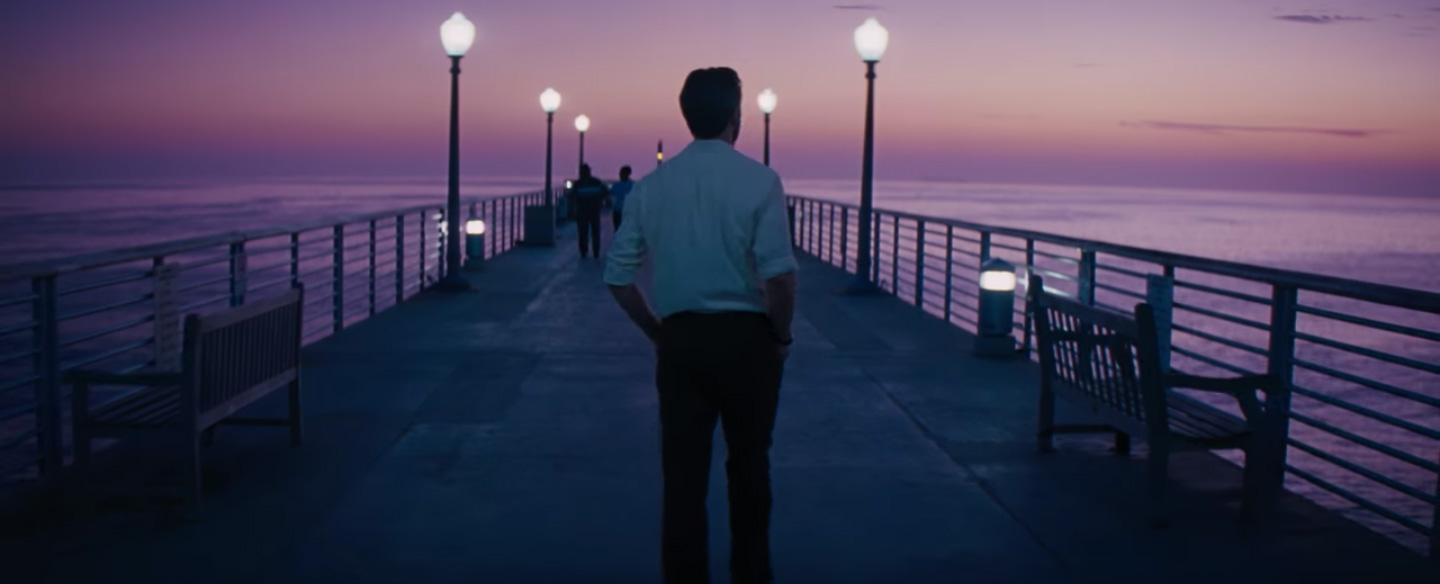
I, like millions of other people, went to a theater last winter to enjoy La La Land, the joyous musical chronicling the trials and tribulations of a young, aspiring actress and her boyfriend, a young, aspiring jazz musician. And as its name so appropriately describes, the movie takes place in the land of dreams, Hollywood. The film is warm and gauzy. The whole movie is easy on eyes. It is the comforting embrace of two hours of lavenders and burnt oranges fading into an overwhelming navy sky. It is the dancing and singing in the old Hollywood tradition of Rodger Astaire and Ginger Rodgers. It is enough to make a believer out of anyone. I walked out of the theater behind a woman tap dancing her way to the exit. My feet itched to join hers in a sort of delirious happiness. The music had infiltrated our hearts, but so had the lie that such a Hollywood had ever existed.

The film industry has always been self-promotional, constantly tempting us like a mirage. Maybe not everyone that travels to L.A. will succeed. Still, the image persists. The tantalizing possibilities matter more than the lives left by the wayside. Somehow after decades of evidence of sexism and racism, we still believe. It helps that they know, better than anyone else, how to put on a convincing act. It helps that we only see the characters on the screen and ignore the real actors and actresses behind them. The escapism offered by films extend far beyond the popcorn-scented auditoriums. The same suspension of disbelief that allows for the enjoyment of so many movies, allowed for a willful ignorance of what really goes on before the cameras turn on. Brutal reality crashed upon audiences everywhere on October 5, when the New York Times publicized Harvey Weinstein’s decades of sexual harassment. The subsequent two weeks saw numerous other women report similar situations where Weinstein used his significant influence as a successful producer to try and coerce them into sexual favors. Their silence was ensured by a similar fear that they would be driven out of the business if they were to accuse a figure of his stature. It took thirty years. Three decades of countless victims intimidated by the threat of not only one man, but the industry-wide acceptance of his actions. Suffering men like Weinstein who exploit their power is still seen as the necessary price of success. After all, dreams don’t come free.

Hollywood is the ultimate drug, promising a candy-coated future, all the while hiding the same old problems that plagues every other aspect of our society. If La La Land had been truer about its intentions, Mia might have been driven to more desperate measures to achieve her goal of stardom. Instead, she is offered the perfect opportunity without having to sacrifice any of her ideals, like so many her real-life counterparts. These are women who are forced to resort to invisible boyfriends or the awkward, laughing brush off to defend against the unwanted advances of other men. La La Land isn’t the first to colorfully airbrush over reality. It won’t be the last. It is up to us to decide whether to pull the blindfold down again.

The Sequel

My freshman year ended suddenly. The last morning was a rushed, desperate attempt to collect everything- lost sunglasses, books, and suitcases- before I left Ann Arbor for four months. Even though I was one of the first to finish with exams and leave, an emptiness already pervaded the dorm. The last week had been an extended game of Tetris for everyone in the hall, trying to cram a full year of life into a few cardboard boxes. The storage vans had come and gone. It was time for me to leave too. One chocolate croissant later, I was on a plane thousands of miles above Ann Arbor.

Four months later, I was on another plane, landing in Detroit. Again, my mind was occupied with practicalities. First, I had to escape the airport, life and luggage intact. Then, there were new roommates to meet, an orientation to attend, and a seemingly endless amount of unpacking. But as I watched the sun rise over Ann Arbor from the bus window, the pressure of so many unfinished tasks gave away to a feeling of déjà vu instead. Here was the IM building where I had spent hours pretending to exercise. There was my old dorm, quickly filling up with new residents. Someone different would be living in the room that was no longer mine, yet the room would remain the same. Everything was just as I had left it, awaiting my return. It was as if there had never been an ending. Instead, the ending blurred with the beginning and formed a strange purgatory in the early morning light. The world was in limbo and I was the only moving wisp among closed stores and empty sidewalks.

In a strange way, it reminded me of watching a television show. No matter how much I changed, the characters remained preserved behind the screen. Time passes differently in that dimension. It moves slowly. Sometimes, it even moves backward instead of forward. Characters can be rebooted and storylines can be recycled. Shows can be extended for lifetimes, in the most extreme examples with new actors replacing the ones who have left. Sometimes, a franchise can even be revived thirty years later for prequels or sequels to the original story. Returning to the status quo is good business. New wallets emptied for old material. Sometimes, I wish my life could be as free of consequences as one in a sitcom, where both triumphs and disasters are easily erased in a week. As my bus made its slow progress to its final destination, I realized that I had returned to where I had begun. My life had been renewed for a second season, sophomore edition. It made me feel small, a component of a much bigger production beyond my perception. Some things may have changed, new classes at different times; the essential components remained the same.

Our lives are filled with these constant structures. There are of course, the immovable buildings that tower over us. But there are also ones that are not even physical, such as familial relationships, or consequential, like the television show, revisited again and again. They are stabilizing forces that tether us to a certain place for a certain amount of time. When that time comes to an end, we may leave for different pastures, but the same structures will remain if we choose to return. We can point at those structures and excitedly describe our former lives. In a few months, my sophomore year will come to an end. In a few years, my college experience will come to an end. A permanent end to one series and the beginning of a spinoff. Life blending into a life-like imitation.


People flocked to Hill Auditorium

People flocked to Hill Auditorium this past Saturday to celebrate the Michigan Bicentennial. Alumni from over the years came to speak at about where their maize and blue foundation took them. At the tribute, we saw appearances from Darren Criss, Sanjay Gupta, Cecilia Muñoz, and many more reputable names. (James Earl Jones unfortunately could not attend because of health reasons, but a video of  him reading an excerpt from “Death of a Salesman” in place of his absence.) Each wolverine shared a little about his or her life today and their success after attending Michigan. Between distinguished alums, UM organizations like vocals from the dashing Friars filled the air with sound. Another part of the tribute included nostalgic stories that were accompanied by slideshows of places that were prevalent in Ann Arbor culture years ago when most of the audience was in school here. Some of the places like Zingerman’s are still just as popular. Throughout the whole show, there was an undoubted sense of pride and achievement within everyone in the room. It’s great to be a Michigan Wolverine. We rock. Look at all we have accomplished?

Amongst all the pride and the excitement, something was quiet.

I told one of my best friends that I’d attended the bicentennial tribute. I told him about all the famous people and their achievements, about how impressed I was, about the work I have to do to keep up with their success, about how cool their lives are. In return, he asked me, “did any of them mention being happy?”

Come to think of it, not one person mentioned “happy.” Success, yes. However, happiness cannot be defined by success. Success is defined by happiness. It’s easy to get swept away by the fortune one career offers, but remember to stay in touch with yourself as you make decisions about your future.


The Fast and Furious Films, Ranked

I’ve been wanting to watch the Fast and Furious movies for a while, ever since Furious 7 came out and I saw tons of people ranking them and felt left out. And, since I’m a completist, I wasn’t going to be content just watching the ‘good ones’—people usually say that Fast Five is when the series gets good, but I was for sure going to watch them all now.

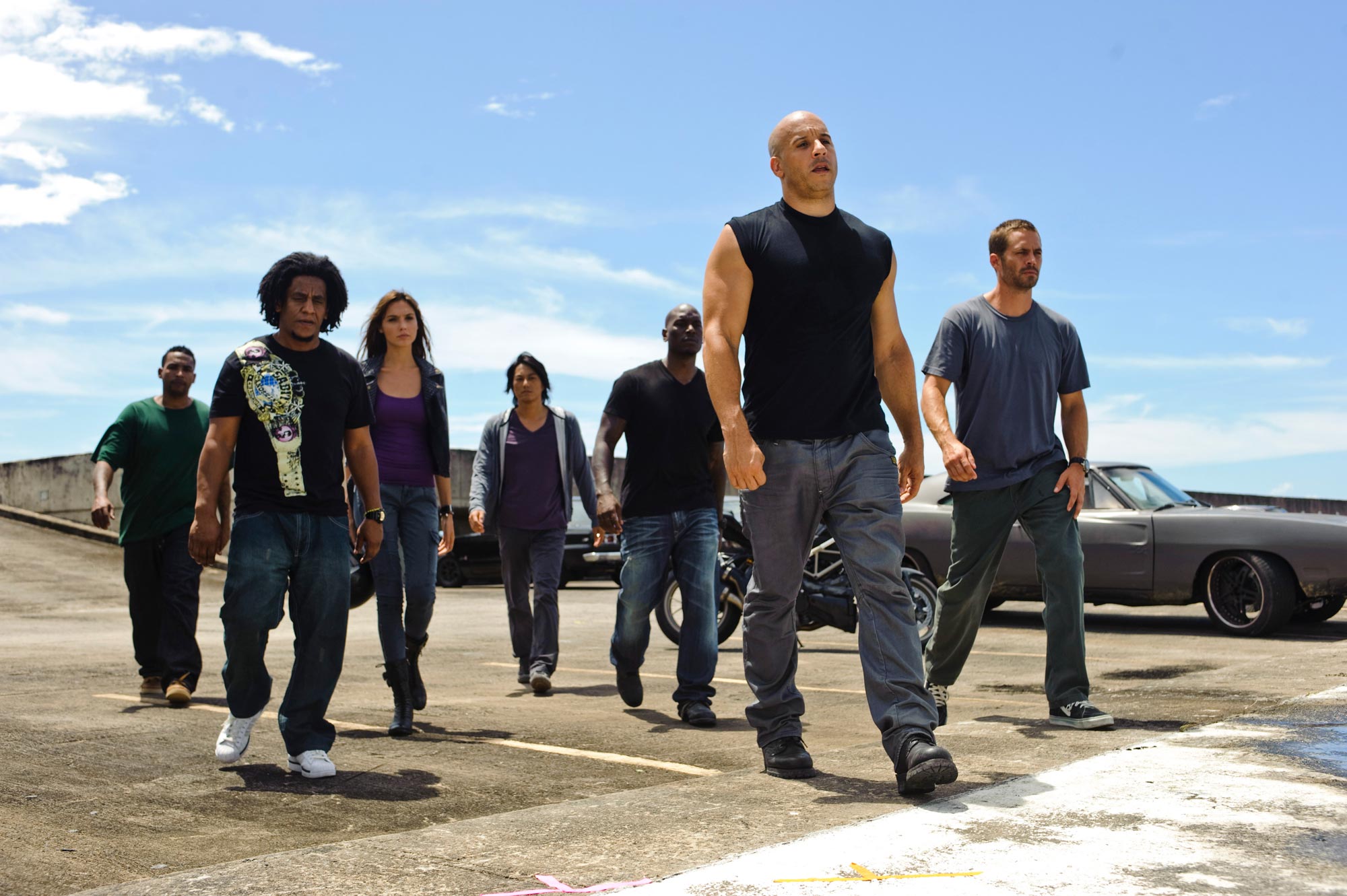
Well, today, I finally watched Furious 7 and finished the series, which is perfect timing, since The Fate of the Furious comes out this weekend. Here’s my ranking, from worst to best.

  1. The Fast and the Furious: Tokyo Drift

Some people will tell you that this is the best one, for some reason. It’s not. Lucas Black’s character has to be one of the blandest, most boring, least convincing protagonists I’ve ever seen. Paul Walker is pretty bland in his movies, but he’s mostly adequate for the role he’s playing. You don’t really need to have a lot of acting chops to play the protagonist in a Fast and Furious movie, but Lucas Black somehow makes it possible to be ‘not good enough for a Fast and Furious movie.’ That’s impressive.

Also, this is probably one of the more sexist and exploitative entries. All the Japanese imagery is cliché and stereotypical. Some people claim that at least this movie is stylish, which makes it more interesting than 2 Fast 2 Furious or Fast & Furious, and I agreed for maybe a few minutes at random, but it’s really not that stylish. The action scenes are just not exciting. Maybe that’s where we disagree, Tokyo Drift fans.

  1. Fast & Furious

I thought this one would be a step above the second and third movies, since it brings back the original cast: Paul Walker, Vin Diesel, Johanna Brewster, and Michelle Rodriguez. Well, it was better than Tokyo Drift, but that’s not sayin’ much. This one is mostly just boring. The only really enjoyable action scene is right at the beginning, and the climax falls pretty flat.

  1. 2 Fast 2 Furious

I kinda liked this one. People say this one is super boring and unstylish, but I thought it was actually pretty entertaining. I particularly liked the trick where Brian and Roman hid their cars inside the garage, then Tej released hundreds of cars at once so the cops didn’t know which ones were them. Was that not clever? I also, of course, liked the climax, when Brian drives the car off a ledge and crashes it onto a boat. That was something straight out of the later movies!

Roman is boring compared to Dominic, so Dom is still missed here, but he’s mildly funny, so it works.

  1. The Fast and the Furious

Very solid movie! The first entry in the series is pretty simple and grounded compared to the insanity of the later movies, but it’s reliably entertaining, and Vin Diesel is instantly engaging, somehow super charismatic. Maybe I’m just saying this because I’ve gotten used to watching him, but I still think he was most effortlessly engaging in this first movie.

These movies aren’t super emotional or complex, but I really like the simple hook of Brian getting in too deep with Dom’s crew and eventually thinking of him as a legitimate friend who he looks up to and wants to help out. The final turn of the movie, when he lets Dom go instead of arresting him, just lands perfectly.

  1. Fast & Furious 6

I’m tempted to put this above Fast Five, because they were very close for me. This one has Luke Hobbs working with the team, and I love his rapport with them. Dwayne Johnson is great, obviously. I also quite liked both of the climaxes—the early, fake-out one, where they’re racing down the highway, and the real one, where they’re racing down the runway. The highway scene also features one of the most ridiculous things I’ve seen in this series, defying-the-laws-of-physics-wise. It’s when Dom sees Letty about to fall between the two parallel bridges, so he crashes his car and leaps out right at the perfect moment in the perfect direction, somehow careening himself across the chasm, knocking into Letty, and hurtling them to safety. So many parts of it are absurd and impossible, which makes it great.

  1. Fast Five

This is where the series gets really good, and I think if you were watching this without realizing how big an uptick in quality it would be, you’d be shocked, and you might over-rate it. I’ve heard so many good things about this one that my expectations were pretty damn high, and while I wasn’t disappointed, it didn’t quite exceed my expectations. It also felt maybe ten minutes too long.

That said, so many things about this movie are amazing. Dwayne Johnson’s Luke Hobbs instantly becomes the best character in the series. The heist plot is super fun in an Ocean’s Eleven, assembling-a-team way, and the humor is pretty good. And this has some of those deliriously fun action scenes that you come here for, like the opening train heist, and most notably, the climax. A couple of cars dragging a giant vault is just a recipe for success; from the very beginning of that scene, I realized how fun it was about to be to watch them absolutely demolish everything with that vault, and I had a big grin on my face the whole time.

  1. Furious 7

I think most people like Fast Five the most and agree that Justin Lin’s directing of action sequences is a tad better than James Wan’s, but I really liked Wan’s work here. The trick he does where he flips the camera when a character flips is great. Also, this movie is just so over-the-top and great. The whole scene where Dom drives their across a chasm between two skyscrapers, then does it again, is so deliriously fun, as is the scene when the cars go sky-diving, and much of the climax is like that, too.

Plus there’s the ending tribute to Paul Walker/Brian, which is legitimately emotional. I almost teared up seeing all those flashbacks to earlier movies.

Can’t wait to watch Fate!

Stress

It is finals time again and there is a distinct sense of panic and stress. It is expressed in the groans after a new paper is announced and in quick steps of a student running from class to class. In the libraries, it pervades like a suffocating heaviness in the air. Everyone is intently scribbling and just as impatiently flicking eraser dust off their papers as if they feel the pressure bearing down on them. In an environment such as this, it is almost obligatory to feel stressed when you see everyone around you in a similar state. It suffuses even the brief moments of relaxation. Immediately, I feel guilty for letting my guard down even for a moment, as if sitting outside and enjoying the breeze could kill. As college students, we expect stress, even joke about the dread. Yet, there seems to be a consistently unasked question: Why are we stressed at all?

Perhaps, unconsciously, I want to feel stressed. Stress, after all, is self-inflicted. It is not my teachers or even my parents that are forcing me to meet some arbitrary standard of performance. It is only me behind the judge’s table. It is paradoxical and illogical. Somehow, I’ve become both the man dying of thirst and the shifting mirage he chases. The freedom and independence of college is a double-edged sword. Now, there is no one left to blame. There is a trap in setting these impossible expectations. We get stuck in a perpetual cycle of disappointment and stress and often don’t even know why. When that stress vanishes for even a second, I question why, instinctively creating more. Stress is so effective at drowning out everything else. But it is also a shallow feeling devoid of any meaning, but panic. It is as if all we chose to hear was the drone of the alarm instead of music. It becomes a buffer against feeling or thinking about anything too deeply. Then, when the homework is gone and the tests are over, all we are left with is an inexplicable emptiness.

Yet for all the stress, this weekend was an unexpected joy. People crowded the Diag, relaxing on hammocks, flinging frisbees in open defiance of the foreboding libraries standing guard over them. Perhaps they had found the solution after all. We often take stress for granted. In the end, it is really a choice we can choose not to make.